Our "All Signal, No Noise" approach
Drives an intelligence service that is succinct and timely, and is highly regarded by our time constrained client base.
Link to the page
MNI INTERVIEW: China Panda, Dim Sum Bond Boom To Continue - Ma
Link to the pageExclusives


China's Panda and offshore renminbi bond markets, which saw issuance surge 68% and 46% year-on-year in the first half of 2026, are likely to sustain rapid growth for several years, driven by lower Chinese borrowing costs and growing interest from overseas issuers, a government advisor told MNI.
The nearly 300 basis points interest-rate differential between China and the U.S. remains the strongest incentive for foreign borrowers to tap renminbi-denominated debt markets, Ma Jun, chair of the Green Finance Committee (GFC) of the China Society for Finance and Banking, told MNI on the sidelines of the Financial Street Forum in Beijing. "I think it will continue, not just in the short term, but in the medium term as well," said Ma, former chief economist at the People's Bank of China, adding that the recent strong growth could be sustained "for quite a few years."
MNI reported recently that Brazil is about to take another step towards its first issuance of Panda bonds – renminbi-denominated debt issued by foreign entities in mainland China – before the end of the year. (See MNI EM POLICY: Brazil's China Rating To Pave Way For Panda Bonds). Dim Sum bonds are issued in the offshore renminbi market, predominantly in Hong Kong.
Beyond the cyclical interest-rate advantage, Ma said that the increase in promotion of the two markets was attracting prospective borrowers that had previously been unaware of the financing options available in China and Hong Kong. Recent conversations with banks across Central Asia showed a general lack of knowledge about Panda bonds, he said, noting the region represented substantial untapped potential, particularly in emerging markets.
Further simplification of issuance procedures and lower costs for obtaining green or sustainability labels could also support market growth, he continued, adding standardisation across jurisdictions would help reduce the complexity and expense of issuing bonds.
Offshore renminbi bond issuance reached approximately CNY820 billion (USD115 billion) by mid-to-late June 2026, up 46.8% from a year earlier, according to S&P Global. The outstanding market was estimated at between CNY2 trillion and CNY2.3 trillion. Meanwhile, Panda bond issuance in mainland China jumped 68% year-on-year to around CNY160 billion in the first half of 2026, according to S&P Global, with outstanding bonds exceeding CNY500 billion for the first time in July.
MULTILATERAL BANKS
Ma also expects multilateral development banks to play a greater role in helping developing-country borrowers access China's domestic bond market, where investors generally favour highly rated securities.
He drew a distinction between the two renminbi bond markets, noting offshore Dim Sum investors have a broader range of risk appetites, reducing the need for credit guarantees. By contrast, mainland Panda bond investors typically seek highly rated issuers, making credit enhancement important for developing-country borrowers with weaker credit profiles.
"That's why the guarantee is becoming important for some of the developing countries," he added. Ma cited recent guarantees involving the Asian Infrastructure Investment Bank and Asian Development Bank in connection with Pakistan's Panda bond issuance as examples of how multilateral lenders could help emerging-market borrowers access renminbi financing. Ma expects more such transactions and potentially broader participation from other multilateral development banks, including the New Development Bank.
Oct-26 03:25
Australia’s labour market is showing clear signs of loosening despite some additional uncertainty in the February and August data following changes to the Australian Bureau of Statistics’ collection methodology, an ABS official told MNI.
The unemployment rate rose 10 basis points to 4.7% in September, while other indicators point to jobseekers taking longer to find work, said Sean Crick, head of labour statistics at the ABS.
"We ask some questions about how long someone has been unemployed for, or how long they've been looking for, and we're seeing more people in that one-to-12 month time frame rather than the one-month time frame, which indicates a bit of labour market softening,” Crick added.
The ABS is also seeing people remain unemployed for longer, while the participation rate edged lower in September, he added. These developments reinforced the broader picture of a softening labour market, which the Bureau’s methodological changes would not materially alter, he noted.
While he admitted the Bureau's recent labour data collection upgrades injected extra noise, particularly into the August results that had continued into September, this did not detract from the broader message coming through the numbers, he argued. (See MNI INTERVIEW: RBA Hike Risk Remains, Despite Jobs Data)
DATA UPGRADES
The ABS began modernising its Labour Force Survey in April, completing the changes in August. The upgrades allow respondents to complete the survey on mobile phones, improve the security and efficiency of the underlying infrastructure, and streamline questions on supplementary topics such as employment characteristics, casual work experience and barriers to employment.
The changes form part of an ongoing effort to ensure the survey, which has been running since 1960, reflects the modern labour market and how people interact with government services.
Crick noted the main effect on the seasonally-adjusted data is confined to February and August, when the old model included additional questions on supplementary topics. The ABS found these questions could influence how respondents answered the survey as a whole, potentially affecting whether they were classified as employed or unemployed.
Under the previous methodology, the Bureau adjusted for these effects before applying seasonal adjustments, Crick explained. "The new model no longer requires those adjustments, but removing them makes it harder to distinguish any residual seasonal patterns in February and August."
Crick said the resulting uncertainty was small and would not undermine the broader labour market signals. While the ABS could not quantify the additional variability precisely, it expected it to remain below the usual standard errors associated with its labour force estimates.
The Bureau flagged the potential for additional noise when it released the August data to ensure users understood the limitations, he said, but stressed that the changes would have little effect on the overall interpretation of labour market conditions, pointing to comments made this week by Deputy Governor Andrew Hauser on the softening labour market.
Oct-26 00:37
Bank of Canada Governor Tiff Macklem is considering delivering the first interest rate increase in over three years, boosting market bets on a move this week with his concern that higher global energy prices are now a bigger threat to the 2% inflation target than sagging exports and investment.
Thirteen of 22 economists surveyed by MNI see a quarter-point rise in the 2.25% overnight lending rate at a decision due Wednesday at 9:45 EST. Before Macklem’s Oct. 17 comments from IMF meetings in Bangkok most economists saw the Bank on hold, even as the last decision mentioned stronger inflation risk.
The Governor referred to global instability including the continued Iran conflict, moving away from an earlier view he could look through a narrow one-off jump in energy prices. Macklem told MNI last month he faced tough choices in looking at prices versus signs of a rebound from U.S. tariffs, but in the end the inflation goal comes first. (MNI INTERVIEW: Macklem-BOC Faces Tough Calls Ahead On Rates)
Consumer prices advanced 3.1% in September, the fourth time in five months it was at the top of the Bank's 1% to 3% target band. While core measures remained near 2%, the Bank's quarterly business and consumer surveys published the same day as CPI showed a boost in long-term price expectations, eroding one of Macklem's prior arguments for patience.
CONSECUTIVE HIKE SIGNAL?
The decision may also return to statements Macklem gave earlier this year that consecutive hikes could be needed if price stability was threatened. Canada's policy rate is also half a point below what officials deem neutral and some investors forecast that two or three hikes are needed to show inflation-fighting credentials.
An increase would be the Bank’s first since July 2023 when the policy rate went to 5%. Officials cut rates four times last year as U.S. tariffs were imposed. With the Federal Reserve and the ECB turning to, hikes the Bank's rate is now far below the federal funds rate of 3.75%-4%. That exposes a potential new source of inflation if Canada's dollar weakens and makes imports more expensive.
New inflation forecasts in the Bank's quarterly outlook will get a big upgrade, Macklem says, and the new view of price gains over the Bank’s two-year horizon will give investors clues on the policy path as well. In July, the Bank said inflation would be 2.2% this quarter and 2.1% in 2027. With the Bank focused on inflation persistence any changes to the 2028 forecast for 2% inflation could also offer guidance.
Resilient growth as the U.S. escalates the tariff war means Canada’s upside risks run beyond inflation. While GDP could slow to 1% annualized in the fourth quarter following another round of tariffs, the Bank's latest business survey indicated firms believe Donald Trump will soften his trade stance.
NUDGE THE PATH
Fiscal policy is also taking a bigger role sustaining companies hurt by geopolitics, and Canada's status as an oil and gas exporter provides another lift. Mark Carney's budget due Nov. 5 is on track for major deficit spending on the military, infrastructure and subsidies for makers of steel, aluminum and autos.
Still, big bets on what officials will do in tricky moments have been a set-up for disappointment, and meeting minutes have shown Governing Council members at times have been divided on the inflation path. The Bank's decisions also bucked market consensus five times in 2022 and 2023 coming out of the pandemic.
“The question we're going to be asking ourselves is: is inflation likely to come back down towards our target on its own, or are we going to have to raise interest rates to influence the path, nudge the path for inflation back towards the target?” Macklem told reporters from IMF meetings in Bangkok.
Oct-23 17:49
Belgium's fiscal consolidation is likely to be agreed next week and should lower the country's yields and improve its ratings outlook, the debt agency head told MNI, adding that he does not expect the European Central Bank to pause quantitative tightening because of surging sovereign yields.
Although Belgium's government failed to agree on a draft budget including a EUR10 billion consolidation package earlier this month, Jean Deboutte said "we expect them to take decisions and to have an adjustment there in the budgetary part by the end of next week."
"I wouldn't rule out that we would have quite quick effects on the spreads," he said in an interview, because "we can gain easily a number of basis points, just by showing if something will be submitted to the EC."
"Rating agencies, for instance, now incorporate the vision that the deficit will remain above 5% [of GDP]. So it's up to us now to positively surprise the market and also surprise the rating agencies by showing something," he said.
"Even on unchanged [fiscal] policy, we don't really expect an increase in our funding needs ... and also on unchanged policy, our deficit will not really rise that much.”
If a budget is not presented by next week, "it will be difficult to vote for it before the end of the year in terms of national procedures, and this is also a little bit negative. So I think that everybody knows that."
ECB QT
Deboutte said the idea that the ECB could pause quantitative tightening to help member states is a "little bit bizarre," and "I don't think we will take it into account in our decisions. That would be a little bit too optimistic."
"I would be surprised if they already would take action now for it at this moment. I think that's too early for that," he said. (See MNI INTERVIEW: ECB Should Halt QT - Bini Smaghi)
Pressure on yields comes as "the demand for capital is huge" across the world, he said. "There's the ongoing need for capital with quite astronomical figures last couple of days again from the U.S. to AI," he said, pointing also to the U.S. budget deficit.
"There’s more attention to every country's budgetary initiatives than otherwise," he said, adding that "Italy, Belgium, and to a lesser extent Spain maybe are feeling the heat as well." (See MNI INTERVIEW: Belgian Yields Rise As Market Awaits ECB Hike)
LONG END UNDER PRESSURE
Lower demand for credit is particularly visible at the long end, he said.
"It's also general for the euro area; investors are no more interested in 30-year [bonds], maybe Spanish bonds or Italian bonds. I think there's a general weakness."
Dutch pension reforms to enable higher-risk investing are also having an impact. "It's evident that pension funds in the Netherlands also play a big role there, and that we see continuous selling of long-dated positions, maybe not even thirty-year, but even lower maturities, and so that's of course not very helpful as well."
"Dealers say there's not enough demand anyway, so we don't even have to think about the price for us to issue" ahead of the Dec 4 publication of Belgium's funding plan, he said.
"We did not yet decide fully about next year's plan ... in the meantime we don't see much demand for anything longer than 20 years.”
Deboutte doesn't "see a future where we give up on 30-year [bond] forever. Thirty-year bonds will be there, maybe next year, if it's not next year, maybe the year after, or the year thereafter. I think countries with a debt like Belgium, they need a 30-year point which is liquid."
The 4.35% coupon rate carried by the new January 2056 OLO launched in February appears modest in retrospect, he said.
"We're very pleased with the strategy that we have been following ... We were right, even if we don't always know what the future will do." (See MNI INTERVIEW: Problem If Belgian 30-Year Hits 4.5%-Debt Chief)
Oct-23 12:57
The European Commission is planning to replicate its agreement with Beijing to limit imports of hybrid vehicles in other major industrial sectors under pressure from surging Chinese imports, including chemicals, MNI understands.
Trade Commissioner Maros Sefcovic has already referred to the hybrid deal, under which China has agreed to significantly limit vehicle exports to the European Union, as "proof of concept.”
Other sectors now in Brussels’ sights include chemicals, which faces existential level challenges from Chinese imports and whose problems have been key to making Germany take a more hawkish line on the China threat.
The Commission has been encouraged by the show of unity among leaders at last week's EU summit to maintain its current carrot-and-stick strategy which emphasises the need for trade negotiations to achieve tangible results while at the same time being ready to deploy credible trade weapons if talks fail.
MNI understands that the Commission could present proposals for a new diversification tool and broader safeguarding protections as early as Dec 9, ahead of the end-of-year summit, at which leaders are expected to discuss new trade weapons. (See MNI: EU Aims To Reduce China-Dependence, Avoid Trade War)
HIGH STAKES
Officials are aware that the dual-track approach is a high-stakes one and runs a significant risk of retaliation, not just from China, but also from the administration of U.S. President Donald Trump as midterm elections loom. A recent non-paper on EU trade defence from France and Germany conceded the danger of retaliation and proposed an "inventory of retaliation measures" which could be coordinated at leader level. More detail is also expected on this proposal from the Commission in December. (See MNI INTERVIEW: EU Still Undecided On Tough Action Over China)
Brussels is also understood to be nervous of imminent announcements of trade actions in the ongoing U.S. Section 301 trade investigations into EU digital policies and excess industrial capacities.
The next phase of EU-China trade talks are expected to start in January and culminate in March with a meeting between Sefcovic and counterpart Commerce Secretary Wang Wentao in Brussels.
Oct-23 09:53The European Commission is planning to replicate its agreement with Beijing to limit imports of hybrid vehicles in other major industrial sectors under pressure from surging Chinese imports, including chemicals, MNI understands.
Trade Commissioner Maros Sefcovic has already referred to the hybrid deal, under which China has agreed to significantly limit vehicle exports to the European Union, as "proof of concept.”
Other sectors now in Brussels’ sights include chemicals, which faces existential level challenges from Chinese imports and whose problems have been key to making Germany take a more hawkish line on the China threat.
The Commission has been encouraged by the show of unity among leaders at last week's EU summit to maintain its current carrot-and-stick strategy which emphasises the need for trade negotiations to achieve tangible results while at the same time being ready to deploy credible trade weapons if talks fail.
MNI understands that the Commission could present proposals for a new diversification tool and broader safeguarding protections as early as Dec 9, ahead of the end-of-year summit, at which leaders are expected to discuss new trade weapons. (See MNI: EU Aims To Reduce China-Dependence, Avoid Trade War)
HIGH STAKES
Officials are aware that the dual-track approach is a high-stakes one and runs a significant risk of retaliation, not just from China, but also from the administration of U.S. President Donald Trump as midterm elections loom. A recent non-paper on EU trade defence from France and Germany conceded the danger of retaliation and proposed an "inventory of retaliation measures" which could be coordinated at leader level. More detail is also expected on this proposal from the Commission in December. (See MNI INTERVIEW: EU Still Undecided On Tough Action Over China)
Brussels is also understood to be nervous of imminent announcements of trade actions in the ongoing U.S. Section 301 trade investigations into EU digital policies and excess industrial capacities.
The next phase of EU-China trade talks are expected to start in January and culminate in March with a meeting between Sefcovic and counterpart Commerce Secretary Wang Wentao in Brussels.
Oct-23 09:52
The People’s Bank of China is likely to hold its policy rate unchanged over the rest of the year, though it could still reduce banks’ reserve requirements, economists and policy advisors told MNI, warning that any major easing could undermine the drive towards economic restructuring and boost bubbles in areas like AI.
A reserve ratio cut would depend on liquidity demand from local debt issuance and on whether the economy weakens noticeably in October and November, said Su Jian, professor at Peking University's School of Economics and director of the National Center for Economic Research. Razor-thin interest margins for banks and rising nonperforming loans following four years of property sector weakness also add to the case for a reserve requirement cut, said Lian Ping, director of the China Chief Economist Forum.
GDP growth is expected to remain low amid structural rebalancing, and room for rate cuts is limited, with banks’ net interest margins having just stabilised at 1.41%, said Su, predicting growth a bit higher than 4.5% this year, aligning with the target of 4.5%–5.0%. The resumption of Federal Reserve rate hikes has widened China-U.S rate spreads, and rising producer price inflation also limits space for lower rates, he added.
This year's Government Work Report explained that setting the growth target between 4.5% and 5.0% was mainly aimed at leaving room for structural adjustments, risk prevention, and reform, laying a foundation for better future development, Su said. Unlike past measures aimed at stimulating growth, policymakers now prioritise economic rebalancing, and have a degree of tolerance for a slowdown so long as it is not sharp, he said. (See MNI INTERVIEW2: China Needs Monetary Easing To Boost Growth)
Lian expected growth of about 4.6% for 2026, and of 4.6-4.7% in Q4, thanks to higher exports, support policies already implemented, and a low comparison base.
EASING CONSTRAINTS
Recent incremental policies including tweaks to structural monetary tools and mortgage subsidies have put a floor under infrastructure investment and stabilised the housing market, said Wang Qing, chief macro analyst at Orient Golden Credit Rating International. Policymakers need time to assess their impact, but additional measures to buoy export momentum, housing, consumption and investment are likely, to guarantee a smooth start to 2027, Wang said.(See MNI PBOC WATCH: Oct LPR To Hold As Targeted Easing Deployed)
The focus will be on channeling resources into high-tech manufacturing as China pursues self reliance in its race with the U.S., while avoiding blanket stimulus which might be diverted towards property and traditional infrastructure, he said. Officials are wary of encouraging excessive borrowing and wish to preserve policy headroom for external shocks or trade frictions.
Still, China’s cycle of policy expansion is far from over, though any further stimulus is likely to be measured, said Su, pointing to external volatility and the danger that over-rapid restructuring could trigger an excessive downturn.
The major support package unveiled in September 2024 has largely mapped out the policy envelope for the next three years, according to Lian, adding that major new stimulus on top of that is unlikely. It was centred around a CNY12 trillion local debt quota for de-risking, a substantial issuance of special sovereign bond issuance, and monetary easing.
Due to a lack of targeting, large liquidity injections provide limited real-economy traction and risk inflating asset bubbles, accumulating hidden hazards in the medium to long term, Lian added.
STRUCTURAL TOOLS
While the central bank has stressed the role of structural relending tools in supporting weak and key sectors, their use has been smaller than expected. The PBOC stopped revealing the volume of its structural tools in Q2 2025, when 10 facilities totalled CNY5.9 trillion.
Uptake for the facilities has been uneven, with private enterprise re-lending at about 76% quota utilisation, while consumer services and eldercare facilities lag, according to Su. Incentives remain marginal, he said, noting that the 1.25% relending rate differs little from the 1.2% paid on one-year deposits, while collateral-poor SMEs struggle with banks’ conservative risk controls. Making them work would require interest subsidies and credit guarantees, he added, though he noted that prolonged flows of targeted cheap money could also distort capital allocation and fuel overcapacity.
Zhao Xijun, co-dean of the China Capital Market Research Institute at Renmin University of China, said policy support should be more targeted toward sectors with real, pent-up borrowing appetite, such as eldercare, education, and healthcare.
Oct-23 08:28
The direction of corporate inflation expectations in the December Tankan survey will be a key factor in the Bank of Japan Board’s decision on whether to raise the 1.25% policy rate at its Dec 17-18 meeting, MNI understands.
Bank officials are monitoring how the recent rise in crude oil prices and sluggish private consumption have affected companies’ medium-term inflation expectations. A December hike, which the market currently gives a 60% chance of occurring, will become more likely should the December Tankan show corporate inflation expectations resuming their upward trend, though other factors will also weigh in the decision.
Bank officials believe medium-term corporate inflation expectations are not yet firmly anchored and remain alert to the risk that both upside and downside factors could influence them.
SOFTER SEPTEMBER
The September Tankan showed companies expected annual consumer inflation to reach 2.6% in September, down from 2.7% in June. They also expected inflation of 2.6% three years ahead and 2.5% five years ahead, compared with record highs of 2.6% for both measures in June.
While the survey partly eased the BOJ’s concerns about higher underlying CPI inflation, officials do not consider the recent pause to be evidence expectations are firmly anchored. Input prices have eased, and supply chains have remained resilient despite prolonged tensions in the Middle East, which the survey may have failed to capture.
MNI also reported this week the Bank will offer a strong signal to its hiking intentions within October's Outlook report, with any move away from a warning of upside risks making a December hike less likely. (See MNI POLICY: BOJ Unsure That Three More Hikes Needed)
Oct-23 08:28
The Reserve Bank of New Zealand is likely to raise its Official Cash Rate by 25 basis points to 3% on Wednesday, with core inflation above the Bank’s 1-3% target band and the OCR still below its estimate of the neutral rate.
A hike would be the third consecutive increase following September’s move, and return the OCR to its August 2025 level. (See MNI RBNZ WATCH: Breman Takes Cautious Stance On Further Hikes)
Markets assign an 88% probability to a hike and see the OCR peaking at 3.8% by September 2027, above the upper bound of the Bank’s estimated neutral range. Each meeting through to then carries about a 60% chance of a further increase.
Q3 INFLATION
Governor Anna Breman adopted a cautious tone on further tightening after September’s move, while other policymakers signalled the possibility of a pause. (See MNI INTERVIEW: RBNZ's Gai Sees Gradual Return To Midpoint) However, Q3 inflation data, particularly underlying measures, remains elevated, strengthening the case for another hike.
CPI excluding fuel rose 3.0% y/y, up from 2.9%, while CPI inflation excluding fuel and food accelerated to 3.2% from 2.9%. The 30% trimmed mean increased to 3.0% from 2.6%, while the weighted median rose to 3.1% from 2.7%. Higher international air transport costs, local authority rates and vegetable prices were the largest contributors to quarterly inflation, rising 14.3%, 6.2% and 10.5%. These increases were partly offset by lower fuel prices, with petrol falling 6.5% and other vehicle fuels and lubricants declining 15.5%.
The labour market remains weak and an unlikely source of inflationary pressure, and further hikes could dampen its recovery. But external factors, including the Middle East conflict and global oil prices, are the driving force behind price rises, while the weaker New Zealand dollar – which has declined between 2.5-4% against major currencies over the last two months – has also increased the risk of imported inflation.
ECONOMISTS’ VIEWS
Former central bank officials and independent economists broadly agree the OCR is likely to rise further, with some arguing the rate needs to reach 4% or higher to contain inflation.
Former Assistant Governor John McDermott has consistently advocated for a higher OCR this year. While elevated diesel prices could weigh on economic growth, rising energy costs are adding to inflationary pressures, McDermott noted. “The world's awash with huge amounts of uncertainty and risk. So, things can change. But the immediate issue with energy prices is they're adding to inflation right now.”
But Michael Reddell, an independent commentator and former RBNZ special adviser, believes market expectations for the OCR remain too high, warning that elevated diesel prices could ultimately weaken economic activity. Reddell was less convinced that the neutral OCR was materially higher than before the Covid-19 pandemic. Weak productivity growth, subdued migration and modest nominal GDP growth instead pointed to a relatively low neutral rate closer to 3%, he argued.
“The Bank's nowcast was already revising down those growth estimates for later in the year,” he said, adding that he thought that the Monetary Policy Committee faced a difficult decision next week.
Oct-23 07:29
UK consumer confidence slumped in October, sliding at a pace exceeded only in the immediate aftermath of the Covid pandemic, the head of a leading survey told MNI.
“There has been an extraordinary collapse in consumer confidence in October," with the pace of decline "alarming," Neil Bellamy, Consumer Insights Director at GfK, an NIQ Company, said in an interview.
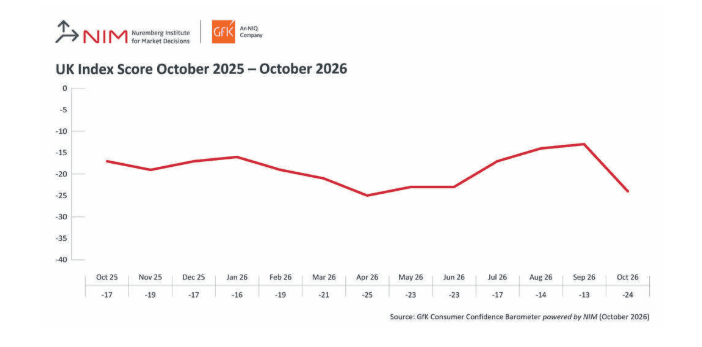
GfK's Overall Index Score showed consumer sentiment down 11 points to -24 in October, with all sub-indices decreasing compared to last month.
"The last time we saw an 11-point drop was in July 2016, following the Brexit vote. In recent years, only the onset of the Covid pandemic saw a larger fall (down 25 points)," Bellamy noted.
Recent sentiment indicators from S&P Global and the British Retail Consortium have also showed significantly weaker sentiment, as rising inflation, higher fuel costs, employment concerns, the prospect of an interest rate hike and pre-Budget unease weigh on household sentiment. (see MNI INTERVIEW: UK Wage Deals Look Capped At Around 3%- Attwood )
"Relentless cost-of-living pressures, against an international backdrop of unresolved regional conflicts that are themselves contributing to domestic inflation now at 3.5%, appear to have swept aside the nascent optimism we saw following the appointment of a new UK prime minister this summer," he said. (see MNI INTERVIEW: UK Consumer Enjoys July 'Burnham Bounce' - GfK )
"After three months of improving confidence, October is a sharp reminder of how quickly the public mood can switch," Bellamy added.
CONCERNS
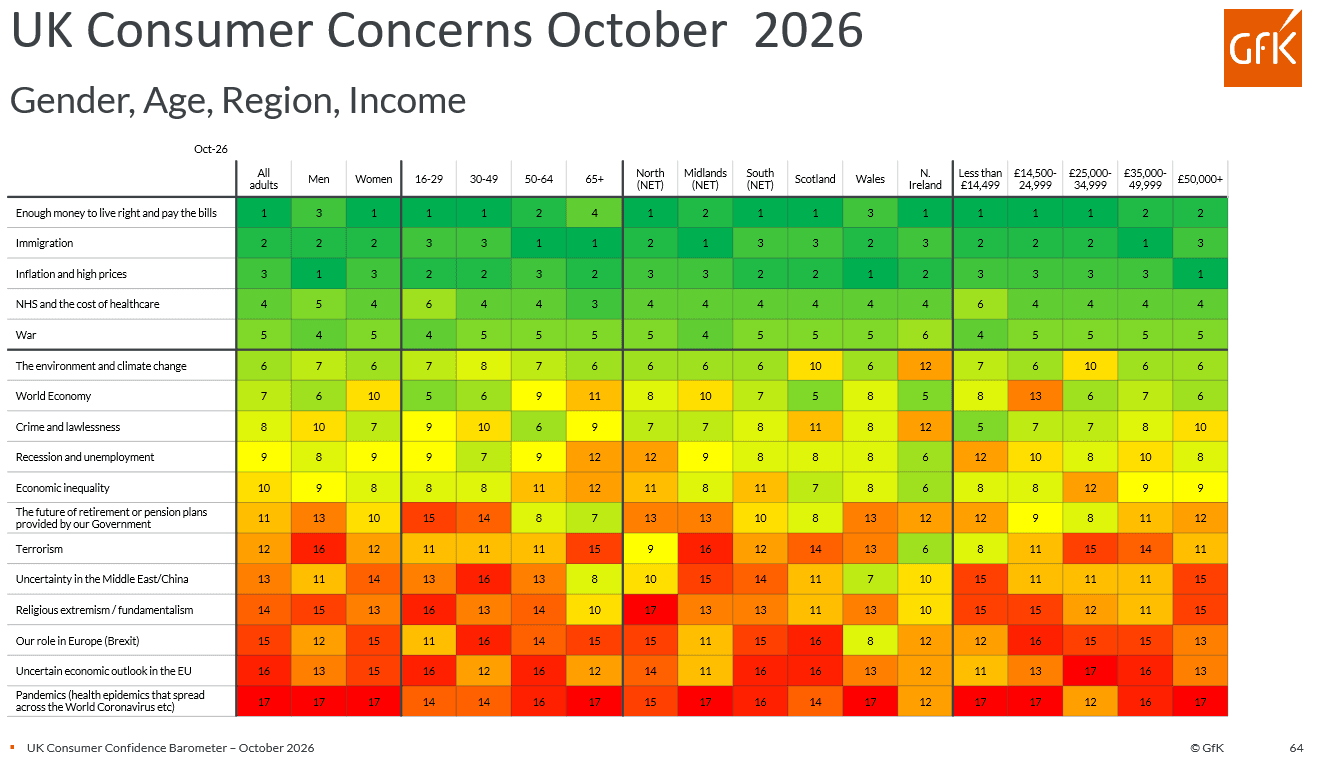
No single major economic event has driven the decline, despite the upcoming budget, according to Bellamy. Weakness was seen across the full spectrum of income, age and gender.
"People are very worried; they are changing shopping habits; they are going without," he said.
While all measures were lower, the two largest decreases were in expectations for the wider UK economy in the coming year and the intention to make major purchases, both slumping by 14 points. These sub-indices are often seen as a leading indication of consumers’ willingness to part with their cash on the high street
The measures of personal finances, both looking back 12 months and ahead a year, were also down, by seven and eight points respectively. Analysts at GfK consider the look-ahead for personal finances as a clear indicator of the likely path ahead.
"Headline consumer confidence is now back to the level seen in April, May and June of this year and the summer’s buoyant mood has evaporated," Bellamy said.
Oct-23 05:50
About
Our Head Office is in London with offices in Chicago, Washington and Beijing, as well as an on the ground presence in other major financial centres across the world.


