MNI EUROPEAN MARKETS ANALYSIS: USD/JPY & JGB Yields Off Highs
- The Japan FinMin stepped up FX rhetoric, stating FX intervention is possible. USD/JPY is lower but only modestly. The Japan cabinet approved a extra stimulus worth ¥21.3trillion (which was in line with recent media reports). JGB yields have moved off recent highs. BoJ Governor Ueda warned around the weaker yen impacting local inflation.
- The USD was mostly softer elsewhere, but index levels are holding close to recent highs. US equity futures are up modestly, despite further weakness in Bitcoin.
- Looking ahead, we have flash PMIs for the UK, EU and US. Fiscal borrowing and retail sales are also due in the UK. In the US more Fedspeak is also due.
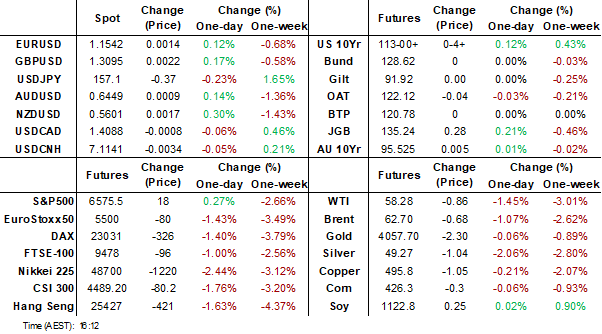
MARKETS
US TSYS: Treasury Yields Give Back Some of Overnight Gains
US treasury futures are all up marginally today whilst heading for a weekly gain. The US 10-Yr is at 113-00 today looking at reasonable gains for the week having closed off last Friday at 112-17. TYZ5 is back above all major moving averages, having dipped below for 10 trading days as investors views on potential rate cuts in December whipsaw around.
Cash is weaker today with yields up to +1bps higher in the front end, giving back overnight gains.
- The 2-Yr is up +1.3bps to 3.548% - lower by -6bps for the week.
- The 5-Yr is up +1.0bps at 3.658% - lower by -8bps for the week
- The 10-Yr is up +0.8bps at 4.094% - lower by -5bps for the week.
- The 30-Yr is up +0.1bps at 4.726% - lower by -2bps for the week.
Whilst the flow of government provided data continues tonight with housing starts, building permits and new home sales the reality is that markets are deeming these releases as stale. The November preliminary PMIs however should receive more focus alongside the University of Michigan inflation and sentiment indicators. There are no major auctions scheduled at this stage with bills and 2-Yr notes the focus.
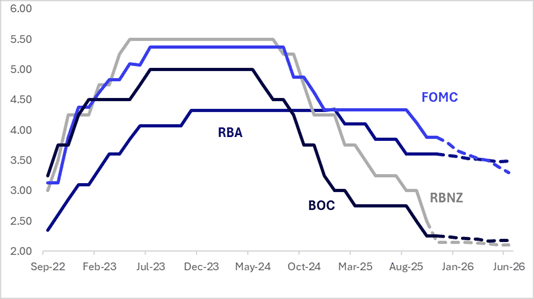
STIR: $-Bloc Pricing Out To Jun-26 Little Changed Over The Past Week
Interest rate expectations across the $-bloc out to mid-2026 were broadly stable over the past week, with all net moves confined within a narrow ±2bp range.
- The main event was Wednesday’s release of the FOMC Minutes from the October meeting (link). While views within the Committee “differed strongly,” the minutes indicated that only a minority may push for a follow-up rate cut in December.
- This aligns with MNI’s assessment that, based on post-meeting commentary, most of the broader Committee is leaning toward holding rates in December — though that does not necessarily imply that pro-cut voices form a majority within the 12-member voting group.
- The next key regional event is the RBNZ policy decision on November 26. 27bps of easing is priced for November, with a cumulative 35bps by February 2026.
- Looking ahead to June 2026, current market-implied policy rates expected are as follows: US (FOMC): 3.30%, -58bps; Canada (BOC): 2.18%, -7bp; Australia (RBA): 3.49%, -11bps; and New Zealand (RBNZ): 2.10%, -40bps.
Figure 1: $-Bloc STIR (%)
Source: Bloomberg Finance LP / MNI
JAPAN: Cabinet Approves ¥21.3Trln Stimulus Plan, Extra JGB Issuance Expected
The Japan cabinet has approved PM Takaichi's fresh fiscal stimulus. As expected the stimulus is valued at ¥21.3trillion, which is well above last year's extra budget (+27%) and the largest since the Covid pandemic. Initial market reaction may not be large, as the ¥21trillion figure has been mentioned in recent days by various media outlets. USD/JPY is relatively steady, last near 157.20, still sitting down slightly for the sessions. JGB futures also haven't shifted too much, holding a positive bias, but away from best levels (last 135.19, +.23 for Dec futures).
- BBG notes the bulk of the package is for price relief measures: "The plan includes ¥11.7 trillion for price relief, with measures such as subsidies for gas and electricity bills and cash handouts per child.", while adding "The price relief measures are expected to push down the overall inflation gauge by an average 0.7 percentage point from February to April." (per the Japan Cabinet office).
- There will focus on on additional bond supply from a JGB standpoint: Rtrs notes: "The size of additional government bond issuance has still to be finalised, but is expected to be larger than the 6.69 trillion yen issued for last year's stimulus, sources familiar with the matter said."
- The aim is also to pass this new extra budget by Nov 28 and parliamentary approval before year end (per Rtrs).
BOJ: Market BoJ Pricing Outlook & USD/JPY Gains Diverging
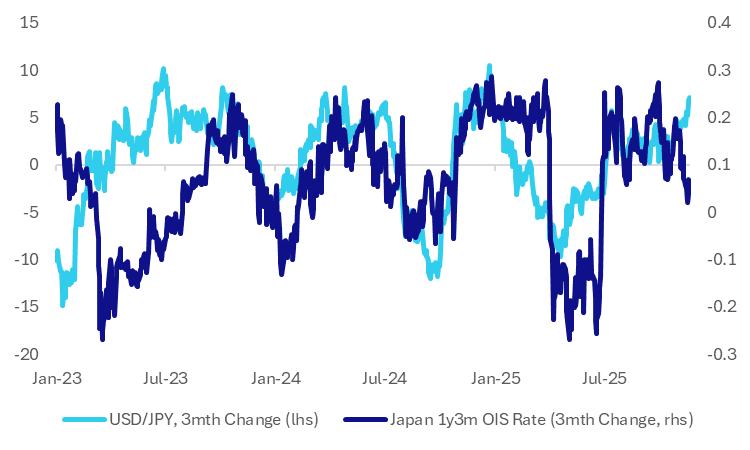
The weaker yen trend remains a key focus point for Japan policy makers. Earlier the FinMin stated that FX intervention was an option, a clear step up in rhetoric around yen weakness. BoJ Governor Ueda was also before parliament and warned that the weak yen could raise import costs and domestic prices, ultimately putting upward pressure on consumer prices. The chart below plots the 3 month rate of change in spot USD/JPY and the 3 month change in the 3 month OIS rate (1yr forward) as a proxy for the markets monetary policy outlook. The relationship has diverged somewhat recently, with little change in the 3mth rate of change in the policy proxy despite the break higher in USD/JPY. All else equal if USD/JPY continues to track higher risks, are likely to build around markets pricing in higher rates.
- There are a number of caveats of course. The new Takaichi regime is leaning against tighter BoJ expectations. The FinMin stated earlier that Japan is still halfway to achieving its sustainable, stable price goal (accompanied by wage gains). Katayama added that she understands the BOJ agrees with this assessment.
- Still, near term push back on BoJ rate hikes may drive the market to feel the central bank is at risk of falling further behind the curve. It may then price in more catch up later on.
- The other factor is that the market may not feel that policy rates are likely to go much beyond 1%. The 3mth rate 1yr forward OIS is currently 0.98% and this year we have spent little time above 1%.
- Such assessments could change though once we get a clearer picture of the new stimulus package the government is expected to announce soon. From late yesterday via BBG: Japanese Prime Minister Sanae Takaichi is set to unveil an economic package funded by an extra budget about 27% bigger than what was pledged in her predecessor’s spending plan a year ago, underscoring her commitment to an expansive fiscal policy.
Fig 1: Japan BoJ OIS Market Pricing Outlook & USD/JPY - 3 month Changes
Source: Bloomberg Finance L.P./MNI
JGBS: Yields Extend Retreat From Yesterday’s Peaks
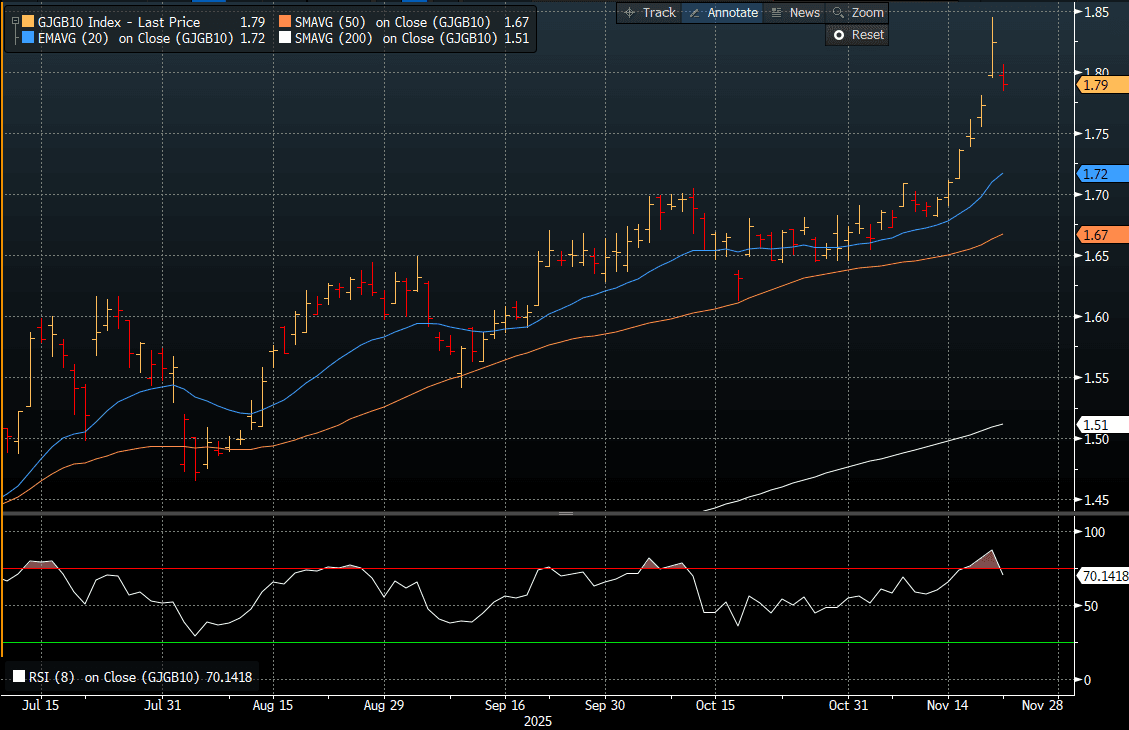
JGB futures are stronger, +25 compared to settlement levels, albeit off session highs. Nevertheless, the market has managed to unwind yesterday's explosive move to cycle lows.
- Japan's Oct CPI was in line with market forecasts across the three inflation metrics, and a slight tick up from the Sep outcome. Headline printed at 3.0%y/y, as did the core ex fresh food measure (both measures were 2.9% in Sep). The ex fresh food, energy measure edged up to 3.1%y/y from 3.0% prior.
- “Japanese Prime Minister Sanae Takaichi’s cabinet approved a stimulus plan valued at ¥21.3 trillion to address voter frustrations. The plan includes ¥11.7 trillion for price relief, with measures such as subsidies for gas and electricity bills and cash handouts per child. The price relief measures are expected to push down the overall inflation gauge by an average 0.7 percentage points from February to April.” - BBG
- Cash JGBs are flat to 6bps richer across benchmarks, with the curve flatter. The benchmark 10-year yield is 3.4bps lower at 1.790% versus the cycle high of 1.84%, set yesterday. (see chart)
- Swap rates are flat to 4bps lower.
- On Monday, the local market will be closed for a holiday.
Source: Bloomberg Finance LP
JAPAN DATA: Oct Inflation Ticks Up But Services Still Sub 2% Y/Y
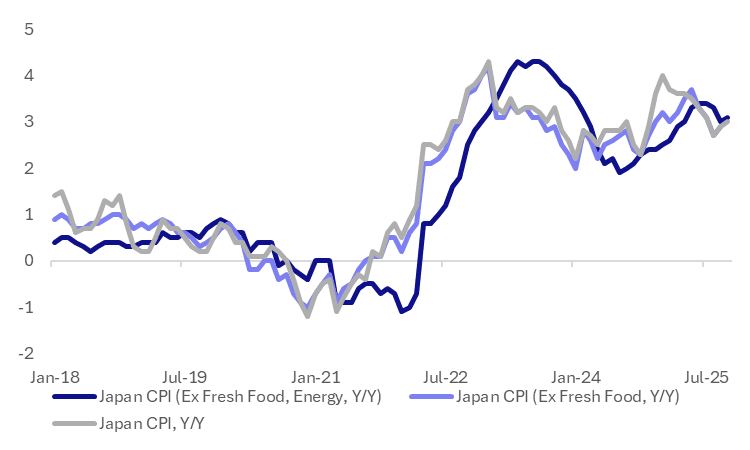
Japan Oct CPI was in line with market forecasts across the three inflation metrics, and a slightly tick up from the Sep outcome. Headline printed at 3.0%y/y, as did the core ex fresh food measure (both measures were 2.9% in Sep). The ex fresh food, energy measure edged up to 3.1%y/y from 3.0% prior. The chart below shows the trends of the three inflation measures. We remain wedged close to 3%y/y. Our policy team noted: Services prices – a key gauge for the BOJ in assessing the strength of the wage–price cycle – increased 1.6% y/y in October, up from 1.4% in September. BOJ officials noted that services inflation remains below 2% and has not accelerated sufficiently to ensure achievement of the price target. So, the outcome is unlikely to shift BoJ thinking. We await Ueda's speech On Dec 1.
- In terms of the detail, all of the measures in m/m terms were up 0.4%, while goods prices rose 0.3%m/m. Services posted a 04%m/m gain but these are often revised away.
- In terms of the segments, food rose 0.9%m/m after a 0.7% gain prior. The pace of fresh food gains did ease. Utilities rose 0.8%m/m, ending a four month run of declines. Household goods rose 1.3%m/m, after falling 0.7% prior. Entertainment was up 1.4%, after a 2.1% drop in Sep, but this segment tends to be volatile.
- In y/y terms we did see much of a shift from Sep outcomes.
Fig 1: Japan CPI Y/Y - Trends All Close To 3%
Source: Bloomberg Finance L.P./MNI
JAPAN DATA: Exports Better Than Forecast, Y/Y Momentum To US Less Negative
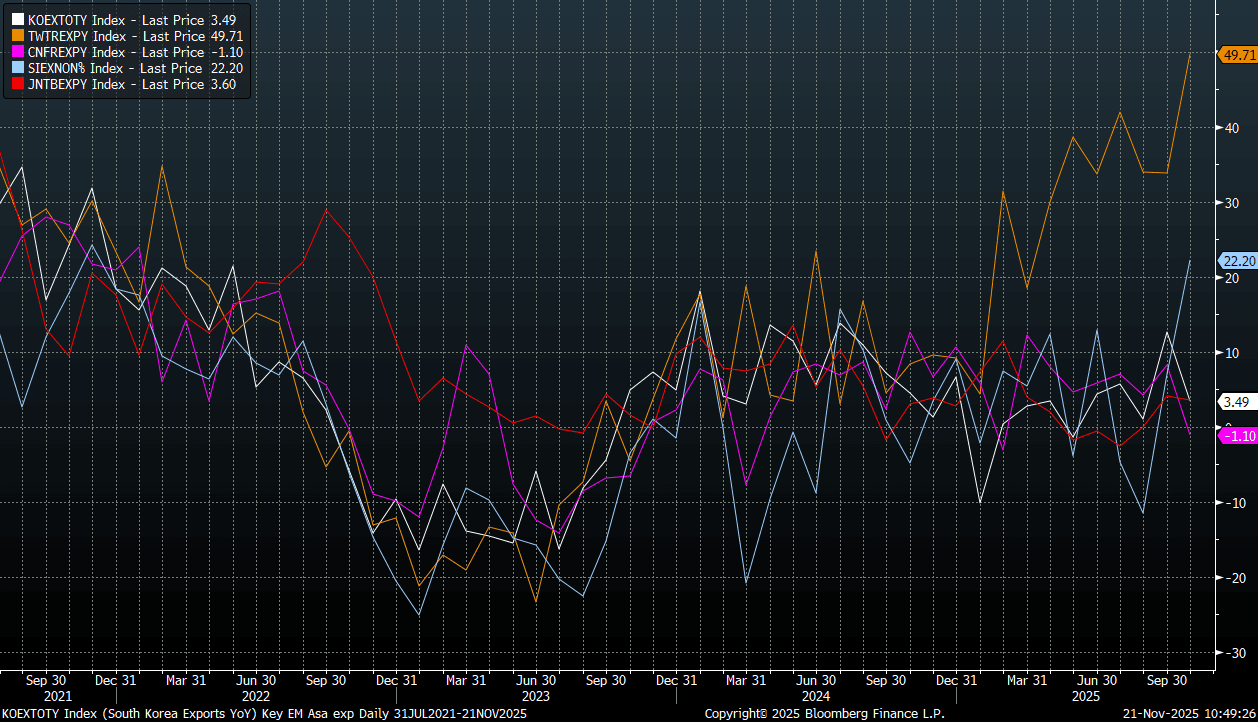
Japan Oct exports were better than forecast up 3.6%y/y, versus 1.1% forecast and 4.2% prior. Imports were also stronger than forecast up 0.7%y/y (-1.0% was forecast and 3.0% was the Sep outcome). For exports this broadly matches other trends seen in export orientated economies, see the chart below (Japan y/y exports is the red line). Most economies, outside of China, are up from recent lows in terms of y/y momentum, although Taiwan remains the clear outperformer. This resilient backdrop for Japan will be welcomed by the authorities, although growth rates are below 2024/2025 highs.
- The trade balance was -¥231.8bn, close to forecasts and the Sep outcome. In seasonally adjusted terms we were close to flat though, better than forecast and prior.
- Exports to the US were -3.1%y/y, to the EU 9.2% y/y and China 2.1%y/y. For the US, exports were down 13.3% in Sep, so this is an improvement. Automobile exports to the U.S. fell 7.5% y/y, pressured by trade policy, following a 24.2% decline in September. Focus will be on whether we can further sequential improvement in these trends. In volume terms, exports to the US were flat (after a 13.5%y/y decline in Sep).
Fig 1: Key Asian Economy Export Trends - Y/Y
Source: Bloomberg Finance L.P./MNI
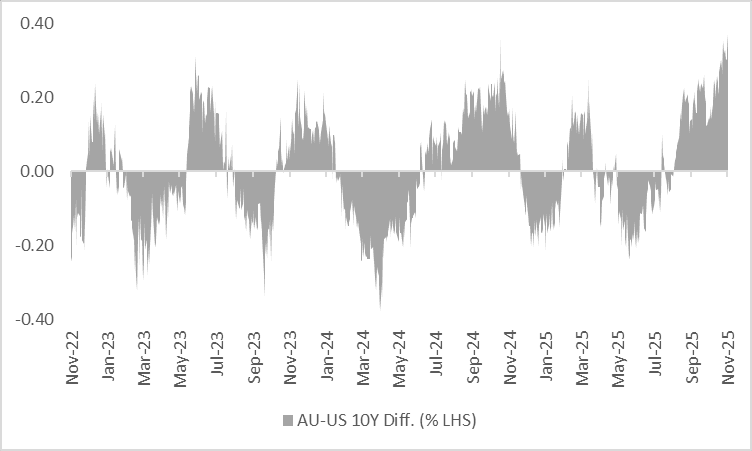
AUSSIE BONDS: Modest Rally But AU-US 10Y Diff At Highest Level Since Late 2022
ACGBs (YM +2.0 & XM +1.0) are marginally stronger but well off session highs.
- Cash US tsys are flat to 1bp cheaper, with a flattening bias, in today's Asia-Pac session after yesterday's risk-off induced rally.
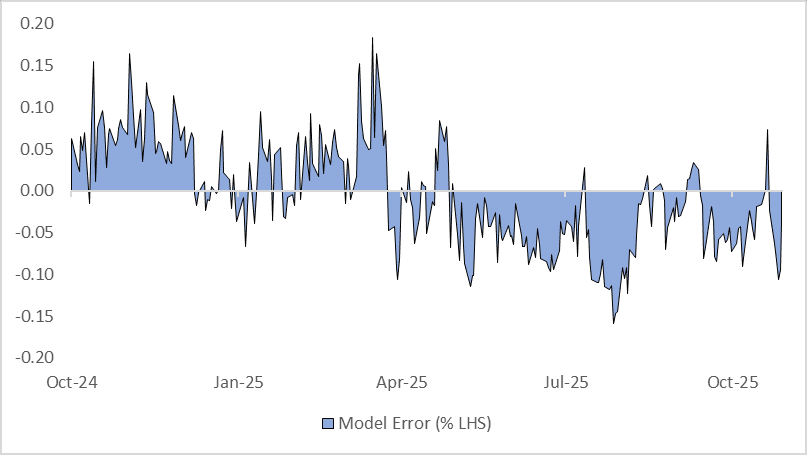
- Cash ACGBs are 1-2bps richer with the AU-US 10-year yield differential at +37bps, the highest since late 2022. (see chart)
- However, a simple regression of the 10-year yield differential against the AU-US 1-year forward 3-month swap rate (1Y3M) differential over the past two years suggests the current spread is +7bps to fair value.
- The latest ACGB May-32 supply achieved a weighted average yield that printed 0.44bp through prevailing mids (per Yieldbroker). Moreover, the cover ratio increased, rising to 3.5171x from 3.3850x.
- The bills strip is little changed.
- RBA-dated OIS pricing is showing a 25bp rate cut in December at a 2% probability, with a cumulative 11bps of easing priced by mid-2026.
- The local calendar will be empty until Wednesday’s October CPI data.
- Next week, the AOFM plans to sell A$400mn of the 4.25% 21 June 2034 bond on Tuesday, A$700mn of the 2.75% 21 November 2029 bond on Wednesday and A$900mn of the 3.75% 21 April 2037 bond on Friday.
Bloomberg Finance LP
AUSTRALIA DATA: Nov PMIs Up, Particularly Manufacturing, Services Jobs Moderates
Australian Nov preliminary PMIs saw improvement across the board, most notably for manufacturing. The manufacturing index rose to 51.6 from 49.7. We are still short of earlier 2025 highs around 53.0, but the the turn around from Oct levels under 50.0 is notable. On The services side, we edged up to 52.7, from 52.5 prior. Again we remain off recent cycle highs, but it broadly suggests reasonably economic momentum for Q4. The composite index was at 52.6 from 52.1 in Oct. The data is second tier, but reinforces the RBA's on hold backdrop in the near term.
- In terms of the detail on the manufacturing side, output rose to 52.1 from 49.4, while new orders were also up. For services, the employment index eased back to 50.1 from 52.1 (all via BBG). This is probably the only negative from the prints.
NEW ZEALAND: Trade Deficit Widens In Oct, Not Showing Typical H2 Improvement Yet
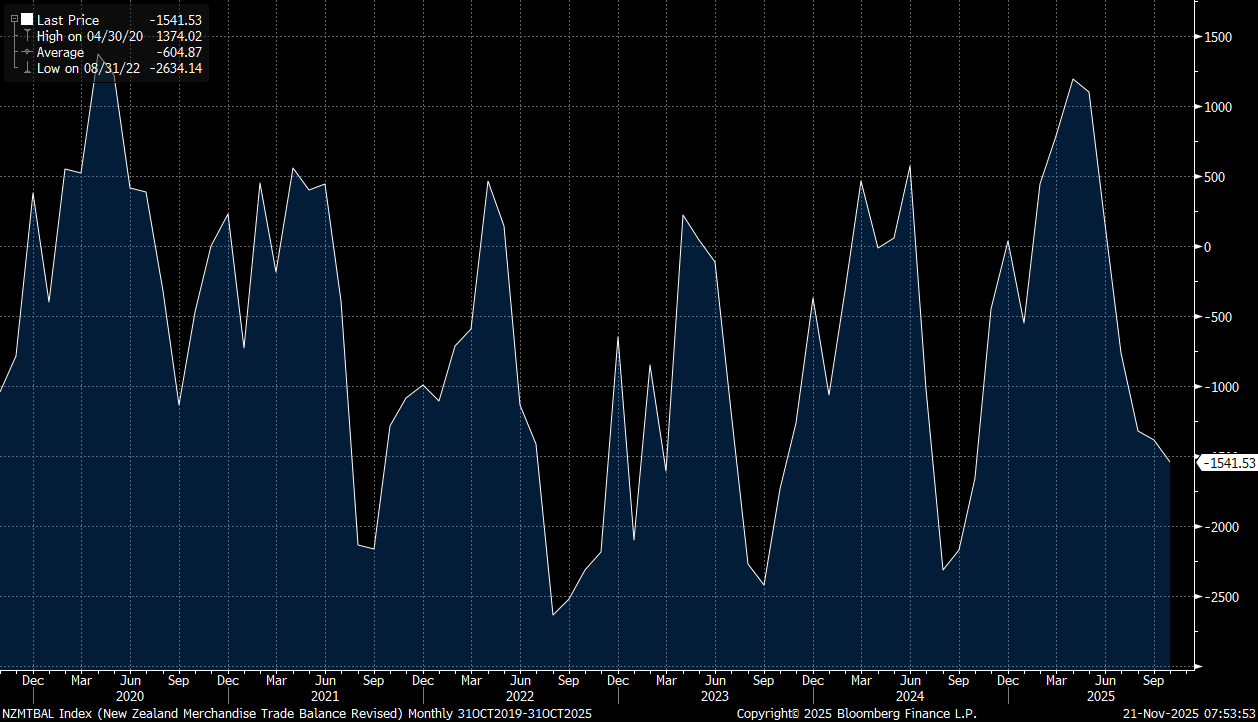
New Zealand Oct trade data saw the trade deficit widen slightly to -NZ$1542mn from a revised -NZ$1384mn in Sep. Both exports and imports rose in the month, with imports up by slightly more to drive the wider deficit. The chart below plots the trade deficit for NZ, which usually tends to improve throughout the second half of the year, but this trend isn't evident yet. This is a NZD negative at the margins, and comes after the further decline in whole milk prices earlier this week (at the GDT auction) (see this link). Note the 12 mth YTD deficit was -NZ$2281mn, showing a further trend improvement.
- Exports were up 16% versus Oct 2024 levels, although we are still off earlier 2025 highs in levels terms. Strength was in milk powder and other related products. Exports to China rose 18%, but were up to other destinations as well.
- Imports were up 11% in y/y terms. Stats NZ noted - "petroleum and products**, up $209 million (30 percent); fertilisers, up $209 million (370 percent); mechanical machinery and equipment, up $192 million (19 percent); and electrical machinery and equipment, up $174 million (26 percent)."
- To the extent these import rises reflect a better local investment/domestic demand outlook, will be a watch point going forward.
Fig 1: New Zealand Trade Deficit - Not Showing The Typical Second Half Improvement Yet
Source: Bloomberg Finance L.P./MNI
NZGBS: NZ-US 10Y Diff Sharply Wider, RBNZ Next Wednesday
NZGBs closed showing a twist-steepener, with yields 1bp lower to 3bps higher across benchmarks.
- Cash US tsys are 1-2bps cheaper, with a flattening bias, in today's Asia-Pac session after yesterday's risk-off induced rally.
- The NZ-US 10-year yield differential closed 7bps wider at +7bp. Yesterday, a simple regression of the 1Y3M forward swap spread against the 10-year yield differential over the past three years suggested the differential was about 10bps below its estimated fair value. Today, it closed 3bps below fair value. (see chart)
- Swap rates closed flat to 3bps higher, with the 2s10s curve steeper.
- Next week, the local calendar will be empty until the RBNZ Policy Decision on Wednesday.
- RBNZ dated OIS pricing closed slightly softer across meetings. 27bps of easing is priced for November, with a cumulative 35bps by February 2026.
- Our policy team also highlights a former RBNZ economists' viewpoint on the OCR outlook; see this link for more details.
Bloomberg Finance LP
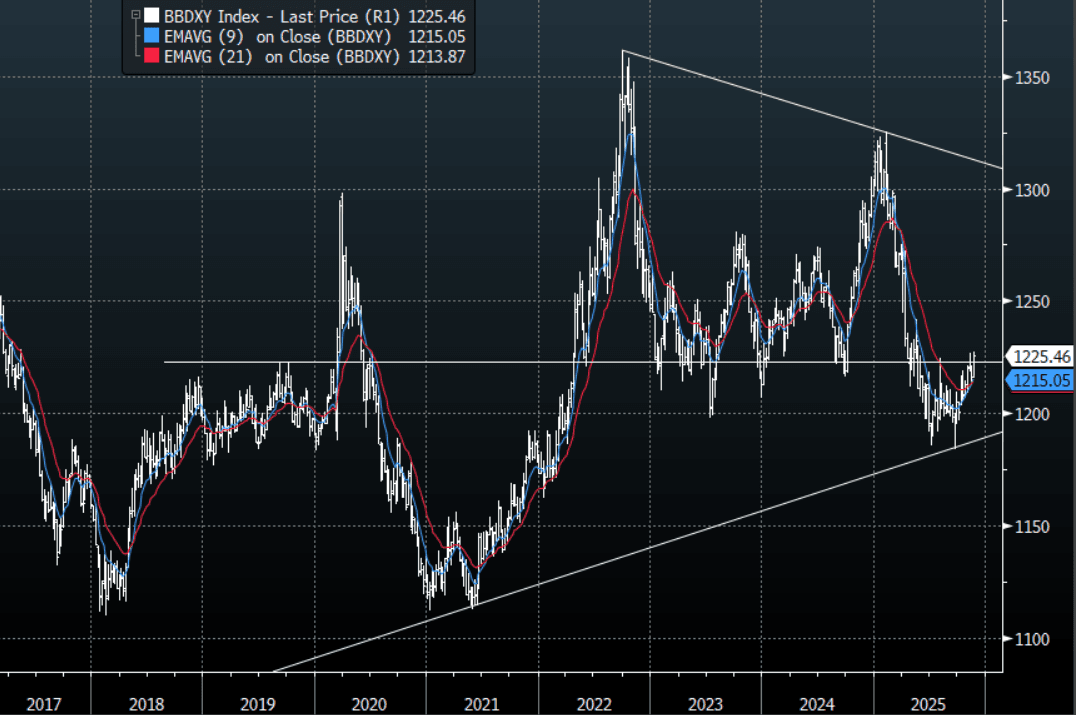
FOREX: USD - BBDXY Is Consolidating Around 1225
The BBDXY has had a range today of 1225.56 - 1226.95 in the Asia-Pac session; it is currently trading around 1225, -0.10%. The USD has drifted lower in our session albeit still close to its recent highs. While the price remains above 1218-1220 I would be skewed toward expressing a long, looking for a retest of the 1230-1240 area at some point. On the day I suspect dips toward 1222-1224 could continue to be supported as the market tries to build a base from which to extend higher.
- EUR/USD - Asian range 1.1524 - 1.1539, Asia is currently trading 1.1540. The pair consolidated just above the 1.1500 area yesterday. On the day I still prefer to be skewed short while below the 1.1545-65 area, as the market turns its focus toward the 1.1400 support.
- GBP/USD - Asian range 1.3053 - 1.3087, Asia is currently dealing around 1.3090. I continue to favor fading rallies, as GBP looks to have put in a medium term top. I suspect rallies will continue to be faded on the day while we stay below the 1.3100-1.3150 area as the market looks to challenge the 1.3000 support.
- Cross asset : SPX +0.30%, Gold $4055, US 10-Year 4.092%, BBDXY 1226, Crude Oil $59.15
- Data/Events : EZ HCOB Eurozone PMI’s/Negotiated Wages, Germany HCOB Germany PMI’s, France Business Confidence/Manufacturing Confidence/HCOB France PMI’s
Fig 1: BBDXY Spot Weekly Chart
Source: MNI - Market News/Bloomberg Finance L.P
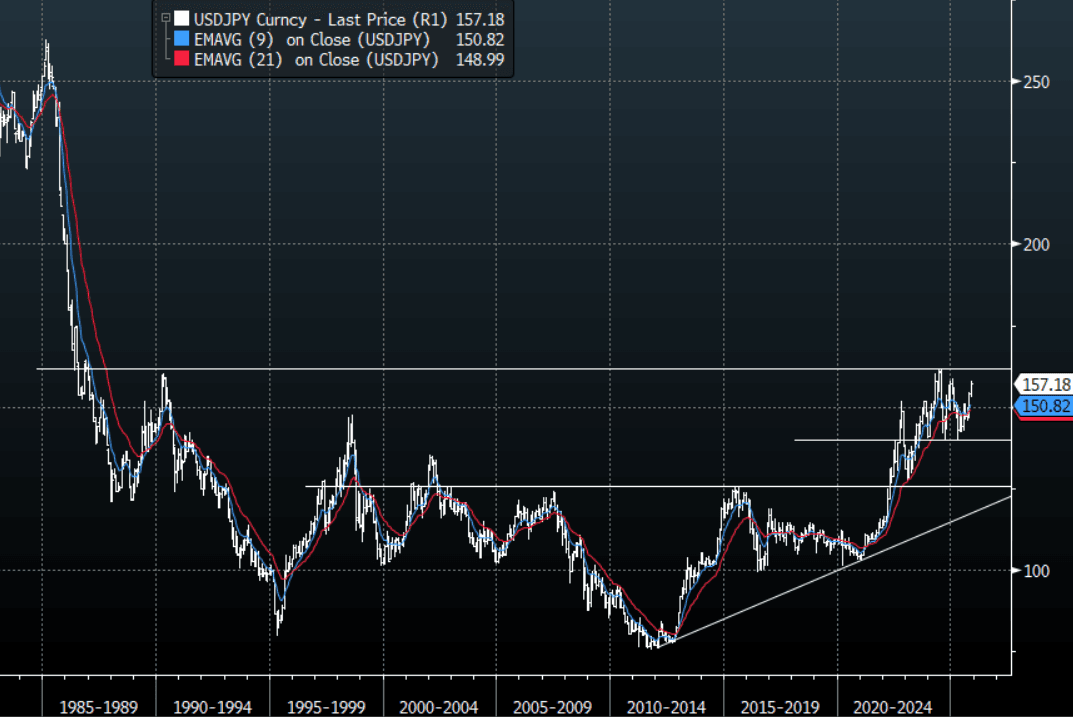
JPY: USD/JPY - Consolidates Above 157.00
The USD/JPY range today has been 157.09 - 157.59 in the Asia-Pac session, it is currently trading around 157.10, -0.20%. The pair continues to consolidate its recent gains above 157.00. The horse looks like it has bolted now though and Japanese officials would have to do something extraordinary to change the narrative. The path of least resistance is now a higher USD/JPY and I suspect any dips back toward the 154-155 area would be used as buying opportunities. I feel they will have to show some sign of fighting this toward or above 160, but given the current inputs this could potentially go a lot higher than that. It will be interesting when we get the CFTC data back as I suspect real money would only just be starting to turn back to a short Yen position.
- MNI AU - Market BoJ Pricing Outlook & USD/JPY Gains Diverging: The weaker yen trend remains a key focus point for Japan policy makers. Earlier the FinMin stated that FX intervention was an option, a clear step up in rhetoric around yen weakness. BoJ Governor Ueda was also before parliament and warned that the weak yen could raise import costs and domestic prices, ultimately putting upward pressure on consumer prices. All else being equal if USD/JPY continues to track higher risks are likely to build around the markets pricing in higher rates.
- "JAPAN FINANCE MINISTER KATAYAMA: OUR PLANNED STIMULUS PACKAGE IS NOT NECESSARILY EXPANSIONARY, WE ARE MINDFUL OF NEED FOR WISE SPENDING - [RTRS]"
- Options : Close significant option expiries for NY cut, based on DTCC data: 155.00($933m),156.00($880m), 157.00($495m) . Upcoming Close Strikes : 153.00($1.17b Nov 26), 154.00{$1.94b Nov 26), 155.00($1.46b Nov 26) - BBG.
- The USD/JPY Average True Range(ATR) for the last 10 Trading days: 113 Points
Fig 1 : USD/JPY Spot Weekly Chart
Source: MNI - Market News/Bloomberg Finance L.P
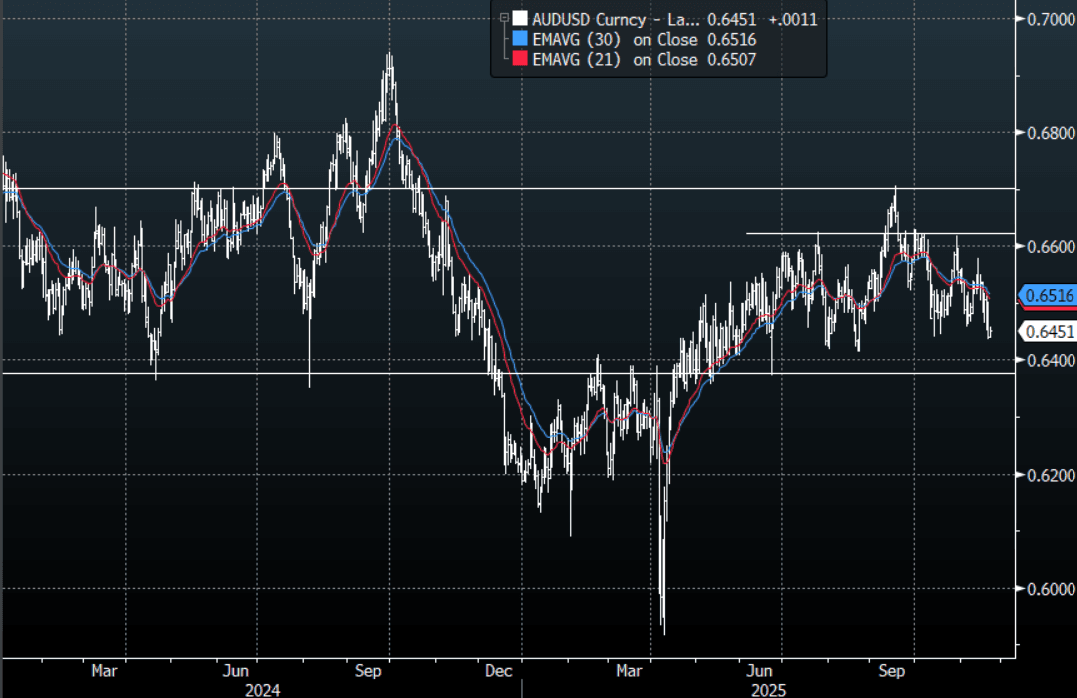
AUD/USD - Support Around 0.6440-0.6450 Holds for Now
The AUD/USD has had a range today of 0.6438 - 0.6458 in the Asia- Pac session, it is currently trading around 0.6450, +0.15%. The AUD/USD has a little higher in a quiet Asian session as the market tries to digest the implications of the overnight price action in risk. This does not have a great smell and we are now sitting on some pivotal levels in global risk that if they give way will potentially signal a deeper pullback. The AUD/USD traded heavy overnight in sympathy to this backdrop and should risk actually break lower it would become vulnerable. The pair is probing its first support right here around the 0.6440-0.6450 area which has been pretty solid the last couple of months, through here and the focus will then turn to the pivotal 0.6350 support. On the day while risk remains under pressure and the AUD is capped below 0.6500-0.6525 I suspect rallies will be faded and the market will be looking to see if it can break this 0.6440-50 support properly to build for a move lower.
- MNI AU - Nov PMIs Up, Particularly Manufacturing, Services Jobs Moderates: Australian Nov preliminary PMIs saw improvement across the board, most notably for manufacturing. The manufacturing index rose to 51.6 from 49.7. We are still short of earlier 2025 highs around 53.0, but the turn around from Oct levels under 50.0 is notable. On the services side, we edged up to 52.7, from 52.5 prior. Again we remain off recent cycle highs, but it broadly suggests reasonably economic momentum for Q4. The composite index was at 52.6 from 52.1 in Oct. The data is second tier, but reinforces the RBA's on hold backdrop in the near term.
- Options : Closest significant option expiries for NY cut, based on DTCC data: 0.6500(AUD2.28b). Upcoming Close Strikes : 0.6450(AUD991m Nov 26), 0.6500(AUD1.07b Nov 26), 0.6535(AUD1.69b Nov 26) - BBG
- The AUD/USD Average True Range for the last 10 Trading days: 47 Points
Fig 1: AUD/USD spot Daily Chart
Source: MNI - Market News/Bloomberg Finance L.P
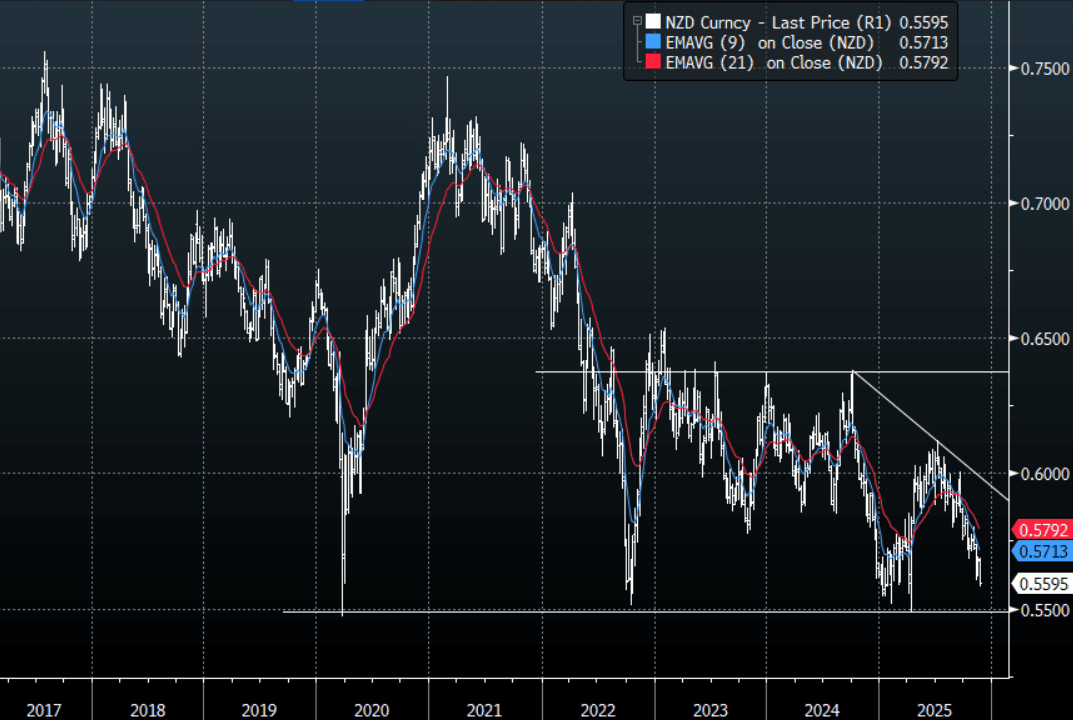
NZD/USD - Drifts Back Toward 0.5600
The NZD/USD had a range today of 0.5581 - 0.5598 in the Asia-Pac session, going into the London open trading around 0.5595, +0.15%. The NZD/USD drifted a little higher as the market tries to digest the implications of the overnight price action in global risk. This does not have a great smell and we are now sitting on some pivotal levels in global risk that if they give way will potentially signal a deeper pullback. The NZD continues to trade heavy with this backdrop having topped out back toward 0.5640 overnight. The next target is the pivotal 0.5500 area which has been very strong support the last few years. On the day I suspect while the NZD remains under 0.5630-50 the rallies will be faded as the market turns its focus toward that support.
- MNI AU - Trade Deficit Widens In Oct, Not Showing Typical H2 Improvement Yet: New Zealand Oct trade data saw the trade deficit widen slightly to -NZ$1542mn from a revised -NZ$1384mn in Sep. Both exports and imports rose in the month, with imports up by slightly more to drive the wider deficit. This is a NZD negative at the margins, and comes after the further decline in whole milk prices earlier this week. Note the 12 mth YTD deficit was -NZ$2281mn, showing a further trend improvement.
- MNI Interview: Our policy team also highlights a former RBNZ economists' viewpoint on the OCR outlook, see this link for more details. https://www.mnimarkets.com/articles/mni-interview-rbnz-done-easing-after-next-cut-fmr-economist-1763697187886
- Options : Closest significant option expiries for NY cut, based on DTCC data: 0.5480(NZD644m). Upcoming Close Strikes : 0.5670(NZD788m Nov 26), 0.5720(NZD646m Nov 25) - BBG
- The NZD/USD Average True Range for the last 10 Trading days: 42 Points
Fig 1: NZD/USD Spot Weekly Chart
Source: MNI - Market News/Bloomberg Finance L.P
Asia Stocks Looking at Worst Week Since April
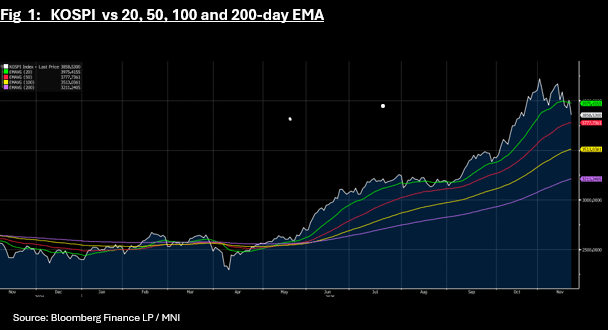
Major bourses were down today with the tech heavy NIKKEI and KOSPI leading the falls. The falls have seen the weakest week for major bourses since the volatility of April. With clarity on a rate cut not forthcoming in the data overnight, Asia's investors appear to be resetting their expectations for rates, weighing heavy on equities, with yields ignoring overnight leads to push higher in the Asia trading day. Despite the better than expected Nvidia results, some forecasters are now saying that the tech led rally is on shaky grounds and fundamentals are likely to reassert in the near term. With several key bourses recently at highs and P/Es at top end of estimates, a modest change in sentiment has the potential for a sizeable change in momentum.
- The NIKKEI fell -2.4% today and is down -3.5% for the week, whilst the KOSPI is down -3.7% today and -3.9% for the week. The losses for the KOSPI sees it back below the 20-day EMA for the first time since the beginning of September and at 3,854, has the 100-day EMA of 3,777 below it.
- China's major bourses have had a very week Friday with the Hang Seng down -2% and -4.7% for the week whilst the CSI 300 is down -1.9% and -3.2% for the week.
- SE Asia's bourses are mixed with the Jakarta Composite holding onto a weekly gain of +0.35% despite falling -0.25% today whilst Malaysia is down for the week by -0.50% following falls of -0.15% today and the SE Thai down -1.15% today to slip to a loss of -0.6%
- India's NIFTY 50 is weak at the outset of the trading day in India, down -0.45% whilst retaining gains of +0.5% for the week as hopes hang on the announcement of a trade deal with the US soon.
Oil Set for Weekly Fall on Ukraine Peace Plan
- Oil is set for moderate losses for the week as news of a Ukraine / Russia peace plan drives prices lower Friday.
- WTI is down -1.8% today at US$58.06 bbl and currently down -3.3% for the week. WTI has delivered weekly gains on twice out of the last eight trading weeks, primarily on supply concerns.
- The IEA forecasts increased estimated surpluses in 2026 of up to 4 million barrels a day, with global growth prospects modest at best. Were a peace deal to be reached and Russian oil allowed to flow, this would add further pressure to oil prices.
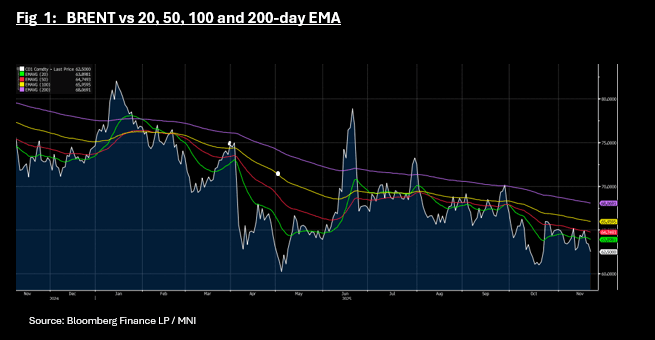
- Brent is down -1.40% today at US$62.49 bbl and down -2.9% for the week. The losses this week sees Brent back below all major moving averages, having dipped below the 20-day EMA of $63.89.
- In further potential increases to supply, President Trump is looking to expand drilling access for US firms to increase US output with over 30 possible new leases proposed. Leases are being explored in areas in California, Florida and Alaska and could open up more than 1 bn acres of coastal zones to drilling.
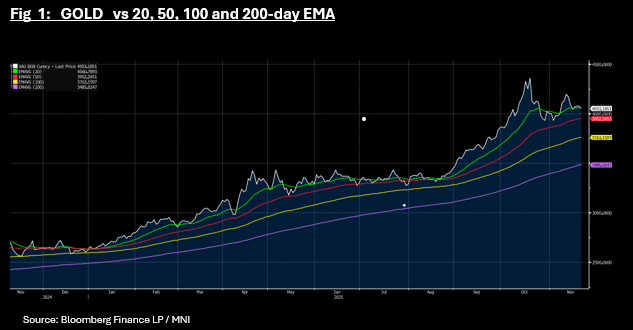
- As the probability of a rate cut by the FED continues to diminish, gold's fortunes have turned down and on course for a weekly fall.
- Gold is losing ground by -0.59% today to be at US$4,053.28 and lower by -0.77% for the week.
- Since it's high on October 20, gold is now over 7% lower with key drivers being diminished rate cut expectations and the calming of the trade war.
- The falls today sees bullion slip below the 20-day EMA of US$4,060.73. Below is the 50-day EMA of $3,952.24.
ASIA FX: KRW & TWD Tracking Lower For The Week, Amid Tech Equity Rout
At this stage KRW and TWD are tracking comfortably lower for the week, as the tech equity rout continues. The won is the worst performer in EM Asia, down around 1.4%, although it looks like there is some supply above the 1470 level. USD/TWD continues to track higher, last above 31.30. Earlier highs were just short of 31.36. CNH is also down for the week, but remains a relative outperformer against stronger USD trends.
- USD/CNH was last near 7.1135, with near selling interest emerging on recent moves above 7.1200. The USD/CNY fix moved back under 7.0900 and the fixing error stayed near recent wides. CNH/JPY remains in a strong uptrend (although the FinMin stated today FX intervention is an option). This pair was last near 22.11, aiming for 2024 highs at 22.2089.
- Spot USD/KRW was last wedged between 1471/72. Earlier highs were at 1474, amidst sharp equity losses of over 3.5%. Offshore investors have also returned to being large sellers of local stocks today, amidst the sharp equity reversal seen in the tech space as Thursday trade unfolded. We may be seeing supply of USD/KRW above 1470 though as the FinMin looks to stabilize FX supply/demand imbalance.
- Spot USD/TWD continues to track higher, with little signs of equity relief (Taiex down 3.5% to early Oct levels). We were last near 31.30/35. We continue to close the gap with break down levels near 32.00 from late April/early May. BBG notes: "Taiwan's life insurers proposed changes to accounting rules to cut annual hedging costs and provide relief for excessive currency swings." See this link.
ASIA FX: PHP Best Performer For The Week, Aided By Equity Rebound
Most USD/Asia pairs in South East Asia FX are lower, although for the week only PHP FX is firmer. There is less fallout for South East Asian markets from tech equity related losses. However, less prospects of a Fed easing before year end is providing some USD support via the yield channel.
- PHP is up around 0.25% at this stage, as we continue to see moves above 59.00 draw selling interest in the pair. Yesterday also saw strong offshore equity inflows of just over $125.6mn. Offshore investors may be using depressed PCOMP levels as fresh entry points. PCOMP shares are up firmly from multi year lows under 5600, last approaching 6000. USD/PHP is still above its 20-day EMA though, which comes in at 58.84 (spot was last 58.90).
- USD/IDR is flat for the week, holding above 16700 at this stage. The steady BI hand this week, amid a renewed focus on FX stability has likely helped at the margins. Still, the pair remains above all its key EMAs (20-day back near 16683.45).
- USD/MYR is lower, continuing the recent run of greater volatility in the pair, but at 4.1435/40 still remains above recent lows. For now, we seem to have firm resistance above the 4.1600 level.
- USD/THB is relatively steady, the pair ticking back up to 32.45/50, but likewise remains within recent ranges.
KOREA: First 20-day Trade Data Jump Supports Rates Hold
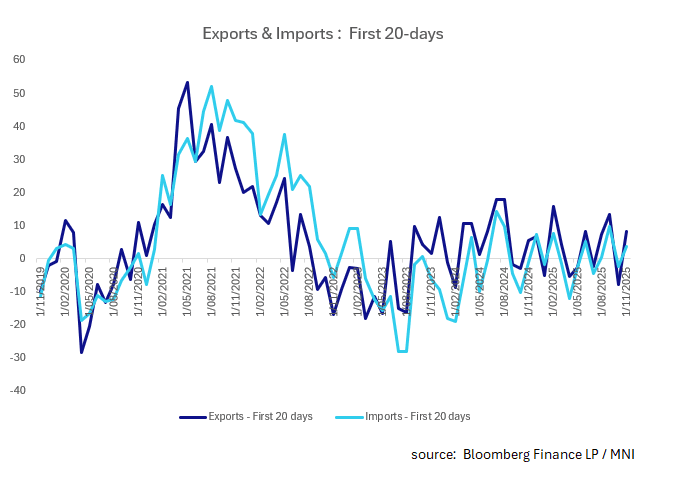
- Korea's first 20-days exports and imports were strong, rebounding from last month's decline. The main driver for the decline last month was the adjustment for working days differences.
- Exports rose +8.2% above the 5-Year average of +5.4%. Chip exports rose +26.5% YoY and exports to China were up +10.2% and US +5.7%
- Korea's first 20-days imports rose +3.7%, following a decline of -2.3% yet remains below the 5-Yr average of +5.5%
- Trade data has been impacted over the last two months by frontloading of shipments, particularly chips / electronics, ahead of the Trump Xi meeting yet the underlying trend is strong suggesting the worst of the trade war may be over and potential upside for the Korean economy.
- This comes at a time when rate expectations have moved away from cuts, with markets now suggesting an extended hold.
- The challenge remains with the Won which has lost ground by -2.7% in the last month, and is feeding into the higher PPI released this morning.
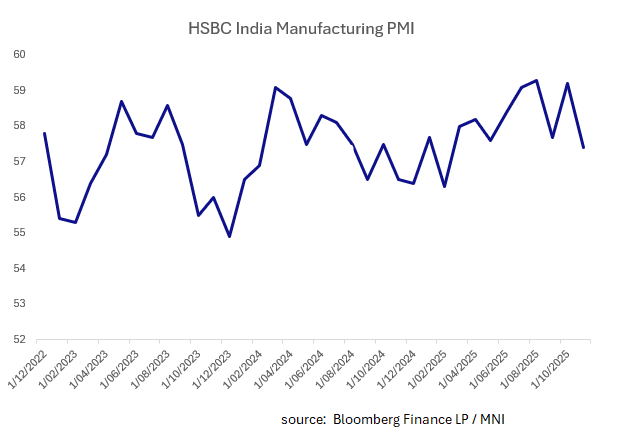
INDIA: PMI Manufacturing Weakest Since February
- India's PMI Manufacturing fell to its lowest since February with today's release of the Preliminary November numbers.
- At +57.4 it was materially down from the prior month of +59.2 with output down to 60.7 from 63.7 and new orders down from the month prior.
- PMI services was up at +59.5 from +58.9 in October as employment fell to 51.2 from 51.4 for the lowest reading since April 2024 and prices charged down.
- Whilst these numbers are weaker, the PMIs have held up strongly through the middle part of the year in the face of the US India trade war, with many forecasters expecting a fall earlier in the year.
- India's PMIs remain higher than regional peers and the weakening today will not impact monetary policy for now, but will watched in case the declines continue in the coming months.
UP TODAY (TIMES GMT/LOCAL)
| Date | GMT/Local | Impact | Country | Event |
| 21/11/2025 | 0700/0700 | *** |  GB GB | Public Sector Finances |
| 21/11/2025 | 0700/0700 | *** | GB | Retail Sales |
| 21/11/2025 | 0745/0845 | ** |  FR FR | Manufacturing Sentiment |
| 21/11/2025 | 0800/0900 |  EU EU | ECB de Guindos Remarks/Q&A at Foro Gran Via | |
| 21/11/2025 | 0815/0915 | ** | FR | S&P Global Services PMI (p) |
| 21/11/2025 | 0815/0915 | ** | FR | S&P Global Manufacturing PMI (p) |
| 21/11/2025 | 0830/0930 | ** |  DE DE | S&P Global Services PMI (p) |
| 21/11/2025 | 0830/0930 | ** | DE | S&P Global Manufacturing PMI (p) |
| 21/11/2025 | 0830/0930 | EU | ECB Lagarde Speech at European Banking Congress | |
| 21/11/2025 | 0900/1000 | ** | EU | S&P Global Services PMI (p) |
| 21/11/2025 | 0900/1000 | ** | EU | S&P Global Manufacturing PMI (p) |
| 21/11/2025 | 0900/1000 | ** | EU | S&P Global Composite PMI (p) |
| 21/11/2025 | 0930/0930 | *** | GB | S&P Global Manufacturing PMI flash |
| 21/11/2025 | 0930/0930 | *** | GB | S&P Global Services PMI flash |
| 21/11/2025 | 0930/0930 | *** | GB | S&P Global Composite PMI flash |
| 21/11/2025 | 1000/1100 | EU | Negotiated Wage Growth | |
| 21/11/2025 | 1130/1230 | EU | ECB de Guindos Remarks/Q&A at Deusto Business School | |
| 21/11/2025 | 1230/0730 |  US US | New York Fed's John Williams | |
| 21/11/2025 | 1330/0830 | ** |  CA CA | Retail Trade |
| 21/11/2025 | 1330/0830 | US | Fed Governor Michael Barr | |
| 21/11/2025 | 1345/0845 | US | Fed Vice Chair Philip Jefferson | |
| 21/11/2025 | 1400/0900 | US | Dallas Fed's Lorie Logan | |
| 21/11/2025 | 1400/0900 | US | Boston Fed's Susan Collins | |
| 21/11/2025 | 1445/0945 | *** | US | S&P Global Manufacturing Index (Flash) |
| 21/11/2025 | 1445/0945 | *** | US | S&P Global Services Index (flash) |
| 21/11/2025 | 1500/1000 | *** | US | U. Mich. Survey of Consumers |
| 21/11/2025 | 1500/1000 | ** | US | University of Michigan Surveys of Consumers Inflation Expectation |
| 21/11/2025 | 1500/1000 | ** | US | Wholesale Trade |
| 21/11/2025 | 1500/1000 | ** | US | Wholesale Trade |
| 21/11/2025 | 1540/1540 | GB | BOE Pill in Panel at Swiss National Bank | |
| 21/11/2025 | 1800/1300 | ** | US | Baker Hughes Rig Count Overview - Weekly |
| 21/11/2025 | 1800/1300 | ** | US | Baker Hughes Rig Count Overview - Weekly |
| 21/11/2025 | 1800/1300 | ** | US | Baker Hughes Rig Count Overview - Weekly |
| 22/11/2025 | 0800/0900 | EU | ECB Lagarde in Roundtable at Austrian National Bank | |
| 22/11/2025 | 1100/1200 | EU | ECB Lagarde Keynote on Fiscal and MonPol |


