MNI EUROPEAN MARKETS ANALYSIS: AU Domestic Demand Strong
- Chinese officials will aim to raise the household consumption-to-GDP ratio by an average of one percentage point per year over the next five years from the current 39.9% towards the 50-70% range typical of developed economies, using a combination of consumption-related infrastructure spending, services subsidies and wage-growth support, MNI understands.
- South Korea's third quarter GDP surprised to the upside as the Bank of Korea eyes a lengthy pause for monetary policy.
- Australia’s third quarter GDP rose 0.4% q/q, 30 basis points below expectations, and 2.1% y/y, 10bp below forecasts, National Accounts data released on Wednesday showed. However, domestic demand rose 1.2% q/q contributing 1.1pp.
- The Trump administration canceled a slate of interviews with finalists to be the next chair of the Federal Reserve, with no reason given for the decision as he sung the praises of National Economic Council Director Bessent.
- The day ahead sees Turkey and Swiss CPI, PMI Services and Composite across various EU, EU PPI and in the US - ADP Employment Change, Import/Export Price Index, Industrial Production MoM, S&P Global US Services PMI, ISM Services Index and New orders
MARKETS
US TSYS: Yields Lower Across Curve; TYH6 Nears Key Tech Level
Bond futures are up modestly across all maturities today in a relatively low volume trading day in Asia. The 10-Yr is up +02 at 112-31 with topside resistance at 113 being the 20-day EMA. Downside resistance in the 50-day EMA is at 112-27, where it failed to trade below in recent falls.
Cash rallied across the curve with yields down across all maturities, with the front end outperforming.
- The 2-Yr is down -1.2bps to 3.50%
- The 5-Yr is down -1.2bps to 3.645%
- The 10-Yr is down -1bps to 4.079%
- The 30-Yr is down -0.9bps to 4.739%
Projected rate cut pricing rises vs. late Monday US time (*): Dec'25 at -24.6bp (-24.7bp), Jan'26 at -31.8bp (-30.6bp), Mar'26 at -39.7bp (-37.8bp), Apr'26 at -46.8bp (-44.1bp).
Wednesday Key Data Calendar: ADP Employment Change, Import/Export Price Index, Industrial Production MoM, S&P Global US Services PMI, ISM Services Index and New orders.
For new issuance, bills remain in focus with a US$75bn 6-week auction
JGBS: 30YY Leads Yields Higher Ahead Of Tomorrow's Supply, Rinban Op Fuels Sell
JGB futures are weaker, -24 compared to settlement levels.
- (Bloomberg) JGB contracts are extending losses in the afternoon session, with investors surprised at the depth of the selling of bonds back to the BOJ at its regular buying operations. Given this week’s 10-year auction was solid, the amount of bonds being offered is causing some level of shock, especially looking at the short duration,s which are most affected by BOJ rate hikes.
- (Dow Jones) "Japanese government bond yields are higher as expectations for a near-term rate increase by the Bank of Japan continue. The BOJ's policy board is scheduled to meet on Dec. 18-19 for a final rate decision for the year. To gauge the economy's strength, investors will be focusing on economic indicators, including household spending data due Friday."
- Cash US tsys are ~1bp richer in today’s Asia-Pac session.
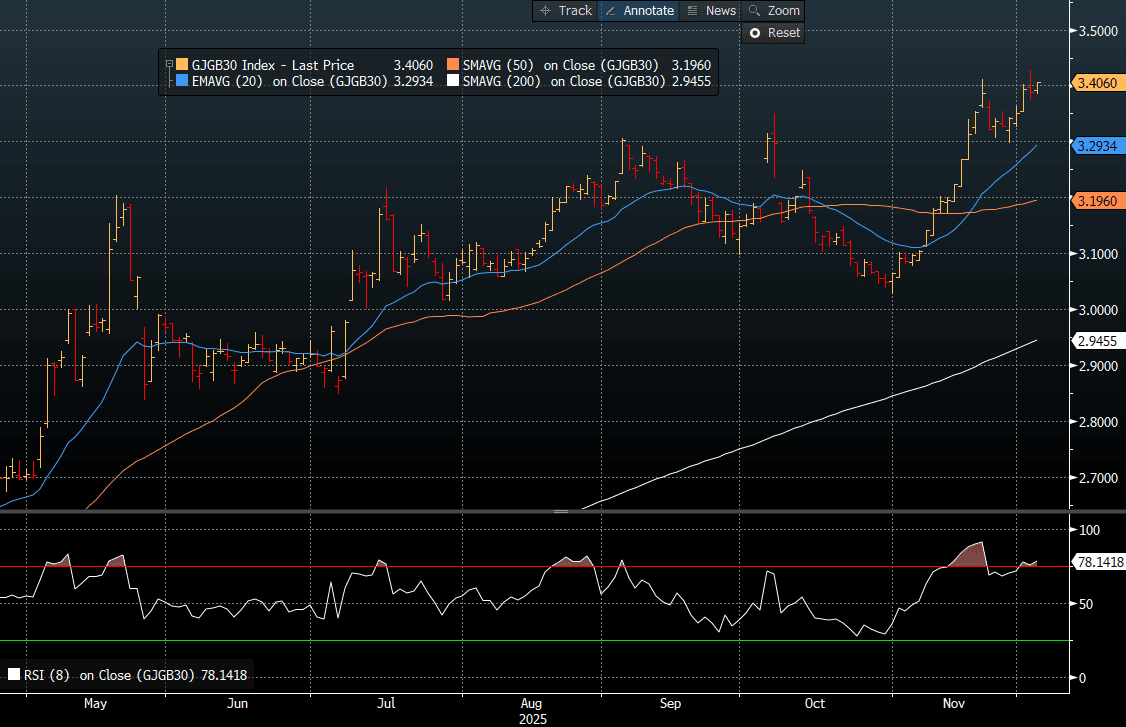
- Cash JGBs are flat to 2bps cheaper across benchmarks, with the 30-year underperforming ahead of tomorrow’s supply. The benchmark 10-year yield is at 1.877% versus the cycle high of 1.886%, set before yesterday's strong 10-year auction.
- Swap rates are flat to 1bp higher.
- Tomorrow, the local calendar will see weekly International Investment Flow data alongside 30-year supply.
Source: Bloomberg Finance LP
AUSSIE BONDS: Q3 Domestic Demand Drives Yields Higher, Hike Priced By Dec-26
ACGBs (YM -6.5 & XM -3.0) have bear-flattened after today’s Q3 GDP data. The market initially rallied on the data headlines but quickly reversed after details revealed underlying strength.
- Q3 GDP was lower than expected at 0.4% q/q & 2.1% y/y after an upwardly revised 0.7% q/q & 2.0% y/y. However, the details were a lot stronger than the headline, with domestic demand rising 1.2% q/q to be up 2.6% y/y, the strongest since Covid-impacted Q1 2022.
- Cash US tsys are ~1bp richer in today’s Asia-Pac session.
- Cash ACGBs are 3-6bps cheaper with the AU-US 10-year yield differential at +56bps, the widest since mid-2022.
- The latest round of ACGB Dec-35 supply saw the weighted average yield print 0.30bp through prevailing mids. However, today’s cover ratio slumped to 2.3550x from 3.4875x.
- The bills strip has sharply steepened, with pricing -1 to -10.
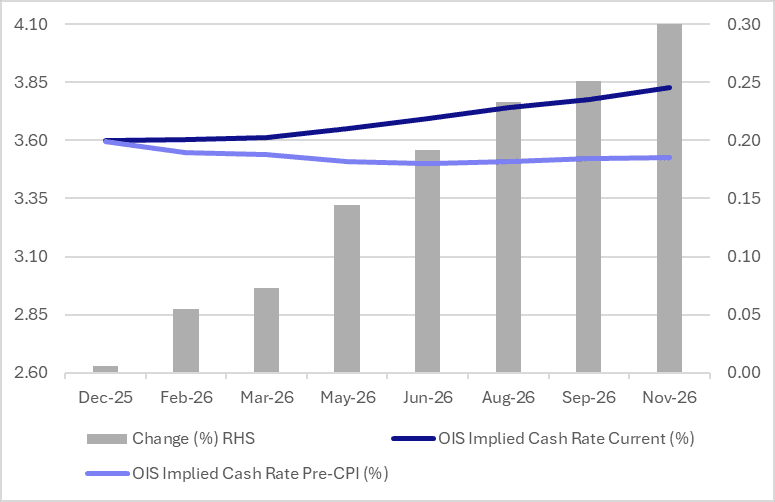
- RBA-dated OIS pricing is 1-7bps firmer for meetings beyond May today. Pricing shows zero probability of a 25bp rate cut in December. More notably, the market has shifted to assign a 96% probability of a 25bp hike by December 2026.
- Tomorrow, the local calendar will see Trade Balance and Household Spending data.
- The AOFM plans to sell A$1000mn of the 2.75% 21 November 2028 bond on Friday.
Figure 1: RBA-Dated OIS – Current Vs. Pre-CPI Monthly
Source: Bloomberg Finance LP / MNI
STIR: RBA-Dated OIS Pricing Shows 84% Chance Of Dec-26 Hike After Q3 GDP
RBA-dated OIS pricing is 1-6bps firmer for meetings beyond May after today’s Q3 GDP data. Pricing initially softened on the data but quickly reversed after details revealed underlying strength.
- Q3 GDP was lower than expected at 0.4% q/q & 2.1% y/y after an upwardly revised 0.7% q/q & 2.0% y/y. However, the details are a lot stronger than the headline, with domestic demand rising 1.2% q/q to be up 2.6% y/y, the strongest since Covid-impacted Q1 2022. The softer GDP print was due to a 0.5pp inventory detraction, the largest since Q2 2023, which may reflect stronger demand driving a drawdown and which may be followed by a rebuild.
- Currently, pricing shows zero probability of a 25bp rate cut in December.
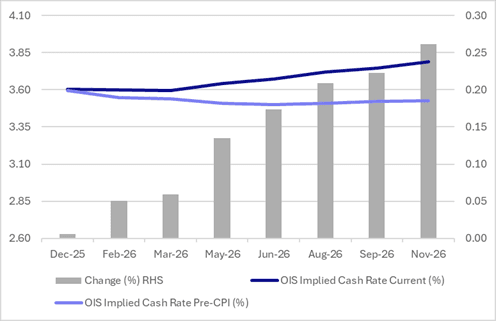
- More notably, the market has shifted to assign an 84% probability of a 25bp hike by December 2026.
- Today’s move extends the recent firming in rate expectations, which began after the stronger-than-expected Monthly CPI on 26 November, to 5–26bps across the curve, led by December 2026.
Figure 1: RBA-Dated OIS – Current Vs. Pre-CPI Monthly
Source: Bloomberg Finance LP / MNI
AUSTRALIA DATA: Gradual Productivity Recovery, ULC Growing Strongly
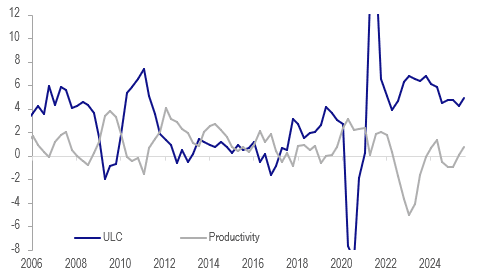
Productivity growth in Australia has been lacklustre for some time and concerning the RBA as it limits the rate of wage growth consistent with its inflation target over the medium-term. It appears to be slowly improving though with a 0.1% q/q rise in Q3, the third straight increase, bringing annual growth to +0.7% up from Q2’s 0.1%. However, RBA Governor Bullock said in November that the Board is concerned about the pace of unit labour cost (ULC) growth and Q3 is likely to have added to these worries.
- Q3 ULC rose 1.3% q/q to be up 4.9% y/y, the highest growth rate since Q2 2024 and historically elevated. It was up 4.2% y/y in Q2. Q3 2024 saw a 0.7% q/q rise in ULC and so it was substantially higher this year.
- Bullock told the Senate Economics Committee on Wednesday that the Q3 rise in inflation may suggest a rebuilding in margins after they were squeezed earlier but still reflects demand strong enough to allow this. Given the strong rise in Q3 ULC, businesses may have had to increase prices.
- Hours worked rose 0.2% q/q in Q3, the seventh straight quarterly increase, but annual growth eased to 1.3% after Q2’s 1.9%. The fact hours are still rising is consistent with the RBA’s view that the labour is a little tight.
Australia productivity vs ULC growth y/y%
Source: MNI - Market News/ABS
AUSTRALIA DATA: Strong Domestic Demand Growth To Keep RBA Cautious
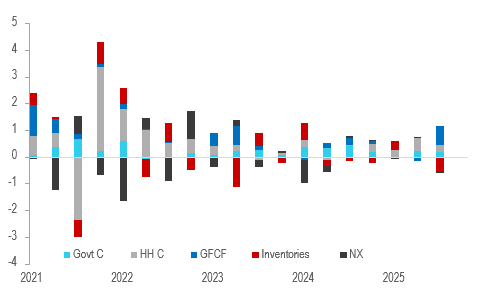
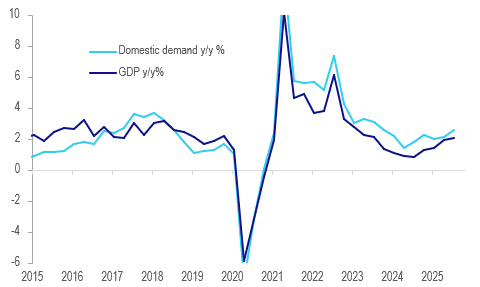
Q3 GDP was lower than expected at 0.4% q/q & 2.1% y/y after an upwardly revised 0.7% q/q & 2.0% y/y. However, the details are a lot stronger than the headline with domestic demand rising 1.2% q/q to be up 2.6% y/y, the strongest since Covid-impacted Q1 2022. The softer GDP print was due to a 0.5pp inventory detraction, largest since Q2 2023, which may reflect stronger demand driving a drawdown and which may be followed by a rebuild.
Australia contributions to q/q GDP pp
Source: MNI - Market News/ABS
- In November, the RBA forecast Q4 GDP growth of 2.0% y/y. Excluding revisions, this would require a 0.5% q/q rise and so growth is developing as it expects. However, it has been around the bank’s estimate of trend and today Governor Bullock said that while the output gap size is uncertain, it probably has closed, which increases risks to inflation from stronger demand. Thus, rates are likely on hold for some time and domestic demand strength poses an upside risk to inflation.
- Private consumption rose 0.5% q/q, concentrated in essential spending, and contributed 0.3pp to quarter GDP. The savings rate rose 0.4pp to 6.4%. A 1.7% q/q increase in disposable income supported expenditure.
- Public consumption rose 0.8% q/q contributing 0.2pp.
- Investment was strong up 3.0% q/q contributing 0.7pp with 0.2pp from the public sector and 0.3pp from private machinery & equipment, which rose 7.6% q/q. Data centre development was a major driver.
- Strong import growth is consistent with stronger domestic demand and especially capex. Imports were up 1.5% q/q & 4.2% y/y after Q2’s 2.5% y/y. Exports were also solid at +1.0% & 3.6% but not enough to prevent net exports detracting 0.1pp.
- The statistical discrepancy made a -0.1pp contribution after Q2’s +0.2pp.
- GDP per capita was flat but up 0.4% y/y.
Australia GDP vs domestic demand y/y%
Source: MNI - Market News/ABS
RBA Says Still Needs To Work On Bringing Inflation “Sustainably” To Target
RBA Governor Bullock and Assistant Governor (Financial Markets) Kent have appeared before the Senate Economics Committee. There was little added to the November meeting’s message that the persistence of Q3 inflation is being monitored but the RBA expects the quarterly CPI changes to moderate over coming quarters. Bullock did note that if the rise proves more persistent then it would signal higher demand pressures and that there would be implications for monetary policy.
- The AUD OIS market has around a 50% chance of a rate hike priced in by the August 2026 meeting.
- Bullock admitted that inflation is “not yet sustainably” within the band and that the Board needs to keep “working on this”. While inflation has been above the 2.5% mid-point for a prolonged time, projections that it will be around that point within the forecast horizon and anchored inflation expectations reassure the bank. The risk is that they could become unanchored the longer it takes inflation to return to 2.5%.
- She noted that the Q3 rise in inflation may suggest a rebuilding in margins after they were squeezed earlier but still reflects demand strong enough to allow this.
- The unemployment rate at 4.3% is “a little bit below NAIRU”, a concept that is difficult to estimate. The underemployment rate also signals that the labour market remains a little tight.
- The RBA sees policy as well positioned to respond to overseas risks including a resumption of trade wars, geopolitical tensions, rising government budget deficits, elevated asset prices and China’s economy.
- Risks from China stem from its ongoing property sector problems, soft domestic demand growth and a resumption of its trade war with the US or other countries introducing trade barriers to cheap imports from China.
BONDS: NZGBS: Partial Unwind Of Post-RBNZ Sell-Off
NZGBs closed showing a bull-flattener, with benchmark yields 4-7bps lower. Nevertheless, yields remain 12-25bps higher than last week’s pre-RBNZ levels.
- On a relative basis versus its $-bloc counterparts, NZGBs also had a good day, with the NZ-US and NZ-AU 10-year yield differentials 6bps and 10bps lower, respectively.
- NZ commodity export prices fell 1.6% m/m in November versus -0.3% in October.
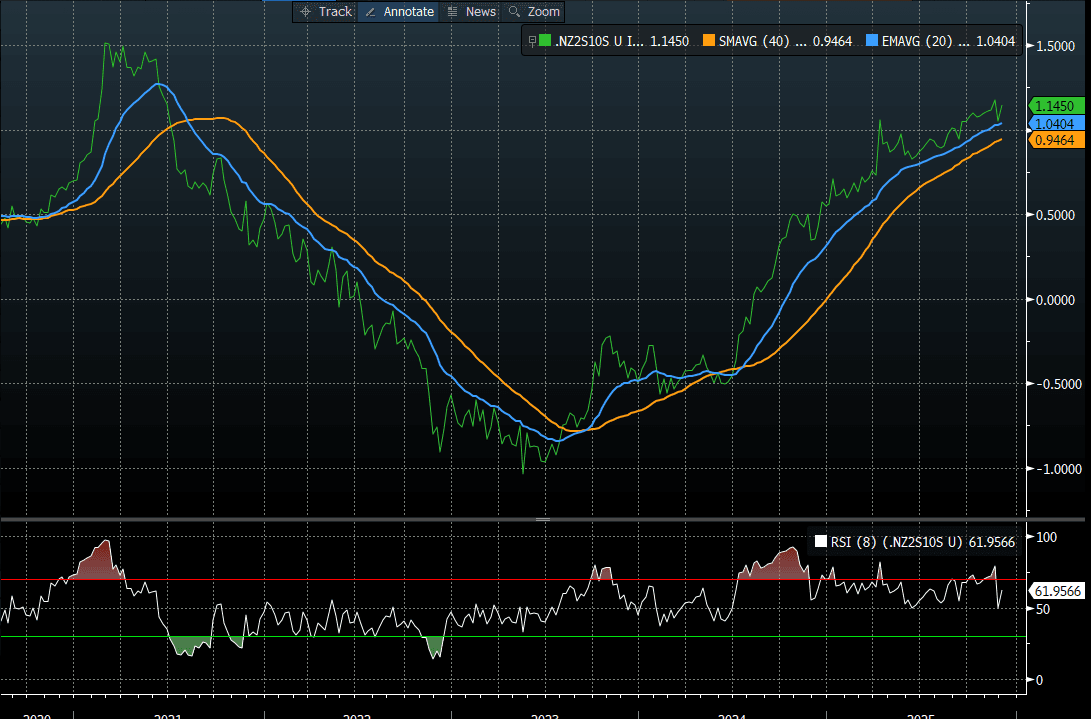
- Swap rates closed 2-7bps lower, with the 2s10s curve flatter. Nonetheless, the curve remains within striking distance of the 2021 peak (see chart).
- RBNZ-dated OIS pricing closed slightly softer across meetings. 2bps of easing is priced for February, while November 2026 assigns 31bps of tightening.
- Tomorrow, the local calendar will see Cotality Home Values and Volume of All Buildings data alongside NZ Government 4-Month Financial Statements.
- The NZ Treasury also plans to sell NZ$150mn of the 4.50% May-30 bond, NZ$225mn of the 4.50% May-35 bond and NZ$75mn of the 2.75% May-51 bond.
Bloomberg Finance LP
FOREX: USD - BBDXY Capped Toward 1220, Trades Heavy In Asia
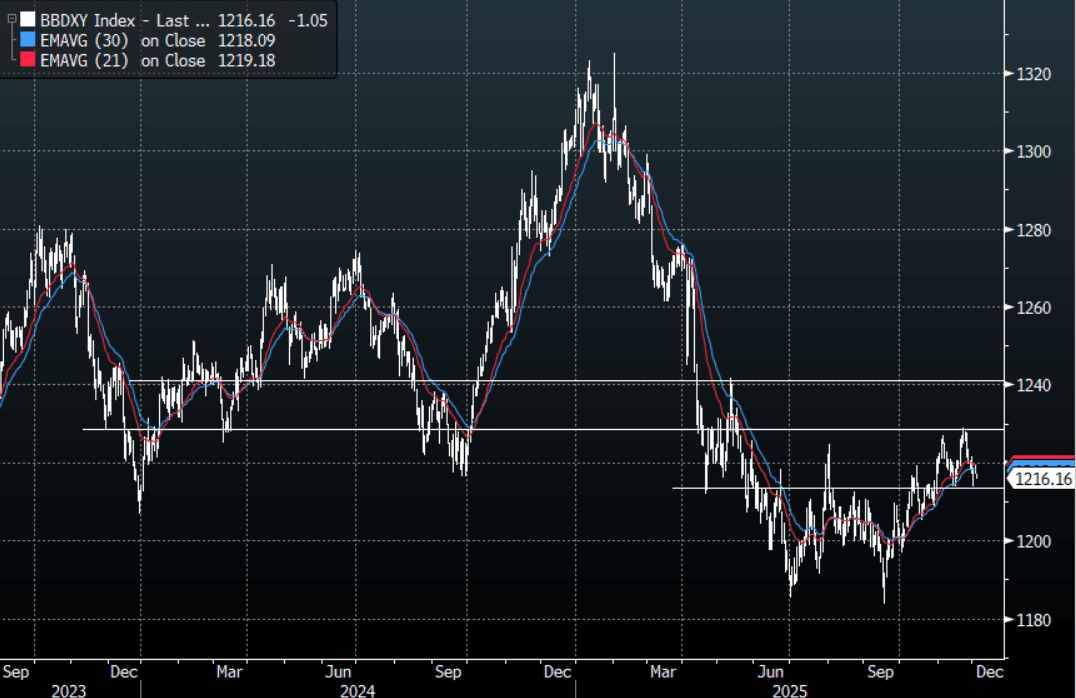
The BBDXY has had a range today of 1216.02 - 1217.21 in the Asia-Pac session; it is currently trading around 1216, -0.10%. The USD has traded heavily all through the Asian session. The market seems confident Kevin Hassett will be announced as the new Fed Chair, this obviously adds headwinds to the USD from a rates perspective. The “sword of Damocles” hanging over the USD is also the Supreme Court's decision on the legality of Trump’s tariffs, this too could be announced toward the end of the year as the case has been expedited on national security reasons. On the day look for resistance again back towards the 1218-1221 area where sellers should remerge initially, a move back below 1214 which has been decent support recently could signal a deeper pullback towards 1205-1208 initially.
- EUR/USD - Asian range 1.1621 - 1.1638, Asia is currently trading 1.1640. The pair has consolidated above the 1.1600 area overnight. On the day as the market looks for more US cuts the USD should remain heavy. I suspect dips back toward 1.1600-20 could be supported initially looking to test the 1.1655-75 area later, a break of which could signal the beginning of some upward momentum again.
- GBP/USD - Asian range 1.3205 - 1.3232, Asia is currently dealing around 1.3230. The pair found decent demand sub 1.3200. I remain skewed toward shorts but I feel this move does signal the need to be patient. On the day GBP needs to hold above the 1.3180-1.3200 area which should continue to be supported, while above here look for the market to test the 1.3270-90 area initially, a break of which opens up a move toward 1.3350-70 where I suspect sellers could return.
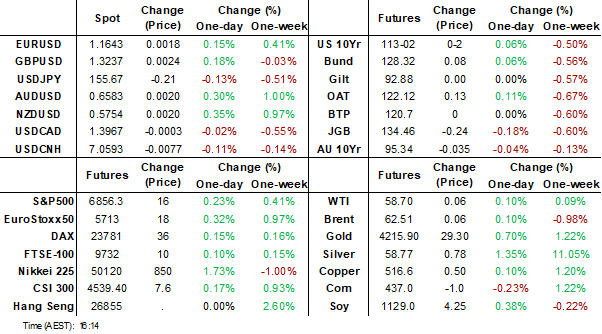
- Cross asset : SPX +0.20%, Gold $4225, US 10-Year 4.076%, BBDXY 1216, Crude Oil $58.63
- Data/Events : France HCOB France Services PMI, Spain HCOB Spain Services PMI, EZ HCOB Eurozone Services PMI/ PPI, Italy HCOB Italy Services PMI, Germany HCOB Germany Services PMI
Fig 1: BBDXY Spot Daily Chart
Source: MNI - Market News/Bloomberg Finance L.P
JPY: USD/JPY - Drifts Lower As The USD Trades Heavy
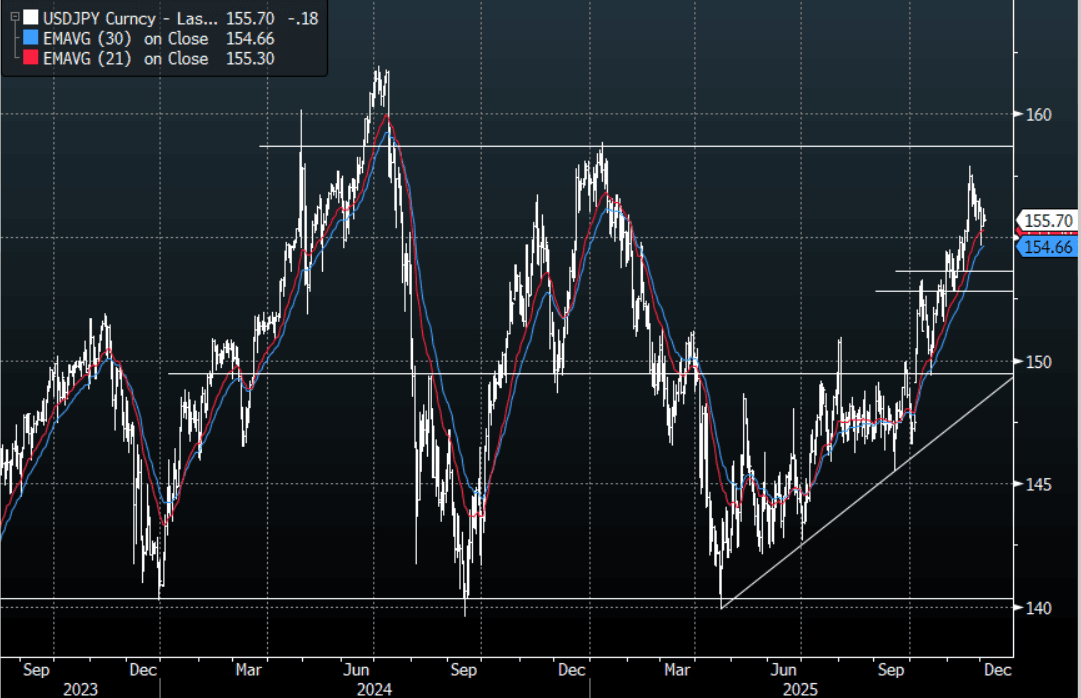
The USD/JPY range today has been 155.61 - 155.91 in the Asia-Pac session, it is currently trading around 155.70, -0.10%. The pair has drifted lower as the USD trades heavy across the board. The market is pricing in the fact that the Yen move looks like it could force the BOJ into action in December and a possible Hassett appointment brings more U.S. cuts into focus. This should keep the move that looked about to go parabolic a little more contained in the short-term but I suspect the market will still look for opportunities to express a long USD. Technically USD/JPY continues to look like it wants to test higher with the first big support back toward the 153-155 area which should see buyers reemerge. On the day I suspect we will continue to consolidate within a wider 155.00-156.50 range, with risk turning around its poor start to the week a short Yen might best be expressed in the crosses.
- (Dow Jones) - "Japanese government bond yields are higher as expectations for a near-term rate increase by the Bank of Japan continue. The BOJ's policy board is scheduled to meet on Dec. 18-19 for a final rate decision for the year. To gauge the economy's strength, investors will be focusing on economic indicators, including household spending data due Friday."
- MNI POLICY: Ueda Sharpens Dec Rate Hike, Risks Credibility. A hold at the Bank of Japan’s Dec. 18–19 meeting would be inconsistent with the bank’s recent market communications and would undermine its credibility, following Governor Kazuo Ueda’s comments on Monday that strongly indicated policymakers are set to raise the 0.5% rate this month, MNI understands.
- Options : Close significant option expiries for NY cut, based on DTCC data: 155.50($1.27b). Upcoming Close Strikes : 153.00($1.2b Dec 4), 155.00($1.4b Dec 5), 156.00($1.14b Dec 8 ) - BBG.
- The USD/JPY Average True Range(ATR) for the last 10 Trading days: 88 Points
Fig 1 : USD/JPY Spot Daily Chart
Source: MNI - Market News/Bloomberg Finance L.P
AUD/USD - GDP Data Not So Bad Sees AUD Bounce Back, Testing 0.6580
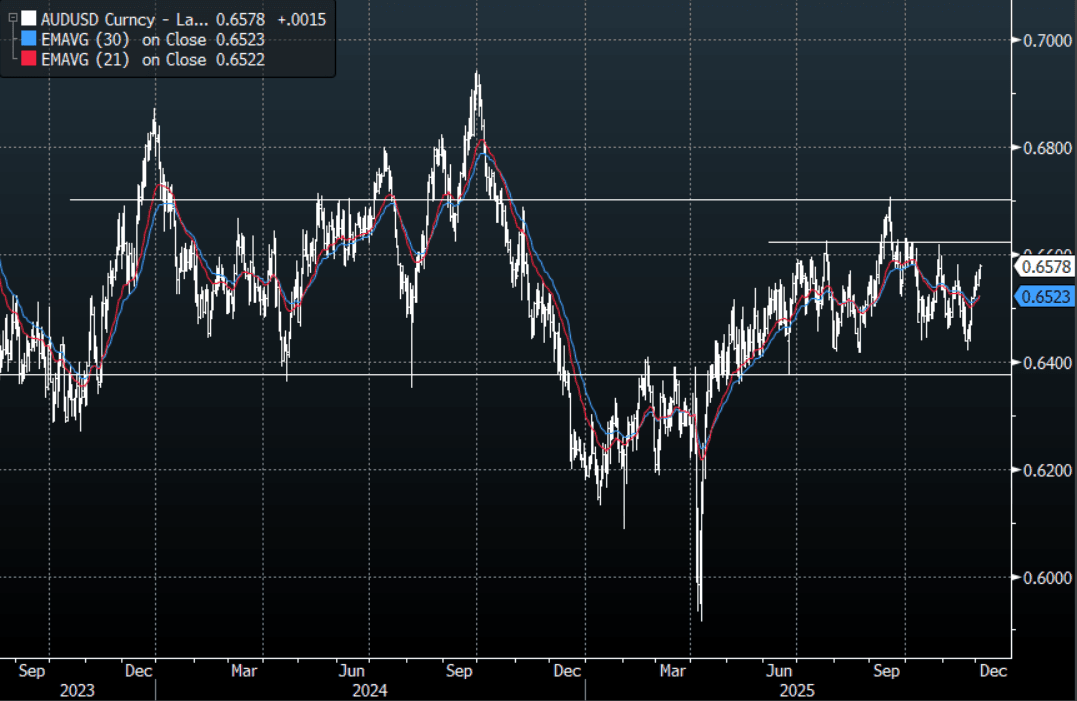
The AUD/USD has had a range today of 0.6553 - 0.6578 in the Asia- Pac session, it is currently trading around 0.6575, +0.20%. The AUD/USD had a brief look lower on the immediate GDP print back quickly recovered once the details showed underlying strength. The AUD has not backed off in all the noise and is pressing the pivot around 0.6580 within its wider 0.6350-0.6700 range. On the day, it feels like there is an air of inevitability around the AUD pushing above 0.6580 so I suspect dips back toward the 0.6535-0.6555 area could now be supported. A clear break above 0.6580 and the AUD could build some momentum looking to once again test the top end of its recent range, first target 0.6630 and then 0.6700.
- MNI AU - Strong Domestic Demand Growth To Keep RBA Cautious. Q3 GDP was lower than expected at 0.4% q/q & 2.1% y/y after an upwardly revised 0.7% q/q & 2.0% y/y. However, the details are a lot stronger than the headline with domestic demand rising 1.2% q/q to be up 2.6% y/y, the strongest since Covid-impacted Q1 2022. The softer GDP print was due to a 0.5pp inventory detraction, largest since Q2 2023, which may reflect stronger demand driving a drawdown and which may be followed by a rebuild.
- MNI AU - RBA-dated OIS pricing is 1-7bps firmer for meetings beyond May today. Currently, pricing shows zero probability of a 25bp rate cut in December. More notable, the market has shifted to assign a 96% probability of a 25bp hike by December 2026.
- Options : Closest significant option expiries for NY cut, based on DTCC data: none. Upcoming Close Strikes : 0.6475(AUD814m Dec 8), 0.6490(AUD710m Dec 4), 0.6500(AUD1.11b Dec 5) - BBG
- The AUD/USD Average True Range for the last 10 Trading days: 37 Points
Fig 1: AUD/USD spot Daily Chart
Source: MNI - Market News/Bloomberg Finance L.P
NZD/USD - Drifts Sideways Above 0.5700, Eyes 0.5760-70
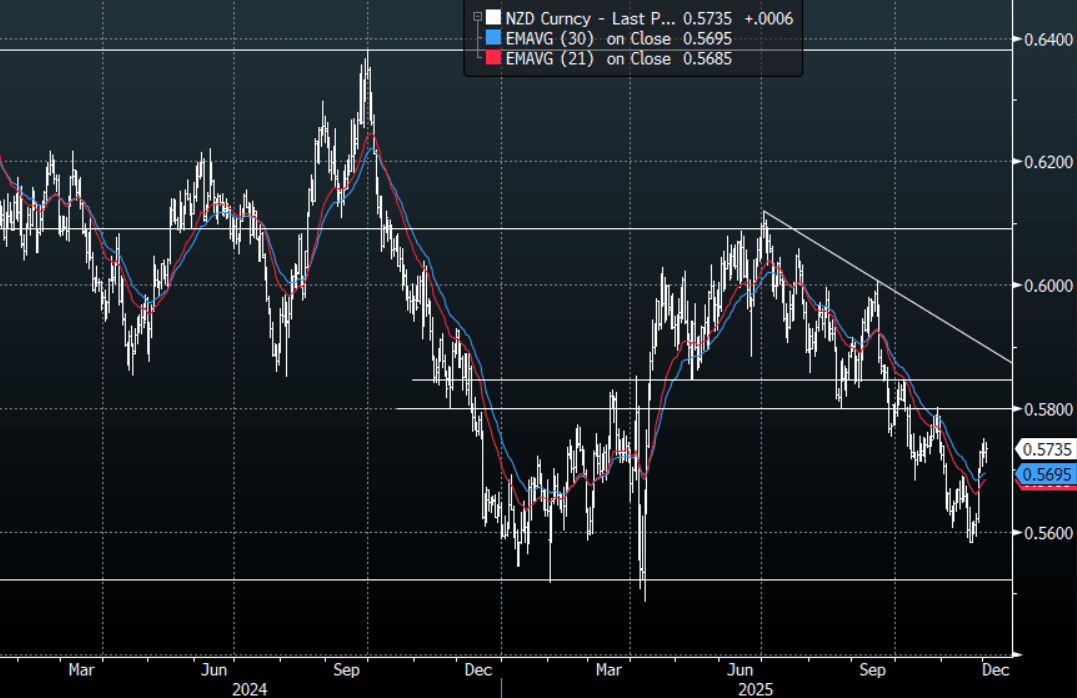
The NZD/USD had a range overnight of 0.5725 - 0.5752, Asia is trading around 0.5735. The NZD continues to trade sideways consolidating just below the 0.5750 area, risk has managed to turn the poor start to the week around and Crypto has eventually seen buyers on the dip. Positioning could still be an issue in the short term. On the day it looks as though the NZD could remain well supported on dips, a sustained push back above 0.5760-70 should then potentially see the focus turn back toward the more important 0.5800-50 resistance. On the day support looks to be back toward the 0.5690-0.5710 area.
- Bloomberg: “Whole Milk Powder Average Price Falls to $3,364 a Ton from $3,452 at the previous auction, according to the GlobalDairyTrade website. GDT's weighted average price for all milk products was $3,507 a ton.”
- Options : Closest significant option expiries for NY cut, based on DTCC data: 0.5575(NZD547m), 0.5730(NZD621m). Upcoming Close Strikes : 0.5670(NZD382m Dec 8), 0.5700(NZD332m Dec 5), 0.5730(NZD692m Dec 8 ) - BBG
- The NZD/USD Average True Range for the last 10 Trading days: 42 Points
- Data/Event: ANZ Commodity Price, Cotality Home Value
Fig 1: NZD/USD Spot Daily Chart
Source: MNI - Market News/Bloomberg Finance L.P
ASIA STOCKS: Regional Bourses Mixed; China Lags Tech Rally Again
Whilst US indexes finished modestly up overnight, it wasn't enough to spur regional investor appetite with a mixed day across the region for major bourses. With most key AI tech stocks providing gains, tech heavy bourses were up again today with the NIKKEI and KOSPI leading. BITCOIN has recovered all of Monday's losses following news that China is cracking down on crypto speculators and that helped feed into better risk sentiment in general. China's major regional bourses are down and continue to lag the tech led boom elsewhere, with some market commentators suggesting that Chinese AI / tech names remain undervalued relatively to SK and JN names.
- The NIKKEI is up +1.5% to break above the 50,000 level to be 4.5% below the October high whilst the KOSPI was up again, by 1.2% today to break above the 4,000 level and close in on the early November high of 4,221
- China's major bourses are all lagging, with the Hang Seng the worst performer, down -0.95%. With Shanghai Comp and the CSI 300 doing little but trending weaker, it was down to Shenzhen to follow lower, dropping -0.35%
- The TAIEX is up +0.60% with TSMC up over 1% as US President Trump signs bill to deepen US-Taiwan ties .
- Having closed at a new high of 26,215 on November 27, the NIFTY 50 has fallen moderately each day since and is down -0.4% today at the open ahead of this week's RBI decision and the currency under pressure again.
- Jakarta and KL are moving in opposite directions with the JCI up +0.25% whilst the FTSE Malay KLCI is down -0.44% taking out some of its gains to start December.
OIL: Crude Little Changed As Waits For US EIA Data Out Later
Oil prices are little changed today ahead of the US EIA fuel inventory and demand data later. The industry figures showed crude and product builds. The market is also monitoring US-Ukraine-Russia developments closely in case a peace deal is close which could see an easing of restrictions on Russia at a time of excess global oil supply. It doesn’t seem worried at this stage regarding Russia’s threat to strike vessels of countries supporting Ukraine.
- WTI is off its intraday low of $58.37/bbl to be steady at $58.66/bbl, while Brent is slightly higher at $62.49 after falling to $62.18.
- US Secretary of State Rubio said that talks are currently at the point of trying to work out what Ukraine can accept and to bridge the divide between it and Russia. Russia said that President Putin agreed with many points in the revised plan and the territory issue was discussed. The US is now going back to the Ukrainians.
- Venezuela, the world’s 17th largest oil exporter in 2023 (IEA), remains an issue with the US saying it will continue targeting drug running vessels and Rubio saying that negotiating a deal would be difficult as Venezuela’s Maduro has “broken every deal he’s ever made”.
- Bloomberg reported a US crude inventory build of 2.48mn barrels last week, according to people familiar with the API data. There were also product builds with gasoline up 3.1mn and distillate 2.88mn. The official EIA data is out Wednesday.
- Later US November ADP employment, delayed September trade prices/IP and November services ISM/PMI print. European November services/composite PMIs and euro area October PPI are out. ECB President Lagarde speaks before the European parliament and ECB’s Lane and BoE’s Mann also make appearances.
PRECIOUS METALS: Dovish Fed Outlook Driving Prices Up, Silver Reaches Record
Silver has reached another record high during Wednesday’s APAC trading continuing to be driven by expectations of a Fed December rate cut, a dovish new Fed Chair in 2026 and a tight physical market. The rally has encouraged speculators into the market and it is now flashing overbought. The metal is up 0.6% to $58.84/oz after reaching $58.947, above resistance at $59.563. Attention is focused on resistance at $60.00.
- Gold is also higher today rising 0.4% to $4221.1 off the intraday peak of $4228.85.
- Bloomberg is reporting a 200t inflow into silver ETFs on Tuesday to their highest since 2022.
- There is growing conjecture that President Trump will choose his National Economic Council Director Bessent as the next Fed Chair, as he is expected to be more dovish. This is adding support to non-yield bearing assets, such as precious metals.
- The US dollar is softer (BBDXY -0.1%) and yields slightly lower. Equities are mixed with the S&P e-mini up 0.2% and Nikkei +1.5% but Hang Seng down 1.0% and CSI flat. Oil prices are little changed with WTI at $58.66/bbl. Copper is 0.7% higher.
- Later US November ADP employment, delayed September trade prices/IP and November services ISM/PMI print. European November services/composite PMIs and euro area October PPI are out. The ECB President Lagarde speaks before the European parliament and ECB’s Lane and BoE’s Mann also make appearances.
MNI RBI Preview: RBI to Cut, Signal End to Easing
Download the Preview Here
Despite market pricing suggesting a cut is not a foregone conclusion, we forecast the RBI to cut rates at its last meeting of the year, whilst signaling and end to the easing cycle due to:
- Inflation at cyclical lows and risking deflation.
- RBI not wanting inflation to undershoot their FY forecast further.
- Tailwinds showing up in the October data.
- Governor has given a steer on rates, possibly to allow currency markets to adjust.
CHINA: PMI Services Moderates Again
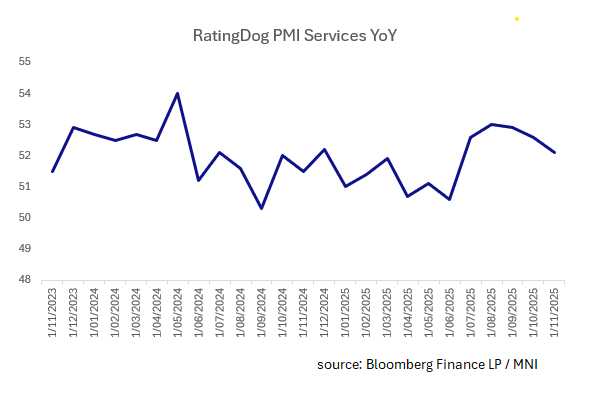
- After declining in October, the RatingDog PMI Services fell again in November.
- November's reading takes the index to mid-year levels.
- Within the release some positives were an uptick in employment to 49.2 from 49, yet remains in contraction for the fourth consecutive month.
- Prices charged were up relative to last month.
- When coupled with the RatingDog PMI Manufacturing, the PMI Composite fell to 51.2, the lowest since July.
SOUTH KOREA: 3Q GDP Surprises to the Upside
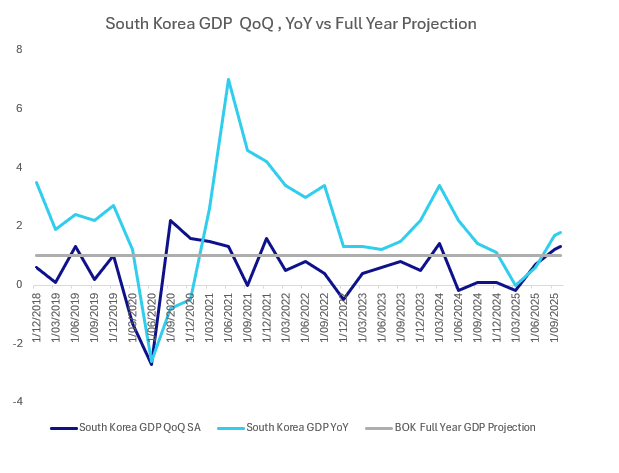
- Korea's 3Q GDP rose +1.8%, up from +1.7% in the second quarter and ahead of expectations.
- The QoQ result was up also, reaching +1.3% from +1.2% prior.
- It is clear that there is some positive tailwinds for the Korean economy as the AI / Tech led boom is increasing demand for Korea's highly regard chips, which is feeding improvements in exports.
- The KOSPI's returns have supported the consumer who was already buoyed by lower rates and real estate prices coupled with a fiscal expansion by the Lee Government.
- As always, headwinds remain as the full impact of the US tariffs (estimated to shave 0.4-0.5% off GDP) and a weak won feeding through to import costs.
- The BOK has upped their fully ear 2025 GDP forecast to 1.0% recently as they continued with rates on hold, and today's GDP remains supportive of that neutral outlook for rates in the near terms.
UP TODAY (TIMES GMT/LOCAL)
| Date | GMT/Local | Impact | Country | Event |
| 03/12/2025 | 0700/0200 | * |  TR TR | Turkey CPI |
| 03/12/2025 | 0730/0830 | *** |  CH CH | CPI |
| 03/12/2025 | 0815/0915 | ** |  ES ES | S&P Global Services PMI (f) |
| 03/12/2025 | 0815/0915 | ** | ES | S&P Global Composite PMI (final) |
| 03/12/2025 | 0845/0945 | ** |  IT IT | S&P Global Services PMI (f) |
| 03/12/2025 | 0845/0945 | ** | IT | S&P Global Composite PMI (final) |
| 03/12/2025 | 0850/0950 | ** |  FR FR | S&P Global Services PMI (f) |
| 03/12/2025 | 0850/0950 | ** | FR | S&P Global Composite PMI (final) |
| 03/12/2025 | 0855/0955 | ** |  DE DE | S&P Global Services PMI (f) |
| 03/12/2025 | 0855/0955 | ** | DE | S&P Global Composite PMI (final) |
| 03/12/2025 | 0900/1000 | ** |  EU EU | S&P Global Services PMI (f) |
| 03/12/2025 | 0900/1000 | ** | EU | S&P Global Composite PMI (final) |
| 03/12/2025 | 0930/0930 | ** |  GB GB | S&P Global Services PMI (Final) |
| 03/12/2025 | 0930/0930 | *** | GB | S&P Global/ CIPS UK Final Composite PMI |
| 03/12/2025 | 1000/1100 | ** | EU | EZ PPI |
| 03/12/2025 | 1000/1000 | ** | GB | Gilt Outright Auction Result |
| 03/12/2025 | 1030/1130 | EU | ECB Lane Keynote at Banca d'Italia Workshop on Exchange Rates | |
| 03/12/2025 | 1200/0700 | ** |  US US | MBA Weekly Applications Index |
| 03/12/2025 | 1315/0815 | *** | US | ADP Employment Report |
| 03/12/2025 | 1330/0830 | ** | US | Import/Export Price Index |
| 03/12/2025 | 1330/1430 | EU | ECB Lagarde Statement at ECON Hearing | |
| 03/12/2025 | 1415/0915 | *** | US | Industrial Production |
| 03/12/2025 | 1445/0945 | *** | US | S&P Global Services Index (final) |
| 03/12/2025 | 1445/0945 | *** | US | S&P Global US Final Composite PMI |
| 03/12/2025 | 1500/1000 | *** | US | ISM Non-Manufacturing Index |
| 03/12/2025 | 1530/1030 | ** | US | DOE Weekly Crude Oil Stocks |
| 03/12/2025 | 1530/1030 | ** | US | US DOE Petroleum Supply |
| 03/12/2025 | 1530/1630 | EU | ECB Lagarde Statement at ECON Hearing (as ESRB Chair) | |
| 03/12/2025 | 1700/1700 | GB | BOE Mann in Panel on Reserve Currencies | |
| 04/12/2025 | 0030/1130 | ** |  AU AU | Trade Balance |
| 04/12/2025 | 0700/0800 | *** |  SE SE | Flash Inflation Report |
| 04/12/2025 | 0700/0800 | *** | SE | Flash Inflation Report |
| 04/12/2025 | 0800/0900 | ** | CH | Unemployment |
| 04/12/2025 | 0830/0930 | ** | EU | S&P Global Final Eurozone Construction PMI |
| 04/12/2025 | 0930/0930 | GB | BOE Decision Maker Panel Data | |
| 04/12/2025 | 0930/0930 | ** | GB | S&P Global/CIPS Construction PMI |
| 04/12/2025 | 1000/1100 | ** | EU | EZ Retail Sales |
| 04/12/2025 | 1245/1245 | GB | BOE Mann Panel at European and Global Issues Conference |


