MNI EUROPEAN OPEN: Japan Equities Up On US Trade News
EXECUTIVE SUMMARY
- TRUMP NAMES MIRAN TO FILL KUGLER’S FED BOARD SEAT - MNI BRIEF
- WALLER EMERGES AS FAVORITE FOR FED CHAIR AMONG TRUMP TEAM - BBG
- A FORMER BOJ OFFICIAL SHARES HIS POLICY RATE OUTLOOK - MNI INTERVIEW
- BOJ OPINIONS: PRICE RISK; MAY EXIT FROM WAITING MODE - MNI
- JAPAN'S AKAZAWA: US TO END TARIFF STACKING AND CUT CAR LEVIES - BBG
- ADVISORS SHARE VIEWS ON CHINA'S NEW BOND INTEREST INCOME TAX - MNI
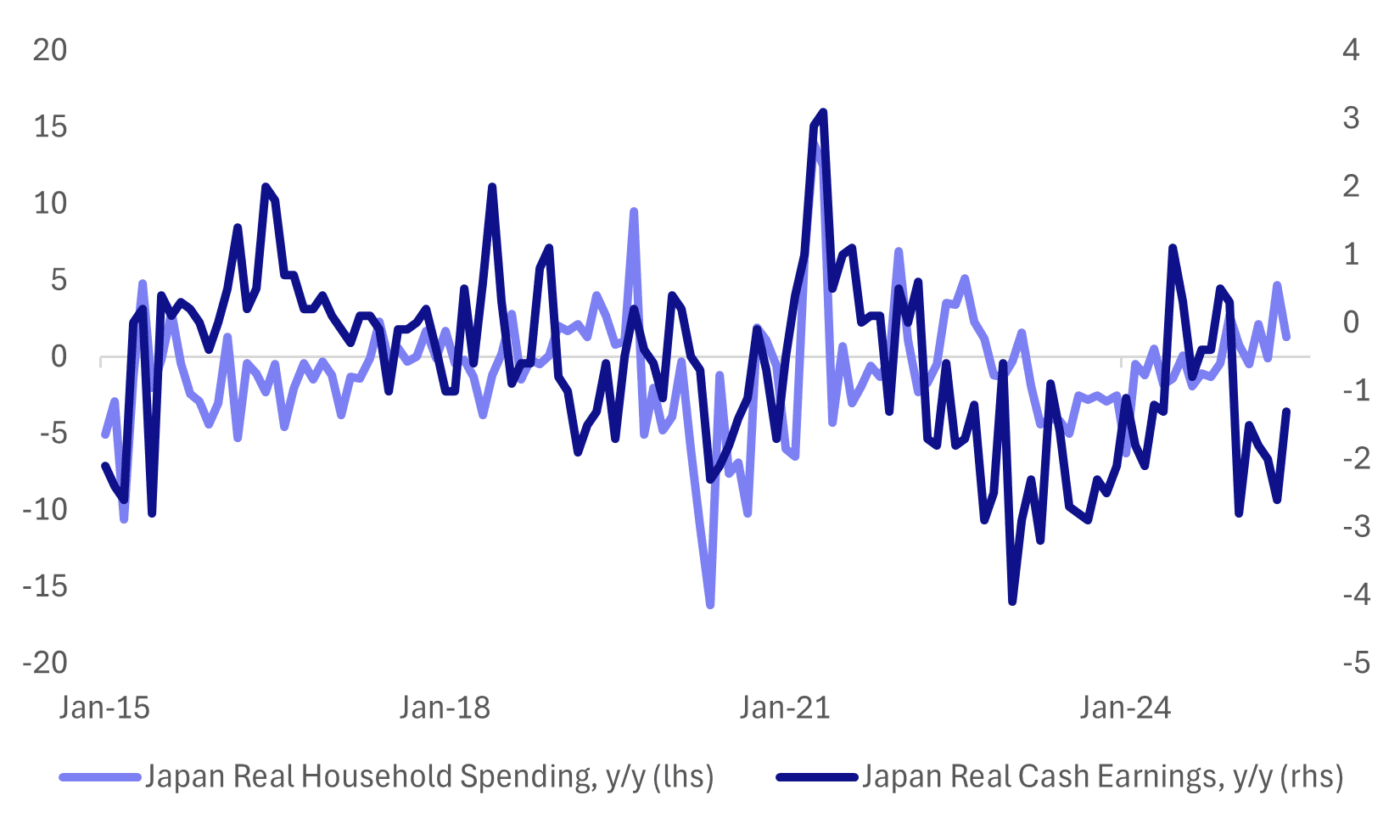
Fig 1: Japan Real Household Spending & Earning Trends - Y/Y
Source: Bloomberg Finance L.P./MNI
UK
BOE (MNI BOE WATCH): The Bank of England Monetary Policy Committee delivered the widely anticipated 25 basis point rate cut at its August meeting but only after an unprecedented second vote and by a narrower margin than any analyst had forecast publicly.
ENERGY (BBG): "The UK confirmed plans to offer discounts on energy bills to people living near new electricity pylons as it seeks to ease opposition to essential grid upgrades."
EU
EU/US (MNI): The credibility of the Brussels pledge to invest USD600bn in the U.S. over the remainder of the Trump presidency is being called into question by EU economic experts.
RUSSIA/US (BBG): "President Donald Trump said he’d be willing to meet with Vladimir Putin, even if the Russian leader hadn’t yet agreed to also sit down with Ukrainian President Volodymyr Zelenskiy.
SWEDEN (BBG): "Sweden’s apartment prices experienced their largest monthly fall in almost three years, adding to signs that households in the largest Nordic nation are turning more cautious."
US
FED (MNI BRIEF): President Donald Trump said Thursday he would name the chair of his Council of Economic Advisers, Stephen Miran, to the Fed board seat vacated by Governor Adriana Kugler last week.
FED (BBG): “Federal Reserve Governor Christopher Waller is emerging as a top candidate to serve as the central bank’s chair among President Donald Trump’s advisers as they look for a replacement for Jerome Powell, according to people familiar with the matter.”
FED (MNI INTERVIEW): The Trump administration is unlikely to score any major reforms of the Federal Reserve because there is no clear effort to pressure Capitol Hill for the kind of legislative changes that would be needed, Gary Richardson, the Fed system's first official historian, told MNI.
INFLATION (MNI BRIEF): The New York Fed's median measures of year-ahead and five-year-ahead consumer inflation expectations ticked up in July, according to the bank's Survey of Consumer Expectations.
CORPORATE (RTRS): “U.S. President Donald Trump on Thursday demanded the immediate resignation of new Intel CEO Lip-Bu Tan, calling him "highly conflicted" due to his ties to Chinese firms and raising doubts about plans to turn around the struggling American chip icon.”
OTHER
JAPAN (MNI INTERVIEW): A former BOJ official shares his policy rate outlook.
JAPAN (MNI): Some Bank of Japan board members acknowledged upside risks to prices but saw no need to rush a rate hike at the July 30-31 meeting, the summary of opinions showed Friday.”
JAPAN (BBG): "The US agreed to end so-called stacking on universal tariffs and cut car tariffs at the same time, Japan’s top trade negotiator Ryosei Akazawa says in Washington."
MIDDLE EAST (RTRS): “Israel's political-security cabinet approved a plan to take control of Gaza City early on Friday, hours after Prime Minister Benjamin Netanyahu said Israel intended to take military control of the entire strip despite intensifying criticism at home and abroad over the devastating almost two-year-old war.
GOLD (FT/BBG): "The US has put tariffs on imports of one-kilogram gold bars, according to the Financial Times, threatening more turmoil in the global bullion market and dealing another trade blow to Switzerland."
CHINA
BONDS (MNI): Advisors share their view on China's new bond interest income tax. On MNI Policy MainWire now, for more details please contact sales@marketnews.com.
MACRO POLICIES (MOFCOM): "China’s macroeconomic policies in H2 will continue to exert force when appropriate while maintaining continuity and stability, a statement from the Ministry of Finance said, following S&P Global Ratings decision to maintain the nation's sovereign credit rating at “A+” with a “stable” outlook."
PROPERTY (SECURITIES DAILY): "Local governments across China will focus on stabilizing the real estate market and advancing urban renewal initiatives in the second half of the year, Securities Daily reported Friday."
SPECIAL BOND ISSUANCE (YICAI): "Local governments are expected to complete issuance of this year’s CNY4.4 trillion in new special bonds by end-October, experts told Yicai."
MNI: PBOC Net Drains CNY4 Bln via OMO Friday
MNI (BEIJING) - The People's Bank of China (PBOC) conducted CNY122 billion via 7-day reverse repos, with the rate unchanged at 1.40%. The operation led to a net drain of CNY4 billion after offsetting maturities of CNY126 billion today, according to Wind Information.
- The seven-day weighted average interbank repo rate for depository institutions (DR007) fell to 1.4100% at 09:31 am local time from the close of 1.4515% on Thursday.
- The CFETS-NEX money-market sentiment index, measuring interbank money-market liquidity, closed at 47 on Thursday, compared with the close of 48 on Wednesday. A higher reading points to tighter liquidity condition, with 50 representing an equilibrium.
MNI: PBOC Sets Yuan Parity Higher At 7.1382 Fri; -0.41% Y/Y
MNI (BEIJING) - The People's Bank of China (PBOC) set the dollar-yuan central parity rate higher at 7.1382 on Friday, compared with 7.1345 set on Thursday. The fixing was estimated at 7.1774 by Bloomberg survey today.
MARKET DATA
JAPAN JUNE HOUSEHOLD SPENDING Y/Y1.3%; MEDIAN 2.7%; PRIOR 4.7%
JAPAN JUNE TRADE BALANCE ¥469.6BN; MEDIAN ¥402.1BN; PRIOR -¥522.3BN
JAPAN JUNE BOP CURRENT ACCOUNT ADJUSTE ¥2397.9BN; MEDIAN ¥2750.8BN; PRIOR ¥2818.1BN
JAPAN JUL BANK LENDING INCL TRUSTS Y/Y 3.2%; PRIOR 2.7%
JAPAN JULY ECO WATCHER SURVEY CURRENT 45.2; MEDIAN 45.5; PRIOR 45.0
JAPAN JULY ECO WATCHER SURVEY OUTLOOK 47.3; MEDIAN 46.4; PRIOR 45.9
MARKETS
US TSYS: Asia Wrap - Yields End Mixed, The Curve Flattens
The TYU5 range has been 112-01+ to 112-04 during the Asia-Pacific session. It last changed hands at 112-02+, down 0-00+ from the previous close.
- The US 2-year yield has edged higher trading around 3.736%, up 0.01 from its close.
- The US 10-year yield has edged lower trading around 4.244%, down 0.01 from its close.
- This has seen the yield curve flatten in Asia - 2s10s -1.00 at 50.601, 5s30s -0.98 at 102.413.
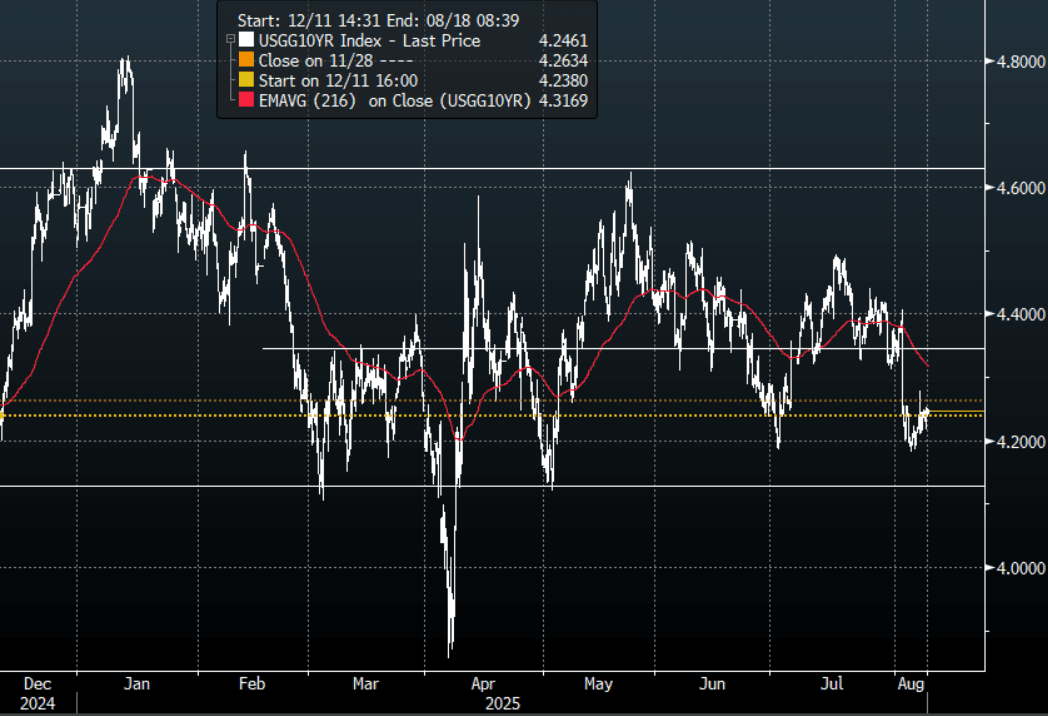
- The 10-year yield had a powerful move lower in reaction to the NFP data, breaking below its 4.30% pivot within the wider range 4.10% - 4.65%. This now turns momentum lower in yields and you could expect buyers of treasuries on bounces back towards 4.30/35% now looking to initially test the 4.10% area.
- Mohamed A. El-Erian on X: “If the Administration were to secure exceptionally rapid Congressional approval for its nominee ahead of the September Fed meeting—and its a big if—the dynamics at the meeting could be fascinating. It’s not totally out of the question, for example, that at least three committee members would dissent from a decision to cut rates by 25 basis points, arguing instead for a more aggressive 50 basis point reduction. After all, last year, the Fed hesitated to cut rates in July, only to opt for a 50 basis point cut at the September meeting.
- RenMac on X: ”According to latest data from Conference Board, more CEOs see a net reduction in workforce. Percent seeing net reduction jumped to 34% in Q3, highest since Q4 2020. Percent seeing at least 1% growth in workforce slid to a low of 27%."
Fig 1: 10-Year US Yield 2H Chart
Source: MNI - Market News/Bloomberg Finance L.P
JGBS: 5Y Leads Yields Higher, Relatively Subdued Session
JGB futures are weaker but off session lows, -7 compared to settlement levels.
- (MNI) Some Bank of Japan board members acknowledged upside risks to prices but saw no need to rush a rate hike at the July 30-31 meeting, the summary of opinions showed Friday. But one member noted that it would take at least two-to-three more months to gauge the effects of U.S. tariff policy.
- MNI Interview - The Bank of Japan will likely raise its policy interest rate 25 basis points to 0.75% as early as December, though the Board could delay the move to January depending on evolving economic and price conditions, a former BOJ chief economist told MNI.
- Cash US tsys are slightly mixed in today's Asia-Pac session after yesterday's modest sell-off.
- Cash JGBs are flat to 2bps cheaper across benchmarks out to the 30-year, with the 5-year underperforming and the 40-year outperforming (-3bps). The benchmark 10-year yield is 0.3bps higher at 1.491% versus the cycle high of 1.616%.
- Swap rates are 1-2bps higher.
- On Monday, the local calendar will be closed.
AUSSIE BONDS: Modest Bear-Flattener On A Data-Light Session
ACGBs (YM -1.5& XM -0.5) are slightly weaker after another subdued data-light session.
- Cash US tsys are slightly mixed in today's Asia-Pac session after yesterday's modest sell-off.
- Cash ACGBs have bear-flattened, with yields flat to 2bps higher and the AU-US 10-year yield differential at flat.
- Bloomberg - The slump in the US dollar is convincing Australia's individual investors to seek protection for their American investments. Retail investors have poured a record $320 million into BlackRock's Australian-dollar hedged S&P 500 Index exchange-traded fund this year. Damien McIntyre, chief executive of GSFM Pty, said Australian investors are "positioning themselves for US dollar weakness".
- The bills strip has bear-steepened, with pricing -1 to -4 across contracts.
- RBA-dated OIS pricing is little changed across meetings today. A 25bp rate cut in August is given a 98% probability, with a cumulative 62bps of easing priced by year-end (based on an effective cash rate of 3.84%).
- On Monday, the local calendar will be empty.
- Next week, the AOFM plans to sell A$1200mn of the 4.25% 21 December 2035 bond on Wednesday and A$1000mn of the 2.75% 2 1 November 2029 bond on Friday.
BONDS: NZGBS: Closed Slightly Stronger, Subdued End To The Week
NZGBs closed 1bp richer across benchmarks after a subdued end to the trading week.
- The NZ 10-year outperformed its $-bloc counterparts slightly, with the NZ-US and NZ-AU yield differentials 1-2bps tighter on the day.
- Cash US tsys are slightly mixed in today's Asia-Pac session after yesterday's modest sell-off.
- Swaps closed showing a modest bull-flattening, with rates flat to 2bps lower.
- “Inflation expectations remain contained in New Zealand, and don't pose a threat to further easing by the Reserve Bank. The main inflation risk lies offshore - domestically driven price pressures appear muted, with expectations for wage growth pulling back. We see a disconnect between expectations and reality in the labor market, and believe the unemployment rate is likely to surprise to the upside over the coming quarters. That should see the RBNZ deliver more rate cuts than it projects. We expect a 25-basis-point rate cut at its next meeting on Aug. 20.” (BBG)
- RBNZ dated OIS pricing closed little changed across meetings. 23bps of easing is priced for August, with a cumulative 41bps by November 2025.
- On Monday, the local calendar will be empty. The next release will be Card Spending data on Wednesday.
FOREX: Asia FX Wrap - BBDXY Finds Demand Back Towards 1200
The BBDXY has had a range of 1201.73 - 1204.04 in the Asia-Pac session, it is currently trading around 1203, -0.02%. The USD attempted a bounce overnight, but Miran’s appointment to the Fed board has seen that quickly reversed. The market is again very quick to pounce onto anything that potentially justifies selling the USD and Stephen Miran has been very vocal about the USD’s overvaluation being the root of the US’s economic imbalances. Personally I struggle to see how he changes the structural demand for USD’s from inside the Fed other than adding to a dovish tilt within it. Lets see if the market is able to follow through with this initial wave of selling, the 1200 area seems to be holding pretty well for now.
- EUR/USD - Asian range 1.1655 - 1.1679, Asia is currently trading 1.1660. The pair has bounced nicely off the important 1.1300/1.1400 area. The market stalled at its first attempt to challenge the resistance around the 1.1700 area, let's see if it can do better the second time round.
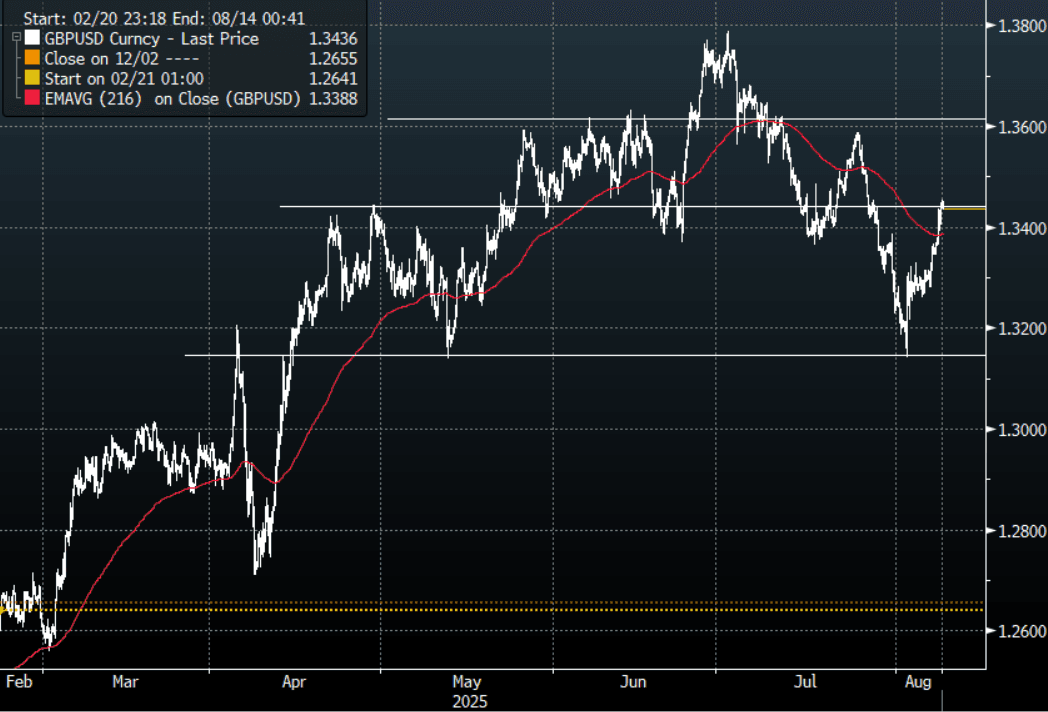
- GBP/USD - Asian range 1.3438 - 1.3453, Asia is currently dealing around 1.3435. The pair bounced nicely off the 1.3100/1.3200 support area. I would suspect sellers could be around on this bounce back towards 1.3450 initially looking to fade this bounce.
- USD/CNH - Asian range 7.1784 - 7.1870, the USD/CNY fix printed 7.1382, Asia is currently dealing around 7.1840. Sellers should be around on bounces while price holds below the 7.2200/2500 area and the PBOC manages the fix lower. Above 7.2500 and we could see a test of the USD Shorts.
- Cross asset : SPX +0.20%, Gold $3398, US 10-Year 4.244%, BBDXY 1203, Crude Oil $63.77
- Data/Events : France ILO Unemployment rate
Fig 1: GBP/USD Spot 2H Chart
Source: MNI - Market News/Bloomberg Finance L.P
JPY: Asia Wrap - USD/JPY Finds Demand Sub 147.00 Again
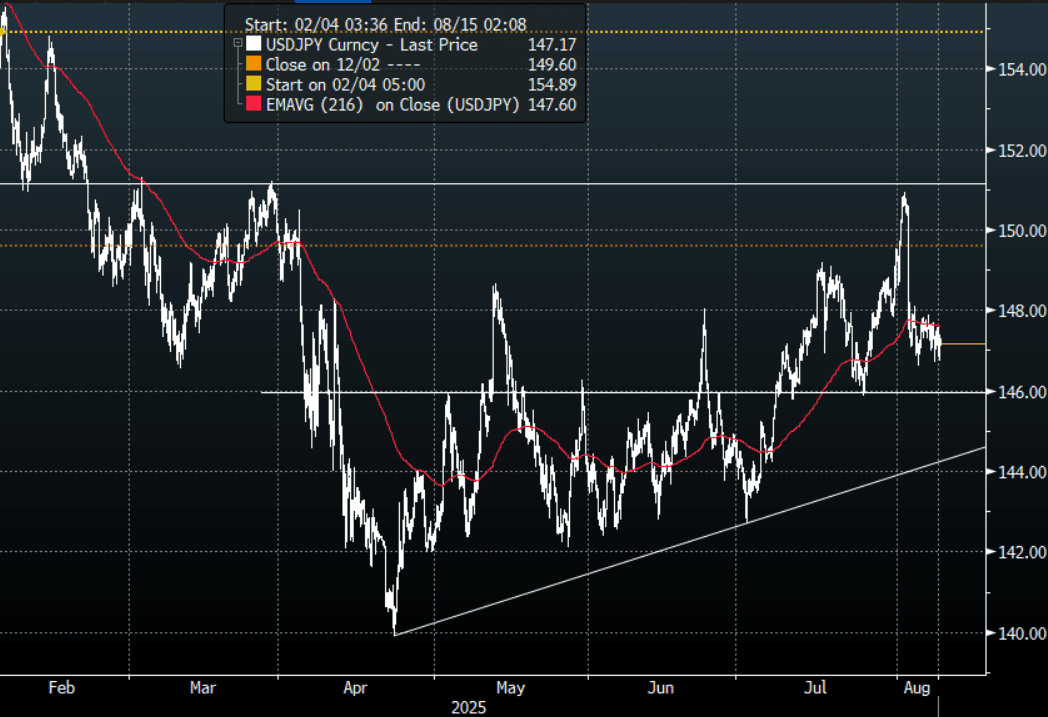
The Asia-Pac USD/JPY range has been 146.72 - 147.37, Asia is currently trading around 147.15, +0.01%. USD/JPY is consolidating within a 146.50-148.00 range. Price has moved very quickly away from the pivotal 151/152 area much to the relief of Institutional Yen longs and the BOJ. CFTC Data shows leveraged accounts had started to aggressively build Yen shorts last week so this quick move lower would have been frustrating. Price is holding above the support area between 146.00/147.00, a move sub 145.00 is needed to turn momentum lower once more, until then the 145.00-151-00 range should dominate.
- (Bloomberg) -- “Japanese stocks rose after Japan’s chief trade negotiator said the US agreed to end so-called stacking on universal tariffs and cut car levies at the same time. Optimism about rate cuts in the US also helped lift the mood.”
- MNI Interview - The Bank of Japan will likely raise its policy interest rate 25 basis points to 0.75% as early as December, though the Board could delay the move to January depending on evolving economic and price conditions, a former BOJ chief economist told MNI.
- (MNI) Some Bank of Japan board members acknowledged upside risks to prices but saw no need to rush a rate hike at the July 30-31 meeting, the summary of opinions showed Friday. But one member noted that it would take at least two-to-three more months to gauge the effects of U.S. tariff policy. "If the U.S. economy is able to withstand the impact to a greater extent than expected, the downward effects on Japan's economy are likely to remain minimal. In that case, it may be possible for the Bank to exit from its current wait-and-see stance, perhaps as early as the end of this year."
- Options : Close significant option expiries for NY cut, based on DTCC data: 146.00($671m), 147.50($501m), 148.20($400m).Upcoming Close Strikes : 147.30($878m Aug 12), 147.00($841m Aug 13) - BBG.
- CFTC data shows asset managers surprisingly added slightly to their JPY longs +75119( Last +72326), while leveraged funds aggressively added to their newly built short JPY position -31280(Last -11571).
Fig 1 : USD/JPY Spot 2H Chart
Source: MNI - Market News/Bloomberg Finance L.P
AUD: Asia Wrap - AUD/USD Unchanged In A Quiet Session
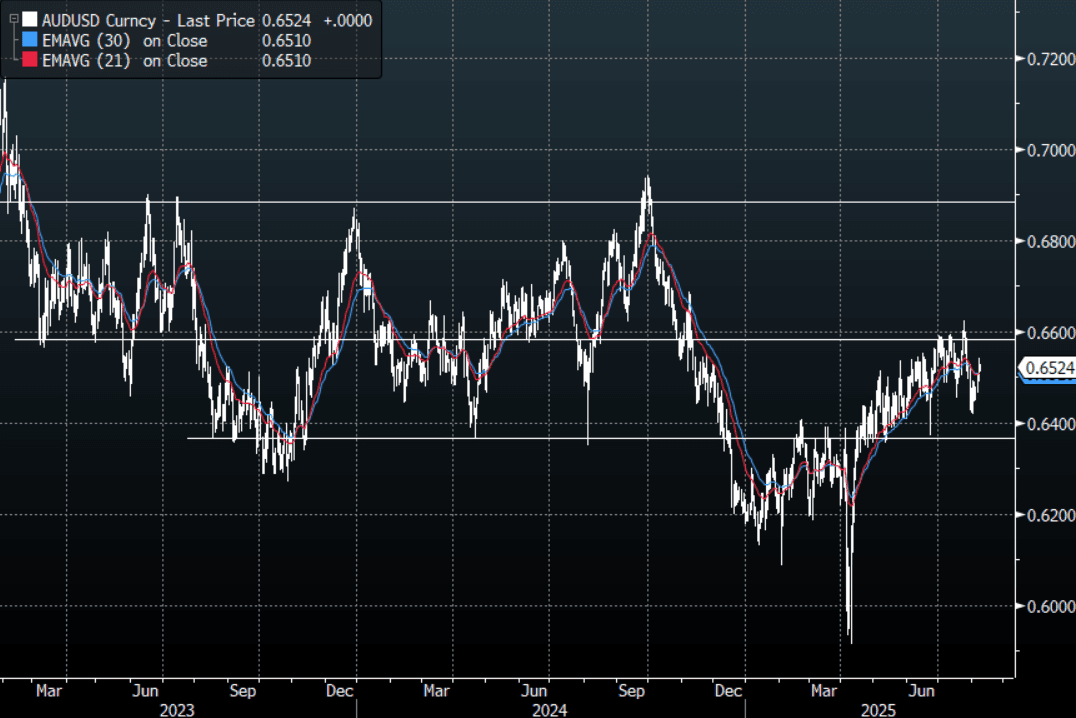
The AUD/USD has had a range of 0.6511 - 0.6528 in the Asia- Pac session, it is currently trading around 0.6520, -0.05%. The headline that Trump is set to nominate Miran to the short-term Fed Board vacancy saw a late move lower in the USD across the board. The market is very quick to use any excuse to sell the USD, Miran’s views on the USD are well publicised but at most he will add 1 more dovish vote to a board that seems to already be turning that way. Can he actually alter the policy on the USD from this position ? Risk has traded a little higher as a result of this, E-minis +20%, NQU5 +0.20% but the AUD ends our session unchanged after initially probing higher.
- Depending on what your view is 0.6550 still offers good risk/reward to fade initially. I feel the performance of US equities over August/September will be crucial as seasonality points to some strong headwinds approaching.
- Bloomberg - The slump in the US dollar is convincing Australia’s individual investors to seek protection for their American investments.Retail investors have poured a record $320 million into BlackRock’s Australian-dollar hedged S&P 500 Index exchange-traded fund this year. Damien McIntyre, chief executive of GSFM Pty, said Australian investors are "positioning themselves for US dollar weakness".
- Stephen Miran At Hudson Bay Capital : ”The root of the economic imbalance lies in persistent dollar overvaluation that prevents the balancing of international trade, and this overvaluation is driven by inelastic demand for reserve assets. As global GDP grows, it becomes increasingly burdensome for the United States to finance the provision of reserve assets and the defense umbrella as the manufacturing and tradeable sectors bear the brunt of the costs."
- Options : Closest significant option expiries for NY cut, based on DTCC data: 0.6500(AUD4.42b), 0.6400(AUD1.32b). Upcoming Close Strikes : 0.6565(AUD783m Aug 12) - BBG
- AUD/JPY - Asia-Pac range 95.76 - 96.06, Asia is trading around 96.00. The pair has bounced to test its first resistance around the 96.00/96.50 area. There should be sellers around here initially, a sustained break below 94.50/95.00 is needed to signal a deeper move lower.
Fig 1: AUD/USD spot Daily Chart
Source: MNI - Market News/Bloomberg Finance L.P
NZD: Asia Wrap - NZD/USD Unchanged After Probing Higher
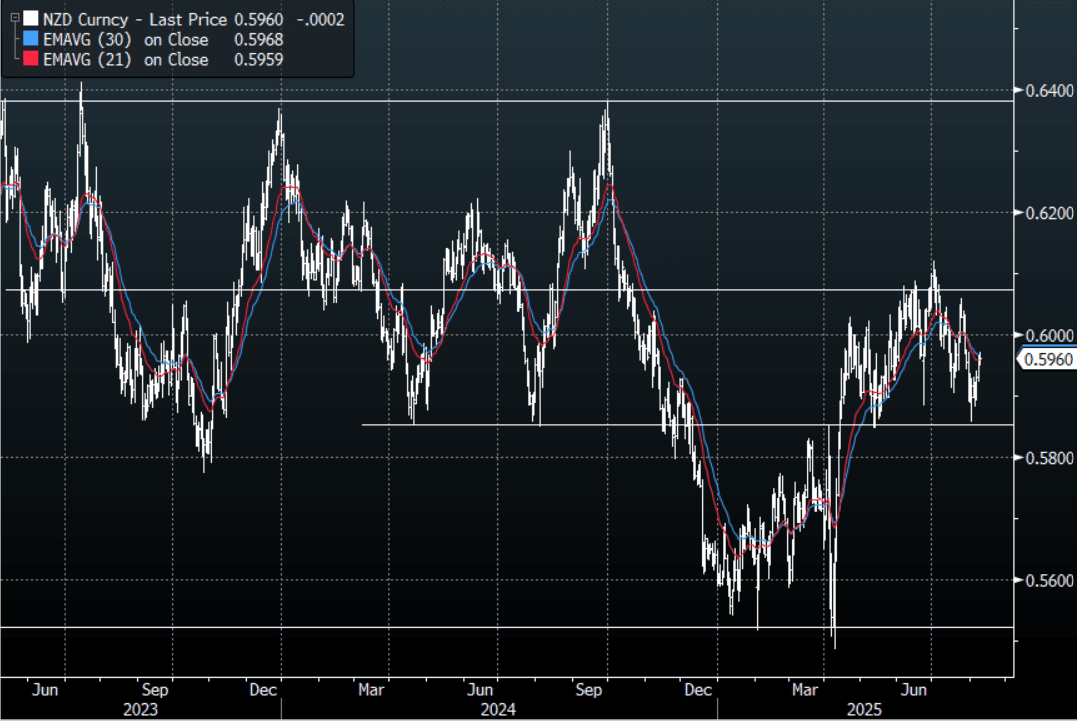
The NZD/USD had a range of 0.5948 - 0.5972 in the Asia-Pac session, going into the London open trading around 0.5960, -0.03%. The market is very quick to use any excuse to sell the USD, Miran’s views on the USD are well publicised but at most he will add 1 more dovish vote to a board that seems to already be turning that way. Can he actually alter the policy on the USD from this position ? Risk has traded a little higher in response to this, E-minis +25%, NQU5 +0.25%.
- NZD/USD bounced nicely off its 0.5850 support but depending on your view I would suspect sellers could return on any bounce back toward 0.6000/0.6050 first up. For the moment back in the 0.5850-0.6100 range looking for a catalyst to break and give clearer direction.
- Kelly Eckhold(Westpac NZ) on LinkedIn - “The RBNZ data on actual lending rates applied to mortgage loans shows significant pass through in June. This was a big month for refinancing. Effective paid rates are down 73 bp from their peak now. Effective rate is back to October 2023 levels.”
- Options : Closest significant option expiries for NY cut, based on DTCC data: none. Upcoming Close Strikes : 0.5920(NZD583m Aug 11), 0.5930(NZD646m Aug 11). - BBG
- CFTC Data shows Asset Managers again reduced their newly built longs in NZD +3903(Last +5034), the Leveraged community reduced their shorts slightly -6250(Last -7328).
- AUD/NZD range for the session has been 1.0929 - 1.0960, currently trading 1.0940. The Cross continues to trade sideways after stalling towards the 1.1000 area once more. The range looks to be 1.0850-1.1000 for now.
Fig 1: NZD/USD Spot Daily Chart
Source: MNI - Market News/Bloomberg Finance L.P
ASIA STOCKS: Japan Firmer On US Trade News, Mixed Trends Elsewhere
Asian equity market trends are mixed as we approach the end of the week. The stand out performer has been Japan stocks, aiding by US-Japan trade talks, which appeared to clarify tariff stacking concerns favorably for Japan. trends elsewhere have been mixed. US equity futures are modestly higher, with Eminis and Nasdaq futures both a little over 0.20% firmer at this stage. Trends are positive for these indices, but we remain off late July highs.
- The Topix is up around 1.5%, the NKY 225 up around 2.2%. For the Topix we are consolidating the recent break above 3000, and tracking at fresh record highs. The NKY 225 is just short of fresh highs. Sentiment has been aided by earlier headlines around US-Japan trade talks, which appeared to clarify the issue around stacking tariffs. Japan's top trade negotiator, Ryosei Akazawa, stated the US will end tariff stacking and cut car tariffs at the same time. There wasn't a timeline on when this would take place, but it is not expected to stretch beyond 6 months.
- Elsewhere we had weaker than forecast Japan real household spending for June. The BoJ Summary Of Opinions recognized inflation risk but exiting the current wait and see approach may not happen until the end of this year.
- Trends are mixed elsewhere, with the HSI off around 0.65% in Hong Kong, while the CSI 300 is little changed, last near the 4117 level.
- The Kospi is also weaker, but still above 3200, while Taiwan's Taiex is around flat. This comes after yesterday's strong outperformance as TSMC rallied to record highs on views the company will avoid the US's 100% chip tariff. Offshore investor inflows were also very strong.
- In South East Asia, trends are relative steady outside of Singapore stocks, which are down around 0.50%. Indonesian markets have performed better, up close to 0.80% at this stage.
- Indian markets remain under pressure, with the benchmark Nifty and Sensex indices both down around 0.40% at this stage. We are up from recent lows, but the downtrend looks firmly entrenched at this stage, amid heightened US tariff risks.
Oil Caps off Poor Week with Further Falls
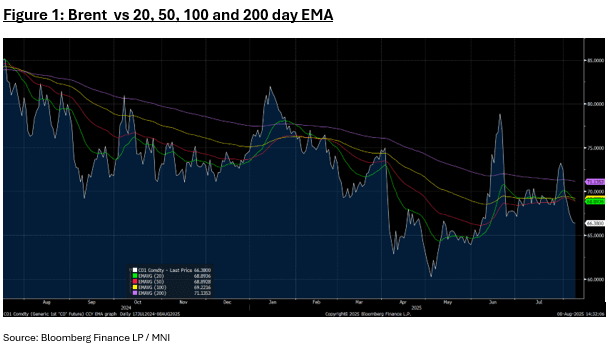
- Oil prices have found new lows for the week today, as prices dropped for a seventh consecutive day.
- WTI is down -0.14% at US$63.79 in the Asia trading day, and down -5.3% for the week.
- Brent is down -0.11% at $66.36 and -4.7% for the week. Brent is trading below all major moving averages, the nearest being the converged 20-day and 50-day EMA of $68.89. All major moving averages are beginning to trend downwards, pointing to the bearish trend starting to become entrenched.
- This week the President announced a doubling of tariffs on all Indian imports to 50% as a penalty for the ongoing purchase of Russian oil, prompting local state-owned oil refiners to pull back from purchases and look elsewhere. Treasury Secretary Scott Bessent, meanwhile, said the US may also impose tariffs on China at some point, when asked about targeting countries that buy Moscow’s energy.
- August sees the OPEC+ supply increase kick in, which could further suppress prices.
Gold Fails To Hold Above US$3,400
- Gold traded briefly in the Asia morning above US$3,400 before retreating to around $3,396.70 and flat to the US close. Despite this gold remains up 1% for the week on renewed hopes of interest rate cuts in the US.
- Investors are grappling with the FT headline and implications from the US slapping tariffs specifically on 1kg gold bars, seemingly aimed specifically at Switzerland. Whilst gold has long been seen as a 'safe-haven' in the trade war it is now caught up in it.
- The PBOC added 60,000 ounces of gold in July according to data released. As the Central Bank continues to diversify away from the USD it ia adding to its gold reserves, now up to its eight consecutive month of additions.
- Despite the tariff news on bars, Citi upgraded its three month gold forecast to $3,500 per ounce, citing U.S. economic weakness, dollar softness, geopolitical risk, and robust investor appetite for the metal.
- Gold remains above all major moving averages again this week, sitting above the 20-day EMA of $3,356.96. All major moving averages remain modestly upward sloping, a sign that the bullish momentum could continue.
UP TODAY (TIMES GMT/LOCAL)
| Date | GMT/Local | Impact | Country | Event |
| 08/08/2025 | 0600/0800 | ** |  SE SE | Private Sector Production m/m |
| 08/08/2025 | 1115/1215 |  GB GB | BOE Pill At National MPC Agency Briefing | |
| 08/08/2025 | 1230/0830 | *** |  CA CA | Labour Force Survey |
| 08/08/2025 | 1230/0830 | *** | CA | Labour Force Survey |
| 08/08/2025 | 1420/1020 |  US US | St. Louis Fed's Alberto Musalem | |
| 08/08/2025 | 1700/1300 | ** | US | Baker Hughes Rig Count Overview - Weekly |
| 08/08/2025 | 1700/1300 | ** | US | Baker Hughes Rig Count Overview - Weekly |
| 09/08/2025 | 0130/0930 | *** |  CN CN | CPI |
| 09/08/2025 | 0130/0930 | *** | CN | Producer Price Index |


