MNI EUROPEAN MARKETS ANALYSIS: Q2 Japan GDP Beats
- Japan Q2 GDP beat expectations, aided by capex. The authorities are cautious on the outlook given tariffs. USD/JPY has dipped but is still above 147.00 at this stage. New Zealand July month price data showed firmer momentum across fuel, food and some parts of services. The RBNZ is expected to cut rates next week.
- China July activity data was all below market forecasts, signaling weaker early Q3 growth. The authorities noted impacts from the weather, while market sentiment is focused on stimulus measures.
- Looking ahead, the main focus will be on US data, headlined by retail sales. The Trump/Putin meeting in Alaska also takes place later on Friday.
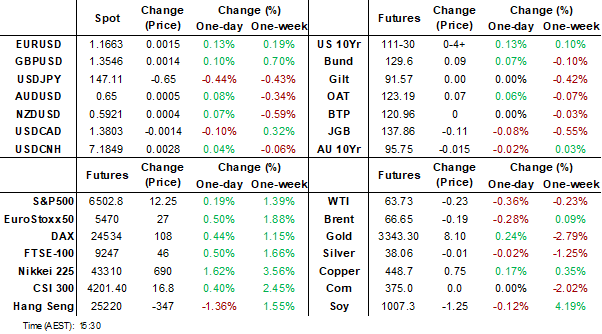
MARKETS
US TSYS: Slightly Richer After Yesterday’s Post-PPI Sell-Off
TYU5 is dealing at 111-29, +0-03+ from closing levels in today's Asia-Pac session.
- July CPI and PPI data pulled market pricing in opposite directions this week. Softer CPI figures initially allowed markets to more than fully price in a 25bp Fed cut in September. However, that view was swiftly unwound after yesterday’s hotter-than-expected PPI report (headline +0.9% M/M vs. +0.2% expected), challenging the post-CPI narrative that tariff effects were proving less severe than feared.
- Bloomberg – “Garfield Reynolds, MLIV Team Leader, said "Treasuries will remain nervous heading into next week’s Jackson Hole event" with inflation concerns likely to see long-dated debt underperform.”
- Cash US tsys are ~1bp richer in today's Asia-Pac session after yesterday's post-PPI sell-off.
- The 4.35% area in 10-Year yields should still see demand initially, but the way the market keeps bouncing off levels just below 4.20% will be disconcerting for longs.
- Data/Events: Retail Sales, Empire Manu., Industrial Production, Business Inventories, U. of Mich. Sentiment, TIC Flows
STIR: $-Bloc Markets Showed Little Net Change Over Past Week
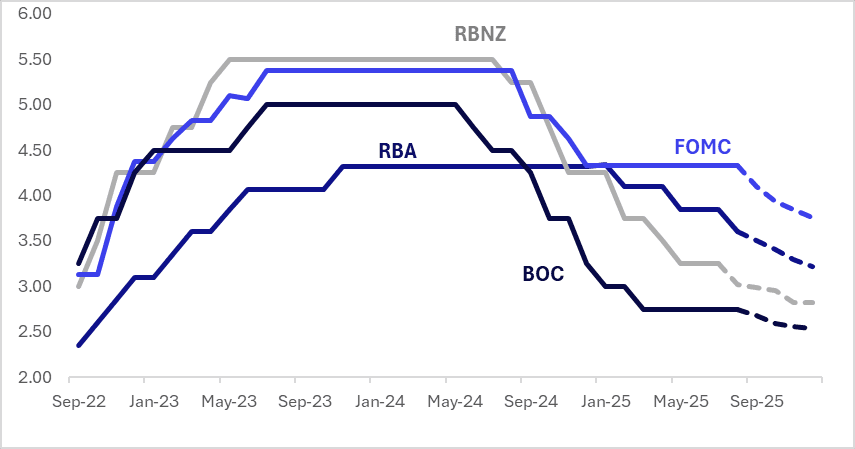
Interest rate expectations across the $-bloc were largely unchanged over the past week, despite several major data releases and a policy move by the RBA.
- In the US, July CPI and PPI data pulled market pricing in opposite directions. Softer CPI figures initially allowed markets to fully price in a 25bp Fed cut in September. However, that view was swiftly unwound after yesterday’s hotter-than-expected PPI report (headline +0.9% M/M vs. +0.2% expected), challenging the post-CPI narrative that tariff effects were proving less severe than feared.
- In Australia, the RBA delivered a widely anticipated 25bp rate cut, bringing the cash rate to 3.60%. The Bank noted that inflation is continuing to moderate toward its 2–3% target, with trimmed-mean inflation at 2.7% and headline at 2.1% in Q2. Domestic demand is gradually improving, household incomes have risen, and while labour market conditions are easing, they remain relatively tight. Having cut rates by a cumulative 75bps this year, the Board signalled a cautious stance—remaining alert to global and domestic risks while keeping its dual focus on price stability and full employment.
- Looking ahead, the next key regional event is the RBNZ decision on August 20. 23bps of easing is priced for this meeting, with a cumulative 42bps by November 2025.
- Looking ahead to December 2025, current market-implied policy rates and cumulative expected easing are as follows: US (FOMC): 3.76%, -57bps; Canada (BOC): 2.53%, -22bps; Australia (RBA): 3.21%, -39bps; and New Zealand (RBNZ): 2.82%, -43bps.
Figure 1: $-Bloc STIR (%)
Source: Bloomberg Finance LP / MNI
JGBS: Cheaper After Better Than Expected
JGB futures are weaker and at session lows, -15 compared to settlement levels.
- Japan's Q2 GDP was better than market expectations. Q/Q growth rose 0.3%, against a 0.1% forecast, while the Q1 outcome was revised up a touch to 0.1% from the original flat estimate. In terms of the detail, private consumption rose 0.2% q/q, versus 0.1% forecast, while Q1 was revised up to 0.2% (originally reported as 0.1%). Capex was up 1.3%, versus 0.7% expected (Q1 was revised down 0.1% to a 1.0% gain). Net exports contributed 0.3% to growth (0.1% was forecast), while inventories took 0.3% off growth, in line with forecasts. Nominal GDP rose 1.3%q/q, a touch below market forecasts of 1.4%.
- "JAPAN FINMIN KATO: MUST CLOSELY WATCH ECONOMIC, PRICE BACKDROP BEHIND RECENT COMMENTS BY BUSINESS SECTOR CALLING ON BOJ TO RAISE RATES, THOUGH SPECIFIC MONETARY POLICY DECISION UP TO BOJ - [RTRS]"
- Cash JGBs are 1-3bps cheaper across benchmarks. The benchmark 10-year yield is 2.7bps higher at 1.573% versus the cycle high of 1.616%.
- Swap rates are ~1bp higher, with swap spreads tighter.
- On Monday, the local calendar will see the Tertiary Industry Index.
JAPAN DATA: Q2 GDP Beats, Aided By Strong Capex, Consumption Slightly Firmer
Japan Q2 GDP was better than market expectations. Q/Q growth rose 0.3%, against a 0.1% forecast, while the Q1 outcome was revised up a touch to 0.1% from the original flat estimate. In terms of the detail, private consumption rose 0.2% q/q, versus 0.1% forecast, while Q1 was revised up to 0.2% (originally reported as 0.1%). Capex was up 1.3%, versus 0.7% expected (Q1 was revised down 0.1% to a 1.0% gain). Net exports contributed 0.3% to growth (0.1% was forecast), while inventories took 0.3% off growth, in line with forecasts. Nominal GDP rose 1.3%q/q, a touch below market forecasts of 1.4%.
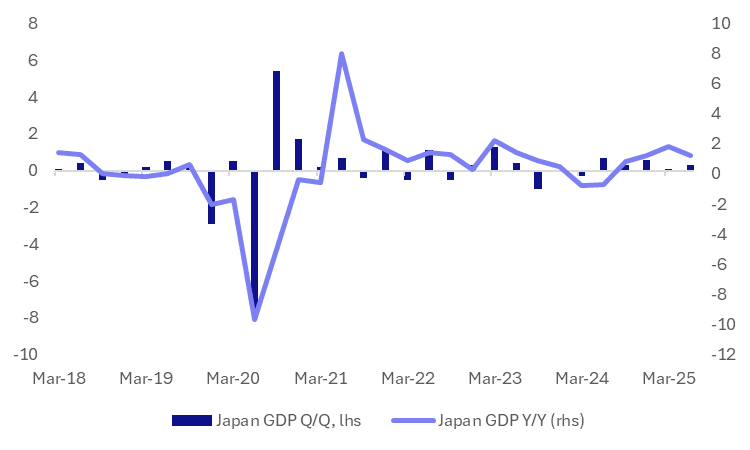
- The chart below plots the q/q and y/y profile for Japan GDP. Whilst not a surging picture, there were some concerns over H1 growth, particularly after Q1 printed negative in q/q terms (on an annualized basis).
- There will be caution around the H2 outlook given tariff levels, but Japan's deal with the US was seen as avoiding a worse case scenario outcome (per a recent Rtrs survey).
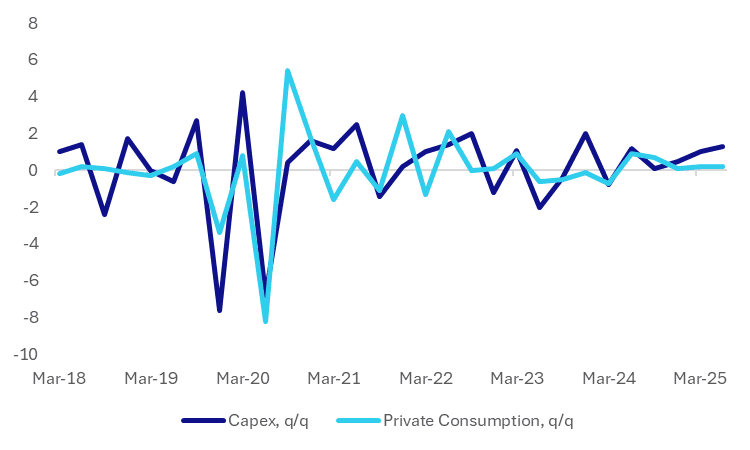
- The same survey noted the deal outcome didn't impact the capex outlook, which remains a firm source of growth for Japan, see the second chart below.
- Whilst consumption has been slightly stronger than forecast the authorities will be aiming for improving trends via continued wage gains over the next 12 months.
Fig 1: Japan GDP - Q/Q and Y/Y
Source: Bloomberg Finance L.P./MNI
Fig 2: Japan Capex And Private Consumption
Source: Bloomberg Finance L.P./MNI
JAPAN DATA: Local Investors Buy Offshore Bonds, Overseas Investors Buy Equities
Japan outbound flows last week saw local investors buy overseas bonds, ending a two week run of net selling for this segment. Cumulative outflows to overseas bonds remain strongly positive in recent months, but in recent weeks aggregate flows have been more modest compared to the first half of July. Local investors continued to sell overseas equities, albeit at a lower pace compared to the prior week.
- In terms of flows into Japan, we saw net buying from offshore investors for the first time in 4 weeks. Cumulative inflows into this space are only marginally positive going back to the start of May. JGB yields remain elevated, with the 10yr still eyeing a test above 1.60%. Fiscal concerns remain, with sentiment at longer dated JGB auctions still skittish.
- Offshore investors bought local stocks for the seventh straight week. The recent break higher in headline equity indices for Japan may be aiding momentum in this space.
Table 1: Japan Weekly Offshore Investment Flows
| Billion Yen | Week ending Aug 8 | Prior Week |
| Foreign Buying Japan Stocks | 489.3 | 193.9 |
| Foreign Buying Japan Bonds | 733.2 | -92.7 |
| Japan Buying Foreign Bonds | 254.9 | -527.0 |
| Japan Buying Foreign Stocks | -225.5 | -752.1 |
Source: Bloomberg Finance L.P./MNI
AUSSIE BONDS: Slightly Weaker, Light Local Calendar Next Week
ACGBs (YM -1.0 & XM -2.0) are weaker but near session bests.
- Cash US tsys are ~1bp richer in today's Asia-Pac session after yesterday's post-PPI sell-off.
- US Data/Events: Retail Sales, Empire Manu., Industrial Production, Business Inventories, U. of Mich. Sentiment, TIC Flows.
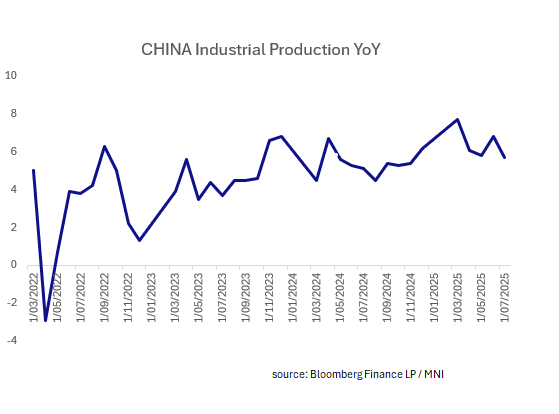
- China's July industrial production expanded +5.7%, missing estimates of +6.0% and below June's result of +6.8%. This was the weakest monthly result since November 2024.
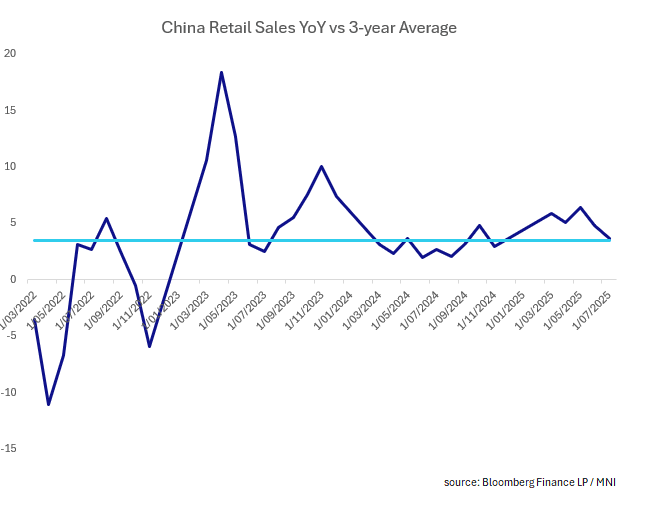
- China's retail sales for July missed forecasts and was weaker than the month prior. July retail sales expanded +3.7%, the slowest since November 2024 and a second consecutive month of moderation.
- Cash ACGBs are 1-2bps cheaper with the AU-US 10-year yield differential at -4bps.
- The bills strip is flat to -1 across contracts, with a steepening bias.
- RBA-dated OIS pricing is firmer across meetings today. A 25bp rate cut in September is given a 28% probability, with a cumulative 37bps of easing priced by year-end (based on an effective cash rate of 3.59%).
- The local calendar will be empty on Monday, ahead of Westpac Consumer Conf on Tuesday.
- Next week, the AOFM plans to sell A$1500mn of the 1.25% 21 May 2032 bond on Wednesday and A$300mn of the 4.75% 21 June 2054 bond on Friday.
BONDS: Closed Cheaper, Tracking Global Bonds
NZGBs closed 2-3bps cheaper, with the NZ-US and NZ-AU 10-year yield differentials little changed.
- (Bloomberg) - Food, electricity and gas prices increased in May from April while rents also increased, Statistics NZ said in a statement Tuesday in Wellington. Airfares and fuel prices declined.
- (Bloomberg) -- New Zealand recorded the most citizen departures in 13 years in the 12 months through June, reducing the net gain through immigration to the lowest in more than two and a half years. Some 71,851 citizens departed the country in the period, the most since June 2012, Statistics New Zealand said Friday in Wellington. There were 25,353 returning citizens, resulting in a net exodus of 46,497.
- Cash US tsys are ~1bp richer in today's Asia-Pac session after yesterday's post-PPI sell-off.
- Swap rates closed 2-3bps higher.
- RBNZ dated OIS pricing closed little changed across meetings. 23bps of easing is priced for August, with a cumulative 42bps by November 2025.
- Next week, the local calendar will see the Performance Services Index on Monday, PPI data on Tuesday and the RBNZ Policy Decision on Wednesday.
NEW ZEALAND: PMI Bounces Strongly In July, Back In Expansion Territory
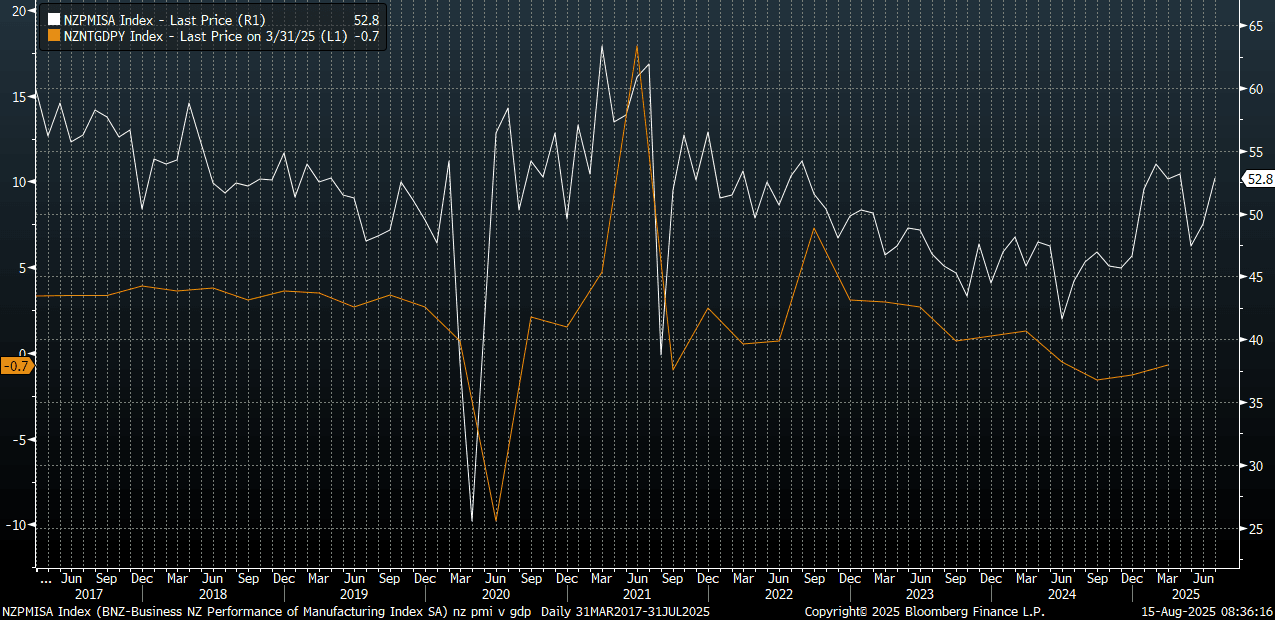
The July BNZ manufacturing PMI rose to 52.8, from a revised 49.2 outcome in June (originally reported as 48.8). This puts the index back to March levels, with Feb's read of 54.0 the recent cycle high for the index. We did get as a low as 47.4 in May, so at face value this is a decent recovery in the index.
- In terms of the detail, production rose to 53.6 from 49.6, while new orders printed at 54.2 versus 51.8 prior. The employment sub index edged up to 50.1 from 48.0 (but this sub index is still below earlier 2025 highs).
- The chart below plots the PMI versus NZ GDP in y/y terms. BNZ noted: “Given the prevailing headwinds it is, perhaps, even more encouraging that the PMI has moved back into expansion”: BNZ senior economist Doug Steel. PMI “simply had to lift to provide us with any confidence that the recovery we are forecasting will happen” (via BBG).
- Note next week we have the RBNZ decision, a 25bps cut is expected. The central bank has highlighted softer survey outcomes as a concern around the economic recovery, so today's result will help at the margin on this front.
Fig 1: NZ PMI Versus GDP Y/Y
Source: BNZ/Business NZ/Bloomberg Finance L.P./MNI
NEW ZEALAND: Food Prices Up 5%y/y In July, Fuel, Travel & Accommodation Up M/M
For July, New Zealand food prices rose 0.7%m/m, after June's +1.2% gain. Food prices are now up 5.0% y/y. Stats NZ noted: "Higher prices for the grocery food group, up 5.1 percent, contributed the most to the annual increase in food prices. The price increase for the grocery food group was due to higher prices for milk, butter, and cheese."
- Other monthly inflation components were up in July. Rents rose 0.1%, while electricity and gas also posted rises. Petrol and diesel prices also firmed (+1.2% and 2.3%m/m respectively). Air travel was also up firmly, along with accommodation services (+3.0%m/m).
- In y/y terms, trends were mixed, electricity and gas prices up over 10%, while fuel remained negative. Accommodation services are now +13.9%y/y.
- The utility strength in y/y terms fits with the RBNZ view around stronger headline inflation pressures in the near term.
- The strength in food and accommodation prices are likely to be watch points in terms of spill over risks to other parts of the economy.
FOREX: Asia FX Wrap - PPI Gives The USD A Reprieve
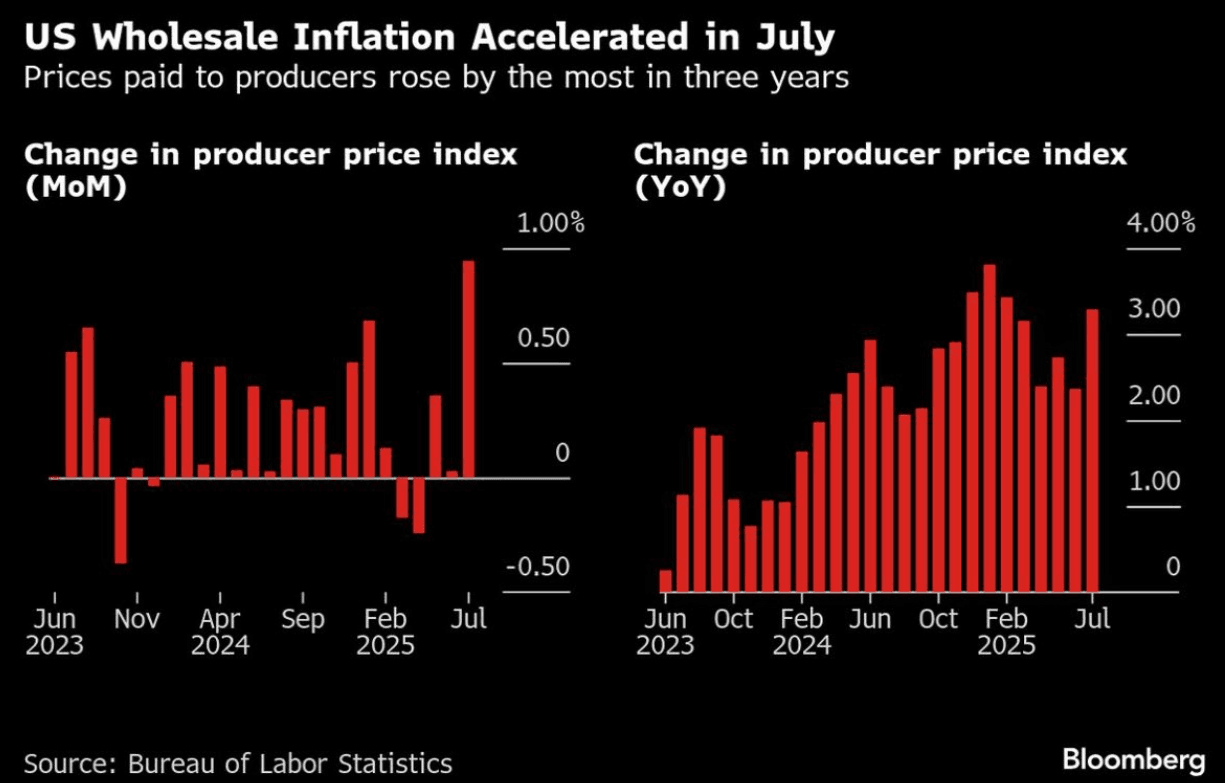
The BBDXY has had a range of 1204.29 - 1205.94 in the Asia-Pac session, it is currently trading around 1204, -0.15%. The USD again found some solid demand just below 1200 and the PPI print then gave it a lift off the lows. Is this just a stay of execution for the USD or can it gain some traction as it makes yet another higher low. The market is clearly more comfortable selling the USD but the longer it fails to extend below 1200 the higher the chances of a pullback. Alexander Stahel on X: "Say after me: stagflation. US wholesale inflation (PPI demand) up 0.9% mom & 3.3% yoy in July -> big -> Same ex energy & food -> companies pass on higher import costs related to tariffs. Sucks for Fed. If they do 25bps in Sept it’s on hold thereafter unless the jobs report blows up.” See Fig.1 Below.
- EUR/USD - Asian range 1.1646 - 1.1665, Asia is currently trading 1.1665. The market moved very quickly back to 1.1700 where it stalled on its first attempt to challenge this area. The pair's momentum higher was extinguished by the data overnight, look for some consolidation while the market looks for some direction.
- GBP/USD - Asian range 1.3526 - 1.3551, Asia is currently dealing around 1.3550. GBP stalled back towards 1.3600 overnight, first support seen now back towards 1.3400/1.3500.
- USD/CNH - Asian range 7.1786-7.1865, the USD/CNY fix printed 7.1371, Asia is currently dealing around 7.1840. Sellers should be around on bounces while price holds below the 7.2200/2500 area and the PBOC manages the fix lower. Above 7.2500 and we could see a test of the USD Shorts.
- Cross asset : SPX +0.20%, Gold $3345, US 10-Year 4.27%, BBDXY 1204, Crude Oil $63.87
Fig 1: US Wholesale Inflation
Source: MNI - Market News/Bloomberg Finance L.P/@BurggrabenH
JPY: Asia Wrap - USD/JPY Tops Out Toward 148.00, Trades Offered In Asia
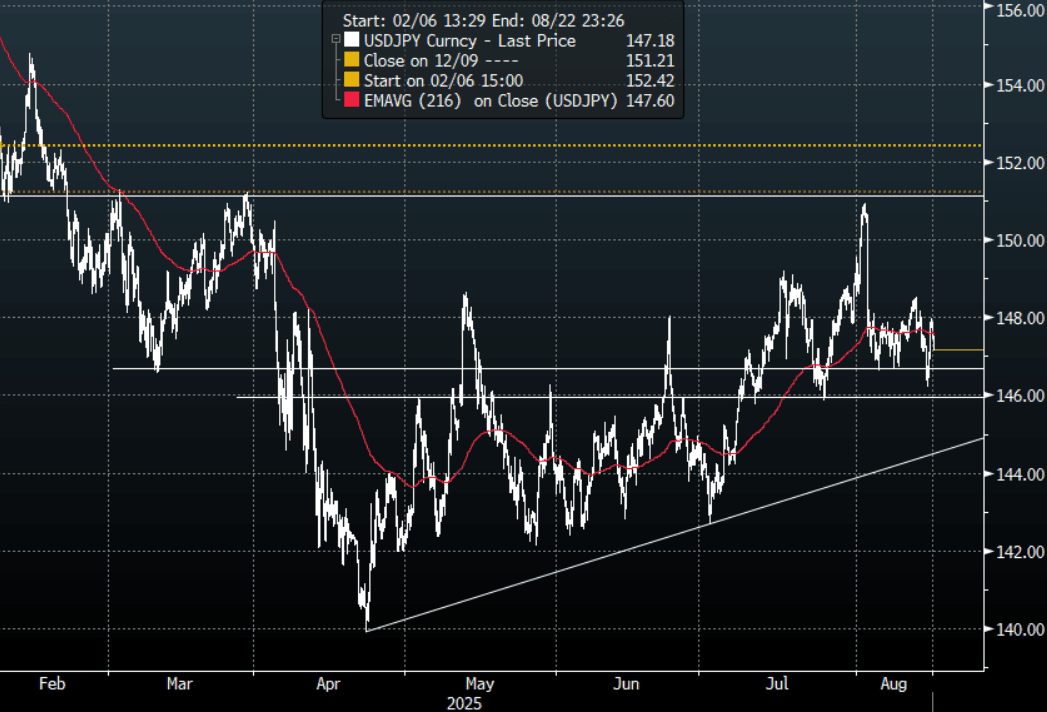
The Asia-Pac USD/JPY range has been 147.20-147.87, Asia is currently trading around 147.25, -0.35%. USD/JPY found good demand towards 146.00 and then reacted higher to the move in US yields by reversing the whole move lower. Price continues to hold above the support area between 146.00/147.00, a sustained move below this support is needed to turn the momentum potentially lower again. While this plays out it looks to be more range trading within the wider 146.00-151.00 range. The pair has traded heavily all throughout the Asian session after stalling towards 148.00.
- Japan Q2 GDP Beats, Aided By Strong Capex, Consumption Slightly Firmer: Japan Q2 GDP was better than market expectations. Q/Q growth rose 0.3%, against a 0.1% forecast, while the Q1 outcome was revised up a touch to 0.1% from the original flat estimate. In terms of the detail, private consumption rose 0.2% q/q, versus 0.1% forecast, while Q1 was revised up to 0.2% (originally reported as 0.1%). Capex was up 1.3%, versus 0.7% expected (Q1 was revised down 0.1% to a 1.0% gain). Net exports contributed 0.3% to growth (0.1% was forecast), while inventories took 0.3% off growth, in line with forecasts. Nominal GDP rose 1.3%q/q, a touch below market forecasts of 1.4%.
- "JAPAN FINMIN KATO: MUST CLOSELY WATCH ECONOMIC, PRICE BACKDROP BEHIND RECENT COMMENTS BY BUSINESS SECTOR CALLING ON BOJ TO RAISE RATES, THOUGH SPECIFIC MONETARY POLICY DECISION UP TO BOJ - [RTRS]"
- "JAPAN ECONOMY MINISTER AKAZAWA: U.S. TARIFF LIKELY TO PUSH DOWN JAPAN'S REAL GDP BY 0.3-0.4%, WON'T URGE BOJ TO SET RATES AT PARTICULAR LEVEL - [RTRS]"
- Options : Close significant option expiries for NY cut, based on DTCC data: 145.00($977m), 150.00($685m).Upcoming Close Strikes : 150.00($846m Aug 19), 148.00($809m Aug 20) - BBG.
Fig 1 : USD/JPY Spot 2H Chart
Source: MNI - Market News/Bloomberg Finance L.P
AUD: Asia Wrap - AUD/USD Drifts Higher
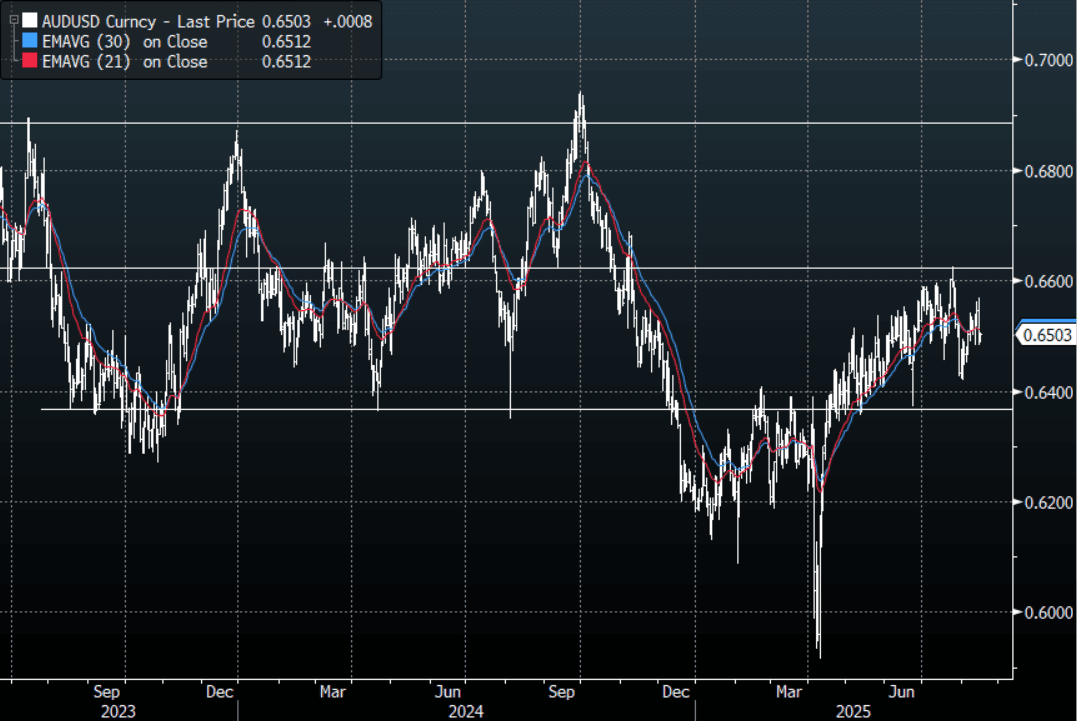
The AUD/USD has had a range of 0.6488 - 0.6505 in the Asia- Pac session, it is currently trading around 0.6505, +0.15%. US yields bounced hard in reaction to the PPI print, reigning in its expectations for larger rate cuts. This saw the USD get a reprieve and bounce off its support area. This has unfortunately really muddied the water for the AUD/USD just as it looked to be trying to build some upward momentum. AUD has drifted back to 0.6500 as a result, firmly in the middle of its 0.6350-0.6650 range with no clear direction. Softer China data was unable to get any follow through below 0.6500 in our session.
- China Property Investment & Sales Decline Further in July: There appears no end in sight for the property sector with Property Investment and Residential Property Sales declining further in July. Property investment Yet to date declined -12%, its worst result since late 2019 as COVID was erupting. Residential Property sales declined -6.2%, down from -5.2% in June. The data shows few bright spots with domestic loans for property and funds for property development down as new construction contracts -19.4%. Properties under construction were down -9.2%.
- China Industrial Production Expansion Weakest Since November: July's industrial production expanded +5.7%, missing estimates of +6.0% and below June's result of +6.8%. This was the weakest monthly result since November 2024.
- China Retail Sales Moderate Further in July: China's retail sales for July missed forecasts and was weaker than the month prior. July retail sales expanded +3.7%, the slowest since November 2024 and a second consecutive month of moderation.
- Options : Closest significant option expiries for NY cut, based on DTCC data: 0.6523(AUD562m), 0.6700(AUD498m). Upcoming Close Strikes : 0.6475(AUD428m Aug 18 ), 0.6515(AUD673m Aug 19), 0.6270(AUD435m Aug 19) - BBG
- CFTC Data shows Asset managers added to their shorts -60729(Last -49183), the Leveraged community added very slightly to their own shorts -13997(Last -13823).
- AUD/JPY - Asia-Pac range 95.59 - 96.07, Asia is trading around 95.75. The pair has bounced and tested its first resistance around the 96.50/97.00 area where momentum stalled. The sellers have capped the move for now, price is firmly back into the 94.50-97.50 range.
Fig 1: AUD/USD spot Daily Chart
Source: MNI - Market News/Bloomberg Finance L.P
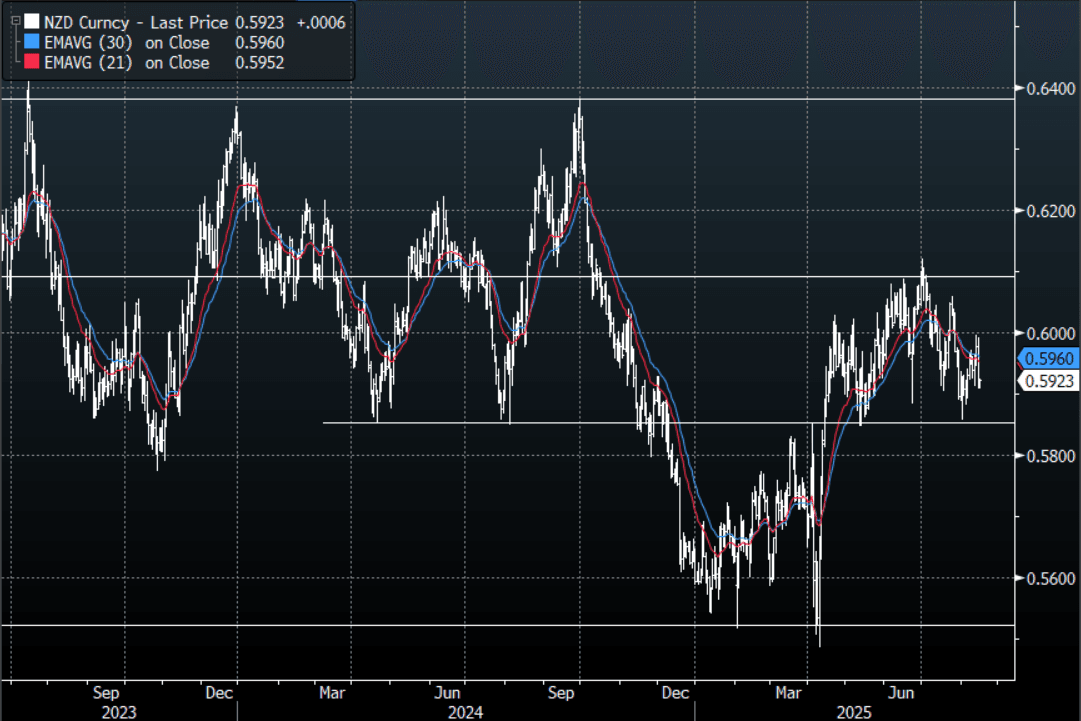
NZD: Asia Wrap - NZD/USD Consolidates Towards 0.5900
The NZD/USD had a range of 0.5908 - 0.5925 in the Asia-Pac session, going into the London open trading around 0.5920, +0.10%. US yields bounced hard in reaction to the PPI print, reigning in its expectations for larger rate cuts. This saw the USD get a reprieve and bounce off its support area. The NZD/USD has moved lower overnight in reaction to this but while still firmly in the 0.5850-0.6150 range it's tough to discern any real direction. Risk has traded a little stronger this morning, E-minis +0.20%, NQU5 +0.05%. NZD has had a quiet session treading water above 0.5900 in our session.
- NZ PMI Bounces Strongly In July, Back In Expansion Territory : The July BNZ manufacturing PMI rose to 52.8, from a revised 49.2 outcome in June (originally reported as 48.8). This puts the index back to March levels, with Feb's read of 54.0 the recent cycle high for the index. We did get as low as 47.4 in May, so at face value this is a decent recovery in the index.
- NZ Food Prices Up 5%y/y In July, Fuel, Travel & Accommodation Up M/M : For July, New Zealand food prices rose 0.7%m/m, after June's +1.2% gain. Food prices are now up 5.0% y/y. Stats NZ noted: "Higher prices for the grocery food group, up 5.1 percent, contributed the most to the annual increase in food prices. The price increase for the grocery food group was due to higher prices for milk, butter, and cheese."
- “NEW ZEALAND ANNUAL NET IMMIGRATION SLOWED TO 13,701 IN JUNE" - BBG
- Options : Closest significant option expiries for NY cut, based on DTCC data: none. Upcoming Close Strikes : 0.5925(NZD400m Aug 20). - BBG
- AUD/NZD range for the session has been 1.0969 - 1.0983, currently trading 1.0975. The Cross continues to trade sideways after stalling towards the 1.1000 area once more. The range looks to be 1.0850-1.1000 for now.
Fig 1: NZD/USD Spot Daily Chart
Source: MNI - Market News/Bloomberg Finance L.P
ASIA STOCKS: Japan Rebounds, HK Down, China Shrugs Off Weaker July Data
Stock trends are mixed in Asia Pac markets for the first part of Friday trade, although more markets are up than down at this stage. US equity futures sit little changed, while EU futures are painting a positive tone, up around 0.35% at this stage.
- China and Hong Kong markets are mixed. The HSI is off over 1%, while the CSI 300 and Shanghai Composite are up close to 0.50%. Disappointment on earnings appears to be weighing on Hong Kong markets, while July China data activity outcomes were all below market expectations. July home prices also fell again in m/m terms.
- This hasn't impacted onshore China equity market sentiment though. The authorities noted flood and higher temperatures impacted July activity. The outcomes may also encourage fresh stimulus. Focus this week has been on subsidy plans on loan interest for individuals and businesses aimed at improving consumption. Another proposal considered would see state owned enterprises purchasing unsold homes. The CSI 300 real estate sub index is up around 1.6% so far today.
- Elsewhere, Japan markets are rebounding from yesterday's losses. Both the Topix and NKY 225 are up around 1.15%. Earlier data showed Q2 GDP growth better than expected led by capex. USD/JPY is lower but still around 100pips above Thursday's lows.
- South Korean markets are closed today, while Taiwan's Taiex is up around 0.30%.
- In South East Asia, Indonesia's JCI hit record highs above 8000 earlier, but is away from best levels now. Focus is on President Prabowo's annual address, while the 2026 fiscal outlook will also be discussed later. Aiming for better growth, but along with fiscal responsibility, will market watch points.
- Singapore, Malaysia and the Philippines are weaker elsewhere in South East Asia.
ASIA STOCKS: Taiwan Inflow Momentum Slows, Indonesia Inflows Continue
Outside of Indonesia, net equity flow trends were mostly negative yesterday. Outflows from South Korea and Taiwan were relatively modest, but Taiwan now has seen aggregate outflows in the past 5 trading days. This followed a very strong inflow period, whilst the Taiex index has climbed close to record highs. Some outflow pressure may reflect profit taking, with the broader backdrop still seen firm from a tech/AI outlook perspective. In South Korea, the Kospi is struggling to trend higher after consolidating around the 3200 region. Concern around the reform agenda and potential tax changes (relating to stock investments) have been factors driving a more cautious backdrop.
- In South East Asia, Indonesian inflows continued, with the last 5 trading days seeing $300mn in net inflows. This comes as the local JCI index reached fresh record highs yesterday. Broader risk tones, amid Fed easing hopes, have helped market sentiment. Today we have President Prabowo Subianto delivering the annual state of the nation address. The 2026 budget speech will also take place. The market will be looking for signs that the fiscal outlook is still being managed prudently but at the same time looking to foster firm GDP growth.
- Elsewhere, outflow trends were mostly evident, with the steady net selling of Malaysian stocks still evident.
Table 1: Asian Markets Net Equity Flows
| Yesterday | Past 5 Trading Days | 2025 To Date | |
| South Korea (USDmn) | -26 | 510 | -4467 |
| Taiwan (USDmn) | -122 | -64 | 4490 |
| India (USDmn)* | -258 | -977 | -12699 |
| Indonesia (USDmn) | 51 | 300 | -3414 |
| Thailand (USDmn) | -17 | -220 | -1919 |
| Malaysia (USDmn) | -25 | -129 | -3314 |
| Philippines (USDmn) | 2 | 31 | -594 |
| Total (USDmn) | -395 | -548 | -21918 |
| * Data Up To Aug 13 |
Source: Bloomberg Finance L.P./MNI
OIL: Slow End to the Week for Oil
- If oil maintains current level, it will end the week largely where it began.
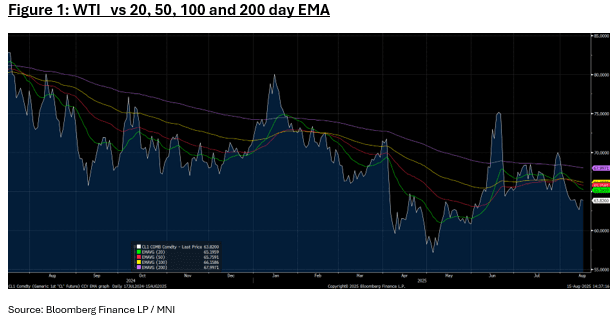
- After finishing yesterday +2.09%, WTI is lower today by a mere -0.14% and -0.09% for the week.
- The strong gains overnight did little to change the technical picture as WTI remains below all major moving averages.
- Brent is down -0.15% in the Asia trading session, but remains up +0.24% for the week.
- OPEC+ crude oil production moderated in June for the first monthly decline for the year after reaching a 24-month-high in June. Saudi Arabia led the fall in production, easing its output after a surge in June.
- Chinese state-owned and mega-sized private refiners are snapping up Western Russian crude cargoes for Oct. and Nov. arrival as India eases off, according to Kpler (a global trade analytics company provider).
- The risks remain that a less than constructive discussion between US and Russia in Alaska could see a knee-jerk reaction from Trump resulting in increased sanctions against Russia that impact its flow of oil.
- US President Donald Trump warned he would impose "very severe consequences" if Vladimir Putin didn't agree to a ceasefire agreement later this week.
- Despite the imminent threats from the summit, global oil markets could record surplus next year as demand growth slows and supplies swell, the International Energy Agency said, with oil inventories forecast to grow at their fastest pace in 5-years.
- Oil inventories will accumulate at a rate of 2.96 million barrels a day, surpassing even the average buildup during the pandemic year of 2020, data from the IEA's monthly report showed. World oil demand this year and next is growing at less than half the pace seen in 2023.
Gold Holds Modest Gains But Down for the Week
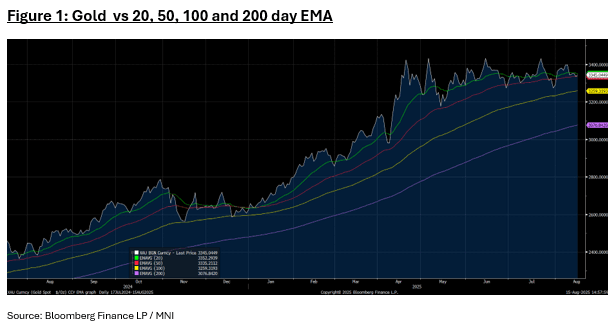
- Gold has delivered modest gains today of +0.29% taking bullion to US$3,345.19 yet remains down -1.54% for the week.
- Overnight US data saw strong producer price data cast doubt on Fed easing prospects, with a September Fed rate cut now no longer fully priced. US wholesale inflation accelerated in July by the most in three years, suggesting companies are passing along higher import costs related to tariffs. US wholesale inflation accelerated in July, suggesting companies are passing along higher import costs related to tariffs. The producer price index increased 0.9% from a month earlier, with services costs increasing 1.1% and goods prices excluding food and energy rising 0.4%. Certain policy-related price increases, such as a 1.2% rise in financial services and insurance costs, will contribute to core PCE inflation.
- Gold remains in tight ranges between the 20-day EMA $3,352.28 and the 50-day $3,335.20.
CHINA: No Change in Trend for House Prices in July
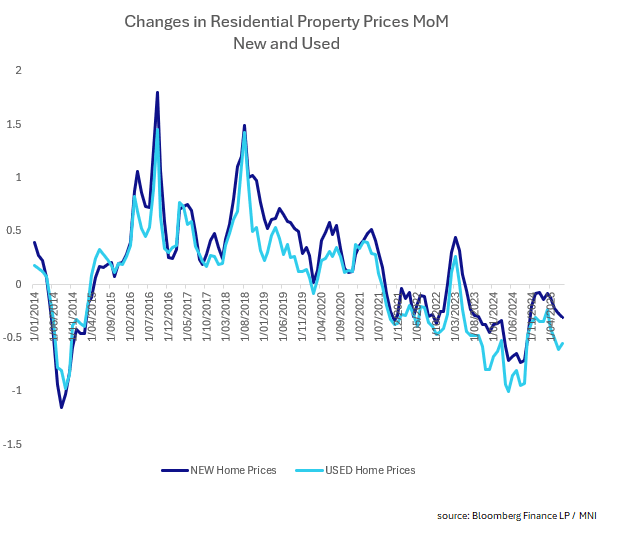
- The deflationary pressure seen in new and used home prices showed no sign of abating in the July release.
- New home prices fell further for both new and used homes.
- New prices were down -0.31% in July, from -0.27% in June.
- New home prices -3.37% YoY vs -3.69% in June and rose in 6 cities MoM, 5 cities YoY vs 14 cities MoM and 3 cities YoY in June.
- Beijing new home prices unchanged for July; down -3.6% YoY and Shanghai new home prices +0.3% for July; up +6.1% YoY.
- Used home prices were down -0.55% in July, from -0.61% in June.
- Used home prices down -5.85% YoY vs -6.09% in June and rose in 1 city MoM vs 1 in June.
- Beijing existing home prices -1.1% for July and down -2.9% YoY and Shanghai existing home prices down -0.9% for July and down -2.2% YoY
- The survey is conducted across 70 cities.
CHINA: Retail Sales Moderate Further in July
- China's retail sales for July missed forecasts and was weaker than the month prior.
- July retail sales expanded +3.7%, the slowest since November 2024 and a second consecutive month of moderation.
- Both Urban and rural sales moderated with consumer goods one of the largest falls.
- Online retail sales grew by +9.2% Year to date to be CNY8.68ttn
- The year to date release saw a moderation also at +4.8%, from +5.0% in June.
- A potential upside for retail sales comes from the policy announcement this week for subsidy plans on loan interest for individuals and businesses aimed at improving consumption. The new policy focuses on subsidies on interest for qualifying personal loans and eligible business loans located within the service sector. The policy is aimed at providing strong support for the sustained growth of the Chinese economy and this plan is aimed to boost it further.
CHINA: Industrial Production Expansion Weakest Since November
- July's industrial production expanded +5.7%, missing estimates of +6.0% and below June's result of +6.8%.
- This was the weakest monthly result since November 2024
- Both the mining and manufacturing sectors were weaker than June with the largest declines from major industries coming from autos, agri and food.
Oil and gas was the only major sector to expand relative to June.
ASIA FX: CNH Shrugs Off Weaker July Data, USD/HKD Slumps On Higher Hibor Rates
In North East Asia FX, USD/CNH is a touch higher, with the weaker July data outcomes weighing only at the margin. However, near 7.1850 leaves us comfortably within recent ranges. Local equities are still up modestly, with focus potentially on further stimulus measures. Focus this week has been on subsidy plans on loan interest for individuals and businesses aimed at improving consumption. Another proposal considered would see state owned enterprises purchasing unsold homes. The authorities also noted July activity was impacted by floods and high temperatures.
- South Korea markets have been out today, while USD/TWD is testing above 30.00. At 30.04 this is fresh multi month highs for the pair. In the past week there has been a notable slowdown in offshore equity flows, after a strong run higher in the period prior. Negative seasonality could also remain in play for TWD.
- Spot USD/HKD is down noticeably, the pair last near 7.8200, which is fresh lows back to mid May. Hibor rates have come to life in recent sessions, as HKMA's on-going intervention and liquidity withdrawal has started to impact. The 1 week Hibor was set today at 0.95%, we were at 0.35% on Wednesday. T/N HKD points at -6.0, so still negative but also back to mid May levels.
ASIA FX: USD/PHP & USD/IDR Firm With US Yield Bounce, Rupiah Up For The Week
In South East Asia FX, the USD has mostly firmed, amid positive carry over from Thursday's session, where the PPI beat aided US Tsy yields. PHP has lost over 0.40%, while IDR is down 0.30%.
- USD/IDR is back above 16160, up around 0.30%. Recent lows rest at 16090 and IDR is still up around 0.80% for the week, the best performer in EM Asia FX. Local stocks hit a fresh record high earlier, but gains have since been pared and we are back around flat. Focus is on President Prabowo's annual address, while the 2026 fiscal outlook will also be discussed later. Aiming for better growth, but along with fiscal responsibility, will market watch points.
- USD/PHP has risen back above 57.00 into the 57.15/20 region. This is quite a bounce from yesterday's 56.65 low. It puts us back above all key EMAs but these points haven't been a strong inflection point for the market of late. Current levels marked highs for the pair this week, while earlier in May we were above 57.50. June remittances were stronger than forecast, up 3.7% y/y (2.8% was forecast).
- USD/THB is up a more modest 0.15%, last near 32.42. Earlier highs were at 32.49, so we remain within recent ranges.
- USD/MYR is back around 4.2190, up around the same amount, but still 0.55% stronger in ringgit terms so far this week. Earlier lows this week were at 4.1865, which has been a support zone for the pair going back to early May.
- USD/SGD is down slightly, last under 1.2840, but is close to Thursday highs (1.2852). SGD may be seeing some benefit from firmer G10 levels versus the USD, most notable JPY (up 0.40%).
UP TODAY (TIMES GMT/LOCAL)
| Date | GMT/Local | Impact | Country | Event |
| 15/08/2025 | 0700/0900 | * |  CH CH | CH Flash GDP |
| 15/08/2025 | 1230/0830 | ** |  CA CA | Monthly Survey of Manufacturing |
| 15/08/2025 | 1230/0830 | ** | CA | Wholesale Trade |
| 15/08/2025 | 1230/0830 | *** |  US US | Retail Sales |
| 15/08/2025 | 1230/0830 | ** | US | Import/Export Price Index |
| 15/08/2025 | 1230/0830 | ** | US | Empire State Manufacturing Survey |
| 15/08/2025 | 1230/0830 | *** | US | Retail Sales |
| 15/08/2025 | 1300/0900 | * | CA | CREA Existing Home Sales |
| 15/08/2025 | 1315/0915 | *** | US | Industrial Production |


