MNI EUROPEAN MARKETS ANALYSIS: Japan Services Inflation Firms
- US Tsy yields are down modestly as Fed Governor Waller advocated lowering the policy rate 25bps at the next FOMC meeting. The USD is down, but only modestly.
- Japan CPI was close to expectations, but services prices firmed. USD/JPY has nudged a little higher though, while JGB futures are stronger and at Tokyo session highs, +25 compared to settlement levels. This weekend we have upper house elections in Japan.
- Looking ahead, we have German PPI, while in the US, housing starts are out, along with the July U. of Mich Sentiment reading.
MARKETS
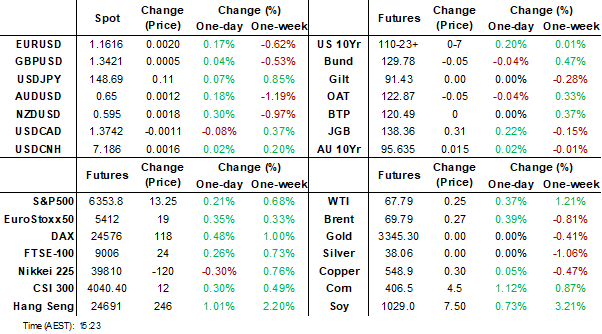
US TSYS: Asia Wrap - Waller Gets Yields Lower In Asia
The TYU5 range has been 110-19 to 110-24 during the Asia-Pacific session. It last changed hands at 110-23, up 0-06+ from the previous close.
- The US 2-year yield has moved lower trading around 3.887%, down 0.02 from its close.
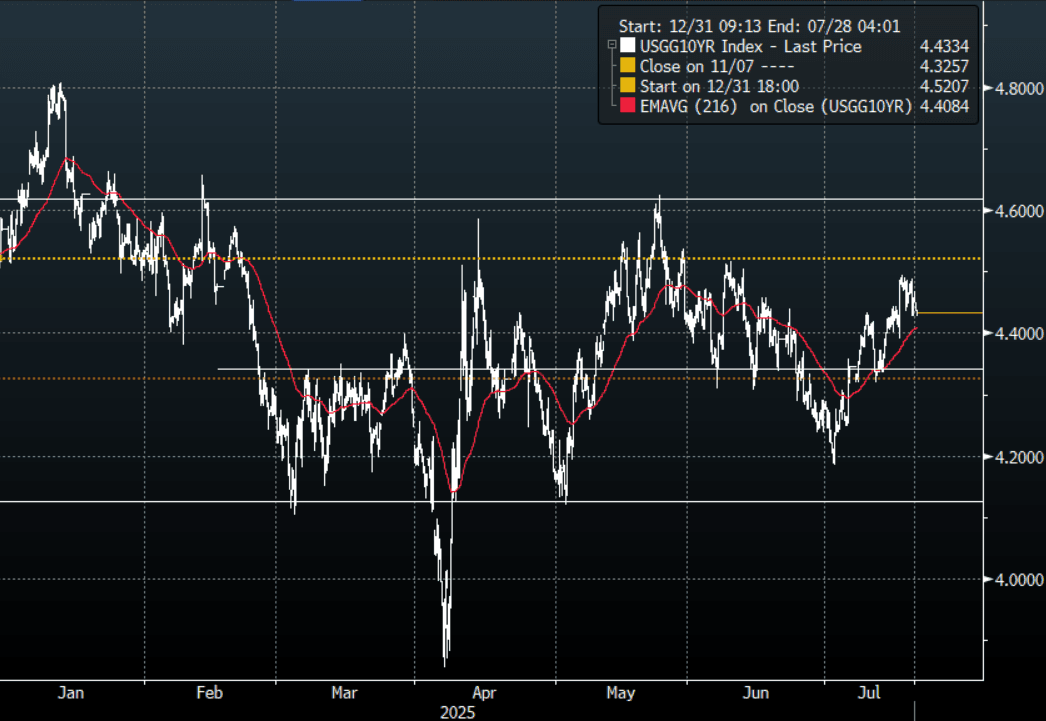
- The US 10-year yield has moved lower trading around 4.433%, down 0.02 from its close.
- The 10-year yield broke above 4.45% in response to the CPI Data, this implies price is likely to turn its focus back to 4.65% and could see further paring back of longs. Support is now back towards the 4.35/40% area which has been the pivot in the larger 4.10% - 4.65% range.
- Nick Timiraos on X: “Waller removes any doubt: He'll vote for a July cut. The opening line of the speech gets to the point: My purpose this evening is to explain why I believe that the FOMC should reduce our policy rate by 25 basis points at our next meeting. Waller arrives at this out-of-consensus position (relative to his colleagues) because he thinks the Fed should look through tariffs and move rates closer to neutral. “We should not wait until the labor market deteriorates before we cut the policy rate.”
- “Torsten Slok, chief economist at Apollo Management, believes "The market is way, way too eager to price in cuts," and sees one rate cut by the end of 2025, while the market is leaning to two cuts.” - BBG
- (Bloomberg) -- “Fed Chair Jerome Powell pushed back against criticism over a $2.5 billion renovation project at its headquarters in Washington, saying the bank takes its responsibility to be good stewards of public resources seriously.”
Data/Events: Housing Starts, U. of Mich. Sentiment survey
Fig 1: 10-Year US Yield Hourly Chart
Source: MNI - Market News/Bloomberg Finance L.P
STIR: $-Bloc Markets Firmer Over Past Week, Except For Australia
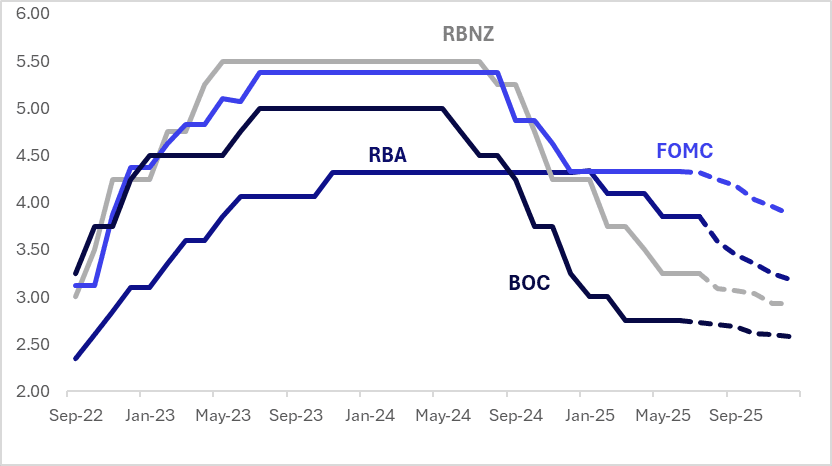
Interest rate expectations across dollar-bloc economies firmed over the past week—except in Australia, where rates softened by 4bps.
- The move was led by Canada (+11bps), followed by the US (+7bps) and New Zealand (+3bps).
- Canada's core inflation rates remained around 3% in June because of elevated shelter costs while headline prices quickened as expected, adding to evidence that without a major disruption from the U.S. trade war economic data is giving the central bank has little scope to cut interest rates at the end of the month. Statistics Canada's "trim" core inflation rate was unchanged at 3% while the "median" index moved up a tenth to 3.1%. Both measures are at the top of the Bank of Canada's 1% band around its 2% target for headline prices. Governor Tiff Macklem has said that while core rates may overstate trend inflation it's likely above 2%.
- The Australian June labour force report came in weaker than expected. Employment rose by just 2k, well below the +20k consensus forecast, following a revised -1.1k fall in May (originally reported as -2.5k). The unemployment rate climbed to 4.3%, above both the 4.1% forecast and May’s 4.1% outcome. More concerning for Governor Bullock and the RBA Board is the softening momentum across broader labour market indicators. The underemployment rate edged up from 5.9% to 6.0%, the underutilisation rate rose from 10.1% to 10.3%, and total hours worked fell 0.9% month-on-month in June.
- Looking ahead, the next key events for the region are the FOMC and BoC meetings on July 30, with markets pricing around a 5% chance of a 25bp cut.
- Looking ahead to December 2025, current market-implied policy rates and cumulative expected easing are as follows: US (FOMC): 3.88%, -45bps; Canada (BOC): 2.58%, -17bps; Australia (RBA): 3.18%, -67bps; and New Zealand (RBNZ): 2.93%, -32bps.
Figure 1: $-Bloc STIR (%)
Source: Bloomberg Finance LP / MNI
JAPAN DATA: Headline CPI Moderates, Services Prices Tick Up Though
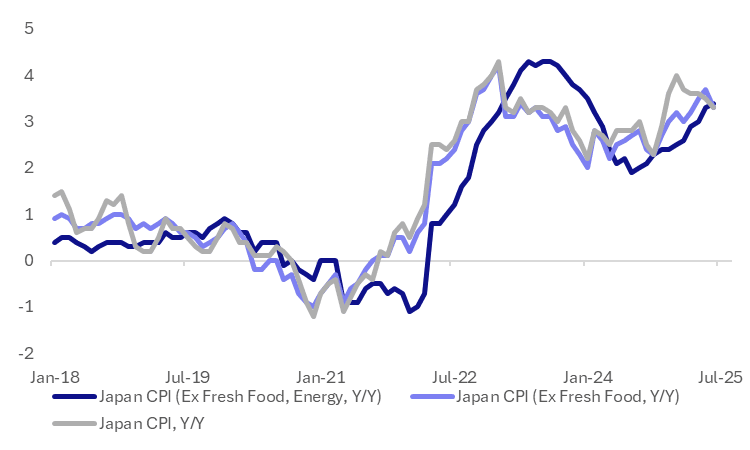
Japan's nationwide CPI print for June was close to market forecasts. Headline CPI printed 3.3%y/y, in line with consensus expectations, while the prior outcome was 3.5%y/y. The core measure which excludes fresh food was 3.3%y/y as well (forecasts were at 3.4%, May's outcome was 3.7%). The measure which also excludes energy was 3.4%y/y, against a 3.3% forecast, which was also the prior outcome.
- The chart below plots these three inflation measures, with headline and core ex fresh moving off recent highs. Still, the core ex fresh food and energy measure ticked up to 3.4%y/y, which is highs back to the start of 2024.
- The measure which excludes all food and energy was steady at +1.6%y/y. Services prices edged up to 1.5% from 1.4% in May.
- In terms of the m/m outcomes, goods prices fell by 0.1%, while services prices rose 0.3%m/m.
- Sub category trends were mostly softer though (albeit un-seasonally adjusted). Food was up 0.2%m/m, but fresh food fell by 2.0%. Utilities were down -1.0%m/m, so too was entertainment. Only household goods, up 0.1%m/m was positive, with other categories down modestly or flat for the month.
- Looking ahead focus will be on whether the June services price rise is sustained. Such a backdrop would give the central bank more confidence around sustainably achieving its inflation target. Still, this data is unlikely to shift near term BoJ thinking, with the central bank seen on hold at the end July meeting outcome.
Fig 1: Japan CPI Trends Y/Y - Mixed Outcomes In June
Source: Bloomberg Finance L.P/MNI
JGBS: Bull-Flattener Ahead Of Upper House Elections
JGB futures are stronger and at Tokyo session highs, +25 compared to settlement levels.
- (Bloomberg) - "BOJ's Eye Will Be on Heat Hidden in Cooler CPI. Japan's June CPI report reveals mixed inflation dynamics, with softer energy costs tempering headline and core price gains. Firms continued to pass on higher costs of labour as well as rice to consumers in a variety of areas, nudging up the gauge that excludes fresh food and energy. The Bank of Japan will focus on the underlying strength, a sign the wage-price cycle is gaining traction and moving inflation closer to its 2% target."
- (Bloomberg) - "Polls for Japan's July 20 upper house election suggest Prime Minister Shigeru Ishiba's Liberal Democratic Party and its coalition partner Komeito risk losing their majority in the chamber. That outcome would leave Ishiba heading a weakened coalition - unable to drive key legislation or, in the worst case, stepping down as leader."
- Cash US tsys are ~1bp richer in today's Asia-Pac session.
- Cash JGBs are 2-5bps richer across benchmarks, with a flatter curve. The benchmark 10-year yield is 3.4bps lower at 1.534% versus the cycle high of 1.60%.
- Swap rates are 1-7bps lower, with longer-dated swap spreads tighter.
- On Monday, the local calendar will be out for the Marine Day holiday.
AUSSIE BONDS: Slightly Richer But Off Bests, RBA Minutes On Tuesday
ACGBs (YM +1.0 & XM +0.5) are slightly stronger but well off Sydney session bests.
- Cash US tsys are 1-2bps richer in today’s Asia-Pac session.
- Nick Timiraos on X: "Waller removes any doubt: He'll vote for a July cut. The opening line of the speech gets to the point: My purpose this evening is to explain why I believe that the FOMC should reduce our policy rate by 25 basis points at our next meeting. Waller arrives at this out-of-consensus position (relative to his colleagues) because he thinks the Fed should look through tariffs and move rates closer to neutral."
- Cash ACGBs are 1-2bps richer with the AU-US 10-year yield differential at -10bps versus -13bps early in the session.
- The bills strip has seen a modest bull-flattener, with pricing flat to +1.
- RBA-dated OIS pricing is softer across meetings today. A 25bp rate cut in August is given a 99% probability, with a cumulative 65bps of easing priced by year-end.
- On Monday, the local calendar will be empty, ahead of the RBA Minutes for the July Meeting on Tuesday.
- A new 21 October 2036 Treasury Bond is planned to be issued via syndication in the week beginning 21 July 2025 (subject to market conditions).
BONDS: NZGBS: Closed On A Weak Note, Underperforms $-Bloc, Q2 CPI On Monday
NZGBs closed modestly cheaper, with benchmark yields 2-3bps higher, after trading in narrow ranges. Cash US tsys are ~2bps richer in today’s Asia-Pac session.
- Accordingly, the NZ 10-year has underperformed its $-bloc counterparts, with the NZ-US and NZ-AU yield differentials 6bps and 4bps wider, respectively.
- June Credit Card Spending falls 1.1% m/m, +0.9% y/y.
- Swap rates closed 1-2bps higher, with the 2s10s curve flatter.
- RBNZ dated OIS pricing closed 1-4bps firmer across meetings. 16bps of easing is priced for August, with a cumulative 31bps by November 2025.
- On Monday, the local calendar will see Q2 CPI data, with consensus expecting +0.7% q/q and 2.8% y/y.
- Westpac: "We estimate that New Zealand consumer prices rose by 0.6% in the June quarter. The annual inflation rate is expected to rise to 2.8% (up from 2.5% in the year to March). Price pressures are easing in interest rate sensitive areas of the economy, like in the services sector and discretionary spending categories. However, increases in food prices and firmness in administered prices are pushing overall inflation higher.”
FOREX: Asia FX Wrap - BBDXY Drifts Lower On Waller Comments
The BBDXY has had a range of 1205.49 - 1207.31 in the Asia-Pac session, it is currently trading around 1206, -0.10%. The USD has drifted lower in our session and as we head into the weekend the market will be wary of any negative Powell news to potentially come out so it is tough for the market to get long of USD’s with this risk over its head. (Bloomberg) - “Well, evidence for the whole “sell America” theme weakened a bit from the latest TIC data, which showed a huge net inflow of $259.4 billion into US long-term assets in May...the biggest net capital inflow since March of 2021. The buying was dominated by private sector names, and appetite was strong across assets, with inflows of more than $100 billion into both Treasuries and equities.”
- EUR/USD - Asian range 1.1592 - 1.1634, Asia is currently trading 1.1620. The pair is testing its first support around the 1.1600 area. The price still looks a little stretched in the short term and is vulnerable to any correction in the USD, first support around 1.1600 then more importantly the 1.1450 area.
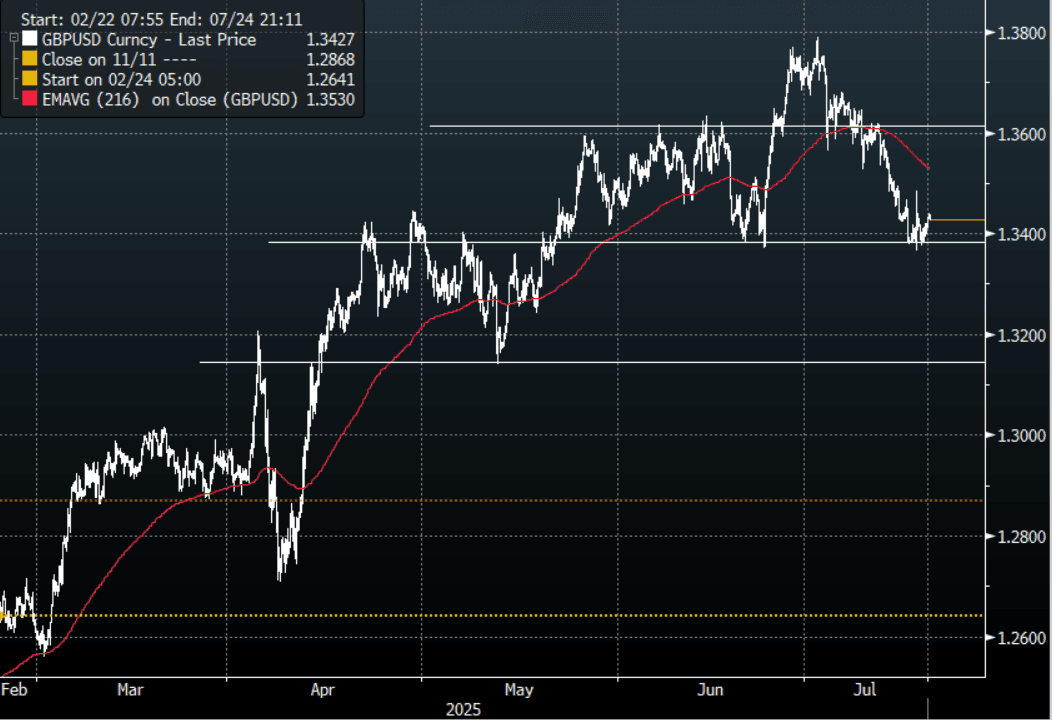
- GBP/USD - Asian range 1.3411 - 1.3441, Asia is currently dealing around 1.3425. The support around 1.3350/1.3400 proved to be solid first up. Bounces back towards 1.3500/1.3550 should now see offers first up.
- USD/CNH - Asian range 7.1805 - 7.1856, the USD/CNY fix printed 7.1498, Asia is currently dealing around 7.1850. Sellers should be around on bounces while price holds below the 7.2000 area and the PBOC manages the fix lower. Above 7.2000 and we could see a test of the USD Shorts.
- Cross asset : SPX +0.15%, Gold $3335, US 10-Year 4.43%, BBDXY 1206, Crude oil $67.70
- Data/Events : EZ Current Account & Construction Output, Germany PPI, Spain Trade Balance, Italy Current Account
Fig 1: GBP/USD Spot 120min Chart
Source: MNI - Market News/Bloomberg Finance L.P
JPY: Asia Wrap - USD/JPY Not Letting Up, Eyes 150/151
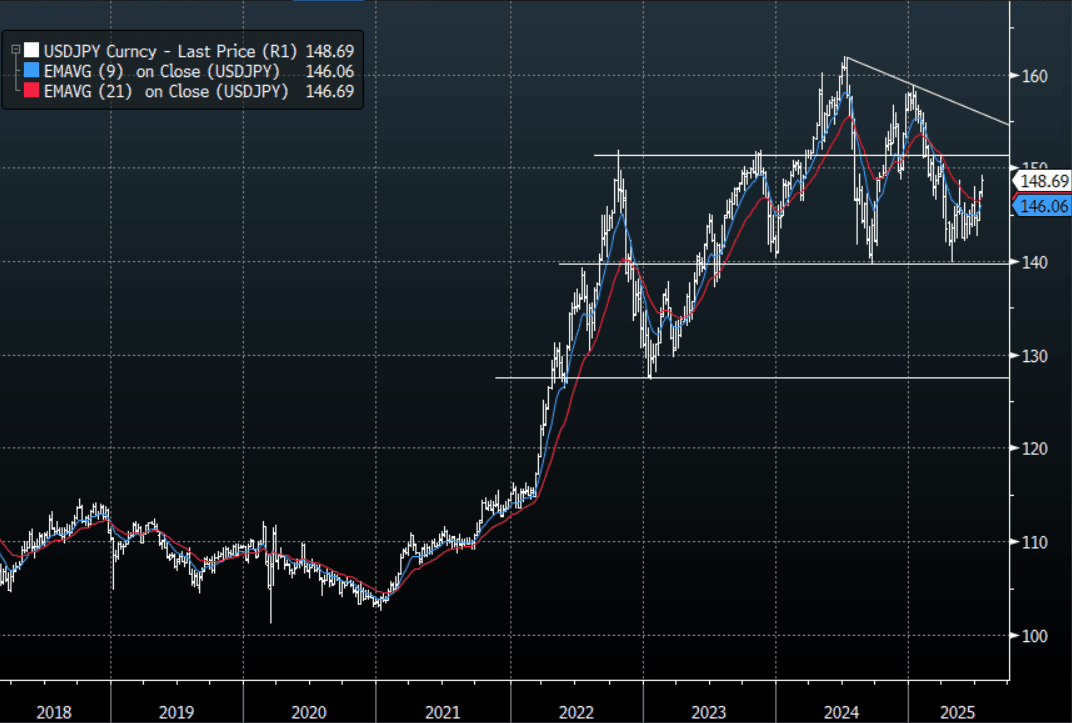
The Asia-Pac USD/JPY range has been 148.29 - 148.73, Asia is currently trading around 148.70, +0.07%. This pair is just not backing off and the price action suggests the JPY longs could face further angst as a test of the 150.00/151.00 area is looking likely unless something changes(Powell being removed ?). Support should now be seen back towards 147.00 first up, then more importantly the 145.00 area. A close back above 151.00 would be very worrying for USD/JPY and it was interesting to see Japanese Officials rattling the cage yesterday regarding the speed of the move.
- (Bloomberg) - “BOJ’s Eye Will Be on Heat Hidden in Cooler CPI. Japan’s June CPI report reveals mixed inflation dynamics, with softer energy costs tempering headline and core price gains. Firms continued to pass on higher costs of labor as well as rice to consumers in a variety of areas, nudging up the gauge that excludes fresh food and energy. The Bank of Japan will focus on the underlying strength, a sign the wage-price cycle is gaining traction and moving inflation closer to its 2% target.”
- (Bloomberg) - “Polls for Japan’s July 20 upper house election suggest Prime Minister Shigeru Ishiba’s Liberal Democratic Party and its coalition partner Komeito risk losing their majority in the chamber. That outcome would leave Ishiba heading a weakened coalition — unable to drive key legislation or, in the worst case, stepping down as leader.”
- Should Prime Minister Shigeru Ishiba’s ruling coalition lose its majority this could see further JPY weakness in response.
- Options : Close significant option expiries for NY cut, based on DTCC data: 147.00($1.25b).Upcoming Close Strikes : 147.00($1.29b July 22), 145.50($1.29b July 21) - BBG.
Fig 1 : USD/JPY Spot Weekly Chart
Source: MNI - Market News/Bloomberg Finance L.P
AUD: Asia Wrap - AUD/USD Drifts Back Above 0.6500 As The USD Recovery Stalls
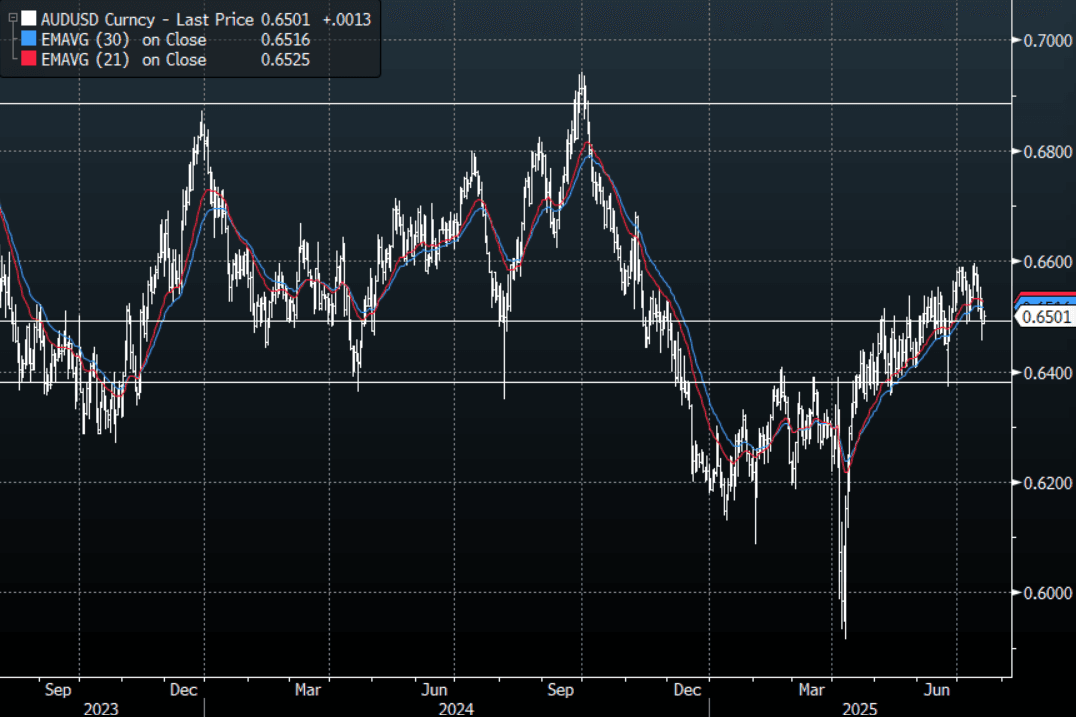
The AUD/USD has had a range of 0.6484 - 0.6511 in the Asia- Pac session, it is currently trading around 0.6505, +0.25%. Decent demand was seen towards the 0.6450 area and we opened in Asia back towards the 0.6500 area once more. Dovish comments this morning by Waller have seen US yields and the USD move lower. This has seen AUD/USD move back above 0.6500 confirming the false break lower overnight, expect offers to reemerge back towards 0.6525/50, but the big USD is going to be the one that ultimately determines where this pair ends up. The market will be wary of any negative Powell to potentially come over the weekend so it is tough for the market to get long of USD’s with this risk.
- Nick Timiraos on X: “Waller removes any doubt: He'll vote for a July cut. The opening line of the speech gets to the point: My purpose this evening is to explain why I believe that the FOMC should reduce our policy rate by 25 basis points at our next meeting. Waller arrives at this out-of-consensus position (relative to his colleagues) because he thinks the Fed should look through tariffs and move rates closer to neutral. “We should not wait until the labor market deteriorates before we cut the policy rate.”
- (Bloomberg) - “ BHP has just released its latest production report. The world’s biggest miner said output of key revenue-earner iron ore rose 2% in the fourth quarter, compared with the year before. Copper output also rose 2%.”
- Options : Closest significant option expiries for NY cut, based on DTCC data: 0.6480(AUD916m), 0.6460(AUD395m), 0.6500(AUD375m) . Upcoming Close Strikes : 0.6500(AUD739m July 21), 0.6600(AUD725m July 21) - BBG
- AUD/JPY - Today's range 96.34 - 96.74, it is trading currently around 96.65, +0.30%. The pair found good demand back towards the breakout area around 96.00, and this will need to hold to build a platform from which to probe higher again. The positive risk backdrop is providing tailwinds.
Fig 1: AUD/USD spot Daily Chart
Source: MNI - Market News/Bloomberg Finance L.P
NZD: Asia Wrap - NZD/USD Bounces Off 0.5900, Trying To Consolidate Above Support
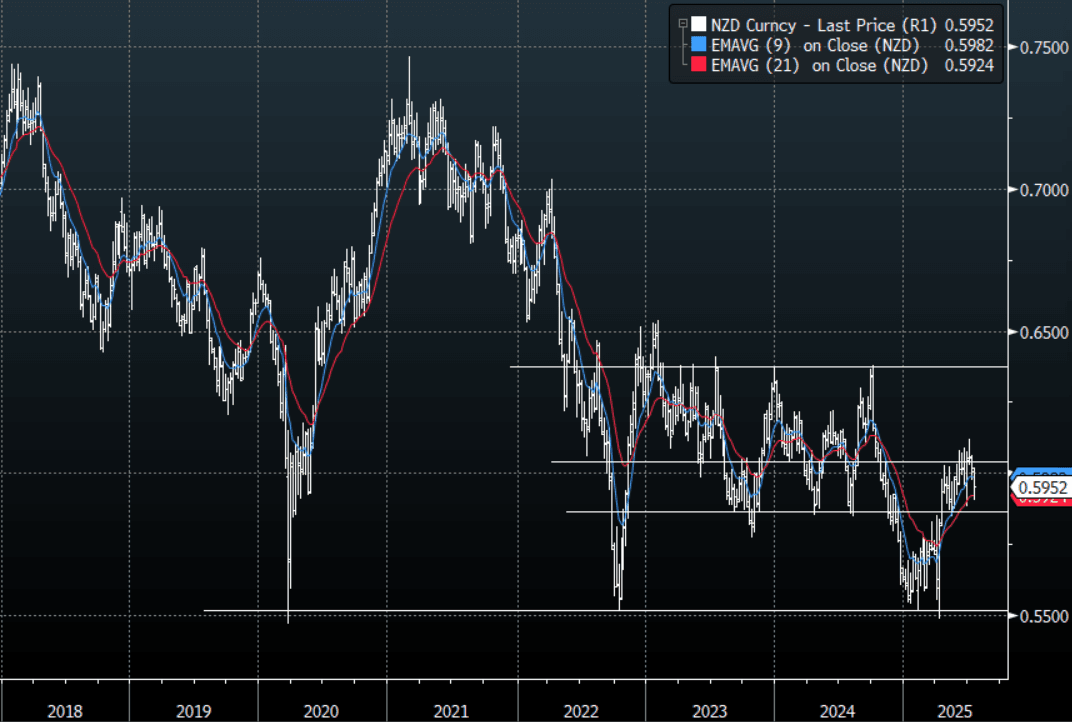
The NZD/USD had a range of 0.5928 - 0.5964 in the Asia-Pac session, going into the London open trading around 0.5955, +0.40%. Dovish comments this morning by Waller have seen US yields and the USD move lower. Decent demand was seen towards the 0.5900 area and we have managed to bounce off this support in our session. This 0.5850/0.5900 area is important support if the pair is to eventually push higher, a weekly close below 0.5850 would turn the picture quite bearish. See Weekly graph below.
- “New Zealand June Credit Card Spending Falls 1.1% M/m, RBNZ Says.” - BBG
- (Bloomberg) -- “Bank of America says the dollar could be poised for a summer rally if the Federal Reserve keeps interest rates steady and institutional investors slow the pace of dollar sales. “We are bearish USD over the medium-term but risk of a summer rally has risen,” FX strategists led by Adarsh Sinha write in a note.”
- Options : Closest significant option expiries for NY cut, based on DTCC data: 0.5932(NZD317m). Upcoming Close Strikes : 0.5905(NZD380m July 21), 0.5750(NZD348m July 23) - BBG
- CFTC Data shows Asset Managers added slightly to their newly built longs in NZD +9229, the Leveraged community added slightly to their shorts last week -8654
- AUD/NZD range for the session has been 1.0916 - 1.0944, currently trading 1.0920. The cross has moved lower in response to the AU Employment data. Dips back to 1.0850/1.0900 should still find support as the pair tries to build momentum to move higher.
Fig 1: NZD/USD Spot Weekly Chart
Source: MNI - Market News/Bloomberg Finance L.P
ASIA STOCKS: Most Markets Higher, Taiwan Outperforms, Japan And Korea Lag
The general backdrop for Asia Pac equities has mostly been positive in the first part of Friday trade. This follows the firm gains for US and EU markets on Thursday, with US markets reaching fresh record highs. Futures are a touch higher so far today.
- Japan markets aren't tracking higher, with the Topix and the Nikkei 225 down marginally. We have the Japan upper house elections this weekend, which may be creating some caution. Opinion polls have suggested the ruling LDP may struggle to hold a majority. Longer dated JGB yields are lower though, while USD/JPY is little changed.
- Taiwan's market is outperforming, up around 1% at this stage. This puts the Taiex index to fresh multi month highs. This follows the solid TSMC results late yesterday, which boosted broader sentiment in the AI/chip space.
- South Korea's market is struggling though, last down around 0.50%. The Kospi hasn't been able to hold above 3200 recently, potentially waiting for the next reform positive catalyst. This has followed a very strong run higher though since late May.
- China and Hong Kong markets are tracking higher, the HSI up around 0.70%, the CSI 300 +0.50% firmer.
- The ASX 200 is up around 1.3% in Australia, which also puts this index at fresh record highs. BHP results aided sentiment in the resource/material space.
- In SEA, Indonesian markets continue to rally, last up around 1.3%, while it has been a quieter so far for the Thailand SET, little changed after yesterday's bumper 3.5% rally. Optimism around a more dovish BoT (with a new Governor coming in a few months), while offshore inflows have also returned to this market.
ASIA STOCKS: Taiwan Equity Inflows Stay Positive, Momentum Improves For Thailand
Equity inflows into Taiwan remained positive yesterday, albeit at slightly reduced momentum seen in recent sessions. Inflows in the past 5 trading sessions are still a healthy +$1.8bn. Positive sentiment around robust TSMC earnings is likely aiding this backdrop. Broader tech equity indices are also either at fresh cycle highs, or close to such levels. Inflows into South Korea have been positive in the last 5 trading days, but in recent sessions momentum has slowed, with the Kospi struggling to hold above the 3200 level.
- Elsewhere, Indian outflows have continued, in line with poorer trends for the headline equity indices.
- Thailand equity inflows have a better run in the past week. Yesterday's inflow was the strongest daily move since late June. The SET index surged +3.5%. Better offshore inflows have been cited as supporting the local index, while the prospect of a potentially more dovish central bank outlook is also another potential positive.
Table 1: Asian Markets Net Equity Flows
| Yesterday | Past 5 Trading Days | 2025 To Date | |
| South Korea (USDmn) | -16 | 639 | -8135 |
| Taiwan (USDmn) | 162 | 1834 | -723 |
| India (USDmn)* | -121 | -659 | -8562 |
| Indonesia (USDmn) | 39 | -89 | -3619 |
| Thailand (USDmn) | 77 | 183 | -2250 |
| Malaysia (USDmn) | -15 | -100 | -2869 |
| Philippines (USDmn) | 0 | -55 | -619 |
| Total (USDmn) | 126 | 1753 | -26777 |
| * Data Up To July 16 |
Source: Bloomberg Finance L.P./MNI
Oil Heading for Weekly Fall on Supply Concerns
- Oil has clawed back some gains in the Asia trading day but if the current trajectory remains, is on track for a weekly loss.
- Oil had a strong night on indications that there is the potential for short term dynamics to increase demand.
- US crude inventory data declined last week at a time when the White House seems adamant that the US stockpile needs to be replenished.
- Additionally, news from Northern Iraq saw drone attacks on Kurdistan oil production which has interrupted supply by up to 200,000 bbl a day it is estimated.
- Iraq approved a plan for its semi-autonomous Kurdish region to transfer oil to Baghdad, a key step toward resuming exports that have been halted for more than two years. The Kurdistan Regional Government will supply Iraq’s state oil marketer SOMO at least 230,000 barrels a day for export, and Baghdad will release funds for salaries of Kurdistan government employees.
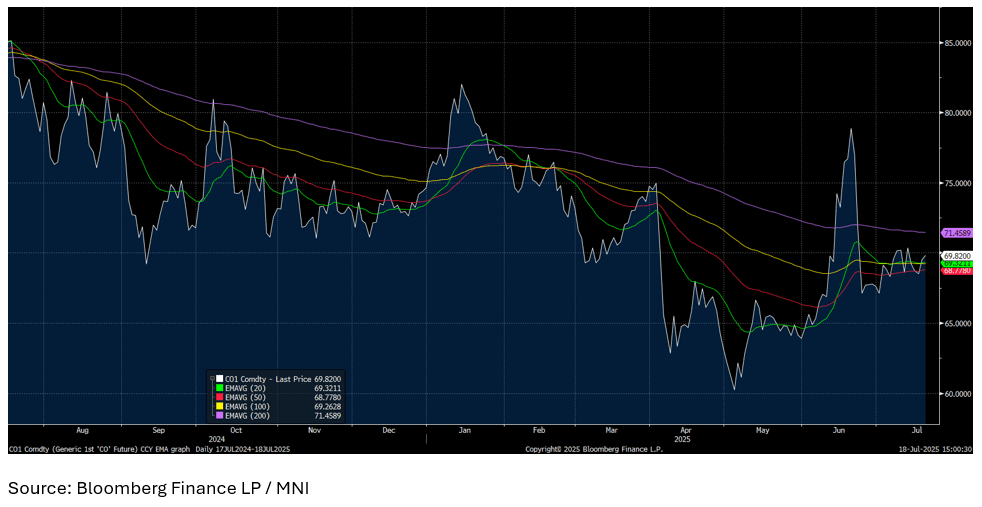
- Currently up +0.44% at US$67.84 bbl, WTI remains lower by -0.90% for the week.
- Brent has gained +0.47% in the Asia trading day, yet remains lower by -0.74% week to date.
- Brent sits between the converged 20-day EMA of $69.32 and below the 200-day EMA of $71.45
Gold Down Modestly, Set for Weekly Fall
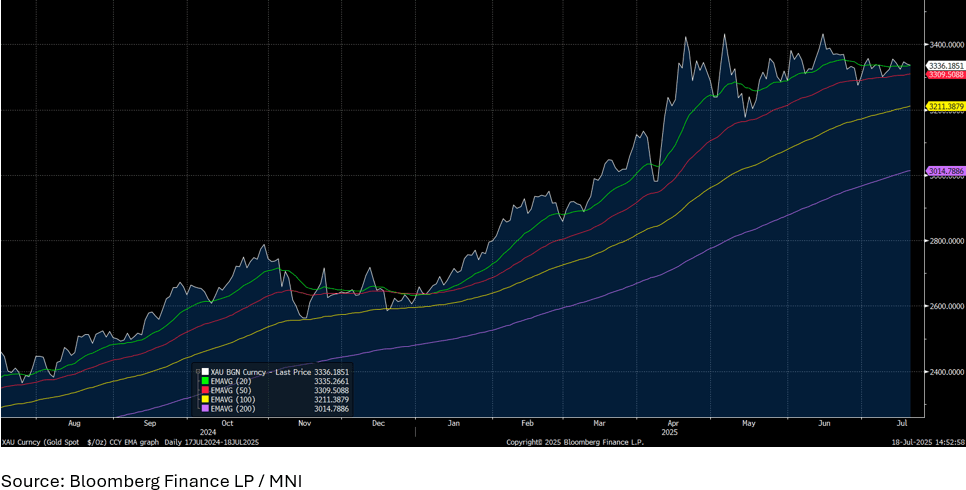
- Gold is down -0.15% at US$3,335.50 in the Asia trading day.
- At these levels, gold remains just $96 off the June high of $3,432.34.
- For the week, gold has lost ground by -0.61%, for it's first weekly loss for the month should the European and US sessions follow suit.
- Gold is highly correlated to US interest rate moves and the data out this week on the US economy has not cemented the idea of a near term interest rate cut.
- Gold is up over 26% year to date on safe haven appeal which this week has been less pronounced.
- Should the ongoing spat between the US President and the the FED Chairman intensify, gold's status could be amplified in the near term.
- Gold remains in line with the 20-day EMA of $3335.25.
MALAYSIA: GDP Up, Exports Very Weak
- In the GDP preview, we worried whether the BNM were cutting rates to head off a material decline in GDP.
- Whilst that concern didn't eventuate with 2Q GDP rising to +4.5% (est. +4.2%; prior +4.4%) where the real surprise came was in the export data release.
- A strong result across most sectors with Agriculture +2% YoY; mining -7.4% YoY; manufacturing +3.8% YoY, Construction +11% YoY; services +5.3% YoY.
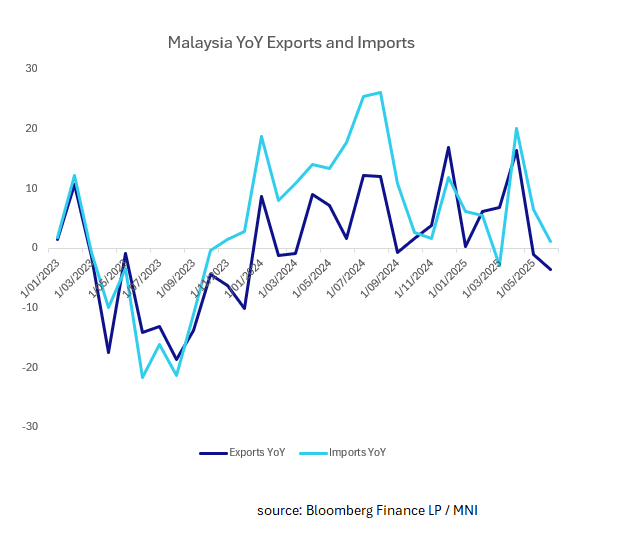
- Exports seemingly collapsed in June, contracting -3.5% for the worst monthly result in 18 months.
- Malaysia has not finalized a trade deal and after the surge in April of exports ahead of tariffs, the data suggests that exporters may now be struggling.
- Exports to the US expanded +4.7%, after +16.1% in May but contracted -9.3% to China.
- In more worrying signs, imports slumped also in what some point to being a weakening of the domestic market.
- At a time when the White House if focused on trade, having an outsized positive Trade balance is not a great headline and the MYR8.59bn surplus is big enough to draw attention.
- Following the BNM cutting rates at their last meeting, there are some observers suggesting that further cuts are coming. The bond market reaction to the data today may be questioning that with bond yields 1-2bps higher across the curve.
SOUTH KOREA: 2s10s Curve Update
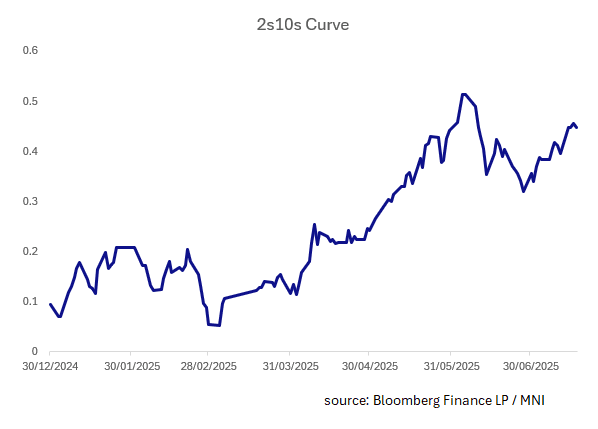
- The steepening of the curve had taken a breather over the last few weeks as the BOK met. However recent sessions as seen the curve steepen again.
- Having reached a year high of +51bps in early June, the 2s10s curve differential had backed off to +35bps by the end of June.
- The curve has steepened again in recent sessions following the recent BOK meeting and stands at +45bps.
- Next week sees some Tier 1 economic data out with PPI early in the week, followed by GDP 2Q
- The Korean bond market has the highest correlation to the US bond market according to our analysis. The UST 10s2s steepening began at the start of April when the US curve moved from 26bps to 64bps before retreating back to trade in range of +44 and +54bps since.
- The Korean curve could be starting to re-calibrate growth expectations for 2025. Current forecasts suggest a mere +1.0% GDP growth for 2025 but as South Korea's parliament has approved a supplementary government budget on May 1 of 13.8 trillion won ($9.7 billion), this could represent upside potential for the growth outlook.
- In 2020 the COVID impacted budget resulted in a deficit of -2.7% and GDP growth the following year of 4.6%. The deficit for 2024 was -3.4% with a skew towards the back end of the year. The 2025 budget forecast at this stage is -2.3% and would be two meaningful deficits in two years for the first time in some time following 2024's deficit of -3.4%.
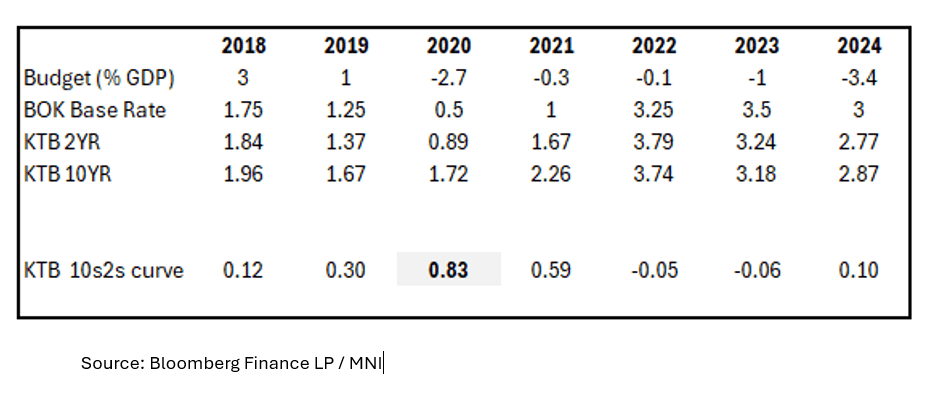
- Looking back at 2020, the curve steepened to 0.83 at year end as the COVID economy required significant budget spend. This could suggest potential steepening to occur in the mid part of 2025 for KTBs should the BOK cut rates as expected and supplementary budgets positively impact growth.
ASIA FX: Little Change To End The Week In NEA FX
North East Asia FX is little changed in the first part of Friday dealings. USD/CNH is holding near 7.1850, while USD/KRW was just above 1392, and USD/TWD near 29.40. USD/HKD sits near 7.8490, off the topside of the peg band, but above recent lows around 7.8425.
- The USD/CNY fixing rose, while the error term was slightly tighter which may have left slightly less support for CNH, but market sentiment in the FX space hasn't moved. Local equities are higher, amid broadly positive global optimism in the space, but the CSI 300 is still under recent highs.
- Spot USD/KRW has traded a fairly tight range so far today, last near 1392. We remain close to recent highs around 1396.55 (which also coincides with the 100-day EMA). The recent uptrend in the pair remains. Local equities have struggled to build a foothold above 3200 recently, following the very strong run up in recent months.
- USD/TWD is near 29.40 in latest dealings, unchanged. The equity and flow backdrop is positive, post TSMC's earnings update yesterday. This, along with a firm chip export outlook, should cap upside in USD/TWD, although we may see further gains in the near term on dividend related outflows.
- Spot USD/HKD saw a brief move lower yesterday towards 7.8425, but sits back close to the top end of the peg band now (near 7.8490). Today's Hibor fixes have seen rates soften, the 1 week back down to 0.26%, providing little HKD support. Yesterday's brief move lower in USD/HKD did not appear Hibor related though.
ASIA FX: SEA FX Marginally Stronger To End The Week
In South East Asia FX, the bias has been for modest USD losses, but aggregate moves have not been large at this stage. Gains are not beyond 0.20% at this stage for most pairs.
- USD/THB got to lows of 32.38, but sits back above 32.40 now, so within recent ranges. Thailand officials are confident that the country will be able to achieve similar tariff rates similar to other countries in the region. Thailand equities are pushing higher again today, up +0.80%, putting the SET through 1200. Offshore investor interest has certainly been stronger this past week.
- USD/MYR is around 4.2450 in latest dealings, little changed for the session. Earlier we had Q2 GDP, which was slightly above expectations, printing at 4.5%y/y. Still, June export growth fell sharply to -3.5%y/y, against a +5.4% forecast.
- USD/IDR is a little lower, but still above 16300 at this stage. Outflows pressures from local equities and bonds have less evident as this week has progressed but haven't turned meaningful positive yet. Local equities continue to surge higher, up to 7379 in latest dealings, fresh highs since Dec last year.
- USD/PHP has edged down a touch, last in the 57.15/20 region. Recent highs in the pair rest at 57.26.
UP TODAY (TIMES GMT/LOCAL)
| Date | GMT/Local | Impact | Country | Event |
| 18/07/2025 | 0600/0800 | ** |  DE DE | PPI |
| 18/07/2025 | 0800/1000 | ** |  EU EU | EZ Current Account |
| 18/07/2025 | 0900/1100 | ** | EU | Construction Production |
| 18/07/2025 | - | EU | ECB Cipollone At G20 Meeting | |
| 18/07/2025 | 1230/0830 | *** |  US US | Housing Starts |
| 18/07/2025 | 1230/0830 | *** | US | Housing Starts |
| 18/07/2025 | 1400/1000 | *** | US | U. Mich. Survey of Consumers |
| 18/07/2025 | 1400/1000 | ** | US | University of Michigan Surveys of Consumers Inflation Expectation |
| 18/07/2025 | 1700/1300 | ** | US | Baker Hughes Rig Count Overview - Weekly |
| 18/07/2025 | 1700/1300 | ** | US | Baker Hughes Rig Count Overview - Weekly |


