MNI EUROPEAN MARKETS ANALYSIS: AUD/JPY Back Above 100.00
- Risk sentiment has surged, as the US Senate moved to end the government shut down (with a number of Democrats supporting the vote in the Senate). US Tech futures have outperformed, while Asia Pac equities are mostly in the green.
- US Tsy yields are higher, while the risk on tone is aiding higher AUD/JPY levels (back above 100.00). Aussie bond futures are testing key support as well. Earlier remarks from the RBA suggested further easing may be constrained by limited spare capacity.
- Later the Fed’s Daly and Musalem speak as well as BoE’s Lombardelli. There are no material data releases.
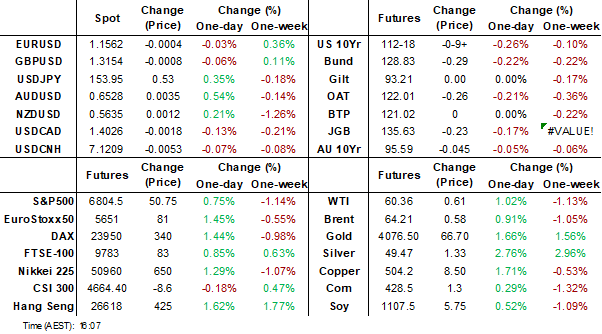
MARKETS
US TSYS: Sell Off Gathers Pace in PM Trading on Shutdown Hopes
The sell off of US bonds continued into the afternoon, as bond futures all dipped. The US 10-Yr bond future is down -09 at 112-18+ and is at the mid-point below the 50-day EMA of 112-25+ and above the 100-day EMA of 112-12+.
Cash sold off as the US inches towards a resolution of the shutdown, with bonds wearing the brunt. A sharp sell off at the opening of cash trading slowed as the morning went on but gathered some pace after the lunch time break, with most maturities a further 0.5bps to 1.0bps higher in the afternoon alone.
- The 2-Yr is up +3.3bps to 3.597%
- The 5-Yr is up +3.8bps to 3.724%
- The 10-Yr is up at 4.136%, +3.7bps higher
- The 30-Yr is up +3.7bps to 4.738%.
The key auction tonight will be a US$86bn 13-week and US$77bn 26-week bills auction. The key test will be the US$42bn 10-Yr on the 13th.
There is no scheduled Tier 1 data tonight, but markets will focus predominantly on the vote to end shutdown with news that enough Democrats in the senate will vote to pass a bill to end the impasse.
JGBS: Bear-Steepener Ahead Of Tomorrow's 30Y Supply
JGB futures are weaker and near session lows, -20 compared to settlement levels.
- "JAPAN PM TAKAICHI: NOT RULING OUT SALES TAX CUT AS OPTION IN FUTURE, BUT IMMEDIATE PRIORITY IS TO COMPILE PACKAGE OF STEPS TO CUSHION BLOW FROM RISING COST OF LIVING, CHANGING SALES TAX RATE WOULD TAKE TIME, SO DECISION ON WHETHER TO DO SO WOULD NEED TO TAKE INTO ACCOUNT WAGE, INFLATION LEVELS AT THE TIME - [RTRS]"
- MNI: BOJ board members largely agreed on the need to raise the policy interest rate eventually but saw no urgency to act at the Oct 29-30 meeting, preferring to confirm sustained wage momentum and the firmness of underlying inflation, according to the summary of opinions released Monday.
- Cash US tsys are 3-4bps cheaper in today's Asia-Pac session after headlines that key US Senate Democrats will advance a GOP bill to end the government shutdown. Risk appetite is firmer.
- Cash JGBs have bear-steepened across benchmarks, with yields flat to 3bps higher. This leaves the 2/30 curve within its well-established range ahead of tomorrow’s 30-year supply. (see chart)
- The benchmark 30-year yield is 2.6bps higher at 3.13% versus the cycle high of 3.351%.
- Swap rates are 1-3bps higher.
- Tomorrow, the local calendar will see Trade balance and Bank Lending data alongside 30-year supply.
RBA: Economy May Already Be Close To Capacity, Makes Further Easing Uncertain
Deputy Governor Hauser answered questions at the UBS Australasia Conference and noted that given capacity pressures and policy stance are difficult to measure, the outlook is unclear and the Board is monitoring the incoming data closely. The main takeaway was that the economy could already be close to trend growth and therefore supply constraints making further rate cuts difficult. If growth rises further without strengthening the supply side, then the pickup in inflation seen in Q3 may be persistent.
- Hauser talked of three scenarios – 1. Capacity pressures and demand growth are not as strong as expected and rates are cut; 2. Growth picks up further and labour market is already tight and so no further easing; 3. Trend growth rises as supply-side of the economy grows and productivity growth improves.
- He reiterated there are no point estimates of the NAIRU or “neutral” policy rate but given that capacity is likely a bit tighter, policy is closer to “neutral” than thought a little while ago and the Board will “feel our way” to see how restrictive it is by the impact seen in the data.
- The RBA assumed that two-thirds of the upside surprise in Q3 underlying CPI was temporary with one-third “signal”. It is monitoring outcomes, to see how accurate this judgement call was. He noted though that if the economy is “stuck at capacity”, then inflation could rise again but at this stage the RBA doesn’t know if this is the case.
- The central case is for activity to recover with inflation returning to just above the band mid-point without a material rise in unemployment. However, given heightened uncertainty around the outlook, the only thing for certain is that the forecasts will be wrong.
AUSSIE BONDS: Cheaper With YM1 Testing Support
ACGBs (YM -5.0 & XM -5.0) are weaker with US tsys after headlines that key US Senate Democrats will advance a GOP bill to end the government shutdown. Risk appetite is firmer.
- Cash ACGBs are 3-4bps cheaper with the AU-US 10-year yield differential at +26bps.
- The bills strip has bear-steepened, with pricing -2 to -5.
- The main takeaway from RBA Deputy Governor Hauser's Q&A today was that the economy could already be close to trend growth, and therefore, supply constraints make further rate cuts difficult.
- RBA-dated OIS pricing is showing a 25bp rate cut in December at an 8% probability, with a cumulative 16bps of easing priced by mid-2026.
- Tomorrow, the local calendar will see Westpac Consumer and NAB Business Confidence data.
- However, the highlight of this week's AUS calendar will be Thursday's October jobs data. The unemployment rate rose 0.2pp to 4.5% in September.
- Last month's weak employment data triggered a solid ACGB rally, but those gains were more than fully reversed after the much hotter-than-expected Q3 CPI report. YM1 is currently testing horizontal support at 96.28 (see chart).
- This week, the AOFM plans to sell A$1200mn of the 4.25% 21 December 2035bond on Wednesday and A$800mn of the 1.75% 21 November 2032 bond on Friday.

Bloomberg Finance LP
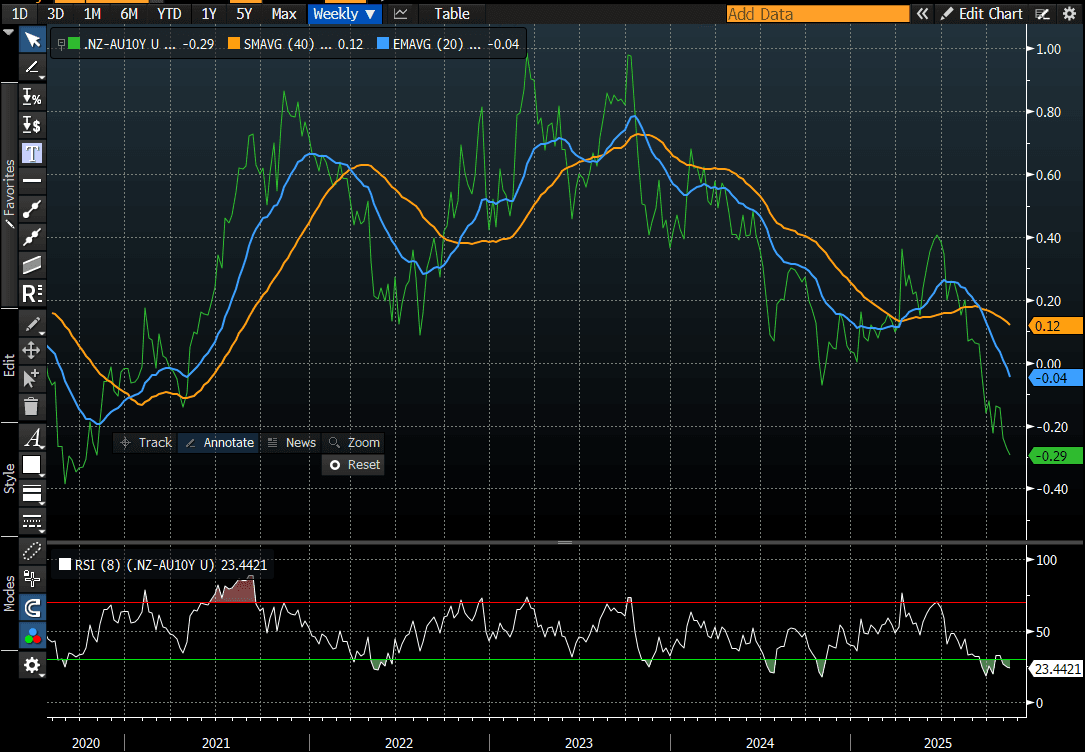
BONDS: Bear-Steepener, NZ-AU 10Y Diff Lowest Since 2020
NZGBs closed showing a modest bear-steepener, with benchmark yields flat to 2bps higher.
- NZGBs outperformed their $-bloc counterparts, with the NZ-US and NZ-AU 10-year yield differentials 2bps and 4bps tighter, respectively.
- At -29bps, the NZ-AU differential is at its lowest since 2020. (see chart)
- Swap rates closed flat to 2bps higher.
- RBNZ dated OIS pricing closed little changed across meetings. 28bps of easing is priced for November, with a cumulative 37bps by February 2026.
- Tomorrow, the local calendar will see the RBNZ's Inflation Expectations data.
- On Thursday, the NZ Treasury plans to sell NZ$250mn of the 4.50% May-30 bond, NZ$150mn of the 4.25% May-34 bond and NZ$50mn of the 5.00% May-54 bond.
Bloomberg Finance LP
JPY: Asia-Pac: USD/JPY Challenging 154.00 Again After Turnaround In Risk
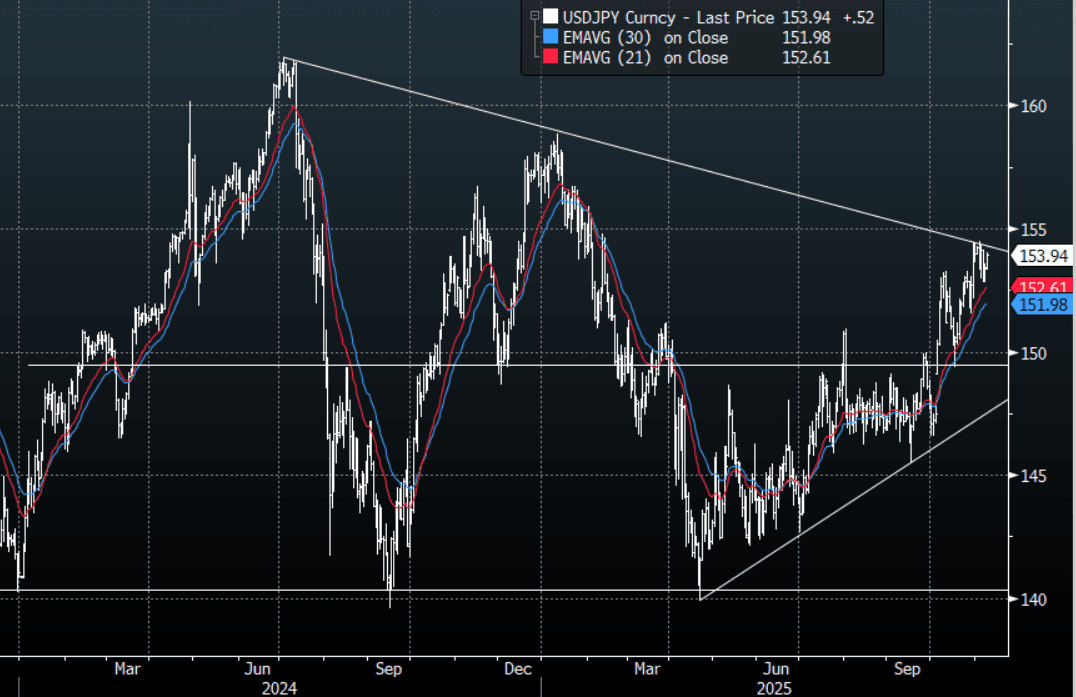
The USD/JPY range today has been 153.45 - 154.03 in the Asia-Pac session, it is currently trading around 153.95, +0.35%. The pair initially gapped higher on the Asian open as reports of a potential deal on the US shutdown made the rounds; it has continued to build on these initial gains as these reports of Dems crossing the aisle have been confirmed. USD/JPY found solid demand around the 153.00 area on Friday again, this positive scenario returns the focus back toward the 154-155 area resistance area once more. A sustained break above is needed to potentially see the uptrend regain upward momentum, the focus would then turn toward the 160 area where I would start to become wary of intervention risks.
- "JAPAN PM TAKAICHI: NOT RULING OUT SALES TAX CUT AS OPTION IN FUTURE, BUT IMMEDIATE PRIORITY IS TO COMPILE PACKAGE OF STEPS TO CUSHION BLOW FROM RISING COST OF LIVING, CHANGING SALES TAX RATE WOULD TAKE TIME, SO DECISION ON WHETHER TO DO SO WOULD NEED TO TAKE INTO ACCOUNT WAGE, INFLATION LEVELS AT THE TIME - [RTRS]"
- MNI: BOJ board members largely agreed on the need to raise the policy interest rate eventually, but saw no urgency to act at the Oct 29-30 meeting, preferring to confirm sustained wage momentum and the firmness of underlying inflation, according to the summary of opinions released Monday.
- Options : Close significant option expiries for NY cut, based on DTCC data: none. Upcoming Close Strikes : none - BBG.
Fig 1 : USD/JPY Spot Daily Chart
Source: MNI - Market News/Bloomberg Finance L.P
AUD: Asia-Pac: AUD/USD Builds On Support As Risk Turns Higher, Eyes 0.6550
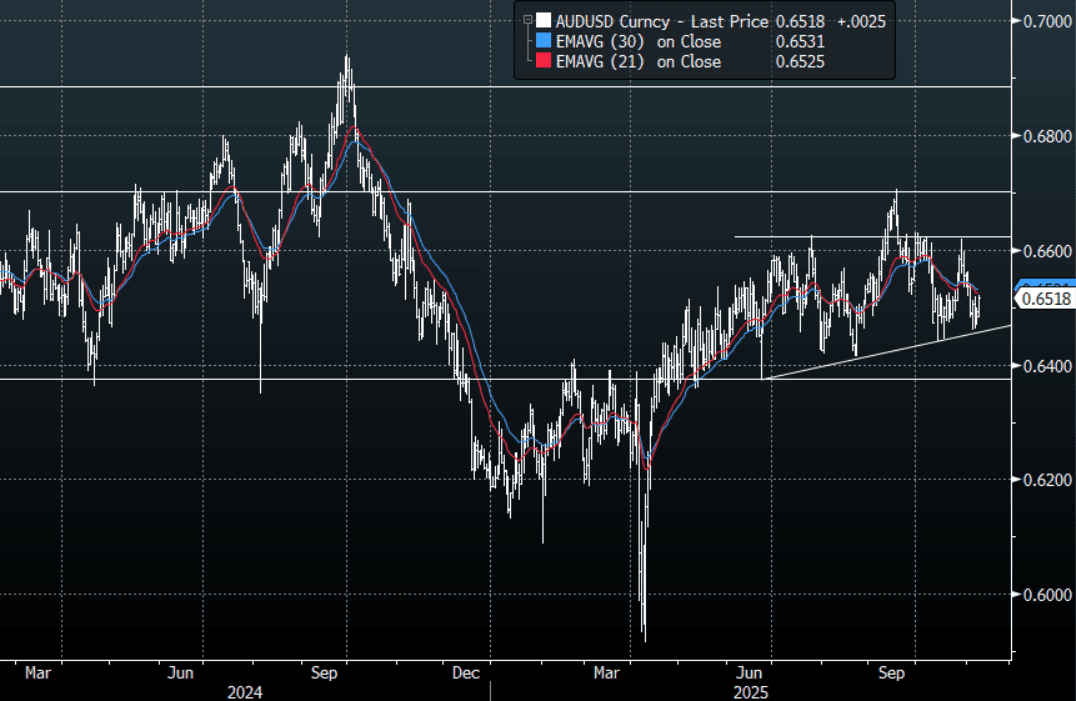
The AUD/USD has had a range today of 0.6483 - 0.6522 in the Asia- Pac session, it is currently trading around 0.6520, +0.40%. A combination of what looks like the end of the US shutdown and better China Inflation data has seen the AUD trade with a clear bid tone to start the week. The AUD/USD has found support and bounced nicely off the 0.6450 area. If risk continues to build on this change in sentiment expect the AUD to remain supported, resistance is around the 0.6550 area. A break above 0.6550 is needed to turn the focus back toward the 0.6650/0.6700 area.
- "SENATE HAS VOTES TO ADVANCE BILL TO END SHUTDOWN" - BBG
- China Inflation: Over the weekend, we had Oct inflation data, which was stronger than expected. Notably, CPI rose 0.2%y/y, against a -0.1% forecast and -0.3% prior outcome. PPI deflation remained at -2.1%y/y, but was a slight improvement on the Sep outcome. On a monthly basis, CPI rose 0.2%, edging up from September's 0.1% growth. Core CPI, which excludes food and energy, rose 1.2% from September's 1.0%, marking the sixth consecutive month of increase and reaching its highest level since Mar 2024
- Options : Closest significant option expiries for NY cut, based on DTCC data: 0.6560(AUD447m), 0.6615(AUD 464m), 0.6630(AUD462m). Upcoming Close Strikes : 0.6500(AUD1.22b Nov 12), 0.6530(AUD882m Nov 12)- BBG
Fig 1: AUD/USD spot Daily Chart
Source: MNI - Market News/Bloomberg Finance L.P
NZD: Asia- Pac: NZD/USD Still Trades Heavy But Wary Of Positioning
The NZD/USD had a range today of 0.5616 - 0.5634 in the Asia-Pac session, going into the London open trading around 0.5630, +0.15%. A combination of what looks like the end of the US shutdown and better China Inflation data has seen the NZD start the week drifting back up off its lows. The NZD continues to trade heavy but it is prudent to be wary of what the reaction to the end of the US shutdown might look like. I am a little wary of positioning in the NZD market though I still suspect any decent bounce will again attract sellers. The first sell area on a pullback would be around 0.5750 and then the more pivotal 0.5850 area.
- "NZ'S PM LUXON WANTS BANKS TO PASS ON RBNZ RATE CUTS FASTER" - BBG
- Bloomberg reports the NZ Treasury says, “New Zealand Economic Recovery Still Emerging. New Zealand’s economy has more spare capacity than previously assumed while a broad-based recovery is still emerging, the Treasury Department says in its Fortnightly Economic Update.”
- Options : Closest significant option expiries for NY cut, based on DTCC data: none. Upcoming Close Strikes : 0.5380(NZD460m Nov 13), 0.5600(NZD538m Nov12), 0.5800(NZD461m Nov 12) - BBG
Fig 1: NZD/USD Spot Daily Chart

Source: MNI - Market News/Bloomberg Finance L.P
FOREX: Asia-Pac FX: USD Drifts Higher In Asia On USD/JPY Move
The BBDXY has had a range today of 1219.55 - 1221.03 in the Asia-Pac session; it is currently trading around 1220, +0.10%. The USD opened stronger in Asia on reports the US shutdown might be ending, this saw risk and Yen-crosses gap higher on the open. The USD/JPY movement dominated the Asian session but I suspect the USD will be sold against risk currencies like the AUD & NZD and even the EUR into the London open should risk build on this initial reaction. Intra-day I suspect sellers should re-emerge back toward the 1223.50 area, the first real buy zone is back toward the 1215 area. Look for the USD to do some work and chop around within the 1215-1230 range. "SENATE HAS VOTES TO ADVANCE BILL TO END SHUTDOWN" - BBG
- EUR/USD - Asian range 1.1542 - 1.1562, Asia is currently trading 1.1550. The pair continued to build on its support below 1.1500, I suspect rallies will now find sellers toward the 1.1650 area initially. This has been the pivot with the larger 1.1400-1.1900 range over the past few months.
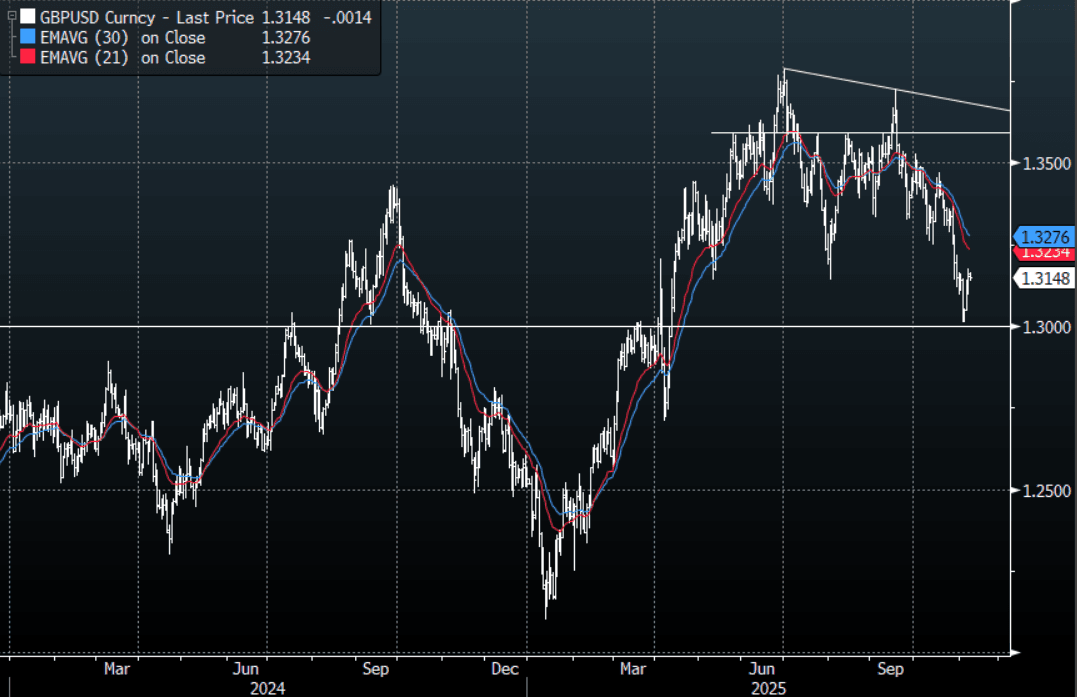
- GBP/USD - Asian range 1.3137 - 1.3164, Asia is currently dealing around 1.3145. The pair continues to build on its bounce off the 1.3000 area. I continue to favor fading rallies though as GBP looks to have put in a medium term top. I suspect the 1.3250-1.3300 area is the place to fade if we see that level again.
- Cross asset : SPX +0.70%, Gold $4050, US 10-Year 4.1340%, BBDXY 1220, Crude Oil $60.20
- Data/Events : EZ Sentix Investor Confidence
Fig 1: GBP/USD Spot Daily Chart
Source: MNI - Market News/Bloomberg Finance L.P
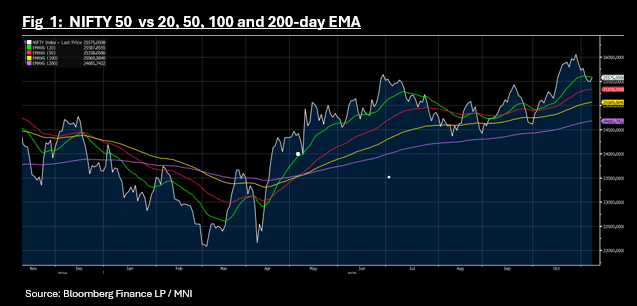
ASIA STOCKS: Tech Bounces Again, NIFTY 50 Nears Key Technical
The sell off in Asia's tech sector appears short lived as bell weather shares like SK Hynix in Korea, jump over 7% today. Last week's decline was the worst in over six months for the tech sector with many key names delivering record breaking gains. Last week's falls started in Wall Street and wasn't helped by warnings from the Korea exchange and is a reminder of stock bubbles of the past. Some key bourses in Asia (like the KOSPI and TAIEX) face concentration risk with the tech sector given their surge, as the sector's share of the index reaches new highs. Risk appetite returned today as it appears the US shutdown could be ending, with most major bourses higher today.
- The NIKKEI delivered gains of +0.93% to reach 50,755, just back from last week's high of 50,752 whilst the KOSPI rose almost 3.00% to reach a new recover more than half of last week's falls.
- In China the story was more mixed with the onshore offshore divide on show. The Hang Seng is up +0.61% whilst onshore bourses are all down modestly. The CSI 300 fell -0.24% to 4,667 but remains above the 20-day EMA of 4,639.
- The FTSE Malay KLCI is up +0.63% whilst the JCI in Indonesia +0.22%. Both retain their positions above all major moving averages.
- In India, as P/E's continue to look stretched and at year end forecasts, the NIFTY 50 fell modestly last week despite the turmoil elsewhere. The falls however took it below the 20-day EMA for the first time since September. The gains this morning takes it to 25,568, just below the 20-day EMA of 25,587.
ASIA STOCKS: Stage Set For SK/Taiwan Outflows To Stabilize? Firm Phils Inflows
Tech related outflows dominated at the end of last week, with last week seeing over $5bn in net outflows from South Korea. This was the most since 2021. Taiwan's $1.2bn in net outflows on Friday, bringing outflows to over $3.5bn for last week. The early focus this week is on a possible end to the US government shutdown, which is boosting US equity futures and having a positive spill over to the Asia Pac region. The Kospi is up over 2%, with additional support coming from reports that the National Pension Service may increase its allocation to domestic stocks, while onshore media also reported from the weekend that the top tax rate on dividend income will be cut to 25% from 35%. If broader risk sentiment stabilizes there is scope for reduced outflow pressures from South Korea. So far today, there has been modest net inflows form offshore investors.
- For Taiwan, Friday's export data, at nearly +50% y/y for Oct, shows underlying strength in the economy, led by the tech export side. This should keep local equity sentiment still supported on dips and by extension inflows. Taiwan, in the past trading month, has seen over $8.5bn in net outflows, which is getting closer to previous trough points.
- Indian outflow momentum continued up to last Thursday, pushing 2025 YTD outflows back close to recent wides.
- In South East Asia trends remained mixed, with Indonesia positive, while Thailand was negative,
- The standout on Friday was the $84mn net inflows into Philippine stocks, the best daily inflow since Sep 23. Friday saw sharp losses for Philippines stocks amidst the GDP miss, with PCOMP closing at multi year lows. Offshore investors potential see value in this dip though.
Table 1: Asian Markets Net Equity Flows
| Yesterday | Past 5 Trading Days | 2025 To Date | |
| South Korea (USDmn) | -272 | -5049 | -1648 |
| Taiwan (USDmn) | -1215 | -3559 | 1287 |
| India (USDmn)* | -307 | -1454 | -16761 |
| Indonesia (USDmn) | 55 | 207 | -2318 |
| Thailand (USDmn) | -84 | -39 | -3056 |
| Malaysia (USDmn) | -11 | -20 | -4179 |
| Philippines (USDmn) | 84 | 77 | -675 |
| Total (USDmn) | -1750 | -9837 | -27348 |
| * Data Up To Nov 6 |
Source: Bloomberg Finance L.P./MNI
OIL: Positive Risk Sentiment Drives Oil Higher As US Shutdown May End Soon
News of an imminent end to the lengthy US government shutdown has boosted risk sentiment in Monday’s trading and thus helped to drive oil prices higher. The impasse was seen to be costly to the economy and would as a result weigh on energy demand. WTI is up 0.8% to $60.25/bbl, close to the intraday high, after falling to $59.74 early in the session. Brent is 0.7% higher at $64.08/bbl after falling to $63.60. Prices remain range bound as the market looks for new information.
- News from the US says that enough Democrats in the senate will vote to pass a bill to end the government shutdown which is in its sixth week.
- The US dollar is slightly higher while the S&P e-mini is up 0.7% and copper +1.6%.
- The market will monitor monthly reports closely this week for any deterioration in the excess supply situation. The IEA increased its 2026 surplus forecast in its October monthly report. It publishes updates on 13 November, while its annual outlook, EIA short-term energy outlook & OPEC report are out 12 November.
- The uncertain impact of additional sanctions against Russia has been providing a floor to oil prices. However, US President Trump has given Hungary a one year exemption from the US sanctions on Russia’s Rosneft and Lukoil, as “it’s very difficult for him [Hungarian PM Orban] to get the oil and gas from other areas”. According to Bloomberg, Hungary imports 90% of its oil from Russia.
Gold Rallies On Hopes US Data Releases Will Clarify Fed Outlook
Gold has rallied 1.3% to $4054.0/oz today despite a slightly stronger US dollar, higher yields and a 0.7% rise in the S&P e-mini. It appears to be a delayed reaction to the softer-than-expected November Uni of Michigan consumer sentiment released on Friday. The move may also be in anticipation of the delayed US data printing softer following reports that a deal has been reached to end the US government shutdown impasse. Thus increasing expectations of further Fed easing.
- Gold broke above initial resistance at $4046.2, 31 October high, opening up $4161.4, 22 October high. It reached a high of $4055.50 but has mainly traded around $4040-4050.
- News from the US says that enough Democrats in the senate will vote to pass a bill to end the government shutdown which is in its sixth week.
- Fed Chair Powell said another rate cut in December is not a given and so the market has around a 60% chance of one priced in with 100% by January. Monetary easing supports non-interest bearing gold.
- The PBoC built its gold reserves in October for a twelfth consecutive month, according to Bloomberg. There was an 8% y/y fall in gold consumption in China in the year to September according to the Gold Association.
- Silver is 1.8% higher at $49.18 but has been unable to break above initial resistance at $49.456, 23 October high. It reached $49.299 earlier.
- Later the Fed’s Daly and Musalem speak as well as BoE’s Lombardelli. There are no material data releases.
INDONESIA: October Consumer Sentiment Jumps Following BI Easing
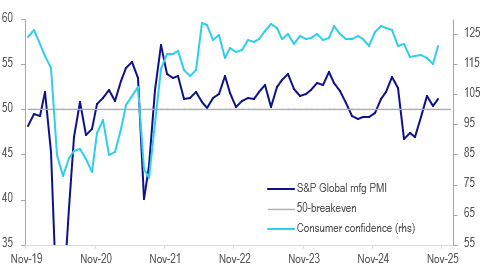
October consumer confidence jumped 5.4% to 121.2, the highest in 6 months but in line with the same time last year. The index fell 1.9% q/q in Q3, pressured by social unrest and economic problems, with real consumption growth moderating slightly to 4.9% y/y from 5%. Sentiment at the start of Q4 suggests that spending could be around 5% again in the quarter possibly supported by the 75bp of easing in H2 2025 to date and an announced moderate fiscal easing in 2026.
- Confidence was supported in October by both economic conditions and expectations which rose 6.2% m/m and 4.8% respectively.
- Concerns over the labour market caused sentiment to decline over H2 and drive protests. This improved in October rising to its highest since May at 102.6 and expectations to 132.0 from 123.1 in September. Current incomes rose to 117.1 from 112.9 while the outlook improved 4.1 points to 138.4.
- Time to buy durable items jumped to 107.5 from 103.2 in September.
- Retail sales growth has held up but auto sales remain very weak. Tourist arrivals have been strong but are now slowing with September up 5.8% y/y after 12.2% y/y in August.
Indonesia economic outlook improves in October
Source: MNI - Market News/LSEG/Bloomberg Finance L.P.
CHINA: Inflation to Lead Yields Higher?
- Following 5 consecutive day of significant liquidity withdrawal, the PBOC returned to injections this morning with bond futures barely reacting.
- The 10-Yr is flat at 108.475, above the 20-day EMA of 108.36
- The 2-Yr is flat at 102.46, at the mid-point between the 200-day EMA of 102.47and the 20-day EMA of 102.44.
- Bonds yields are steady with the CGB 10-Yr unchanged at 1.80%
- The withdrawal of liquidity over the last week, saw the 10-Yr break below 1.80% for several days with some suggestions being that the PBOC was seeking to set a new range of 1.70-1.80%.
- CGBs have been impervious to issuance this year thanks to the steady hand of the PBOC and looking for catalysts for the next move in bond yields has been difficult.
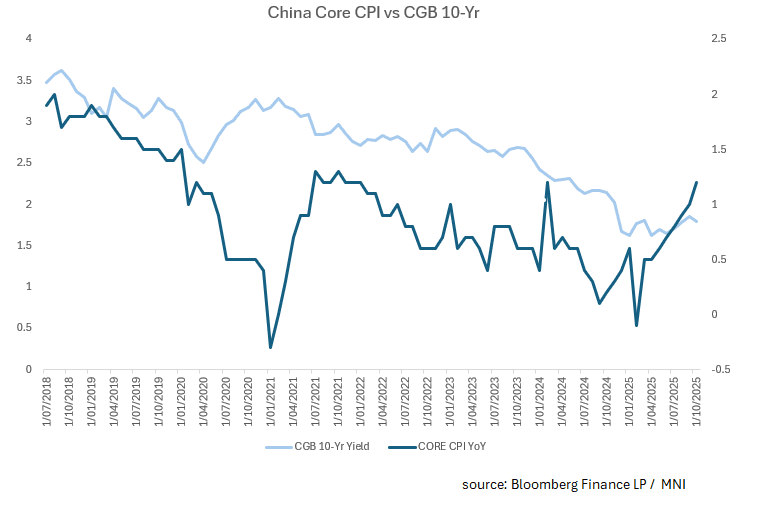
- Over the weekend, China released it's October CPI the YoY number inched up into +0.2% thanks to rises in Core. Core was up to +1.2% for its highest print since February 2024. When assessing the correlation with CGB yields, there appears a reasonable relationship with Core often leading bond yields higher.
- With mounting suggestions of more policy support given economic growth (for some forecasters) described as on weak footing, it would seem unpalatable for bond yields to gap higher from here. The issuance schedule at regional and federal level will remain elevated into 2026 and as asset allocation trends into equities from bonds grow, it is hard to see any allowance for bond yields to gap higher.
- If this relationship holds true, what this could predicate is an increased focus on liquidity injections over the remainder of 2025 with the aim of maintaining yields in tight, manageable ranges.
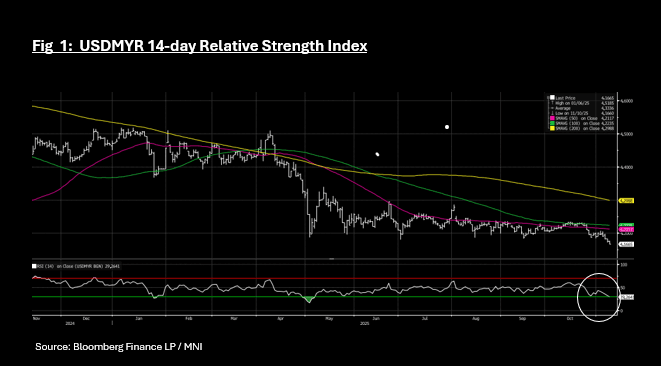
MYR: USDMYR Rally Continues, Approaches Overbought on RSI (14)
- Since the beginning of the month, USDMYR has rallied over three big figures to hit new near term lows of 4.1663.
- Gaining +0.24% Monday, Ringgit has now gained over +1.3% in the last month following a trade deal, expectation for a strong 3Q GDP and a hold from the Central Bank.
- The 14-day Relative Strength Index now shows that USDMYR is near to overbought, suggesting a correction could be close.
- USDMYR 1M Atm VOL is up at 5.88, from prior close of 5.59
The FTSE Malay KLCI is up +0.77% and MGS bonds have had a strong sell off in line with global leads with the MGS 10-Yr up +6bps to 3.52%. The 10-Yr was last above 3.50% in early July.
ASIA FX: KRW Has Scope To Rally More, As Risk Sentiment Bounces
In North East Asia FX, the USD has lost ground amid better risk appetite in the equity space. The US Senate voting on a procedural bill (60-40 votes), to start the process to end the government shutdown has aided equity risk sentiment. US equity futures are up strongly, led by the tech side. In Asia, the Kospi has surged over 3%, but China markets have been laggards.
- The better risk on tone has helped KRW outperform. USD/KRW was last near 1452/53 up around 0.60% in won terms. Still, this only pares Nov to date underperformance ( still off 1.5% despite today's rally). After last week's more than $5bn in offshore outflows (the most since 2021), the focus will be on whether such trends stabilize. So far today, offshore investors haven't returned though. USDKRW also remains well above 20-day EMA support (near 1430), so even with further downside, won bulls might not get excited until we breach such support levels.
- USD/CNH is drifting lower, but still above 7.1200 at this stage. The USD/CNY fix edged up, but the fixing error remain wide, pointing to on-going yuan resilience. A downside test under 7.1200 should bring the 7.1000 region back into focus, but it is likely to be a steady grind rather than a dramatic move lower in the pair. CNH/JPY upside is back in focus with the better risk tone. We were last 21.6200, with late Oct highs around 21.70 targeted on the upside.
- The supportive macro backdrop, coupled with overbought technicals, suggests USD/TWD may lose some upside momentum. Oct export data from the end of last week showed surging export growth on the back of the AI/chip boom. If we see equity inflows return it may aid downside in the pair (note the 200-day EMA is around 30.83, against current spot just under 31.00).
UP TODAY (TIMES GMT/LOCAL)
| Date | GMT/Local | Impact | Country | Event |
| 10/11/2025 | 0700/0800 | *** |  NO NO | CPI Norway |
| 10/11/2025 | 0700/0800 | ** |  SE SE | Private Sector Production m/m |
| 10/11/2025 | 0910/0910 |  GB GB | BOE Lombardelli at BOE/Ghana Central Bank Conference | |
| 10/11/2025 | - | *** |  CN CN | Money Supply |
| 10/11/2025 | - | *** | CN | New Loans |
| 10/11/2025 | - | *** | CN | Social Financing |
| 10/11/2025 | 1630/1130 | * |  US US | US Treasury Auction Result for 26 Week Bill |
| 10/11/2025 | 1630/1130 | * | US | US Treasury Auction Result for 13 Week Bill |
| 10/11/2025 | 1700/1200 | *** | US | USDA Crop Estimates - WASDE |
| 10/11/2025 | 1800/1300 | *** | US | US Note 03 Year Treasury Auction Result |
| 11/11/2025 | 2350/0850 |  JP JP | Balance of Payments | |
| 11/11/2025 | 0001/0001 | * | GB | BRC-KPMG Shop Sales Monitor |
| 11/11/2025 | 0500/1400 | JP | Economy Watcher's Survey | |
| 11/11/2025 | 0700/0700 | *** | GB | Labour Market - AWE & Unemployment |
| 11/11/2025 | 0700/0700 | *** | GB | Labour Market - AWE & Unemployment |
| 11/11/2025 | 0700/0700 | *** | GB | Labour Market - Payrolls & Claimants |
| 11/11/2025 | 0700/0700 | *** | GB | Labour Market - Payrolls & Claimants |
| 11/11/2025 | 0820/0920 |  EU EU | ECB Lagarde Video Message at Bank of Albania | |
| 11/11/2025 | 0830/0930 | SE | Riksbank Minutes | |
| 11/11/2025 | 0830/0830 | GB | BOE Greene in Panel at UBS European Conference | |
| 11/11/2025 | 1000/1100 | *** |  DE DE | ZEW Current Expectations Index |
| 11/11/2025 | 1100/0600 | ** | US | NFIB Small Business Optimism Index |
| 11/11/2025 | 1200/0700 | ** |  BR BR | Brazil Final CPI |
| 11/11/2025 | 1355/0855 | ** | US | Redbook Retail Sales Index |


