MNI EUROPEAN MARKETS ANALYSIS: Another Record High For Gold
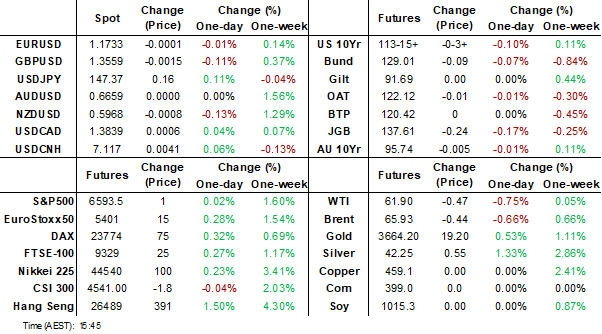
- The USD and US Tsy yields have drifted a little higher. The USD BBDXY index remains sub 1200, while gold has made a fresh high. The US and Japan announced a joint statement on FX, but it largely looks to maintain the status quo.
- We had some NZ data earlier, which was mixed in terms of better card spending, but a lower PMI.
- US-China officials (including US Tsy Secretary Bessent and China Vice Premier He Lifeng) will hold talks in Spain next week.
- Looking ahead we have UK monthly GDP, along with final inflation reads in the EU. In the US focus will be on the Sep U. Of Mich Sentiment reading.
MARKETS
US TSYS: Asia Wrap - Yields Slightly Higher In A Quiet Friday Session
The TYZ5 range has been 113-15+ to 113-18 during the Asia-Pacific session. It last changed hands at 113-16, down 0-05 from the previous close.
- The US 2-year yield is trading around 3.542%.
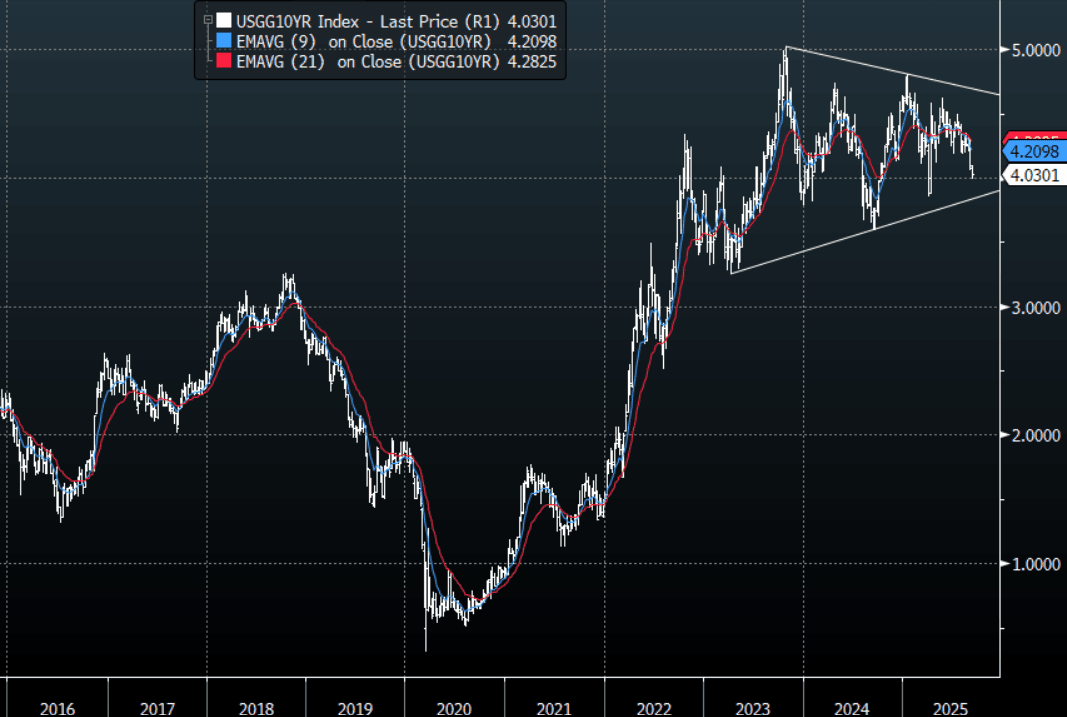
- The US 10-year yield has edged higher trading around 4.03%, up 0.01 from its close.
- 10-Year Yields continued to test lower as inflation data this week proved to hold no smoking gun. The first buy-zone is now back towards the 4.15/4.20% area. Having reached the first target towards the 4.00% zone I expect some supply around this area initially. A sustained break through here and the focus will then turn towards the 3.80% area.
- Mohamed A. El-Erian on X: “With the US CPI numbers matching the consensus forecasts, the main market mover this morning is jobless claims, which came in far higher than expected. The overall signal from this week’s data is clear—and one I’ve stressed for some time, now increasingly echoed by others: inflation may still sit above the Fed’s target, but the greater risk to the economy lies in the pace and severity of labor market weakening.”
- Robin Brooks on X: “It really is starting to look like the tariff inflation shock is over. Categories in the CPI most impacted by China tariffs - like furniture (lhs) and recreational goods (rhs) - saw price spikes peak in June and then fade. August inflation in these categories is near zero…”
- RenMac on X: “Core goods CPI less cars rose just 0.13% in August, or 1.6% SAAR, the weakest pace in several months. This lends support to the notion that tariffs largely are a one-time shock to the price level. Less pressure in August from household furnishings and recreation commodities.”
- Data/Events: U. of Mich. Sentiment
Fig 1: 10-Year US Yield Weekly Chart
Source: MNI - Market News/Bloomberg Finance L.P
JGBS: Futures Weaker & Hovering Near Session Lows
JGB futures are weaker, -14 compared to settlement levels, and hovering near session lows.
- Joint Statement On FX Looks To Maintain Status Quo - USD/JPY Steady: Headlines have crossed following US and Japan issuing a joint statement on FX. At face value, the headlines from the statement on FX look to largely reaffirm what both sides already broadly agree to on FX markets. FX markets should be market determined and that manipulating exchange rates for competitive purposes should be avoided. Domestic policies on monetary and fiscal policy should also not be geared towards driving FX rates.
- Cash US tsys are ~1bp cheaper in today's Asia-Pac session.
- Cash JGBs are 1bp cheaper to 2bps richer across benchmarks, with the curve flatter. The benchmark 10-year yield is 0.9bp higher at 1.59% versus the cycle high of 1.649%.
- Swap rates are flat to 2bps higher. Swap spreads are wider.
- On Monday, the local calendar will be closed.
US-JAPAN: Joint Statement On FX Looks To Maintain Status Quo - USD/JPY Steady
Headlines have crossed following US and Japan issuing a joint statement on FX. Japanese officials noted that the joint statement came out in the aftermath of settling the trade deal. At face value, the headlines from the statement on FX look to largely reaffirm what both sides already broadly agree to on FX markets. FX markets should be market determined and that manipulating exchange rates for competitive purposes should be avoided. Domestic policies on monetary and fiscal policy should also not be geared towards driving FX rates.
- Some key headlines are outlined below: "JAPAN, US FINANCE STATEMENT: REAFFIRMED THAT EXCHANGE RATES SHOULD BE MARKET DETERMINED" and "JAPAN, US FINANCE STATEMENT: RECONFIRMED THEY WILL NOT TARGET EXCHANGE RATES FOR COMPETITIVE PURPOSE" via RTRS.
- Japan Finance Minister Kato stated to the press that discussions with US Tsy Secretary Bessent also didn't cover desirable FX levels. Kato added that this joint statement won't impact potential FX intervention. The statement noted: "*TREASURY, MOF COMMIT TO DISCLOSURE OF ANY FX INTERVENTION OPS." - BBG
- USD/JPY is little changed post these headlines. We were last 147.30, up slightly on end Thursday levels in NY. Session lows so far today rest at 147.12.
AUSSIE BONDS: Trading At Cheaps With The Curve Flatter
ACGBs (YM -3.5 & XM flat) have bear-flattened with both contracts at/or near session cheaps.
- Cash US tsys are ~1bp cheaper in today's Asia-Pac session.
- MNI INTERVIEW: Wages To Limit RBA Easing - Ex Research Chief. Trimmed-mean inflation is likely to remain near the top of the Reserve Bank of Australia's 2-3% target if wages outpace its assumptions despite its recent productivity downgrade, the RBA's former head of research told MNI, noting this would limit the degree of further easing.
- Cash ACGBs are flat to 2bps cheaper with the 3/10 curve flatter and the AU-US 10-year yield differential at +20bps.
- The bills strip is -1 to -4 across contracts, with a steepening bias. Red contracts are some 8-9bps cheaper than the session's best levels.
- RBA-dated OIS pricing is little changed across meetings today. A 25bp rate cut in September is given a 10% probability, with a cumulative 28bps of easing priced by year-end.
- Today, the local calendar was empty.
- Next week, the local calendar will be empty on Monday ahead of an RBA Hunter Fire-Side Chat on Tuesday.
- Next week, the AOFM plans to sell A$1200mn of the 4.25% 21 December 2035 bond on Wednesday and A$1000mn of the 1.00% 21 December 2030 bond on Friday.
BONDS: NZGBS: Bull-Flattener To Close Out Week
NZGBs closed showing a modest bull-flattener, with benchmark yields flat to 2bps lower.
- August card spending trends were mixed relative to the July pace. Retail spending rose 0.7%m/m, versus 0.2% in July. Total spending was up 0.4%, versus a 0.6%m/m gain in July. In terms of the detail, the main drag came from vehicle spending, down 0.9%m/m (after a 5.6% gain in July). Fuel spending was also weaker, off 0.1%m/m. Apparel, durables and consumables spending was all up in m/m terms, to leave core retail spending up 0.9%m/m.
- In y/y terms, total spending was -0.5%, but the continues the modest improvement seen in the series from recent lows (we were at -3.2%y/y back in April). Core retail spend was up 2.4%y/y (from 1.9% prior), so further evidence of a modest pick up in spending momentum.
- Swap rates also closed with rates flat to 2bps lower.
- RBNZ dated OIS pricing closed slightly softer across meetings. 22bps of easing is priced for October, with a cumulative 40bps by November 2025.
- Next week, the local calendar will see the Performance Services Index on Monday, Food Prices on Tuesday, Current Account Balance on Wednesday and Q2 GDP on Thursday.
NEW ZEALAND: August Card Spending Mixed, But Core Trends Improving
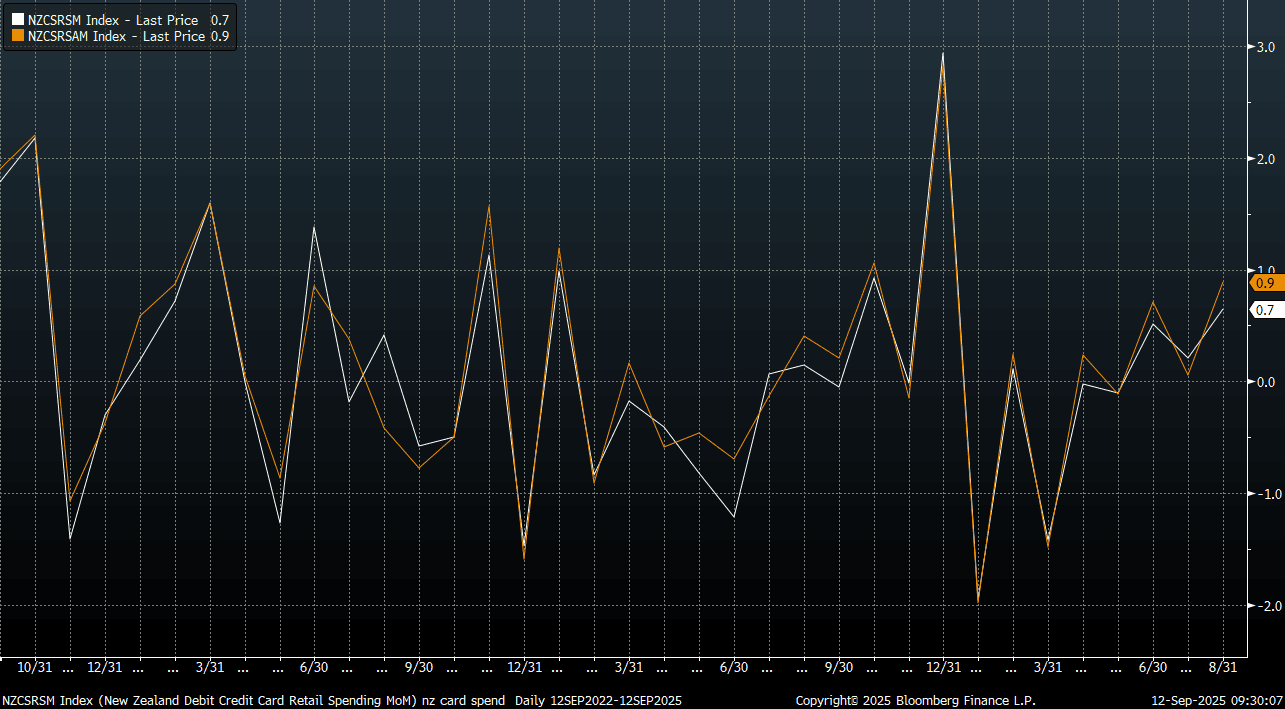
August card spending trends were mixed relative to the July pace. Retail spending rose 0.7%m/m, versus 0.2% in July. Total spending was up 0.4%, versus a 0.6%m/m gain in July.
- In terms of the detail, the main drag came from vehicle spending, down 0.9%m/m (after a 5.6% gain in July). Fuel spending was also weaker, off 0.1%m/m. Apparel, durables and consumables spending was all up in m/m terms, to leave core retail spending up 0.9%m/m.
- The chart below plots this core card spending (the orange line) and headline retail spending.
- In y/y terms, total spending was -0.5%, but the continues the modest improvement seen in the series from recent lows (we were at -3.2%y/y back in April).
- Core retail spend was up 2.4%y/y (from 1.9% prior), so further evidence of a modest pick up in spending momentum.
Fig 1: NZ Card Spending - Retail & Core Retail M/M
Source: Bloomberg Finance L.P./MNI
NEW ZEALAND: PMI Down In August, But Q3 TO Date Average Still Above Q2 Pace
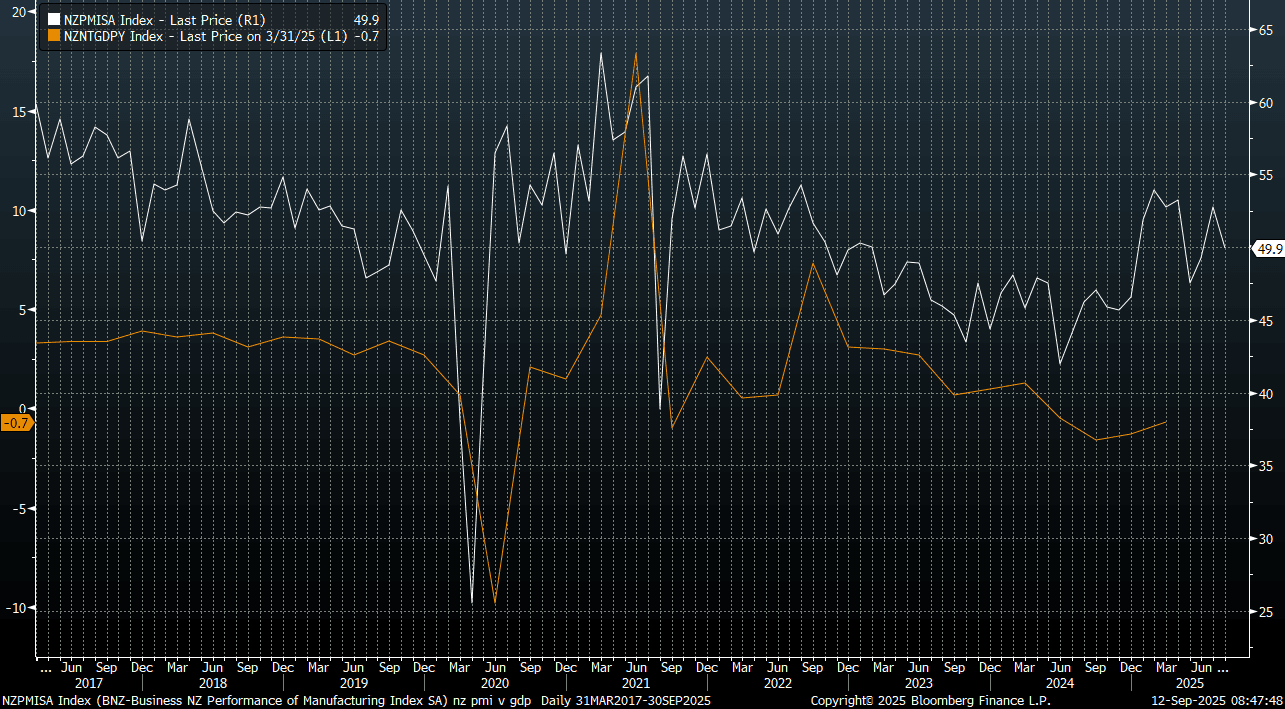
The New Zealand manufacturing PMI fell back into contractionary territory in August. The 49.9 print compares with 52.8 for July. The index is still above recent lows (47.6 recorded in May), but continues the stop/start nature of NZ sentiment indicators.
- The average read for Q3 to date is 51.35, up from Q2's average of 50.0, while the Q1 average for the PMI was 52.7.
- For August the production index fell to 46.6, but new orders improved to 55.2.
- The chart below overlays the PMI against the NZ GDP y/y print. The choppy but higher PMI levels is still implying some improvement in GDP momentum.
Fig 1: NZ PMI Versus NZ GDP Y/Y
Source: BNZ- Business NZ/Bloomberg Finance L.P./MNI
FOREX: Asia FX Wrap - BBDXY Pressing Support Heading Into The Weekend
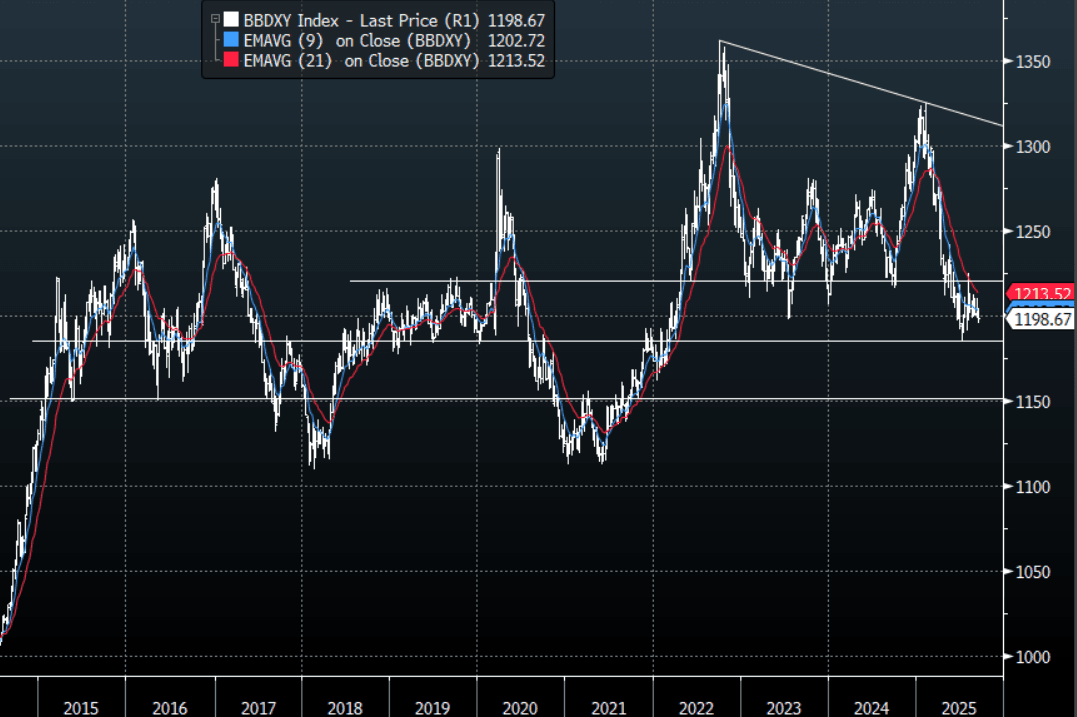
The BBDXY has had a range of 1197.34 - 1198.76 in the Asia-Pac session; it is currently trading around 1198, +0.10%. The USD traded tried to push higher into the CPI data with the market suspecting a higher print, the benign outcome saw it very quickly reverse and we opened back below 1200 again this morning. A sustained break below 1197/1195 is needed to regain the momentum lower to retest the year's lows towards 1180 where demand should return initially. A break sub 1180 would be extremely bearish, should the USD start another leg lower it would have big implications for FX and potentially see a lot of the recent ranges in G10 broken.
- EUR/USD - Asian range 1.1723 - 1.1741, Asia is currently trading 1.1725. The pair bounced strongly overnight, helped by a combination of the US CPI and Lagarde . EUR is still within its wider 1.1350-1.1850 range with a bias to the topside.
- GBP/USD - Asian range 1.3554 - 1.3581, Asia is currently dealing around 1.3555. The pair is back in the middle of its recent 1.3350-1.3650 range, but price action suggests it may be looking to retest the range highs.
- USD/CNH - Asian range 7.1142 - 7.1196, the USD/CNY fix printed 7.1019, Asia is currently dealing around 7.1200. Sellers should be around on bounces while price holds below the 7.2200/2500 area and the PBOC manages the fix lower. Above 7.2500 and we could see a test of the USD Shorts.
- Cross asset : SPX -0.01%, Gold $3655, US 10-Year 4.032%, BBDXY 1198, Crude Oil $61.86
- Data/Events : Germany CPI, France CPI, Spain CPI, Italy Unemployment Rate Quarterly
Fig 1: BBDXY Spot Weekly Chart
Source: MNI - Market News/Bloomberg Finance L.P
JPY: Asia Wrap - USD/JPY Continues To Hold Above Support
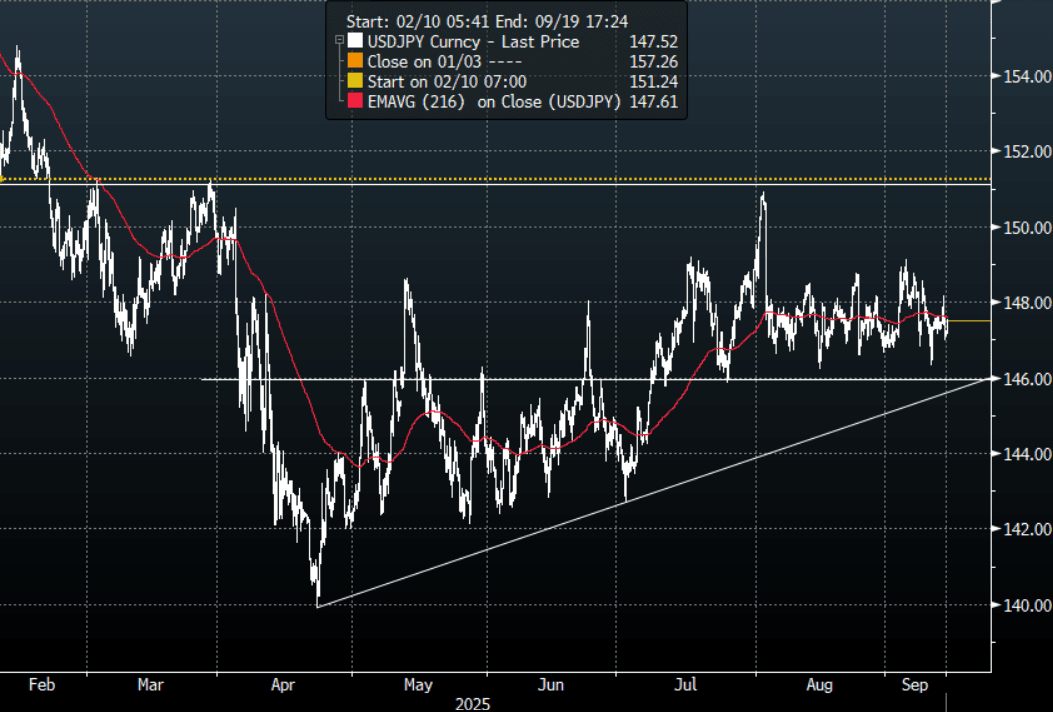
The USD/JPY range has been 147.12 - 147.53 in the Asia-Pac session, it is currently trading around 147.50, +0.20%. USD/JPY tried to push higher into the CPI with the market suspecting a higher print, the benign outcome saw it very quickly reverse and we opened this morning back towards 147.00 again. The price remains in the middle of its recent 146-149 range, and we need a convincing break to see a clearer direction again. CFTC data shows leveraged funds again added a decent clip to their short JPY position last week so they will be hoping this support remains intact. A move back below 145/146 is needed to potentially start seeing these positions being flushed out.
- Joint Statement On FX Looks To Maintain Status Quo - USD/JPY Steady: Headlines have crossed following US and Japan issuing a joint statement on FX. At face value, the headlines from the statement on FX look to largely reaffirm what both sides already broadly agree to on FX markets. FX markets should be market determined and that manipulating exchange rates for competitive purposes should be avoided. Domestic policies on monetary and fiscal policy should also not be geared towards driving FX rates.
- Samantha LaDuc on X: “Toyota can absorb the ¥1 trillion ($6.8 billion) cost of a 15% automobile tariff and make profits [it estimates ¥3 trillion ($20.4 billion) in earnings after the tariffs—rk]. However, few companies are as resilient as Toyota. According to a 2024 Cabinet Office survey of 587 large listed Japanese manufacturing exporters, the 40 most competitive companies expected to be able to record profits [on their exports] even if the yen rose to ¥101. However, the 127 least competitive companies [22% of these listed firms] would need the yen to weaken to the ¥146-152 range to be able to compete and maintain a profit.” Richard Katz Nikkei.”
- "JAPAN TRADE MINISTRY: TO RESTRICT EXPORTS TO ADDITIONAL ENTITIES, INCLUDING 6 IN CHINA, 2 IN TURKEY, 1 IN UAE, AS PART OF SANCTIONS AGAINST RUSSIA'S INVASION OF UKRAINE - [RTRS]"
- Options : Close significant option expiries for NY cut, based on DTCC data: 146.00($1.07b), 147.40($1.6b).Upcoming Close Strikes : 146.00($1.41b Sept 16), 150.00($1.49b Sept 16) - BBG.
Fig 1 : USD/JPY Spot 2H Chart
Source: MNI - Market News/Bloomberg Finance L.P
AUD: Asia Wrap - AUD/USD Probing Above 0.6650 Resistance, Can It Extend ?
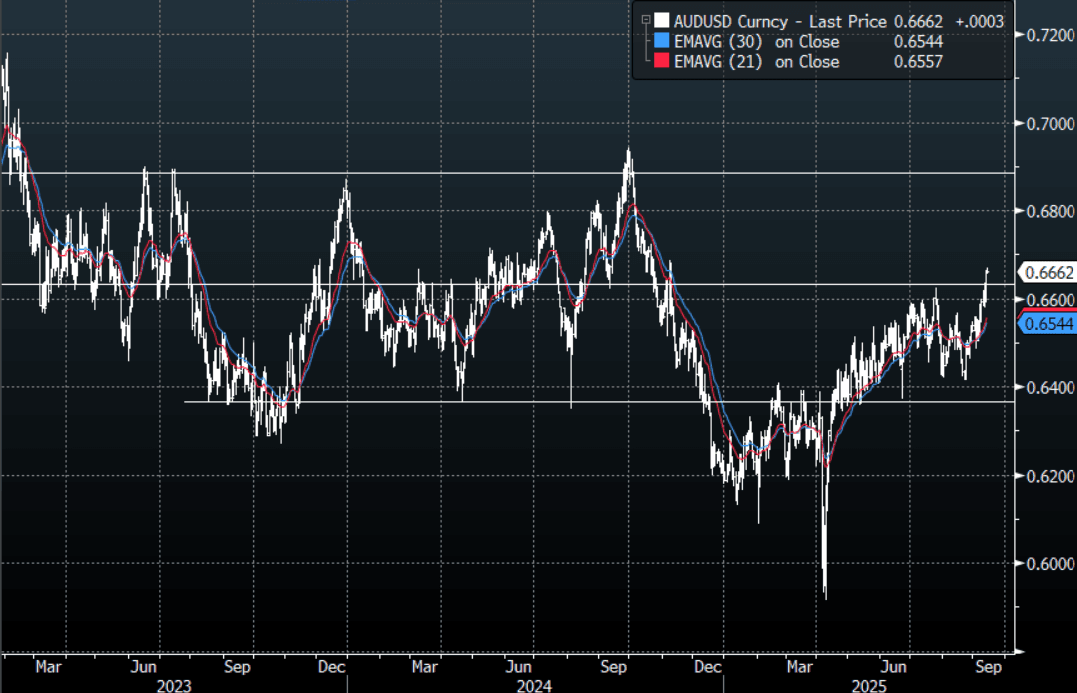
The AUD/USD has had a range of 0.6656 - 0.6669 in the Asia- Pac session, it is currently trading around 0.6660, +0.05%. US stocks loved the CPI data and accelerated higher, while US yields most notably in the long-end continued lower. The AUD liked that combination and is looking to break above its pivotal 0.6650 resistance. Should the USD break and extend lower we could see the AUD gain momentum above 0.6650 and potentially target levels back towards 0.6900/0.7000. This price action suggests dips will be supported for now as we await confirmation of this potential break higher.
- Bloomberg - “An Aussie Rally May See Pensions Bolster FX Hedging: StanChart. The FX hedge ratio of foreign equities has edged up to 22.2% in Q2 from 20.6% in the prior period, “in line with our findings of limited evidence of increased FX hedging by foreign investors. This raises questions on what will lead Australia’s super funds to bolster their hedge ratios” given the Aussie’s positive correlation with risky assets is often cited as a key argument for a low hedge ratio; Chia says a medium-term rally by AUD/USD to around the 0.70 level may do that.”
- MNI INTERVIEW: Wages To Limit RBA Easing - Ex Research Chief. Trimmed-mean inflation is likely to remain near the top of the Reserve Bank of Australia’s 2-3% target if wages outpace its assumptions despite its recent productivity downgrade, the RBA’s former head of research told MNI, noting this would limit the degree of further easing.
- Options : Closest significant option expiries for NY cut, based on DTCC data: 0.6570(AUD383m), 0.6575(AUD377m). Upcoming Close Strikes : 0.6600(AUD449m Sept 16) - BBG
- CFTC Data last week shows Asset managers reduced their shorts for the first time in a while -66025(Last -78758), the Leveraged community though look to be rebuilding their own shorts after winding them down -11860(Last -6447).
- AUD/JPY - Asia-Pac range 98.01 - 98.27, Asia is trading around 98.25. The pair extended higher overnight, turning the focus back towards the 99.00/100.00 area. Dips back towards 96.50/97.00 should be expected to be supported now first up.
Fig 1: AUD/USD spot Daily Chart
Source: MNI - Market News/Bloomberg Finance L.P
NZD: Asia Wrap - NZD/USD Challenging the Bears Conviction
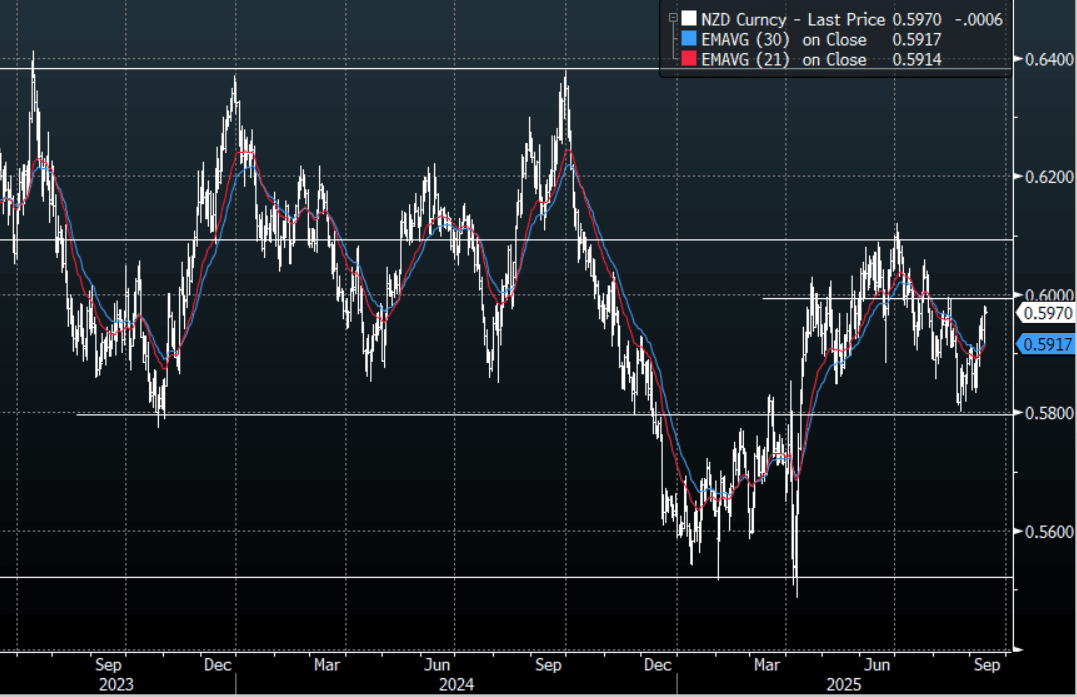
The NZD/USD had a range of 0.5965 - 0.5979 in the Asia-Pac session, going into the London open trading around 0.5970, -0.10%. US stocks loved the data and accelerated higher, while US yields most notably in the long-end continued lower. The NZD found good demand towards 0.5900 and had a strong bounce in reaction to the data. The USD in particular is beginning to look vulnerable, this is dragging the NZD higher frustrating the bears. A close back above 0.6000 would negate any semblance of the downward pressure it was exhibiting.
- August Card Spending Mixed, But Core Trends Improving : August card spending trends were mixed relative to the July pace. Retail spending rose 0.7%m/m, versus 0.2% in July. Total spending was up 0.4%, versus a 0.6%m/m gain in July.
- PMI Down In August, But Q3 TO Date Average Still Above Q2 Pace: The New Zealand manufacturing PMI fell back into contractionary territory in August. The 49.9 print compares with 52.8 for July. The index is still above recent lows (47.6 recorded in May), but continues the stop/start nature of NZ sentiment indicators.
- Bloomberg - “Tsy Secretary Bessent To Meet China Officials Next Week - Rtrs : Headlines have crossed from Reuters that US Tsy Secretary Bessent will meet with China officials, including Vice Premier He Lifeng, in Spain next week. The discussions are expected to cover - "trade, economic and national security issues". Tiktok is also expected to be discussed per Rtrs.”
- Options : Closest significant option expiries for NY cut, based on DTCC data: none. Upcoming Close Strikes : 0.5825(NZD1.01b Sept 17), 0.5900(NZD860m Sept 17), 0.6250(NZD427m Sept 17) - BBG
- AUD/NZD range for the session has been 1.1144 - 1.1159, currently trading 1.1155. The Cross is consolidating above 1.1100, dips back towards 1.1000/1.1050 should be supported now. A break above the multiple highs towards the 1.1200 area is needed to regain the momentum higher.
Fig 1: NZD/USD Spot Daily Chart
Source: MNI - Market News/Bloomberg Finance L.P
ASIA STOCKS: Strong Week for Most, NIKKEI Hits New Highs
Japanese stocks rose for a third day, led by gains in the tech sector, on with gains from tech stocks in the US flowing through to buying of AI-related shares in Japan. Several key bourses in the regions have either hit or are approaching news highs this week on hopes for a cut in interest rates at the Federal Reserve. Signs of life for China's property developers as Evergrande jumped 40% on Friday morning on news of a possible bid. With the exception of the Jakarta Composite, which fell on the news of the departure of the Finance Minister, all major bourses have posted positive gains for the week.
- China's major bourses are finishing the week up with the Hang Seng leading the way. Up +1.53%, the Hang Seng is over +4.2% higher for the week. The CSI 300 is only marginally up today but higher by +1.98% for the week. The Shanghai Comp is up +0.24% Friday, and +1.89% for the week. The Shenzhen Comp is up +0.20% today, and +2.82% for the week.
- The NIKKEI is up again, reaching new highs of 44,812. Up 1% Friday, the weekly gain of just over 4% comes despite having one day of declines.
- Taiwan's TAIEX has seen major portfolio flows ramp up and is up +0.69% Friday and +3.66% for the week.
- The KOSPI is having a very strong period of late, up +1.28% Friday and +5.71% for the week on hopes that the planned tax changes to capital gains won't proceed.
- The FTSE Malay KLCI continues to underperform relative to regional peers. Up +0.42% today, it is higher by just +0.71% for the week.
- The Jakarta Composite is up +1.04% today but unable to recover from losses earlier in the week; to be down -0.49% week to date.
- The NIFTY 50 is higher by +0.35% Friday morning, and up +1.3% for the week.
ASIA STOCKS: Taiwan Inflows For The Week Close To The Strongest For 2025
Strong inflow momentum continued into Taiwan yesterday. The nearly $1.2bn in net inflows bought the past 5 trading sum to just short of $6bn. Since this Monday we have seen near $4.7bn in net inflows, which is back close to the strongest week of net inflows seen in 2025. Late June saw a weekly inflow of just over $4.8bn. Taiwan equities were steadier yesterday, but Thursday US trade saw continued rises in indices like the SOX (now up for six straight sessions). Fed easing expectations and broader optimism around the AI/chip related outlook continue to drive positive sentiment in this space
- South Korean equity inflows remained positive, albeit at a slightly reduced pace compared to earlier in the week. Again, South Korean equity market remains quite positive, with the Kospi continuing to rally. We aren't too far away from the 3400 level. Whilst there is some uncertainty around taxes on capital gains, President Lee left a firm impression yesterday that the government still sees upside in local stocks.
- Elsewhere, Wednesday saw a strong inflows day into Indian stocks, but this only modestly pares year to date outflows.
- Indonesia recorded further outflows yesterday, but the pace of outflows has slowed from earlier in the week (when the new FinMin was first announced).
- Thailand inflows rose, but the past 5 days has still seen a small net outflow.
Table 1: Asian Markets Net Equity Flows
| Yesterday | Past 5 Trading Days | 2025 To Date | |
| South Korea (USDmn) | 168 | 1802 | -3464 |
| Taiwan (USDmn) | 1193 | 5907 | 6494 |
| India (USDmn)* | 510 | 555 | -15138 |
| Indonesia (USDmn) | -12 | -399 | -3726 |
| Thailand (USDmn) | 47 | -11 | -2528 |
| Malaysia (USDmn) | 25 | -2 | -3808 |
| Philippines (USDmn) | 3 | -6 | -732 |
| Total (USDmn) | 1934 | 7847 | -22901 |
| * Data Up To Sep 10 |
Source: Bloomberg Finance L.P.?MNI
Oil Falls Again, Wiping Out Weekly Gains
- Oil dipped further in the Asia trading day, wiping out the gains delivered earlier in the week.
- Despite the IEA trying to temper expected further supply increases with suggestions there could be a modest uptick in demand, the current IEA projections are for world oil output to exceed demand in 2026 by over 3 million barrels per day, placing downward pressure on prices.
- WTI is off -0.82% today at US$61.85 bbl to be largely unchanged for the week. The early part of the week had seen three days of decent gains, resulting in WTI approaching the 20-day EMA of $63.49. Last night's sell off that continued into today has seen it push back below all major moving averages.
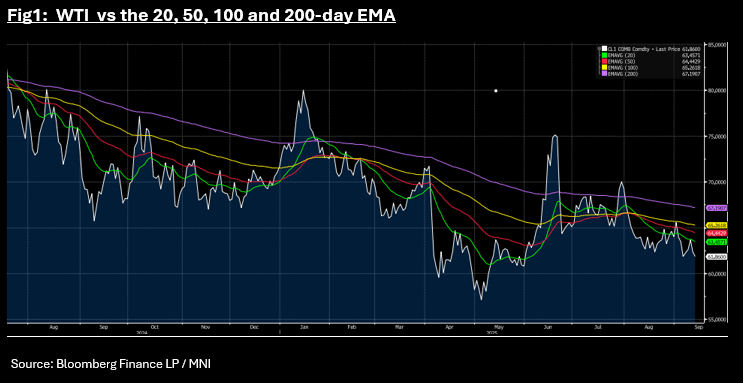
- Brent is lower by -0.72% today, but remains up +0.60% for the week. Brent too has traded below all major moving averages with the 20-day EMA above at US$67.14.
- BBG reports that a Goldman Sachs research report suggests that China could continue the ongoing stockpiling of oil into 2026, aiming to lock into the benefit of lower prices whilst predicting Brent to reach the around US$55 bbl. Saudi Aramco is set to sell ~50-51 million bbls of contractual supplies of Oct.-loading crude to customers in China, higher than 43 million bbls a month ago, according to traders informed by the producer.
GOLD: Another Record High for Gold
- Gold had softened overnight also in what has been a mixed week of performance for the precious metal as it bounces off new all time highs.
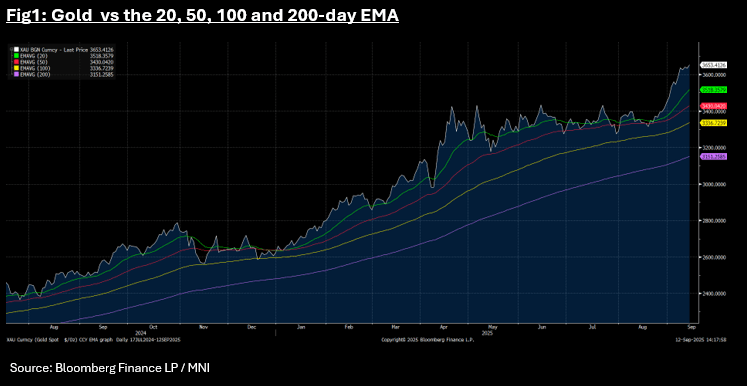
- Having closed at a new high of US$3,640.75 on Wednesday, the fall of -0.18% overnight appears to be driven by profit taking as the 14-day Relative Strength Index points to it looking over-bought market.
- However this didn't stop the bulls taking over in the Asia trading day with gold up +0.53% to a new record high of US$3,653.26.
- For the week, gold has delivered solid gains of +1.85% to see year to date gains, over 38%.
- Gold is highly sensitive to interest rate cuts and with economic data suggesting the probability of a cut is improving, gold has risen.
MALAYSIA: Country Wrap: Budget 2026 About to be Tabled
Market Summary: The FTSE Malay KLCI continues to underperform relative to regional peers. Up +0.42% today, it is higher by just +0.71% for the week. The Malaysian Ringgit has delivered decent gains over the last week, and is up strongly again today by +0.29% to 4.2087 and +0.49% for the week as it approaches levels where it has bounced off 3-times in the last month, failing to hold beneath 4.2050. The MGS 10-YR finally gave back the gains from the rallying leading into the BNM, to finished +4bps higher for the week at 3.40%
- BUDGET 2026, which will be tabled on Oct 10, marks the first budget to support the goals of the 13th Malaysia Plan (13MP) and built on expectations that it will seek to sustain domestic demand . (source The Star)
- While upbeat over the year-on-year (y-o-y) improvement in Malaysia’s industrial production for July following the release of the month’s industrial production index (IPI) report yesterday, economists continue to advocate caution with regards to the general sentiment of the economy. (source The Star)
SOUTH KOREA: Country Wrap: More Cash Handouts to Come
Market Summary: The KOSPI is having a very strong period of late, up +1.28% Friday and +5.71% for the week on hopes that the planned tax changes to capital gains won't proceed. The Won has done little on the week, marginally better at 1,387.60 whilst bonds are set to finish the week lower in yield with the KTB 10-Yr down -4bps to 2.82%
- A second cash handout has been announced with a voucher scheme offering cash handouts to 90 percent of citizens to be implemented later this month, officials said Friday, as part of efforts to stimulate private consumption. (source Korea Times)
- Korea's Finance Ministry suggested that the economy continues to face concerns due to a delayed recovery in construction investment and slowing exports, but positive signs, including improved consumer sentiment, continue to strengthen. (source Korea Times)
CHINA: Country Wrap: AI to Driver Consumerism
Market Summary: China's major bourses are finishing the week up with the Hang Seng leading the way. Up +1.53%, the Hang Seng is over +4.2% higher for the week. The CSI 300 is only marginally up today but higher by +1.98% for the week. The Shanghai Comp is up +0.24% Friday, and +1.89% for the week. The Shenzhen Comp is up +0.20% today, and +2.82% for the week. The Yuan Reference Rate at 7.1019 Per USD; Estimate 7.1069 whilst the 10-Yr CGB is +3bps higher in yield at 1.79%
- China has unveiled comprehensive pilot reform plans to advance market-based allocation of production factors across 10 key regions, marking the country's latest push to build a high-level socialist market economy system and foster high-quality development, officials and experts said on Thursday. (source China Daily)
- Rapidly evolving artificial intelligence is playing an increasingly vital role in fostering new growth drivers and injecting strong momentum into China's consumer market, while reshaping the global trade landscape in the digital economy era, said experts and company executives. (source China Daily)
INDIA: Country Wrap: CPI to Tick up in August
Market Summary: The NIFTY 50 is higher by +0.35% Friday morning, and up +1.3% for the week as the Rupee rises +0.15% to 88.30 to be flat for the week. Bonds have done very little for the week with the 10-Yr where it began at 6.46%
- With data due out later today, India's August Year on Year CPI is forecast to tick higher, whilst remaining below the RBI target of 4%. The Reserve Bank of India (RBI)'s formal inflation target is 4%, with a tolerance band of 2% to 6%. As of September, this framework remains in place with the RBI working to keep headline inflation around the 4% midpoint while ensuring price stability and supporting growth in the Indian economy. RBI Governor Sanjay Malhotra said, "CPI inflation for the current year 2025-26 is now projected at 3.1%. This is down from 3.7% that we had earlier projected in June. In July, CPI hit the lowest since 2017 at 1.55% and is forecast to move higher to +2.11% in the August release. (source MNI)
- Days after Donald Trump shifted his tone on India, his pick for the next American ambassador to India, Sergio Gor, said the president invited Commerce Minister Piyush Goyal next week to meet with US Trade Representative Jamieson Greer in Washington. (source NDTV Profit)
- Adani Group has ceased to berth vessels sanctioned by the US, European Union and the UK at its multiple ports by issuing orders to this effect to the respective port authorities, and vessels operating at high seas. (source Financial Express)
ASIA FX: TWD Outperforms, USD/CNH Edges Up, Eyes On US-China Talks Next Week
In North East Asia FX, we have seen modest gains for TWD, KRW and HKD, while CNH has lost some ground versus the USD. TWD has been the best performer over the past week, up over 1.2%. Within the broader USD/Asia bloc, TWD has only lagged THB gains this week.
- USD/CNH has edged a little higher but remains under 7.1200 at this stage. Earlier the USD/CNY fix was set lower, but remained above 7.1000, which may be tempering expectations for near term gains in the yuan. US and China officials will meet in Madrid next week, where trade and other issues will be discussed. US Tsy Secretary Bessent and China Vice Premier He Lifeng will be at the talks. The Washington Post also reported that US President Trump and China President Xi Jinping could meet soon. In the equity space, after yesterday's strong surge we have seen close to flat outcomes in the first part of Friday trade.
- USD/KRW spot is little changed, last under 1388. The won remains a laggard to broader USD weakness/continued equity gains. Uncertainty around the US-South Korea trade deal may be tempering sentiment in the near term.
- USD/TWD is back lower, last near 30.22, which is close to week to date lows. We have seen a surge in net equity inflows, with inflows of nearly $5bn up to Thursday of this week. The tech/AI surge continues to benefit local stocks, particularly TSMC. Headlines crossed earlier via BBG: "Taiwan is seeking to mitigate the impact of tariffs on domestic industries by aiming to secure a more reasonable “reciprocal” tariff rate and get preferential treatment under the US Section 232 tariff."
- Spot USD/HKD is lower, but found support sub 7.7800 in the first part of dealings. Lower US yields, amid rising Fed easing expectations, is biasing US-HK yield differentials lower.
ASIA FX: THB Outperformance Continues, IDR Rebounds
In SEA FX, the bias has been for softer USD levels, with the stand outs so far today being THB and IDR. USD/THB has fallen more than 1.6% so far this week, the best performer within USD/Asia bloc over this period.
- USD/THB last tracked near 31.67, down around 0.6% and close to recent lows at 31.61. Catch up to weaker USD trends from Thursday, along with firmer gold prices have been THB supports today. Via BBG: "Thai gold demand, excluding central bank purchase, is set to climb 10% this year to 53.7 tons, according to the Thai Futures Exchange. Demand in the first half jumped 21% to 20.7 tons, World Gold Council data show." A break sub 31.50/60 could ultimately see 31.00 targeted, levels last seen in the first half of 2021.
- USD/IDR is back under 16400, up around 0.45% so far today in IDR terms. This brings us back close to the 20-day EMA support point, but greater focus is likely to rest around the 200-day EMA support zone (16261). Cross asset moves are likely helping IDR sentiment. The continued move lower in US real yields is a positive, although USD/IDR remains quite elevated relative to such trends. Focus will remain on the local fiscal outlook, as new FinMin Purbaya Yudhi Sadewa announced late yesterday a review of the 2026 budget.
- USD/MYR is down, last near 4.2100, up close to 0.25% in ringgit terms. We are still above important support around 4.2000.
- USD/PHP is down around 0.20%, close to 57.10 in latest dealings. This leaves the pair in recent ranges.
UP TODAY (TIMES GMT/LOCAL)
| Date | GMT/Local | Impact | Country | Event |
| 12/09/2025 | 0430/1330 | ** |  JP JP | Industrial Production |
| 12/09/2025 | 0600/0700 | *** |  GB GB | UK Monthly GDP |
| 12/09/2025 | 0600/0700 | ** | GB | Trade Balance |
| 12/09/2025 | 0600/0700 | ** | GB | Index of Services |
| 12/09/2025 | 0600/0700 | ** | GB | Index of Production |
| 12/09/2025 | 0600/0800 | *** |  DE DE | Germany CPI (f) |
| 12/09/2025 | 0600/0700 | ** | GB | Output in the Construction Industry |
| 12/09/2025 | 0600/0800 | *** | DE | Germany CPI (f) |
| 12/09/2025 | 0645/0845 | *** |  FR FR | HICP (f) |
| 12/09/2025 | 0700/0900 | *** |  ES ES | HICP (f) |
| 12/09/2025 | 0830/0930 | ** | GB | Bank of England/Ipsos Inflation Attitudes Survey |
| 12/09/2025 | 0900/1100 |  EU EU | Labour Market Quarterly Statistics | |
| 12/09/2025 | - | *** |  CN CN | Money Supply |
| 12/09/2025 | - | *** | CN | New Loans |
| 12/09/2025 | - | *** | CN | Social Financing |
| 12/09/2025 | 1230/0830 | * |  CA CA | Building Permits |
| 12/09/2025 | 1400/1000 | * |  US US | Services Revenues |
| 12/09/2025 | 1400/1000 | *** | US | U. Mich. Survey of Consumers |
| 12/09/2025 | 1400/1000 | ** | US | University of Michigan Surveys of Consumers Inflation Expectation |
| 12/09/2025 | 1600/1200 | *** | US | USDA Crop Estimates - WASDE |
| 12/09/2025 | 1700/1300 | ** | US | Baker Hughes Rig Count Overview - Weekly |
| 12/09/2025 | 1700/1300 | ** | US | Baker Hughes Rig Count Overview - Weekly |


