MNI ASIA MARKETS ANALYSIS: Hawkish Rate Cut Pricing Post Data
HIGHLIGHTS
- Treasuries gapped lower after the delayed Employment report for January was finally released - Private payrolls saw a larger beat, with caveats after major revisions.
- Hawkish repricing in the USD short end as headline NFP comfortably tops expectations, while the unemployment rate fell even as the participation rate firmed.
- KC Fed Schmid said it's appropriate to hold rates steady while eying a smaller balance sheet: "With demand outpacing supply and inflation running closer to 3% than 2%," it's "appropriate to maintain a somewhat restrictive policy stance."
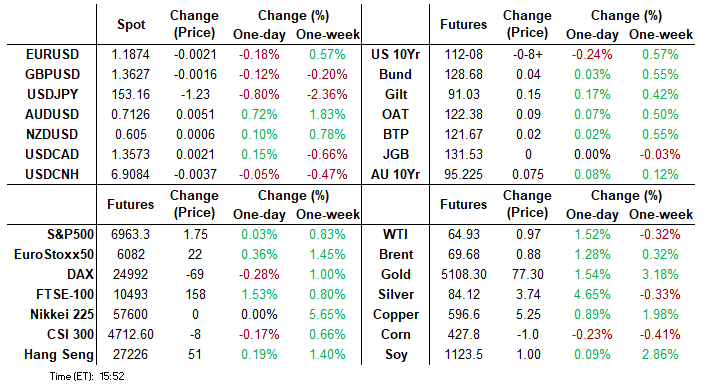
US TSYS
MNI US TSYS: Treasury Yields Rise After Stronger Than Expected Job Gains
- Treasuries look to finish broadly weaker Wednesday, off initial knee-jerk lows following this morning's Jan employment data release.
- Nonfarm payrolls growth was far stronger than expected in January at 130k (cons 65k) after negligible two-month revisions of -17k (mainly in Nov). Private payrolls saw a larger beat, both with the 172k (68k cons) in January but with also a two-month revision of +49k (fairly evenly split over Dec and Nov).
- The Household survey showed a stronger labor market than expected, with the unrounded unemployment rate of 4.283% not just below the consensus of 4.4% and 4.375% prior, but also the lowest since July.
- Treasuries dropped from 112-19 to 112-00 low(-16.5) - the initial technical support (20-day EMA) holding while futures see-sawing off lows through midday. Brief risk-off support as Bitcoin fell 4% to near 66k before paring losses to -2.05%.
- Treasuries retreated after the $42B 10Y note auction (91282CPZ8) tailed, drawing 4.177% high yield vs. 4.162% WI; 2.39x bid-to-cover vs. 2.55x prior. Lowest since Aug 2025: indirect take-up retreats 64.54% vs. 69.65% prior.
- Looking ahead: UK GDP and US jobless claims highlight a lighter calendar on Thursday, before he focus turns to Friday’s release of US CPI.
REFERENCE RATES
US TSYS: Repo Reference Rates
- Secured Overnight Financing Rate (SOFR): 3.65% (+0.02), volume: $3.194T
- Broad General Collateral Rate (BGCR): 3.63% (+0.02), volume: $1.334T
- Tri-Party General Collateral Rate (TCR): 3.63% (+0.02), volume: $1.314T
- (rate, volume levels reflect prior session)
STIR: FRBNY EFFR for prior session:
- Daily Effective Fed Funds Rate: 3.64% (+0.00), volume: $104B
- Daily Overnight Bank Funding Rate: 3.63% (+0.00), volume: $204B
FED Reverse Repo Operation
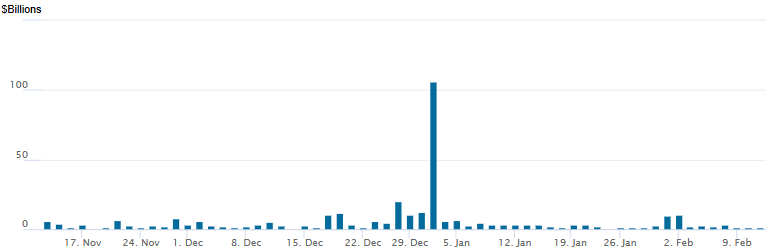
RRP usage recedes to $1.048B with 6 counterparties this afternoon vs. $1.447B Tuesday. Compares to December 12 low of $0.838B (lowest level since mid-March 2021); this years highest excess liquidity measure: $460.731B on June 30.
US SOFR/TREASURY OPTION SUMMARY
SOFR Call interest gained in the second half, while Treasury options saw a surge of low delta midcurve puts at midday. Underlying futures weaker, but well off this morning's post-NFP lows. Projected rate cut pricing cooling significantly vs. late Tuesday levels (*): Mar'26 at -1.5bp (-5.2bp), Apr'26 at -5.6bp (-11.6bp), Jun'26 at -17.9bp (-26.3bp), Jul'26 at -26.6bp (-35.6bp).
SOFR Options:
+10,000 SFRN6 96.68/96.81/96.93/97.06 call condors vs. 96.50 put, 0.0 net
+4,000 SFRM6 96.31/96.43/96.56/96.68put condors, 5.25
-5,000 SFRJ6 96.75/96.87 call spds, 1.0 ref 96.55
+10,000 SFRU6 96.75/97.00/97.25 call fly 2.75 over SFRH6 96.37 calls
+4,000 SFRU6/SFRZ6 96.31/96.43 put spd spd, 0.0 net
Update, +12,000 SFRJ6 96.56/96.68/96.81 call flys, 1.5 ref 96.54
-4,000 SFRZ6 96.75 straddles, 43.5-42.5
-2,500 SFRJ6 97.12 calls, 1.0
over 10,000 SFRG6 96.37/96.43 3x2 put spds
Block, 5,000 SFRG6 96.43/96.50 call spds, 1.25
over 7,700 SFRG6 96.56 calls, cab
6,000 SFRM6 96.50 puts, 0.5 ref 96.635
-2,500 SFRG6 96.31/96.37/96.43/96.50 put condors, 4.5
Block/screen, over 8,000 SFRH6 96.37 straddles, 8.5
+3,500 SFRZ6 96.75/96.81 strangles, 44.75
3,000 SFRH6 96.37/96.43/96.50 put trees, 2.75
+3,000 SFRH6 96.56/96.68 call spds, 1.0 vs 96.42/0.10%
4,000 SFRG6 96.37/96.43 2x1 put spds, 3.25
+4,000 SFRM6 96.37 puts, 1.0
-4,000 SFRG6 96.43/96.50 call spds, 1
+5,000 0QG6 96.81 puts, 1.5
+5,000 SFRH6 96.37/96.43/96.50 call flys, 0.5
2,000 SFRU6 95.87/96.37 put spds ref 96.825
+4,000 0QH6 97.06/97.18 call spds, 2.0 ref 96.905
2,950 SFRH6 96.43 puts ref 96.41
Treasury Options:
-15,000 wk4 TY 113/114 1x2 call spds, 2.0 vs. 112-06.5/0.05%
4,000 TYH6 112.5/113.251x2 call spds
+18,000 TYJ6 111.5 puts, 22 vs. 112-08.5/0.34%
-15,000 TYH6 112 puts, 8 vs. 112-09/0.33%
+35,000 TYJ6 111.5/112.5 strangles, 53-52
+100,000 wk4 TY 109.5 puts, cab-7
+6,000 wk2 TY 112 puts, 5 vs 112-04.5/0.20%
over 50,000 wk2 TY 112.25 puts
-12,000 TYJ6 112 calls, 39 vs. 112-00/0.39%
9,000 TYJ6 114 calls, 8 vs. 112-00.5
2,000 FVJ6 108.75/109.75 strangles, ref 109-09.75
3,000 TYH6 111.75/113.25 strangles
-2,000 TYH6 112.5 puts, 20 vs. 112-16.5/0.46%
over +5,000 TYH6 112 puts, 7
+3,500 TYH6 111.5 puts, 3 vs. 112-11/0.07%
-2,000 TYJ6 112.5/114 call spds 24 vs. 112-13.5/0.28%
+4,000 FVH6 109.25 puts, 11.5
-2,750 USJ6 115 puts, 60
8,500 Wed/wkly 112/112.25 put spds, 4 (exp today)
+3,000 USJ6 114/116 put spds, 48
-2,000 TYH6 111.5/112.5 call spds, 47
+3,000 FVJ6 107.75/108.5 put spds, 6.5 ref 109-11
4,850 FVH6 108.25 puts, .5 ref 109-12
+5,900 TYJ6 109.5 puts, 3 ref 112-14.5
-2,000 TYH6 110.75/111.75 call spds, 61
MNI BONDS: EGBs-GILTS CASH CLOSE: Full Recovery From US Payroll-Related Losses
European yields fell in a bull flattening move Wednesday, despite a stronger-than-expected US labour market report.
- After posting modest gains in morning trade, EGBs and Gilts reversed sharply to the session's worst levels after the US unemployment rate came in lower than expected in January with payroll gains above-consensus.
- But from that point on, there was a steady rally that more than reversed the initial pullback. Part of this appeared related to equity weakness, with US Treasuries lagging European counterparts.
- Both the German and UK curves bull flattened on the day, with Gilts slightly outperforming Bunds across the curve.
- Periphery/semi-core EGB spreads closed mixed but little changed.
- OATs notably outperformed after a 30Y syndication saw strong demand with a record book size for France.
- The highlight early Thursday is UK GDP data - sell-side analysts, and the BOE's latest forecast, look for 0.2% Q/Q growth in the first estimate of Q4 GDP. ECB speakers Thursday include Makhlouf, Nagel, and Lane.
Closing Yields / 10-Yr EGB Spreads To Germany
- Germany: The 2-Yr yield is down 0.3bps at 2.066%, 5-Yr is down 0.5bps at 2.378%, 10-Yr is down 1.6bps at 2.792%, and 30-Yr is down 3.4bps at 3.456%.
- UK: The 2-Yr yield is down 1.9bps at 3.624%, 5-Yr is down 1.9bps at 3.875%, 10-Yr is down 3bps at 4.476%, and 30-Yr is down 4bps at 5.285%.
- Italian BTP spread unchanged at 60.5bps / French OAT down 0.8bps at 59bps
MNI EGB OPTIONS: Large Euribor Call Structures Continue To Stand Out
Wednesday's Europe rates/bond options flow included:
- ERM6 97.87/97.93/98.06c fly, bought for 2.5 in 10k
- ERU6 98.12/98.18cs v 97.93/97.87ps, bought the cs for half in 40k total
- ERZ6 99.00 calls paper paid 0.75 vs. 98.045 on 10K
- ERZ6 98.50/99.00 call spread in 16.5k vs ERZ6 97.8125 put in 5.5k, paper buys the call spread for zero net cost
- ERZ6 97.9375/97.875/97.8125p fly, bought for 0.75 in 4k
- ERZ6 98.12/98.43/98.50/98.81 call condor vs. 98.00/98.12/98.18/98.31 call condor 31.5K given at 2.5/2.25. Reminder that 28.5K was given at 2.5 Tuesday
- ERH7 98.25/98.50/98.875c fly, bought for 1.75 in 5k
- SFIM6 96.75c, bought for 2 in 15k
- SFIZ6 96.80/96.85/96.90/96.95 call condor, bought for 0.25 in +10k
- SFIM7 98.00 call, paper paid 2 in 15k
MNI FOREX: JPY Extends Post-Election Surge Despite Payrolls Volatility
- Higher-than-expected headline figures within the January US employment report sparked some recovery strength on Wednesday. However, intricacies within the report and the overarching bearish dollar narrative quickly sapped the initial greenback enthusiasm. The net impact is a slightly lower dollar index on the session, although this has been dragged by particularly strong performance for both the Japanese yen and the Australian dollar.
- The Japanese yen extended its post-election rebound in APAC trade, prompting USDJPY to fall to a 152.80 low. The pair recovered ahead of the US data, and had an aggressive spike to 154.65 following the release, however, the rally was extremely short-lived with a vicious reversal taking the pair back below 153 in rapid fashion.
- After a few hours of steadier trade between 153.20-80, spot has now edged back below 153.00 as has made fresh session lows below 152.80 as we approach the APAC crossover, further narrowing the gap to 152.10 support, the Jan 27 low.
- AUD outperformance has been linked to a stable session for equities and the positive performance for precious metals. Furthermore, a hawkish leaning RBA Hauser has underpinned the bullish AUD narrative, prompting AUDUSD to close in on the 2023 highs at 0.7158. Aussie strength has been very notable in the crosses, with the likes of EURAUD and GBPAUD extending their 2026 selloffs to around 5.5%, and AUDCHF showing nascent signs of a technical breakout, rising 1.15% today.
- In similar vein, the more stable session for the Euro and sterling have prompted solid corrections for EURJPY and GBPJPY, with the latter extending significantly below its 50-day EMA and the January lows to reach a session low of 208.45.
- UK GDP and US jobless claims highlight a lighter calendar on Thursday, before he focus turns to Friday’s release of US CPI.
MNI FX OPTIONS: Expiries for Feb12 NY cut 1000ET (Source DTCC)
- EUR/USD: $1.1750-60(E2.4bln), $1.1875-80(E637mln)
- USD/JPY: Y153.00($605mln), Y154.00($2.4bln)
- USD/CNY: Cny6.9000($1.1bln)
MNI US STOCKS: Late Equities Roundup: Sentiment Rebounds as Volatility Ebbs
- Stocks are trading narrowly mixed late Wednesday, near mid-range after a volatile first half - gapping higher after better than expected job gains for January this morning, only to reverse course - gap lower as Bitcoin fell over -4% to 66,021.
- Currently, the DJIA trading down 45.21 points (-0.09%) at 50147.41, S&P E-Mini Futures up 7 points (0.1%) at 6968.75, Nasdaq up 4.5 points (0.1%) at 23118.
- Sentiment gradually improved as market volatility evaporated in the second half, the tech-heavy Nasdaq mildly higher at the moment - supported by chip makers: Sandisk Corp +11.40%, Micron Technology +9.05%, Teradyne +5.67%, Western Digital +5.45% and NXP Semiconductors +5.41%.
- Meanwhile, Energy sector shares remained strong as crude prices gained (WTI +0.90 at 64.86): EOG Resources +4.09%, Williams Cos +3.92%, Baker Hughes +3.35% and EQT Corp +3.18%.
- On the flipside, Financials and Communication Services sector shares led declines in late trade, the former tied to Bitcoin weakness: Robinhood Markets -10.25%, Assurant -8.44%, Coinbase Global -6.04%, Intercontinental Exchange -6.00% and Block Inc -5.43%. Omnicom Group -4.53%, Match Group -3.63%,Trade Desk Inc -3.15%, Fox Corp -2.84% and Netflix -2.82% weighed on the Communications sector.
MNI EQUITY TECHS: E-MINI S&P: (H6) Bull Trigger Remains Exposed
- RES 4: 7080.92 0.764 proj of the Nov 21 - Dec 11 - 18 price swing
- RES 3: 7056.95 2.0% Upper Bollinger Band
- RES 2: 7043.00 High Jan 28 and bull trigger
- RES 1: 7022.98 1.0% 10-dma envelope
- PRICE: 6997.50 @ 14:48 GMT Feb 11
- SUP 1: 6923.60 50-day EMA
- SUP 2: 6751.50 Low Feb 6 and key short-term support
- SUP 3: 6691.56 76.4% retracement of the Nov 21 - Jan 28 bull leg
- SUP 4: 6583.00 Low Nov 211 and a key medium-term support
The firm reversal higher on Feb 6 in S&P E-Minis refocuses attention on the primary uptrend and key resistance at 7043.00, the Jan 28 high. Clearance of this level would confirm a resumption of the trend and mark the end of a flat correction in the contract. Key short-term support has been defined at 6751.50, the Feb 6 low, where a break is required to highlight a top and a stronger short-term reversal.
MNI COMMODITIES: Crude Rises, Precious Metals Rebound
- Crude rose to its highest since late-January, before paring gains, as the risk premium builds while the market looks for indications on the next steps in US-Iran negotiations.
- WTI Mar 26 is up by 0.9% at $64.6/bbl.
- The Trump administration has discussed whether to seize Iranian oil tankers to pressure Tehran but have held off amid concern for retaliation and the impact on global oil markets, US officials said cited by Bloomberg.
- Meanwhile, the Wall Street Journal cites three officials saying the pentagon is preparing to send a 2nd aircraft carrier to the middle east.
- A bull cycle in WTI futures remains intact, with key resistance and the bull trigger at $66.48, the Jan 30 high. On the downside, attention is on support at the 20-day EMA, at $62.54.
- Meanwhile, precious metals have rebounded as the overarching bearish dollar narrative quickly reasserted itself in the aftermath of today’s US employment report, sapped the initial greenback enthusiasm.
- Spot gold is currently up by 1.3% at $5,092/oz, while silver has bounced by 4.6% to $84.5/oz.
- The latest bounce in gold highlights a retracement of the Jan 29 - Feb 2 sell-off, with the next resistance point to monitor at $5,139.9, a Fibonacci retracement level.
- For silver, initial firm resistance is at 86.960, the 20-day EMA, followed by $100.0 round number resistance.
THURSDAY DATA CALENDAR
| Date | GMT/Local | Impact | Country | Event |
| 12/02/2026 | 0700/0700 | *** |  GB GB | UK Monthly GDP |
| 12/02/2026 | 0700/0700 | ** | GB | Trade Balance |
| 12/02/2026 | 0700/0700 | ** | GB | Index of Production |
| 12/02/2026 | 0700/0700 | ** | GB | Output in the Construction Industry |
| 12/02/2026 | 0700/0700 | ** | GB | Index of Services |
| 12/02/2026 | 0700/0700 | *** | GB | GDP First Estimate |
| 12/02/2026 | 0900/1000 |  EU EU | ECB's Cipollone At Commissione Europa Conference | |
| 12/02/2026 | - | GB | BOE MPG Meeting | |
| 12/02/2026 | - | *** |  CN CN | New Loans |
| 12/02/2026 | - | *** | CN | Money Supply |
| 12/02/2026 | - | *** | CN | Social Financing |
| 12/02/2026 | 1330/0830 | *** |  US US | Jobless Claims |
| 12/02/2026 | 1330/0830 | ** | US | WASDE Weekly Import/Export |
| 12/02/2026 | 1345/0845 |  CA CA | BOC's Rogers panel talk on productivity | |
| 12/02/2026 | 1500/1000 | *** | US | NAR existing home sales |
| 12/02/2026 | 1530/1030 | ** | US | Natural Gas Stocks |
| 12/02/2026 | 1630/1130 | * | US | US Bill 08 Week Treasury Auction Result |
| 12/02/2026 | 1630/1130 | ** | US | US Bill 04 Week Treasury Auction Result |
| 12/02/2026 | 1800/1300 | *** | US | US Treasury Auction Result for 30 Year Bond |
| 12/02/2026 | 1830/1930 | EU | ECB's Lane At The World Ahead 2026 Gala Dinner | |
| 12/02/2026 | 0000/1900 | US | Fed's Lorie Logan, Stephen Miran |


