EUROZONE: WEEK AHEAD: France No Confidence Vote and ECB Decision
MONDAY - French No-confidence Vote
- On Monday, French PM Bayrou is expected to be ousted by a no-confidence vote. Parties on the right and left of the political spectrum have expressed a lack of confidence in Bayrou's fragile administration, exacerbated by his contractionary 2026 budget plans presented before the summer recess. That leaves markets focusing on the fallout of the vote. Sources suggest President Macron wants to avoid calling another snap election, suggesting the only path forward for French politics is for a new PM to find support for a watered down set of 2026 budget proposals. The Socialist Party have proposed a budget that includes E22bln of fiscal consolidation measures, half of the E44bln planned by Bayrou.
THURSDAY - ECB Decision
- The ECB is unanimously expected to keep rates on hold at 2.00% on Thursday, with OIS markets assigning virtually zero implied probability of such a move. Developments over the summer have done little to push back on President Lagarde's hawkish signalling at the ECB's July press conference. Economic indicators such as the PMIs continue to gradually improve, the unemployment rate is at all-time lows, and inflation remains very close to the 2.0% medium-term target. Additionally, the EU-US trade agreement has significantly reduced trade policy uncertainty, even if the agreed 15% baseline tariff rate is above the ECB's June projection baseline of 10%.
- There appears to be little to no appetite for a September rate cut amongst ECB Governing Council members. However, the MNI Policy Team's most recent source piece suggested the risk bias among policymakers remains cautiously to the downside as they maintain a data-dependent, meeting-by-meeting approach, with eurozone inflation already around the 2% target and likely to weaken. ECB-dated OIS currently price just under 10bps of easing through year-end, with 19bps of cuts through July 2026.
- Based on the analyst previews we have seen so far, changes to the ECB's September macroeconomic projections relative to June are expected to be centred in 2025 (resulting from technical assumption updates and carryover from recent GDP/inflation releases). For 2026 and 2027, analysts don’t expected major changes to core HICP and real GDP projections.
Want to read more?
Find more articles and bullets on these widgets:
Historical bullets
FED: US TSY 17W BILL AUCTION: HIGH 4.105%(ALLOT 83.04%)
- US TSY 17W BILL AUCTION: HIGH 4.105%(ALLOT 83.04%)
- US TSY 17W BILL AUCTION: DEALERS TAKE 26.35% OF COMPETITIVES
- US TSY 17W BILL AUCTION: DIRECTS TAKE 5.67% OF COMPETITIVES
- US TSY 17W BILL AUCTION: INDIRECTS TAKE 67.98% OF COMPETITIVES
- US TSY 17W BILL AUCTION: BID/CVR 3.31
US OUTLOOK/OPINION: Still Some Way For Full Tariff Impact To Show On Prices
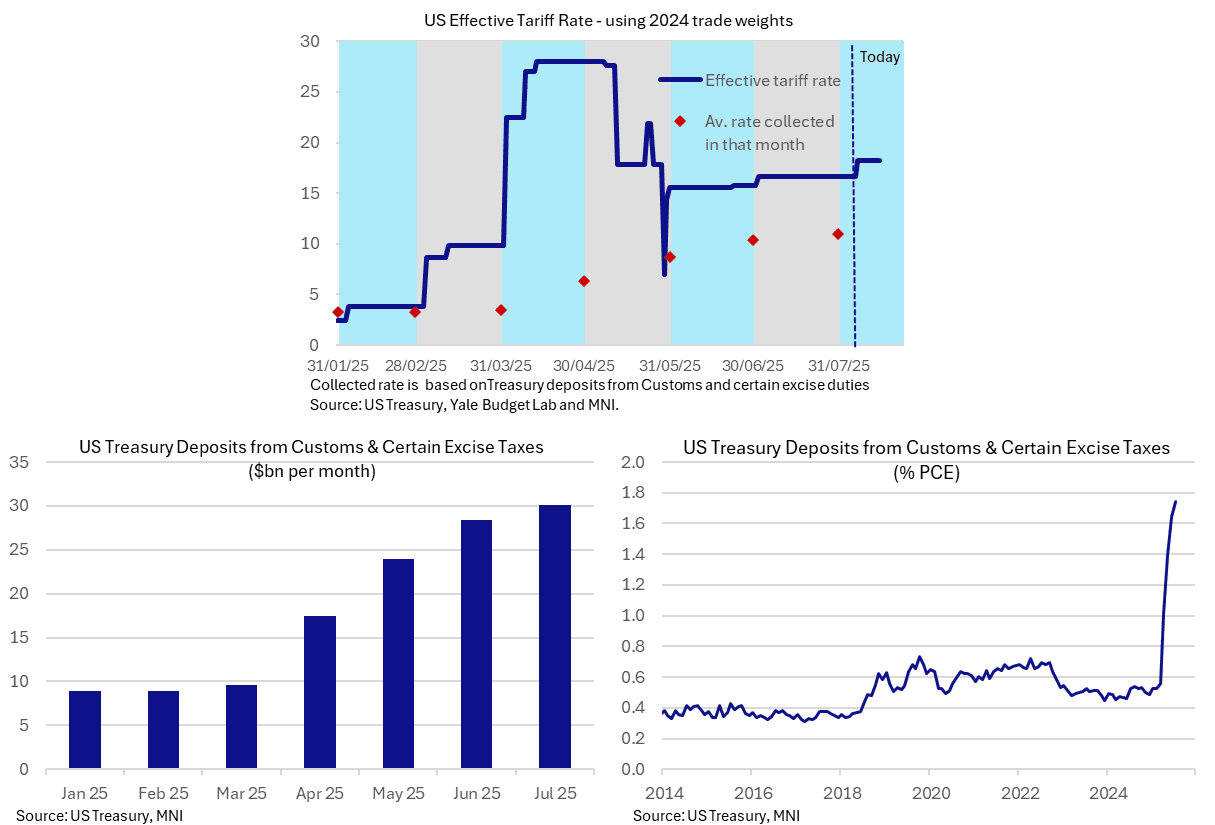
Looking ahead to next week’s US CPI (Tue) and PPI (Thu) releases, latest monthly tariff revenue for July suggests we’re still some way off seeing the full impact from tariffs on prices.
- The effective tariff rate currently stands at 18.3% according to Yale Budget Lab calculations (pre-substitution, i.e. keeping trade shares constant), up from 15.5-16% through June and 16.6% in July.
- In contrast, the $30bn of Treasury deposits from customs and certain excise duties in July was worth 11.0% of goods imports in 2024 (likely reflecting June average tariff rates suggesting further increases still to come). That’s up from 10.3% in June, 8.7% in May, 6.3% in April and 3.0% in Dec 2024 prior to the second Trump administration to give a sense of baseline.
- (Note that this 11.0% rate would be 10.3% if using a 12mth sum up to latest data for June owing to the sharp rise in imports in 1Q25. This dynamic approach with recent data can be misleading).
- Alternatively, these tariff revenues in July were worth ~1.7% of overall personal consumption expenditure, an increase of 1.3pp under the Trump administration.
- Of course, this doesn’t give insight into burden sharing across importers, businesses and consumers.
- On the former, June US import prices showed a partial correction stronger for those from China after what had looked like some taking of a tariff hit in April and May (implied by lower than usual import prices), but import prices more generally haven’t shown much concession. That’s in contrast to NEC Director Hassett saying on Aug 4 that data shows tariffs are being borne by foreign producers, although admittedly the extent to which they’re being borne is vague in that headline.
EQUITY TECHS: E-MINI S&P: (U5) Corrective Pullback Extends
- RES 4: 6523.63 1.764 proj of the May 23 - Jun 11 - 23 price swing
- RES 3: 6500.00 Round number resistance
- RES 2: 6477.31 1.618 proj of the May 23 - Jun 11 - 23 price swing
- RES 1: 6468.50 High Jul 31 and the bull trigger
- PRICE: 6358.00 @ 16:20 BST Aug 6
- SUP 1: 6244.36 2.0% 10-dma Envelope
- SUP 2: 6239.50 Low Aug 1
- SUP 3: 6213.75 50% retracement of Jun - Aug Upleg
- SUP 4: 6203.65 50-day EMA
Equities sold off sharply Friday on the back of the soft NFP print - pushing prices through mid-July lows in the process. Since that spell of weakness, price has traded either side of support at the 20-day EMA, at 6325.25, signalling scope for a deeper retracement toward the 50-day EMA at 6203.65. Clearance of this average is required to signal a stronger reversal. The primary trend remains up, leaving key short-term resistance and the bull trigger at 6468.50, the Jul 31 high.


