ECB: Wage Tracker Still Points To Declining Pay Pressures Through '26
Dec-19 08:42
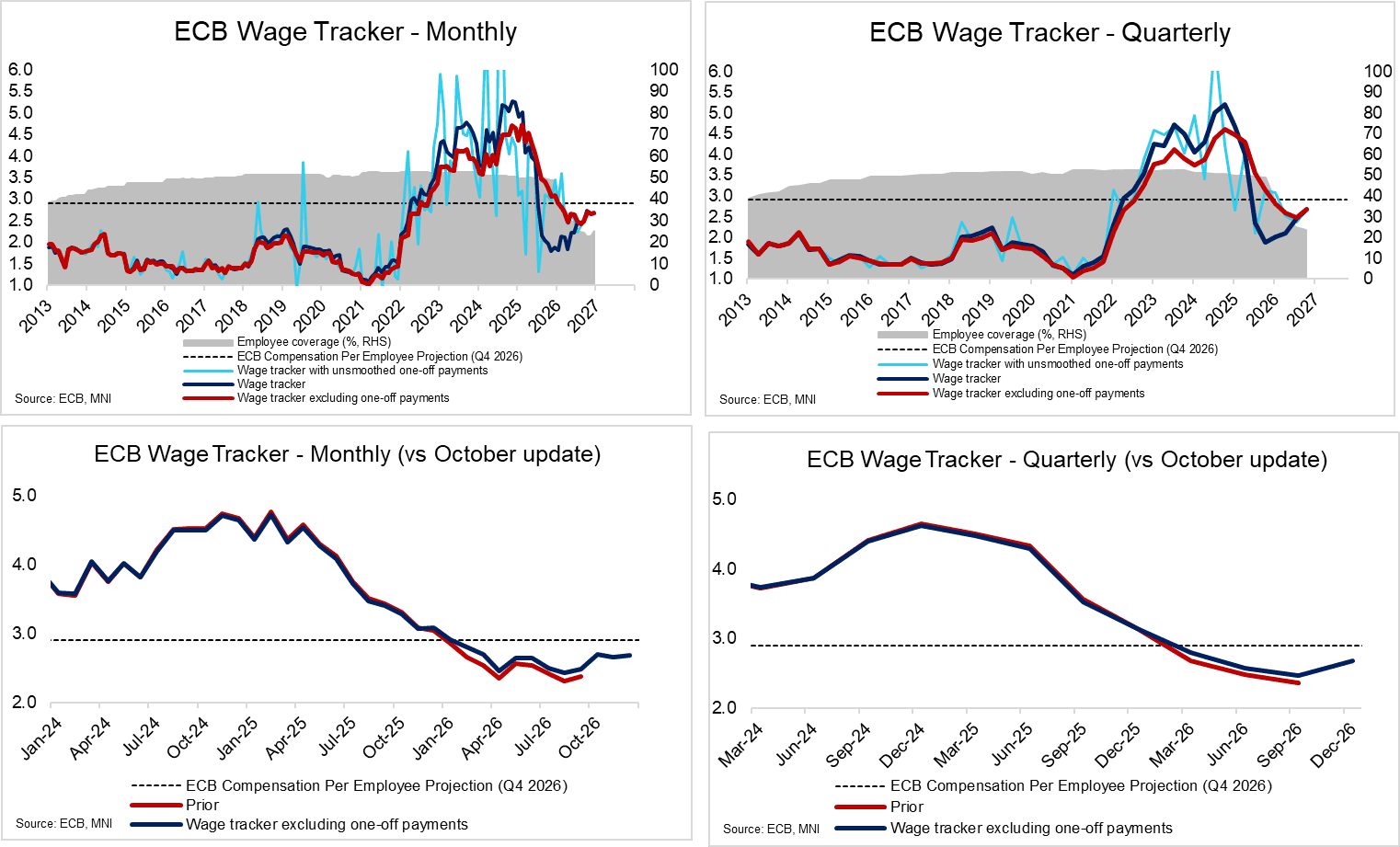
The ECB’s forward looking wage tracker continues to suggest that negotiated wage pressures will ease through 2026, albeit at a slower pace than expected in October. The tracker now includes Q4 2026, albeit with a low employee coverage ratio of just 23%. Negotiated wages excluding one-off payments are expected at 2.8% in Q1 ’26, 2.6% in Q2 and 2.5% in Q3, before rising to 2.7% in Q4.
- Stronger-than-expected compensation pressures were a key factor behind the upward revision to the ECB’s services and core inflation projections. The higher-than-expected compensation per employee figure was due to “payments over and above negotiated wages”. That suggests the negotiated wage tracker shouldn’t be considered a perfect forward-looking indicator of actual future pay pressures. However, it is still an important input into the Governing Council’s thinking.
- The ECB writes that “The headline ECB wage tracker is better suited to describing quarterly or monthly dynamics in negotiated wages as it smoothens one-off payments over time. Meanwhile, the ECB wage tracker with unsmoothed one-off payments is better suited to describing yearly dynamics, ensuring that one-off payments are not smoothed twice when constructing the yearly outcomes.”
- Additionally, “Since the previous data release in November 2025, the ECB wage tracker has been expanded to retroactively include collective agreements in Finland from January 2015 onwards. The forward-looking horizon has been extended to the end of December 2026, providing some initial insights for the full year.”
Want to read more?
Find more articles and bullets on these widgets:
Historical bullets
SONIA OPTIONS: Call Fly buyer
Nov-19 08:33
SFIH6 96.50/96.60/96.80broken c fly, bought for 1.25 in 3k.
US TSY FLOWS: US Roll Pace (updated)
Nov-19 08:22
- WNA: 5%.
- USA: 8%.
- UXY: 4%.
- TYA: 12% (above pace).
- FVA: 11% (above pace).
- TUA: 5%.
SONIA OPTIONS: Outright Put seller
Nov-19 08:21
SFIZ5 96.25p, sold at 2.5 in 2k.
Related bullets

Related by topic
EUR/USD
Bunds
Germany
Euribor
European Central Bank


