AUSTRALIA DATA: Vacancies Appear To Be Stabilising
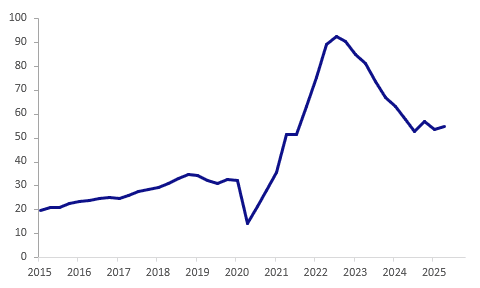
Vacancies in the 3-months to May (Q2) rose 2.9% q/q resulting in an improvement in the annual rate to -2.8% from -9.2% in Q1. The ratio to unemployment rose 1.3pp to 54.8%, in line with the four quarter average. It fell consistently for two years from Q3 2022 after reaching an unusual 92.5% but the vacancy environment now appears to have stabilised. The RBA doesn’t just consider headline jobs and unemployment data but also indicators such as vacancies. The market expects a July rate cut but data suggest the labour market remains tight.
Australia vacancies-to-unemployment %
Source: MNI - Market News/LSEG
- In terms of other vacancy series, SEEK May job ads fell 0.3% m/m after rising 1.8% m/m and are down 5.6% y/y. Internet vacancies fell 2.8% m/m in May and the ratio to unemployment has settled around the series average. ANZ job ads were down 1.2% m/m in May to be down 5% y/y up from -13.3% y/y in January.
- There was a pickup in both private and public job openings in Q2 at 3.2% q/q and 0.6% q/q respectively.
- The ABS noted that the rise in Q2 vacancies “was driven by industries with a high proportion of skilled workers, including Professional, scientific and technical services, and Construction”.
- However, with only 8 out of 18 industries recording an increase in openings, the rise in Q2 was not particularly broad based. Construction saw the largest rise +20.6% q/q, while wholesale trade fell 13.3% q/q.
Want to read more?
Find more articles and bullets on these widgets:
Historical bullets
CHINA PRESS: Authorities Can Prioritise Capital Market To Boost Consumption
Authorities should boost consumption by prioritising resident’s capital market income given the limited potential for increasing wealth through real estate and wealth management products, according to Lian Ping, chief economist at Guangkai Industry Research Institute. In the current macroeconomic environment, wage growth and business income are unlikely to provide significant short- to medium-term support for consumption, Lian said, noting improvements to pensions and social security have only a stabilising effect.
CHINA PRESS: Moody's Unchanged Rating A Positive Reflection Of Chinese Economy
China's Ministry of Finance said Moody's decision to maintain the country's rating and outlook unchanged reflected China's positive economic prospects, Shanghai Securities News reported. New and existing policies will combine to support the nation’s high-quality economic development, following a strong start to the year, a statement on the ministry's website noted.
CHINA PRESS: Yuan May See Limited Appreciation - Analysts
The People’s Bank of China has taken a moderating approach to the yuan’s appreciation momentum rather than actively pushing for substantial gains, Yicai.com reported, citing market insiders' analysis. The yuan could fluctuate between 7.2-7.3 against the U.S. dollar in the next six-12 months, depending on export performance and trading firms’ forex settlement, the newspaper said, citing Zhu Haibin, chief China economist at JP Morgan.


