AUSTRALIA DATA: Underlying Inflation Ends Q3 On Strong Note
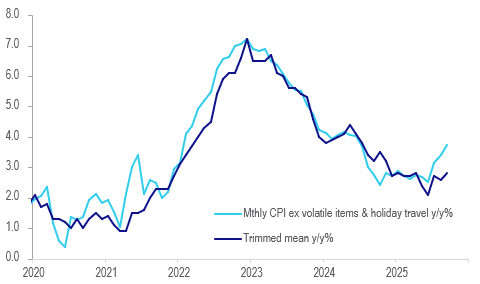
September headline monthly CPI rose to 3.5% y/y from August’s 3.0% rising 0.3% m/m seasonally adjusted, while the trimmed mean picked up 0.2pp to 2.8% y/y. This is the last release of the monthly CPI in its current form and the October data due 26 November will be the new complete series with the headline becoming the “primary measure”. It will take longer for monthly trimmed mean to replace quarterly as it is seasonally adjusted and needs time for seasonal factors to emerge.
- The seasonally adjusted CPI ex volatile items & holiday travel rose 0.4% m/m bringing the annual rate to 3.7% y/y after August’s 3.3%, the highest since June 2024, which is likely also to be concerning for the RBA. 3-month momentum has been trending higher over 2025.
- Services rose to 3.4% y/y in September from 3.3%, in line with the recent sideways trend. Both it and the trimmed mean are off their June low signalling an end to disinflation and some stickiness.
- Housing was a major contributor to annual headline inflation given the increase in electricity due to the expiry and timing of government electricity rebates. The other sectors were food and alcohol & tobacco.
Australia underlying CPIs y/y%
Source: MNI - Market News/ABS
Want to read more?
Find more articles and bullets on these widgets:
Historical bullets
CHINA PRESS: Industrial Profits Return To Growth
Profits at industrial enterprises increased 20.4% y/y in August, reversing a decline of 1.5% in July, driven by efforts to combat aggressive price competition, coupled with a low base from the same period last year, Yicai.com reported citing data by National Bureau of Statistics on Saturday. For the first eight months, industrial profits grew by 0.9% y/y, reversing the continuous decline since May. Profits are expected to keep recovering moderately, with the support of anticipated additional pro-growth policies, and improving market order and more reasonable price transmission and cost distribution mechanisms, the newspaper said citing Wen Bin, chief economist of China Minsheng Bank.
CHINA PRESS: PBOC To Focus On Policy Implementation
The People’s Bank of China may continue prioritising “implementing existing policies” for now, as signaled by its Monetary Policy Committee at the Q3 meeting, 21st Century Business Herald reported. Compared with Q2, the Committee added a call to “ensure thorough implementation of various monetary policy measures to fully unleash policy effects,” while dropping reference to “stepping up efforts to implement additional policies,” though still stressing policy flexibility, the newspaper said.
CHINA PRESS: Beijing Should Boost Short-term Treasury Bond Supply
Authorities should boost the supply of short-term treasuries as their scarcity is hampering the People’s Bank of China’s open market operations, wrote Guan Tao, global chief economist at BOCI China. While the PBOC has positioned treasury bond trading as a tool for base money injections and liquidity management, activity was suspended in January amid a persistent supply-demand imbalance. China’s treasury issuance is largely aimed at deficit financing, dominated by medium- and long-term notes, compared with around 50% short-term issuance in developed economies, Guan noted. He added that treasuries accounted for just 4.9% of the PBOC’s total assets as of August.


