AUSTRALIA DATA: Softer Exports But Capex Imports Up, Surplus Within Recent Range
The April merchandise trade surplus narrowed $1.5bn to $5.4bn but remained above the Q1 average and in line with the levels seen since the end of the post-Covid rebound. There was some payback in the month for the strong increase in March exports, while imports rose at their highest monthly rate since December.
Australia merchandise trade balance $mn
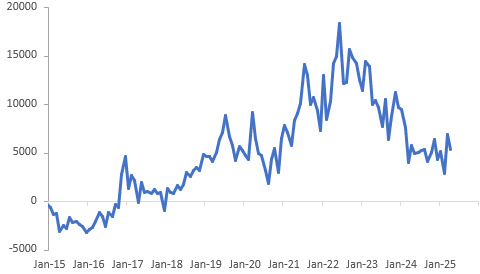
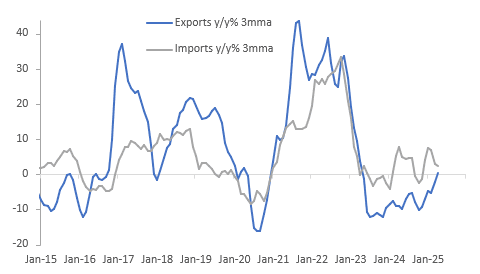
- Merchandise exports fell 2.4% m/m to be up 4.0% y/y in April after +7.2% m/m & +4.6% y/y. Shipments were supported by broad-based strong growth in rural goods (+9.4% m/m & 29.6% y/y).
- The decline in the total was due to a sharp fall in non-monetary gold, which is volatile, but non-rural was down 2.1% m/m to be down 3.6% y/y due to contractions in metal ores and coal, while other mineral fuels and metals rose.
- Goods imports rose 1.1% m/m to be up 5.6% y/y after -2.4% & -2.3% respectively.
- After a very weak March, capex goods posted a broad-based rebound of 7.5% m/m in April to be up 2.8% y/y. Consumer goods were also robust rising 2.8% m/m to be up 6.4% y/y driven by clothing and vehicles. Intermediate imports remained weak with the third straight decline in April at 5.3% m/m but up 1.2% y/y impacted by lower fuel prices.
Australia goods exports vs imports y/y% 3-mth moving average
Source: MNI - Market News/ABS
Want to read more?
Find more articles and bullets on these widgets:
Historical bullets
AUSSIE BONDS: Cheaper Despite Weaker Domestic Data
ACGBs (YM -3.0 & XM -6.0) are weaker and near Sydney session cheaps.
- Building approvals fell 8.8% m/m (estimate -1.5%) in March versus a revised -0.2% in February.
- “Australia's household spending declined 0.3% in March, contrary to a forecast 0.2% increase, due to the impact of a major storm in the nation's northeast. Spending dropped in Queensland by 1.3%, particularly in transport and health, and nationally, six of the nine spending categories declined in March.” (per BBG)
- Cash US tsys dealings in today’s Asia-Pac session with Japan out. TYM5 is slightly cheaper.
- Cash ACGBs are 3-6bps cheaper, with the AU-US 10-year yield differential at -2bps.
- Today’s auction result extended the recent trend of firm pricing for ACGBs, with the weighted average yield printing 0.28bps through prevailing mids, according to Yieldbroker. However, demand moderated somewhat, as reflected by a cover ratio of 2.4833x, down from 2.7067x at the previous auction.
- The bills strip has bear-steepened, with pricing flat to -4 across contracts.
- RBA-dated OIS pricing is flat to 2bps firmer across meetings today. A 50bp rate cut in May is given a 3% probability, with a cumulative 103bps of easing priced by year-end.
CHINA PRESS: China To Deepen Cooperation Among ASEAN+3 Members
Beijing will address global uncertainty by strengthening financial cooperation with the expanded ASEAN+3 group that adds Japan, South Korea and China to the bloc, said Finance Minister Lan Fo’an at the 28th ASEAN+3 Finance Ministers and Central Bank Governors Meeting in Milan. The group agreed to launch a new rapid financing facility under the Chiang Mai Initiative using the yuan and other freely usable currencies. (Source: Securities Times)
CHINA PRESS: Local Government Bonds Up 84% Since January
Local governments issued CNY3.5 trillion of bonds nationwide in the first four months of 2025, up 84% y/y, Yicai reported. Refinancing bonds accounted for CNY2 trillion, up 116% y/y, of which CNY1.6 trillion replaced hidden debt, indicating most of this year’s debt-swap quota has been utilised, Yicai noted. A total of CNY1.2 trillion in new special bonds was issued out of 2025's CNY4.4 trillion quota, with 31% towards municipal and industrial park infrastructure, while transport infrastructure, urban renewal, healthcare and land reserves were allocated 20%, 9%, 6% and 6% respectively.


