AUSTRALIA DATA: NAB Survey Shows Recovery Continued & Inflation Stable In Q3
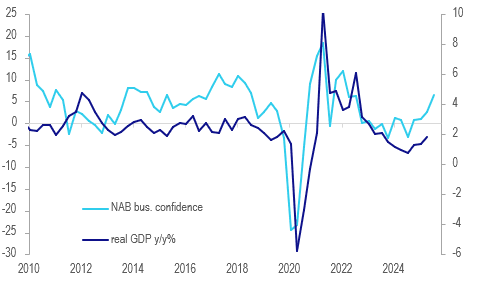
The September NAB business survey showed the gradual recovery in the Australian economy continued. Business confidence rose to 7.3 from 4.3 while conditions were similar to August at 7.6. The Q3 averages though were their highest since Q1 2022 and Q2 2024 respectively, suggesting stronger Q3 GDP growth. While the price/cost components were a bit higher in September, they were little changed in Q3 signalling steady inflation. The data are consistent with activity picking up and concerns that disinflation has stalled, and so with the RBA remaining cautious.
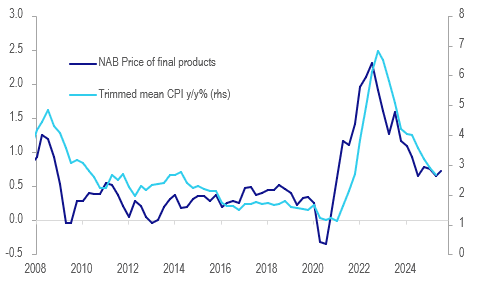
Australia NAB business prices vs trimmed mean CPI %
- Given the volatility amongst some of the components of the monthly NAB survey, it is worth looking at Q3 averages to gauge the recovery and inflation picture in the quarter. Its measure of labour demand fell over 2 points to 2.9 in September but the Q3 average was stable at 3.5 consistent with the RBA’s assessment that labour market conditions are “broadly stable”. September jobs print Thursday and a 0.1pp rise in the unemployment rate to 4.3% is forecast.
- The increase in September business conditions was driven by a pickup in trading to 16.0, its highest since November 2023, and profitability to 5.9, best in almost 18 months. However, forward orders declined to -2.3 from +1.1 but while still weak in Q3 improved one point to -0.5.
- Average Q3 labour cost growth was steady at 1.6% 3m/3m while purchase costs moderated 0.1pp to 1.4% (it has held around 1.5% for 6 consecutive quarters). Final product prices rose 0.7% 3m/3m, in line with 2025 average, while retail prices increased 0.8% down from Q2’s 1.0%, lowest since Covid-impacted Q4 2020. Cost, retail and final product price growth rose in September while labour costs fell 0.1pp.
Australia NAB business confidence vs GDP y/y%
Source: MNI - Market News/LSEG
Want to read more?
Find more articles and bullets on these widgets:
Historical bullets
AUSSIE 3-YEAR TECHS: (U5) Bounces Further Off Support
- RES 3: 97.190 - High May 5 2023
- RES 2: 96.932 - 76.4% of Mar-Nov ‘23 bear leg
- RES 1: 96.860 - High Apr 07
- PRICE: 96.550 @ 15:36 BST Sep 12
- SUP 1: 96.430/95.900 - Low Sep 3 / Low Jan 14
- SUP 2: 95.760 - Low 14 Nov ‘24
- SUP 3: 95.480 - Low Jan 11 2023 and a major support
Aussie 3-yr futures are trading off recent lows. A resumption of gains from here would further narrow the gap with resistance at 96.730, the Sep 17 ‘24 high, leaving 96.860 as the next key level. Any continuation lower would instead strengthen a bearish threat. This would refocus attention on 95.760, the 14 Nov ‘24 low. Conversely, a reversal higher would open 96.860, the Apr 7 high.
FED: MNI Fed Preview-September 2025: A Reluctant Return To Easing
We've published our preview of the upcoming FOMC meeting - Download Full Report Here
- The Federal Reserve is set to resume its easing cycle at the September 16-17 meeting with a 25bp cut to the funds rate range to 4.00-4.25%.
- The decision to cut after a 5-meeting pause was well-telegraphed by Chair Powell, whose Jackson Hole speech described a “shifting balance of risks” toward a weaker labor market that “may warrant adjusting our policy stance”.
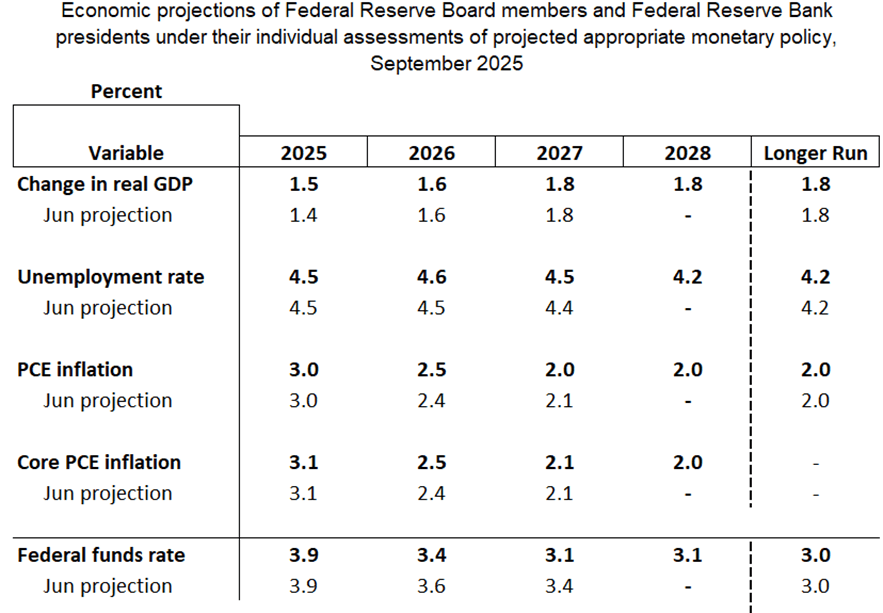
- The updated quarterly projections aren’t likely to bring many changes to the macroeconomic variables, but as usual the signal sent from the Fed rate “Dot Plot” will garner attention. A Committee split between expecting one or two further cuts this year is likely, keeping each of the remaining meetings of 2025 “live”.
- The Statement will downgrade the description of the labor market to reflect a rise in the unemployment rate and poor payrolls growth, and is likely to include at least one dissent to the rate decision.
- But with a Committee that is fairly divided on the way forward, Powell will be noncommittal on future action, reiterating that policy is not on a preset course, and upcoming decisions will be data-dependent.
- A key undercurrent is an increasingly activist approach to Fed personnel management from the White House, which leaves the composition of the FOMC uncertain not just over the medium-term but also at this meeting.
MNI’s separate preview of sell-side analyst summaries to follow on Monday Sep 15
RATINGS: Fitch: France Cut To A+ From AA, Portugal Up To A From A-
Fitch has downgraded France's sovereign rating to A+ (with stable outlook) from AA-. Release here.
- Among other factors in the decision, Fitch cites "High and Rising Debt Ratio", "Political Fragmentation Hinders Consolidation", "Weak Fiscal Record", "High 2025 Deficit", "Uncertain Fiscal Consolidation Path", and "Fiscal Rigidities".
- In "Factors that Could, Individually or Collectively, Lead to Negative Rating Action/Downgrade", Fitch cites "Public Finances: A sustained increase in government debt/GDP over the medium term, due to failure to implement fiscal consolidation measures and/or a persistent increase in financing costs" and "Macro: Materially lower economic growth prospects and weakened competitiveness." Conversely, potentially leading to positive ratings action would be "Public Finances: Confidence that government debt/GDP will be put on a downward trajectory over the medium term, for example, due to fiscal consolidation and/or stronger economic growth".
- Fitch also raised Portugal to A (stable outlook) from A-, while elsewhere, S&P raised Spain to A+ (stable outlook) from A.
- As MNI wrote earlier, we expected France to be downgraded to A+ and Portugal to be upgraded to A.


