MNI EUROPEAN MARKETS ANALYSIS: Gold To Fresh Record High
- Government bond yields moved up from earlier lows. A hawkish LDP member in Japan stressed the need for tighter BoJ policy. In Australia, consumer sentiment ticked down, but NAB business conditions point to further improvement in GDP growth momentum.
- The USD was softer against most currencies, with USD/JPY tracking back under 147.00. USD/IDR was higher though amid fallout from the long time FinMin being replaced.
- Gold prices rose to a fresh record high, continuing the recent strong run.
- US benchmark revisions to payrolls are released later. US August NFIB small business optimism prints. The ECB’s Montagner & Machado and the BoE’s Breeden appear.
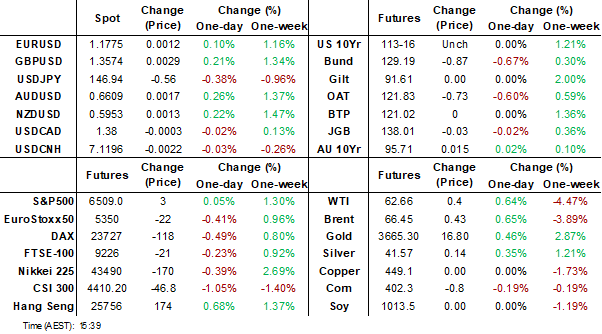
MARKETS
US TSYS: Asia Wrap -Yields Slightly Higher In A Quiet Session
The TYZ5 range has been 113-17+ to 113-19 during the Asia-Pacific session. It last changed hands at 113-17+, unchanged from the previous close.
- The US 2-year yield has edged higher trading around 3.493%, up 0.01 from its close.
- The US 10-year yield has edged lower trading around 4.045%, up 0.01 from its close.
- 10-Year Yields have broken through its support as the market reacts to a labour market that is rapidly cooling. This move should now see buyers return on bounces with the first buy-zone back towards 4.20%. First target the 4.00% zone then the 3.80% area.
- Lance Roberts(RIA) - “Today we will also get the annual revisions to the BLS employment report. That adjustment will likely show that over the last 12-months somewhere between 550,000 to 800,000 fewer jobs were created than originally reported based on the QCEW report. The bond market responded as expected. Bond yields fell as investors realized the disinflationary impact of slower employment and wage growth would increase recession risk. If the revisions to employment show a substantially weaker than expected outcome, bond yields will likely fall further.”
- Bloomberg Economics - “Wall Street expects preliminary benchmark revisions to Bureau of Labor Statistics data, due out Sept. 9, to show that payrolls in the 12 months through March 2025 were overstated by 800k-1 million jobs. We expect a smaller downward revision, of about 560k. That’s still historically large - especially after the massive downward revision a year ago covering the 12 months through March 2024.”
- Data/Events: NFIB Small Business Optimism, Prelim. Benchmark Payrolls Revision
Fig 1: 10-Year US Yield 2H Chart
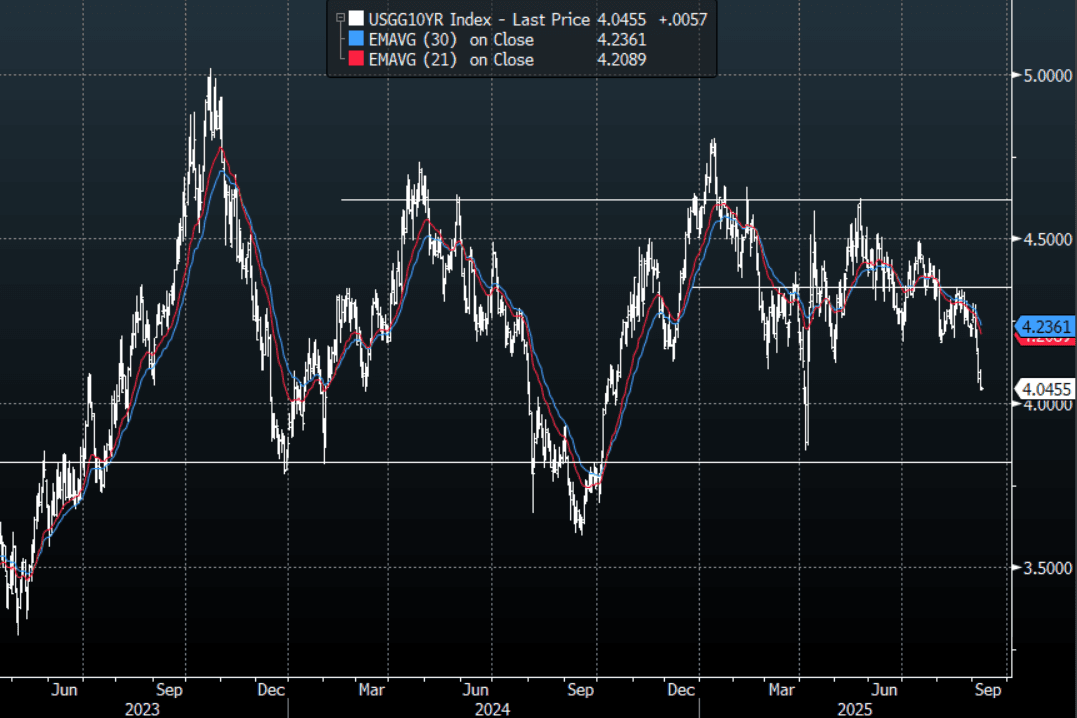
Source: MNI - Market News/Bloomberg Finance L.P
GLOBAL MACRO: Underlying CPI Inflation Appears To Have Stabilised
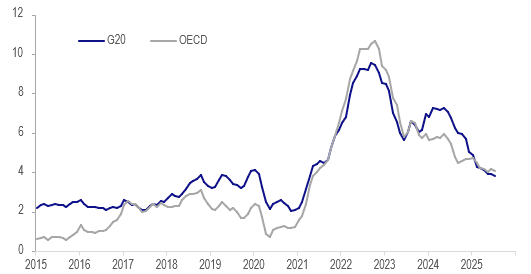
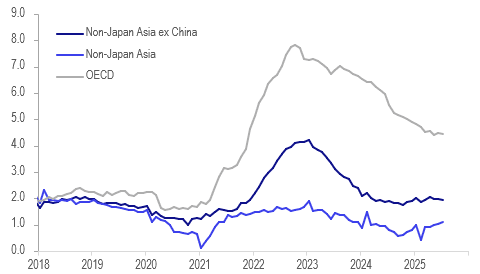
G20 inflation has been trending gradually lower over 2025 with it reaching 3.8% y/y in July, the lowest in over four years. However, both headline and underlying OECD inflation have been fairly stable since March with disinflation progress stalling. Non-Japan Asia ex China core has also been steady around 1.8-2% since the start of 2024. The impact of tariffs on inflation especially in the US remains highly uncertain but lower global demand could put downward pressure on prices.
Global headline CPI y/y%
Source: MNI - Market News/LSEG
- July OECD headline inflation moderated 0.1pp to 4.1%, while core was stable at 4.5%. They peaked at 10.7% y/y and 7.8% respectively in October 2022. August preliminary euro area CPI was steady around 2%.
- US August CPI prints on Thursday and is forecast to show core steady at 3.1% but headline picking up 0.2pp to 2.9%. The data will continue to be watched closely for tariff impacts.
- Non-Japan Asia ex China saw headline inflation moderate 0.3pp to 1.5% y/y in July, the lowest since our aggregate began in 2012. Core was 1.9% y/y down from 2.0% after it peaked at 4.2% in January 2023. China’s underlying inflation picked up 0.1pp to 0.8% in July, the highest in almost 18 months.
- August Asian releases to date saw lower headline and core inflation in Korea and Indonesia, while Taiwan and Thailand were little changed and the Philippines saw both rise.
Asia vs OECD core CPI y/y%
Source: MNI - Market News/LSEG
GLOBAL MACRO: Supply Side Pressures Neutral, Commodity Prices Mixed
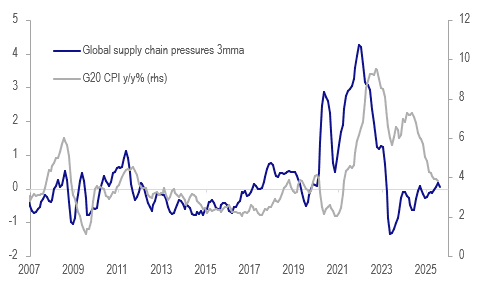
Global indictors have been mixed suggesting that we could see inflation rates remain fairly steady. Some commodity prices were higher in August, such as food, while others were lower, like oil. In September so far metals are higher while oil prices and container rates continue to trend lower.
- There had been concerns that increased US protectionism could adversely impact supply chains. The NY Fed global supply chain pressure index shifted slightly positive in May but returned to -0.1 in August but overall it has remained very close to neutral through 2025 implying few pressures.
Global inflation vs supply chain pressures
- Shipping rates are likely either to be disinflationary or neutral. The FBX container shipping rate fell 16.8% m/m in August to be down 61% y/y with the China to North America’s east coast route down 29.7% m/m & 66.9% y/y. The bulk goods Baltic Freight index rose for the third straight month in August and is slightly higher this month.
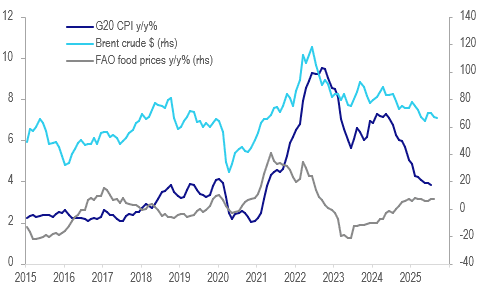
- Brent crude fell for the second straight month in August and has started September lower. It is now down around 10% YTD. With the market widely expected to be in surplus, oil is unlikely to add to inflation pressures.
- FAO food prices have only fallen in two of the last 8 months. Annual inflation has stabilised but is yet to moderate. Processed rice prices rose almost 2% in August but were down over 40% y/y and have started September lower.
- LME metal prices were slightly weaker in August but still up 5.9% y/y and September so far are looking higher with all metals up except lead. Iron ore was higher last month and could post a third straight monthly increase this month. Wool is also up and has been trending higher since last October.
Global inflation vs food & oil prices
Source: MNI - Market News/LSEG
JGBS: Futures Uptick Sold, 5yr Supply Tomorrow
JGB futures sit comfortably off earlier high, last 138.00, -.04 versus settlement levels. In the first part of trade we got to 138.27, but broader positive momentum for bond futures has faded as the session progressed in Asia Pac. US 10yr futures sit unchanged, while other benchmarks have ticked down.
- Outside of broader bond future trends, focus remains on the domestic outlook, with comments today likely helping softer JGB futures at the margin.
- LDP member and former Minister Kono Taro spoke today, noting that if the BoJ delays hiking it will boost inflation (via BBG). He added that the weak yen can be fixed by hiking rates. Kono stated he was undecided on whether to run for the PM position. Kono is more hawkish (compared to other potential PM candidates) when it comes to the fiscal and monetary policy outlooks.
- Current Finance Minister Kato stated: ""JAPAN FINANCE MINISTER KATO SAYS WILL CAREFULLY CONSIDER THE POSSIBILITY WHEN ASKED ABOUT ENTERING THE LDP LEADERSHIP RACE - [RTRS]". He added that price relief is needed to protect low income households (via BBG).
- On the data front, we had Aug money stock figures earlier, while preliminary machine tool orders are out a little later (not likely to be a market mover).
- In the cash JGB space, yields sit up from earlier lows, with the front end slightly leading. The 10yr yield was last around 1.56%, the 30yr back above 3.26%. The 2/30s curve is back under +243bps, 2bps flatter.
- The data calendar is empty tomorrow, but we do have 5yr supply on tap.
AUSSIE BONDS: Yields Up From Lows, Business Sentiment Points To Improving GDP
Aussie bond futures sit off earlier highs, consistent with some softness in US Tsy futures, while locally today sentiment data outcomes were mixed. The 10yr future (XM) was last at 95.705, up 1bps, but against earlier highs of 95.74. 3yr futures sit down a touch, last near 96.555 (earlier highs were at 96.59).
- In the cash ACGB yield space we are up from earlier lows. The 3yr has ticked back up to 3.43%, while the 10yr is near 4.26%, only down 1bps for the session. Both yields were around multi week lows in the first part of trade.
- The 3/10s curve is holding flatter at +84bps.
- On the data front, Westpac consumer sentiment fell 3.1% m/m to 95.4 in September after August’s robust +5.7% m/m to 98.5. It remains in pessimistic territory but above the 2025 average helped by 75bp of monetary easing and lower inflation.
- August NAB business confidence fell to +4 from +8 but conditions improved to +7 from +5. Both have improved in Q3 to date by around 3 points signalling that GDP growth should continue to recover. The price/cost components were lower in August with purchase cost and retail price increases at multi-year lows, which should reassure the RBA.
AUSTRALIA DATA: Growth Recovery Continued In Q3, August Costs/Prices Moderated
August NAB business confidence fell to +4 from +8 but conditions improved to +7 from +5. Both have improved in Q3 to date by around 3 points signalling that GDP growth should continue to recover. The price/cost components were lower in August with purchase cost and retail price increases at multi-year lows, which should reassure the RBA. However, the Q3 average of final product prices is still around where it was in H1 signalling some stabilisation in disinflation. Labour demand also appears to have steadied.
Australia growth outlook
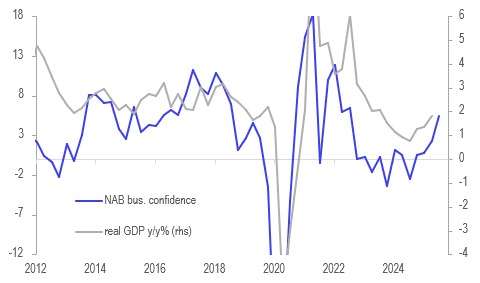
- The pickup in conditions was driven by profitability rising 2 points and employment 3 points to 5.2, its highest in almost a year. Trading was stable.
- The forward-looking orders component rose to +1.4 from -0.2, the highest since April 2023. The export series improved but remained negative.
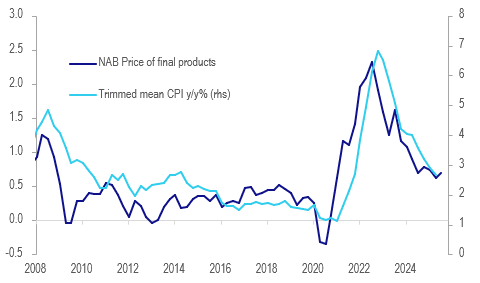
- Labour costs moderated to 1.5% 3m/3m from 1.9% in July, while purchase costs were 1.1% after 1.3%, the lowest since February 2021. This was reflected in final product prices easing to 0.6% from 0.8% with the Q3 average at 0.7% (Q2 0.6%), while August retail price increases dropped to 0.5% from 1.0%, the lowest in almost 5 years, and down 0.2pp to 0.7% in Q3 to date.
Australia inflation outlook
Source: MNI - Market News/LSEG
AUSTRALIA DATA: Consumer Sentiment Weaker But Series Is Volatile
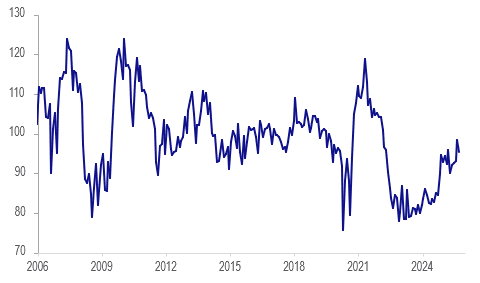
Westpac consumer sentiment fell 3.1% m/m to 95.4 in September after August’s robust +5.7% m/m to 98.5. It remains in pessimistic territory but above the 2025 average helped by 75bp of monetary easing and lower inflation. RBA Deputy Governor Hauser had talked about “scarring” from contracting real incomes continuing to weigh on sentiment. There had not been an RBA meeting since the last confidence print. This month’s decline was driven by increased concerns about the economic outlook and fears of unemployment.
Australia Westpac consumer confidence
Source: MNI - Market News/LSEG
- Westpac continues to expect the RBA to be on hold on 30 September but cut 25bp in November and twice more next year.
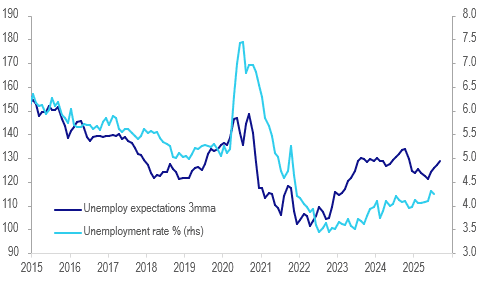
- Unemployment expectations rose 4.6% to 131.4, the highest in a year and just under the series average. It could be signalling an uptrend in the unemployment rate. Thus it isn’t surprising that the “time to buy a major item” fell 3.4%, although people’s financial situation continued to improve.
Australia unemployment expectations
Source: MNI - Market News/LSEG/ABS
- The economic outlook for the year ahead fell 8.9% after rising 4.7% in August, which Westpac believes may have been driven by the pickup in July CPI inflation.
- In terms of news recall, the general feeling was that it was “mixed” rather than “negative” with inflation at its lowest recall level for four years, according to Westpac. Reports on “budget and taxation” had the highest recall and was marginally more negative than in June.
- 69% expect mortgage rates to be the same or lower over the coming year down from 72% in August.
- House price expectations increased further by 2.6% to a 15-year high, while buying sentiment fell 1.7%.
BONDS: NZGBS: Yields Up From Earlier Lows, Q2 Data Points To Weak GDP
NZGB benchmark yields are up from earlier lows. The 2yr yield is now up close to 2bps, tracking back towards 2.95%. The 10yr NZGB yield is around 4.31%, still off 1.5bps. Both benchmarks remain close to recent lows. US Tsy yields have drifted a touch higher, led by the front end, which may have spilled over to NZ at the margins.
- The NZ 2/10s curve remains flatter last near +136.5bps. The NZ 2yr swap rate has edged up to 2.735%, against earlier lows near 2.705%, so mirroring the movement in NZGB front end yields.
- On the data front, Q2 NZ business sales values rose 2.1% q/q with profits up 4.2%. Salaries and wages rose only 1.2% q/q. Manufacturing volumes fell 2.9% q/q after rising 2.4%. Q2 GDP is released on September 18 and the RBNZ is forecasting it to fall 0.3% q/q. Data has shown weak building, goods exports and manufacturing volumes. The RBNZ is expected to cut rates at its October and November meetings.
FOREX: Asia FX Wrap - BBDXY Probing Below 1200
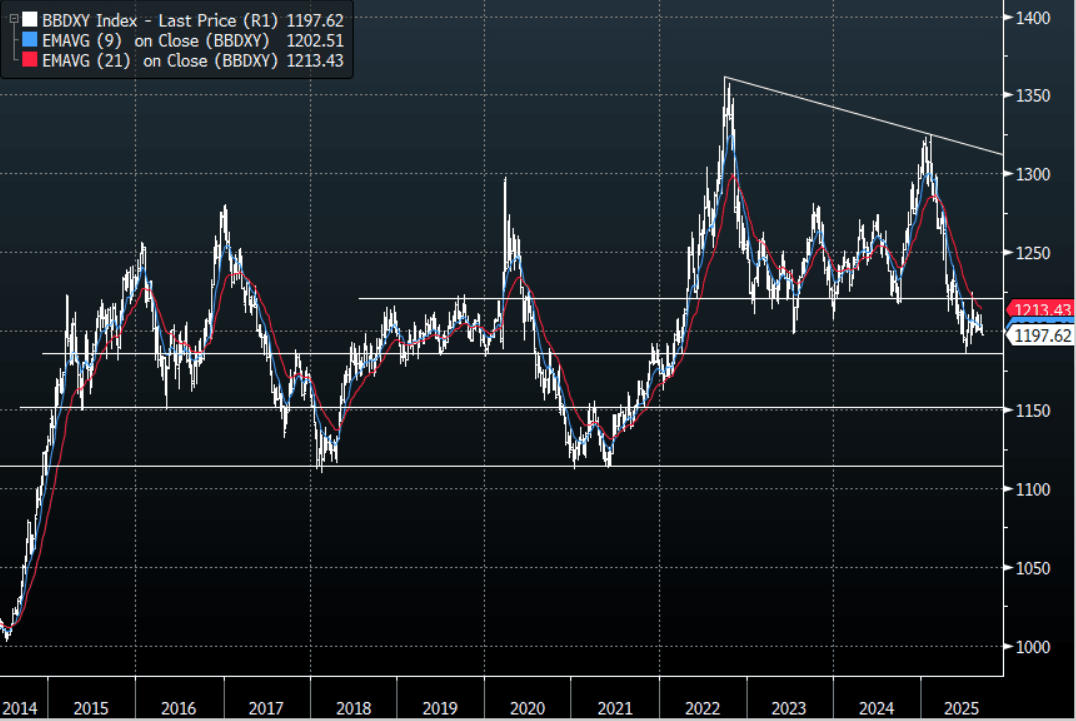
The BBDXY has had a range of 1197.30 - 1198.68 in the Asia-Pac session, it is currently trading around 1197, -0.08%. The USD trades very heavy as the moves in US yields start to take their toll. The headwinds for the USD seem to be compounding and a look below 1195 feels almost inevitable. A sustained break below 1197/1195 is needed to regain the momentum lower and retest the year's lows. Should the USD start another leg lower it would have big implications for FX and potentially see a lot of the recent ranges in G10 broken.
- EUR/USD - Asian range 1.1759 - 1.1778, Asia is currently trading 1.1770. The pair continues to grind higher with focus turning back towards the range highs. EUR is still within its wider 1.1350-1.1850 range with a bias to the topside.
- GBP/USD - Asian range 1.3544 - 1.3574, Asia is currently dealing around 1.3570. The pair bounced strongly off its support around 1.3350 last week. The pair is grinding higher looking towards the top end of its 1.3350-1.3650 range.
- USD/CNH - Asian range 7.1168 - 7.1238, the USD/CNY fix printed 7.1008, Asia is currently dealing around 7.1200. Sellers should be around on bounces while price holds below the 7.2200/2500 area and the PBOC manages the fix lower. Above 7.2500 and we could see a test of the USD Shorts.
- Cross asset : SPX +0.10%, Gold $3652, US 10-Year 4.05%, BBDXY 1197, Crude Oil $62.66
- Data/Events : France Industrial Production MoM
Fig 1: BBDXY Spot Weekly Chart
Source: MNI - Market News/Bloomberg Finance L.P
JPY: Asia Wrap - USD/JPY Drifts Lower After Filling In The Monday Morning Gap
The Asia-Pac USD/JPY range has been 147.16-147.58, Asia is currently trading around 147.20, -0.20%. USD/JPY could not hold onto the gains it made in early Asian trading yesterday and ended up filling in the gap. The support towards 146.00 comes back into view, it has been solid for most of July and August, can it continue to hold as the USD’s own support begins to look precarious. CFTC data shows leveraged funds again added a decent clip to their short JPY position last week so the inability for the price to extend yesterday would be disconcerting, a move back below 145/146 is needed to potentially start seeing these positions being flushed out.
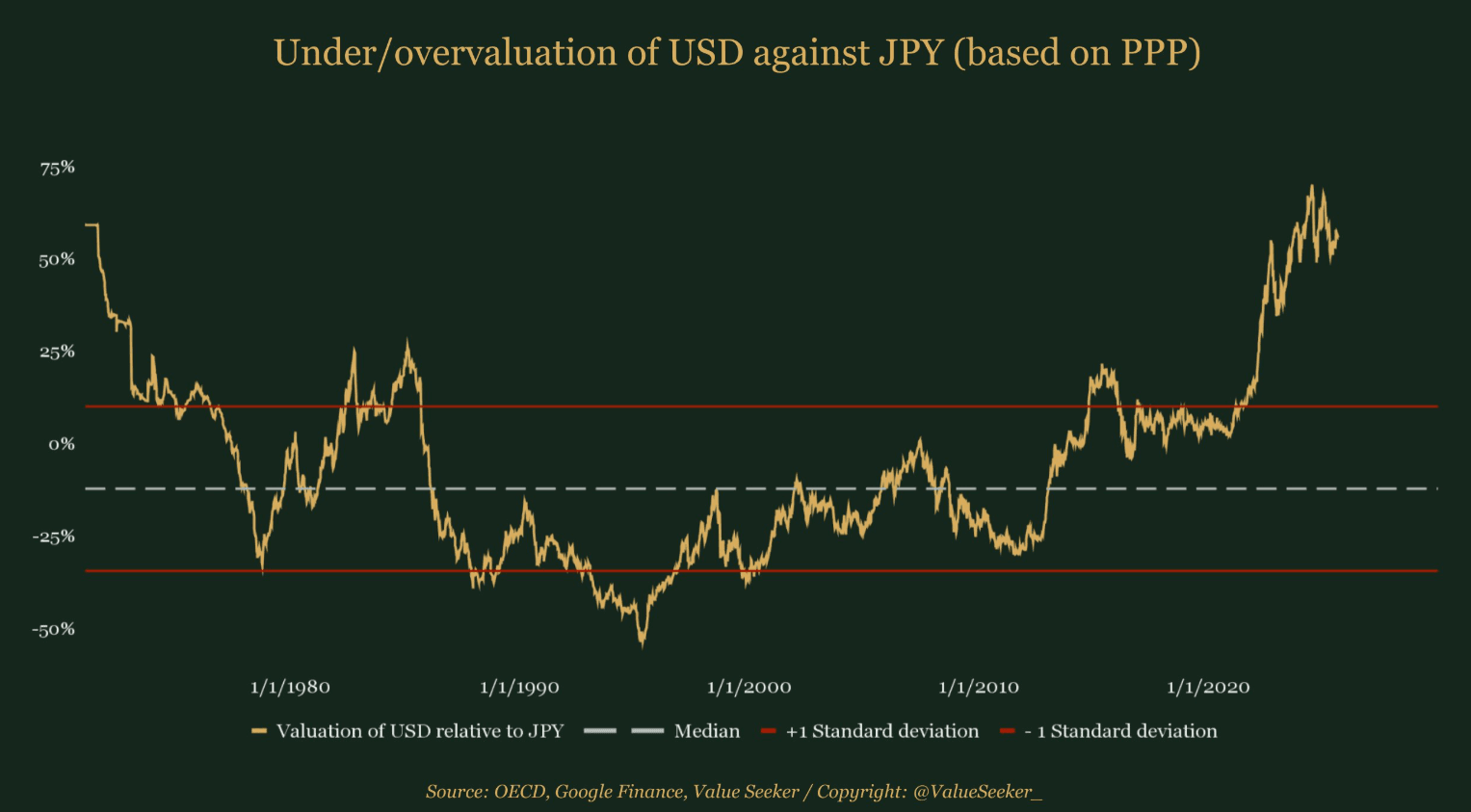
- Value Seeker on X: “The Japanese Yen remains highly undervalued relative to most currencies, including the US Dollar, which trades 50% (3 st. dev.) above its purchasing power parity against the Japanese currency.” See Graph Below.
- Bloomberg - “Japan’s Kono Says BOJ Needs to Hike Rate to Fix Yen, Inflation. The Bank of Japan should raise its benchmark rate to support the yen and curb inflation, Liberal Democratic Party lawmaker and former digital transformation minister Kono Taro said, as political uncertainty clouds the outlook for economic policy.”
- "KATO: MULL IMPACT OF TARIFFS, OPPOSITION VIEWS FOR ECO PACKAGE, PRICE RELIEF IS NEEDED TO PROTECT LOW-INCOME HOUSEHOLDS” - BBG
- "JAPAN LDP DECIDES TO HOLD 'FULL-SPEC' LEADERSHIP VOTE: NTV" - BBG
- Options : Close significant option expiries for NY cut, based on DTCC data: 147.00($931m), 147.50($521m).Upcoming Close Strikes : 145.75($1.12b Sept 11), 150.00($1.11b Sept 11) - BBG..
- CFTC data shows last week asset managers again added to their JPY longs after a consistent period of reduction +78427( Last +76761), leveraged funds though again used the dip to add a decent clip to their newly built short JPY position -66914(Last -52275). One of them is going to be wrong.
Fig 1 : JPY Undervaluation Vs USD(based on PPP)
Source: MNI - Market News/@ValueSeeker_/OECD
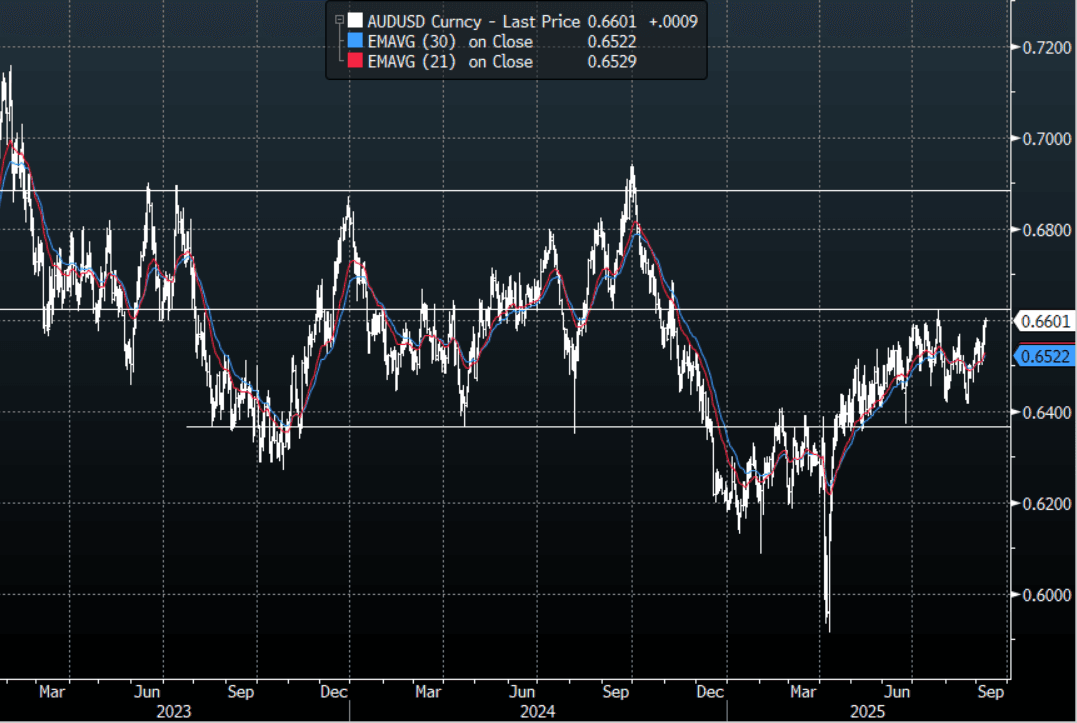
AUD: Asia Wrap - AUD/USD Probes Above 0.6600
The AUD/USD has had a range of 0.6588 - 0.6604 in the Asia- Pac session, it is currently trading around 0.6600, +0.12%. US rates extended lower again and the USD traded soft, the headwinds for the USD seem to be compounding which points to a potential look below its support. The AUD has drifted higher and is looking to test the top-end of its recent range. The AUD remains in its recent multi-month range of 0.6350-0.6650, should the USD break and extend lower we could potentially see the AUD break back above 0.6650. Should this occur it could provide the upward momentum to target levels back towards 0.6900/0.7000. Although still in the range the bias is for dips back to 0.6500 to be supported now.
- Growth Recovery Continued In Q3, August Costs/Prices Moderated. August NAB business confidence fell to +4 from +8 but conditions improved to +7 from +5. Both have improved in Q3 to date by around 3 points signaling that GDP growth should continue to recover. The price/cost components were lower in August with purchase cost and retail price increases at multi-year lows, which should reassure the RBA. However, the Q3 average of final product prices is still around where it was in H1 signaling some stabilisation in disinflation. Labour demand also appears to have steadied.
- Consumer Sentiment Weaker But Series Is Volatile: Westpac consumer sentiment fell 3.1% m/m to 95.4 in September after August’s robust +5.7% m/m to 98.5. It remains in pessimistic territory but above the 2025 average helped by 75bp of monetary easing and lower inflation.
- Options : Closest significant option expiries for NY cut, based on DTCC data: 0.6515(AUD429m), 0.6600(AUD420m). Upcoming Close Strikes : 0.6550(AUD777m Sept 10) - BBG
- CFTC Data last week shows Asset managers reduced their shorts for the first time in a while -66025(Last -78758), the Leveraged community though look to be rebuilding their own shorts after winding them down -11860(Last -6447).
- AUD/JPY - Asia-Pac range 97.12 - 97.28, Asia is trading around 97.20. The pair topped out towards 97.50 but has held onto most of its gains on the gap higher yesterday unlike USD/JPY. A sustained break above 97.50/98.00 is needed to reignite the upward trend.
Fig 1: AUD/USD spot Daily Chart
Source: MNI - Market News/Bloomberg Finance L.P
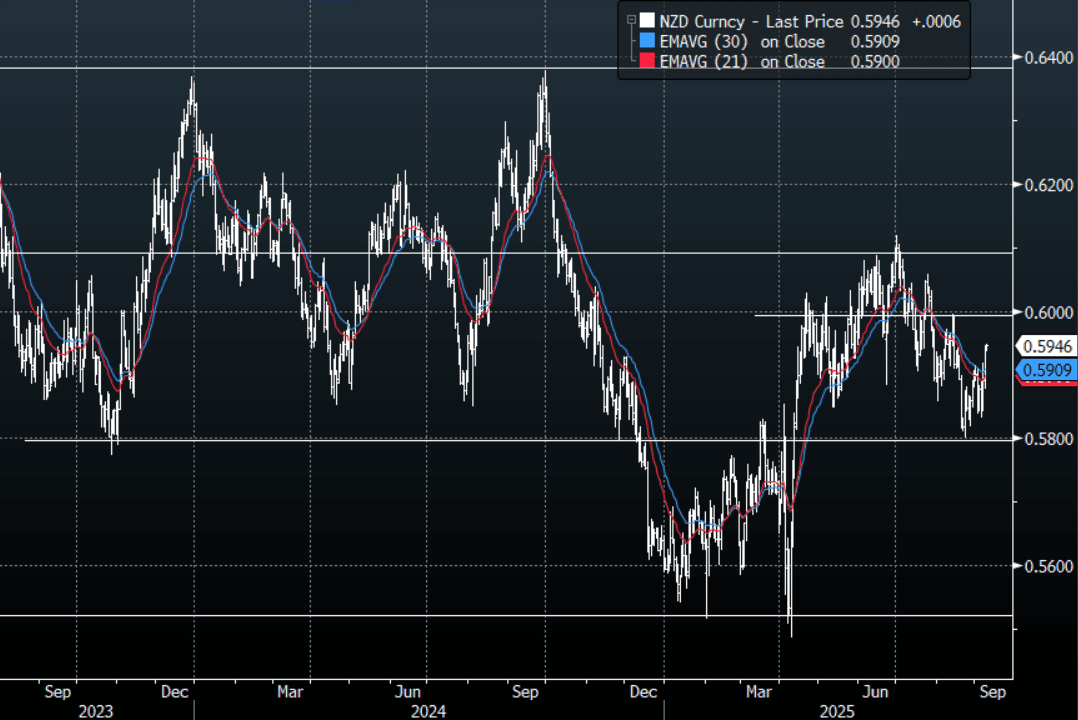
NZD: Asia Wrap - NZD/USD In The Sell Zone, The USD Is A Concern Though
The NZD/USD had a range of 0.5937 - 0.5949 in the Asia-Pac session, going into the London open trading around 0.5845, +0.10%. US rates extended lower again and the USD traded soft, the headwinds for the USD seem to be compounding which points to a potential look below its support. The NZD has bounced into what should be the perfect zone to fade for bears, the price action for the USD though gives me pause. CFTC Data shows light positioning in a market that is struggling for a strong trend as we move back into the middle of the recent 0.5800-0.6100 range.
- (Bloomberg) -- “New Zealand’s main opposition Labour Party is open to having a discussion about the RBNZ’s 1-3% inflation target, the NZ Herald reports.”
- Q2 Data Suggesting Weak GDP Outcome: Q2 NZ business sales values rose 2.1% q/q with profits up 4.2%. Salaries and wages rose only 1.2% q/q. Manufacturing volumes fell 2.9% q/q after rising 2.4%. Q2 GDP is released on September 18 and the RBNZ is forecasting it to fall 0.3% q/q. Data has shown weak building, goods exports and manufacturing volumes. The RBNZ is expected to cut rates at its October and November meetings.
- Options : Closest significant option expiries for NY cut, based on DTCC data: none. Upcoming Close Strikes : 0.5800(NZD515m Sept 10), 0.5870(NZD320m Sept 10) - BBG
- CFTC Data of last week shows Asset Managers added slightly to their new short position in the NZD -5127(Last -4743), the Leveraged community have completely exited their short and have turned a fraction long +285(Last -225).
- AUD/NZD range for the session has been 1.1093 - 1.1105, currently trading 1.1100. The Cross is consolidating around 1.1100, dips back towards 1.1000/1.1050 should be supported now.
Fig 1: NZD/USD Spot Daily Chart
Source: MNI - Market News/Bloomberg Finance L.P
ASIA STOCKS: A Mixed Day as Jakarta Down
Indonesia stocks slid again today following yesterday's shock announcement of the removal of the popular Finance Minister. Concerns are rising as to whether the Prabowo government will maintain fiscal discipline and damage the long term outlook for the economy. Japanese stocks were weaker today after yesterday's gains, in what local traders are describing as profit taking. China's homebuilder index is up by around 5% as after Shenzhen announced home buying curbs will be eased yesterday, with the positive momentum carried into today.
- China's major onshore bourses were all lower today with the CSI 300 down -0.46%, Shanghai Comp -0.29% and Shenzhen down -0.80% whilst the Hang Seng in Hong Kong went the other way, up +0.80%.
- The NIKKEI is down moderately by -0.13%
- The TAIEX in Taiwan is one of the strongest regional performers today as portfolio inflows turn strongly positive; up +1.05% today.
- The KOSPI is up again, today by +1.10%, and has now gained for six successive trading days.
- The FTSE Malay KLCI is lower by -0.12%.
- The Jakarta Composite is down heavily by -1.75% following yesterday's falls of -1.28%hp
- India's NIFTY 50 has had five days of very modest gains and is up today by a mere +0.27%.
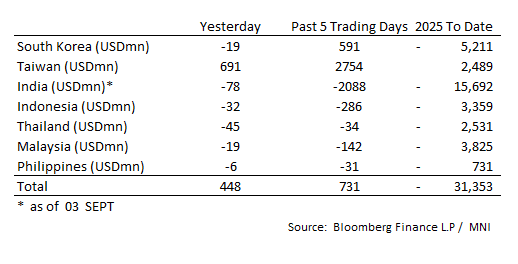
ASIA STOCKS: Equity Flow Update for Major Regional Bourses
Taiwan’s inflows continue.
- South Korea: Recorded outflows of -$19m yesterday, bringing the 5-day total to +$591m. 2025 to date flows are -$5,211m. The 5-day average is +$118m, the 20-day average is -$18m and the 100-day average of +$65m.
- Taiwan: Had inflows of +$691m yesterday, with total inflows of +$2,754 m over the past 5 days. YTD flows are positive at +$2,489m. The 5-day average is +$551m, the 20-day average of -$96m and the 100-day average of +$219m.
- India: Had outflows of -$78m as of the 3rd, with total outflows of -$2,088m over the past 5 days. YTD flows are negative -$15,692m. The 5-day average is -$418m, the 20-day average of -$215m and the 100-day average of -$3m.
- Indonesia: Had outflows of -$32m yesterday, with total outflows of -$286m over the prior five days. YTD flows are negative -$3,359m. The 5-day average is -$57m, the 20-day average +$18m and the 100-day average -$15m.
- Thailand: Recorded outflows of -$45m yesterday, with outflows totaling -$34m over the past 5 days. YTD flows are negative at -$2,531m. The 5-day average is -$7m, the 20-day average of -$42m and the 100-day average of -$14m.
- Malaysia: Recorded outflows yesterday of -$19m, totaling -$142m over the past 5 days. YTD flows are negative at -$3,825m. The 5-day average is -$28m, the 20-day average of -$32m and the 100-day average of -$10m.
- Philippines: Recorded outflows of -$6m yesterday, with net outflows of -$31m over the past 5 days. YTD flows are negative at -$731m. The 5-day average is -$6m, the 20-day average of -$5m the 100-day average of -$4m.
OIL: Crude Continues Rally, EIA Report & US Inventory Data Out Later
Oil prices have continued to rise during today’s APAC trading after rallying around a percent on Monday. WTI is 0.7% higher at $62.70/bbl, close to the intraday day high, and Brent is up 0.7% to $66.46/bbl. The USD index is 0.1% lower today, which is likely supportive of dollar-denominated crude.
- The IEA forecast a record market surplus for 2026, which has pressured oil prices. The EIA short-term energy outlook is published Tuesday with the IEA and OPEC monthly reports on Thursday. After OPEC’s weekend decision to increase its production target 137kbd, the projections in these reports will be watched closely.
- Saudi Arabia cut prices for October across grades for its Asian buyers after OPEC hiked output 2.2mbd over the last five months. This is another sign that the group is now focussed on regaining market share rather than managing prices. US shale producers have grown their share in recent years.
- Industry-based US inventory data is also out today.
- US benchmark revisions to payrolls are released later. US August NFIB small business optimism prints. The ECB’s Montagner & Machado and the BoE’s Breeden appear.
GOLD: Another New Record High, US Payroll Revisions Later
Gold prices reached a new record high of $3654.57/oz during today’s APAC session but are currently around $3652.8 to be up 0.5% on the day. Friday’s disappointing US payroll data has bolstered Fed cut expectations with over 25bp now priced in for September 17 and almost 75bp by year end. The market is also waiting for the ruling on whether Fed Governor Cook can be removed. The US dollar is 0.1% lower today while yields are little changed.
- Gold held below resistance at $3674.8. Today’s US payroll revisions, Wednesday’s August PPI and Thursday’s CPI will be important for the rate outlook and thus for non-yield bearing bullion.
- ETF flows into gold have also pushed prices higher with Bloomberg reporting Monday’s inflows were the highest in close to 3 months.
- Silver is off its intraday low of $41.209 to be little changed around $41.35. It reached $41.419 earlier holding below resistance $41.467.
- Equities are mixed with the S&P e-mini is up 0.1% and Hang Seng +0.8% but CSI 300 down 0.5% and Jakarta Comp -1.6%. Oil prices are higher again with WTI +0.6% to $62.66/bbl. Copper is up 0.3%.
- US benchmark revisions to payrolls are released later. US August NFIB small business optimism prints. The ECB’s Montagner & Machado and the BoE’s Breeden appear.
INDONESIA: Risk Appetite Could Be Challenging Going Forward
- The news overnight of the removal of the popular Finance Minister Sri Indrawati and replaced with Purbaya Yudhi Sadewa has the potential to negatively impact risk appetite in Indonesia after a period of good performance.
- Purbaya appears more aligned with President Prabowo's pro growth approach, as opposed to Indrawati's commitment to a 3% of GDP deficit.
- Observers are wary that Purbaya may be more accommodating of President Prabowo’s expansionary fiscal agenda—particularly ambitious programs like a national free school lunch initiative and defense spending—that could challenge Indonesia’s fiscal discipline. Purbaya has expressed optimism about achieving 8% economic growth, calling it “not impossible,” and stressed the need to rapidly boost both private sector and government participation to stimulate the economy.
- In his first press conference today, Purbaya has stated that "he will maintain fiscal discipline so that the national budget remains healthy and credible", adding that "The Ministry of Finance must understand the current conditions and current issues. We must not be naive and focus on small issues that hinder strategic policies.”
- Purbaya asks the finance ministry to work with him on ensuring that fiscal policy can be a strong instrument to encourage economic growth
- In early April we published on Indonesia noting "CDS Just Off Highs, FX Reserves Well Placed Relative To History" as tariffs were being threatened, and the trade war escalating Indonesia's equity market struggle leading up to the EID break and before the tariff announcement, already down 8% year to date.
- Soon after the BI was vigilant and kept rates on hold at their April meeting before cutting in May and July. The Jakarta Composite is +28% higher from its April lows and one of the best regional performers.
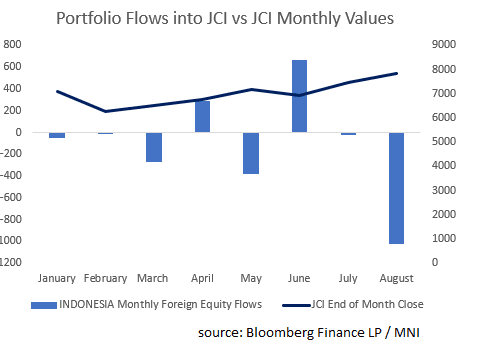
- This is despite foreign inflows being mixed at best this year. Having said that, the kick higher in the JCI did follow on from large inflows in June. With August being disastrous with very strong outflows.
- Whilst this outflow picture points to offshore investors already being positioned to some extent for bad news, as we noted above it may take some time to boost/restore confidence, as the market reserves judgement on the new finance minister.
- The other part of the portfolio picture in terms of bonds has been mostly strong so far in 2025. So this could also become a pressure point.
Fig 1: Indonesian Equity Portfolio Flows Monthly versus the JCI Month End Close January - August
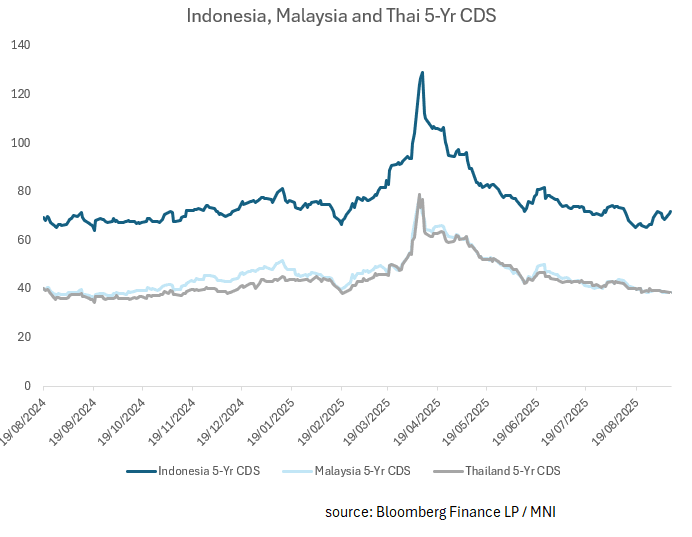
- CDS is well off April highs, rallying to new lows of +64bps by September, showing little reaction to protests on the streets of Jakarta over recent weeks.
- The weakness has been in the currency with the IDR down -0.40% over the last six months versus regional peers the Thai Baht +7.1% and Malaysian Ringgit +5%.
- This week's Indonesia Foreign Reserve data release shows that reserves are falling, down US$2bn from the prior month, most likely as the Central Bank continues to defend the currency. We expect this trend to continue, although strong portfolio pressures might make it difficult for the 16500 level to be a line in the sand.
- The CDS hasn't moved today post the news. The currency has weakened to new lows since the April sell off at a time when the JCI fell into the close yesterday to be down -1.28% and is down -0.84% today. Bond yields have reacted negatively also with the front end higher by +12bps in the 5-year.
- Judging by the August flow data the risks are for a potential correction for the JCI following several months of good performance, bond yields are reacting already and should be monitored closely. If risk sentiment turns drastically negative, that could in turn equate to CDS widening.
Fig 2: Indonesia, Malaysia and Thai 5-Yr CDS Spread
Source: MNI - Market News/Bloomberg
CHINA: Country Wrap: Economist Survey Shows Growing Confidence
Market Summary: China's major onshore bourses were all lower today with the CSI 300 down -0.46%, Shanghai Comp -0.29% and Shenzhen down -0.80% whilst the Hang Seng in Hong Kong went the other way, up +0.80%. The Yuan Reference Rate at 7.1008 Per USD; Estimate 7.1249 and bond yields are steady , with the 10-Yr at 1.78%
- President Xi has told BRICs nations to defend the multilateral trading system and advance greater BRICs cooperation in a virtual BRICS Summit from Beijing on Monday (source China Daily)
- Yicai's Chief Economist survey for September shows a growing confidence in the economic outlook. (source Yicai)
SOUTH KOREA: Country Wrap: Govt Think Tank Constructive on Economic Outlook
Market Summary: The KOSPI is up again, today by +1.10%, and has now gained for six successive trading days, whilst the Won is flat at 1,386.45. Bonds yields are mixed with the KTB 10-Yr at 2.86% (+1bps from last night's close).
- The current administration’s plan to split the Ministry of Economy and Finance into two separate bodies is causing fears of diminished momentum, with the split off economic and policy oversight from budget and strategy planning, to undermine government policy efficiency, market watchers said Monday. (source Korea Times)
- A government think tank suggests there is slight improvement in the economic outlook (source Yonhap)
ASIA FX: Mixed Trends, THB Rally Continues, IDR Falters
Asian currency trends are mixed, most notably with THB continuing to rally, whilst IDR has fallen sharply in the aftermath of popular Finance Minister Sri Indrawati no longer holding her position. In NEA TWD has continued to rally, but KRW has remained a laggard.
- USD/IDR got to highs of 16492 in the first part of trade, but sits back around 16430 currently. We ended Monday's session near 16300, so this is still an IDR loss of 0.75%. New FinMin Purbaya Yudhi Sadewa stated that "he will maintain fiscal discipline so that the national budget remains healthy and credible", adding that "The Ministry of Finance must understand the current conditions and current issues. We must not be naive and focus on small issues that hinder strategic policies." (via BBG). Local equities are down over 1.65%, while offshore investor flows will be watched to gauge sentiment to this news. BI was intervening earlier and likely helped curb USD/IDR moving through 16500.
- In contrast, USD/THB has slumped to fresh multi year lows, last at 31.635, up around 0.70% in THB terms. A smooth transition to the new PM is likely aiding sentiment, while gold prices have also risen to a fresh record high. The authorities and local economic bodies are concerned about FX gains, and the link to gold prices, but no fresh policy steps have been announced at this stage. Former leader Thaksin was also sentenced to 1yr jail, but market impact hasn't been evident.
- Spot USD/KRW sits little changed, the pair last near 1387. The won has underperformed the recent tech equity rebound and better inflow backdrop. Interestingly, earlier headlines crossed from Rtrs: "S.KOREA PRESIDENTIAL ADVISER: U.S. TRADE NEGOTIATIONS BEING DELAYED DUE TO ISSUE OF FX MARKET IMPACT FROM $350 BLN PACKAGE". This likely reflects that South Korean investment flows into the US w2ould boost USD/KRW higher.
- TWD is rallying though, aided by better equity inflows. USD/TWD spot was last under 30.40.
- Finally, USD/CNH is little changed, last under 7.1200.
UP TODAY (TIMES GMT/LOCAL)
| Date | GMT/Local | Impact | Country | Event |
| 09/09/2025 | 0645/0845 | * |  FR FR | Industrial Production |
| 09/09/2025 | 0900/1000 | ** |  GB GB | Gilt Outright Auction Result |
| 09/09/2025 | 1000/0600 | ** |  US US | NFIB Small Business Optimism Index |
| 09/09/2025 | 1150/1350 |  CH CH | SNB's Schlegel at BIS fireside chat | |
| 09/09/2025 | 1255/0855 | ** | US | Redbook Retail Sales Index |
| 09/09/2025 | 1400/1000 | *** | US | Preliminary Benchmark Revision |
| 09/09/2025 | 1515/1615 | GB | BOE Breeden Moderates BIS Fireside Chat | |
| 09/09/2025 | 1700/1300 | *** | US | US Note 03 Year Treasury Auction Result |
| 10/09/2025 | 0130/0930 | *** |  CN CN | CPI |
| 10/09/2025 | 0130/0930 | *** | CN | Producer Price Index |
| 10/09/2025 | 0600/0800 | *** |  NO NO | CPI Norway |
| 10/09/2025 | 0600/0800 | ** |  SE SE | Private Sector Production m/m |
| 10/09/2025 | 0700/0900 | ** |  ES ES | Industrial Production |
| 10/09/2025 | 0800/1000 | * |  IT IT | Industrial Production |
| 10/09/2025 | 0900/1000 | ** | GB | Gilt Outright Auction Result |
| 10/09/2025 | 1100/0700 | ** | US | MBA Weekly Applications Index |
| 10/09/2025 | 1145/1345 | CH | SNB's Schlegel on Central Bank Communication in Vezia | |
| 10/09/2025 | - | *** | CN | Money Supply |
| 10/09/2025 | - | *** | CN | New Loans |
| 10/09/2025 | - | *** | CN | Social Financing |
| 10/09/2025 | 1230/0830 | *** | US | PPI |
| 10/09/2025 | 1230/0830 | *** | US | PPI |


