MNI EUROPEAN MARKETS ANALYSIS: Gold Surges Through $4000
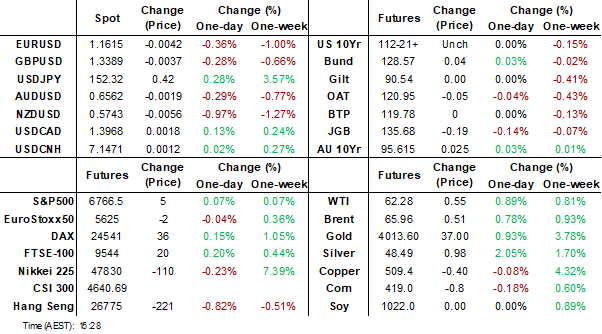
- NZD and local yields fell sharply after the RBNZ cut by 50bps (which wasn't fully priced in). The USD was firmer elsewhere against the majors, with USD/JPY above 152.00.
- Japan labour earnings data was well below forecasts for August, adding to an on hold case for the BoJ in Oct.
- Gold has tested psychological round number resistance at $4000 and decisively breached it, with multiple supports still in play.
- Later the Fed’s Musalem, Barr, Goolsbee, Kashkari and the ECB’s Lagarde, Elderson, Buch, Tuominen and BoE’s Pill speak. The September FOMC meeting minutes will also be published.
MARKETS
US TSYS: Asia-Pac: Yields Slightly Higher In A Quiet Session
The TYZ5 range has been 112-19+ to 112-22 during the Asia-Pacific session. It last changed hands at 112-21+, unchanged from the previous close.
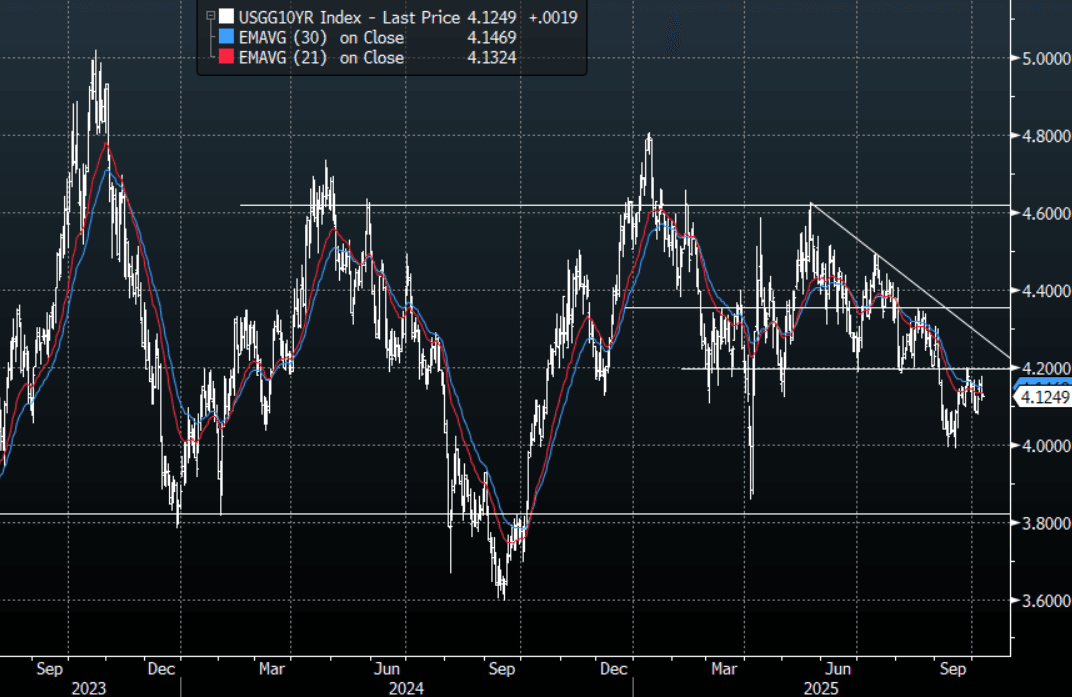
- 10-Year yields bounced to start the week on the back of global politics but remains subdued below 4.20% as the market works through the US shutdown. I suspect buyers continue to be around 4.20% initially and look to fade bounces higher looking for a move back towards 4%.
- The US 10-year yield is trading around 4.125%.
- The US 2-year yield is trading around 3.568%.
- MNI Brief - Stephen Miran emphasized the importance of an independent U.S. central bank, and said he will not be playing a part in the search for the next Fed chair.
Fig 1: 10-Year US Yield Daily Chart
Source: MNI - Market News/Bloomberg Finance L.P
JGBS: Twist-Flattener As Long-End Unwinds Politically Induced Sell-Off
JGB futures are weaker, -20 compared to settlement levels, but off session lows.
- August's labour earnings data today was comfortably below market expectations. This likely reinforces expectations that the BoJ will likely remain on hold at the Oct policy meeting. Japan's new political regime had already noted that October is too soon for a rate hike. BoJ Governor Ueda also noted recently that the risk was low for the central bank to fall behind the inflation/policy curve (with today's data supporting this theme).
- Nevertheless, cash JGBs out to the 10-year part of the curve have seen moderately higher yields today. In large part because the market already had only a 25% chance of a 25bp hike in October priced.
- Cash US tsys are little changed in today's Asia-Pac session after yesterday's modest rally.
- Cash JGBs beyond the 10-year are, however, richer as it continues to unwind the yield overshoot associated with the change in political leadership over the weekend. The benchmark 30-year yield is 2.6bps lower at 3.272% versus the cycle high of 3.351% set before yesterday’s auction result.
- The swap curve has twist-flattened, pivoting at the 20-year, with rates 2bps higher to 3bps lower.
- Tomorrow, the local calendar will see Weekly International Investment Flows, Tokyo Avg Office Vacancies and Machine Orders alongside 5-year supply.
JAPAN DATA: Aug Labor Earnings Notably Sub Forecasts, BoJ Likely Holding In Oct
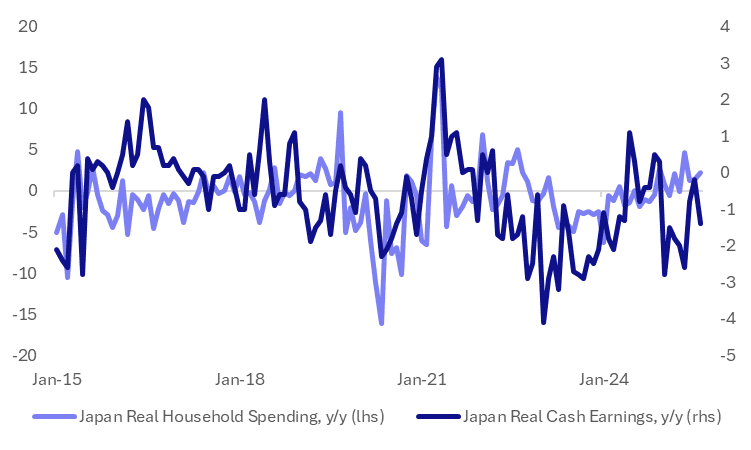
August labour earnings data in Japan was comfortably below market expectations. Headline earnings rose 1.5%y/y (against a 2.7 forecast and 3.4% July outcome), while real earnings dipped back to -1.4%y/y (-0.5%) was forecast. Real earnings have not been in positive territory (in y/y terms) so far in 2025. This will reinforce expectations of the BoJ likely remaining on hold at the Oct policy meeting. Japan's new political regime had already noted that Oct is too soon for a rate hike. BoJ Governor Ueda also noted recently that the risk was low for the central bank to fall behind the inflation/policy curve( with today's data supporting this theme).
- The chart below updates the household spending versus real labour earnings trend post today's data. Recall yesterday that household spending was stronger than forecast but today's real earnings data re-opens a modest wedge between the two series. This may create uncertainty around the extent which the positive trend in household spending can be maintained.
- Bonus payments were down notably in y/y terms, off -10.5%y/y, versus a 6.3% gain in July, so this provides some offset to the softer headline results. We can often bounce back after negative months.
- On a same sample base, cash earnings printed at 1.9%, versus 2.7% forecast. Scheduled full time pay on the base y/y was 2.4% against a 2.5% forecast. Special payments fell -5.7%y/y (against a 4.7% rise in July).
- This may help offset the weaker than expected headline outcomes, but still the BoJ and authorities are likely to want to see stronger underlying earnings momentum.
Fig 1: Real Earnings Struggling For Positive Momentum
Source: Bloomberg Finance L.P./MNI
AUSSIE BONDS: Data-Light Session, YM Biased Lower, AU-US 10YY Near Top Of Range
ACGBs (YM flat & XM +2.0) are modestly stronger in today's data-light session but off session bests.
- According to MNI’s technicals team, Aussie 3-yr futures (YM) have traded lower, and the contract has cleared the Sep 3 low of 96.435. A break of this level negates the recent short-term bullish theme. This breach signals scope for an extension towards 96.280, the May 15 low on the continuation chart. The short-term resistance to watch is 96.615, the Sep 12 high. Clearance of this level is required to reinstate a bullish theme.
- Cash US tsys are little changed in today's Asia-Pac session after yesterday's modest rally.
- Cash ACGBs are 1-3bps richer with the AU-US 10-year yield differential at +23bps. At 23bps, the differential is approaching the top of the +/- 30bp range it has traded in since late 2022.
- The bills strip is flat to +2 across contracts.
- RRBA-dated OIS pricing is largely unchanged across meetings today. Markets now assign a 40% probability to a 25bp rate cut in November, with a total of 14bps of easing priced by year-end. This marks a notable shift from late September, when markets had fully priced a 25bp cut ahead of the August CPI release.
- Tomorrow, the local calendar will see Consumer Inflation Expectation data.
BONDS: Bull-Steepener After RBNZ Cuts By 50bp
NZGBs closed 4-7bps richer after the RBNZ cut 50bps to 2.50%.
- The MPC discussed cutting the OCR by 25bp or 50bp and all members agreed the latter was appropriate given material spare capacity in the economy. Given that this is likely to persist for some time and that while the economy has begun to recover it remains lacklustre, further cuts bringing policy into stimulatory territory are likely. In line with this it said that “the Committee remains open to further reductions in the OCR”.
- The MPC’s inflation concern appeared to shift this month. In August, it said it could ease policy further “if medium-term inflation pressures continued to ease as expected”, whereas this month it seemed more concerned with undershooting the target mid-point, stating it “remains open to further reductions … for inflation to settle sustainably” near the 2% mid-point over the medium-term.
- Swap rates closed 4-6bps lower on the day.
- RBNZ dated OIS pricing closed 9-15bps softer across meetings. 34bps of easing had been priced for this meeting. A cumulative 62bps of easing had been priced by November 2025 versus 75bps now (including today’s move).
- Tomorrow, the local calendar will see the NZ Government 12-Month Financial Statements.
- The NZ Treasury also plans to sell NZ$275mn of the 1.50% May-31 bond and NZ$175mn of the 4.25% May-34 bond.
RBNZ: Larger Cut Gives Sluggish Economic Recovery Extra Boost, Easing Bias
The MPC discussed cutting the OCR by 25bp or 50bp and all members agreed the latter was appropriate given material spare capacity in the economy. Given that this is likely to persist for some time and that while the economy has begun to recover it remains lacklustre, further cuts bringing policy into stimulatory territory are likely. In line with this it said that “the Committee remains open to further reductions in the OCR”.
- The discussion included both 25bp and 50bp cuts. Arguments for 50bp to 2.5% included “prolonged spare capacity”, downside risks to growth and therefore inflation, moderation in domestic inflation resulting in greater confidence inflation is contained, and risk that households and businesses are being particularly cautious. The MPC wanted to send “a clear signal” to support the economy.
- Monetary policy lags, “signs of recovery”, time to ensure inflation returning to 2%, upside inflation risks from “constrained supply and cost pressures” and that signalling further easing for November would ease financial conditions argued for a more cautious 25bp cut.
- The MPC’s inflation concern appeared to shift this month. In August, it said it could ease policy further “if medium-term inflation pressures continued to ease as expected”, whereas this month it seemed more concerned with undershooting the target mid-point stating it “remains open to further reductions … for inflation to settle sustainably” near the 2% mid-point over the medium-term.
- It now expects inflation around 2% over H1 2026 rather than “by mid-2026” which may reflect its marginal revision to spare capacity and risks following the 0.9% q/q GDP contraction and recent modest activity data. Q2 GDP was impacted by a “large seasonal balancing item”, which the RBNZ expects to be reversed.
- There will be no press conference or forecast update today.
NZD: Asia-Pac: NZD/USD Breaks Lower As RBNZ Surprises Market With 50bps Cut
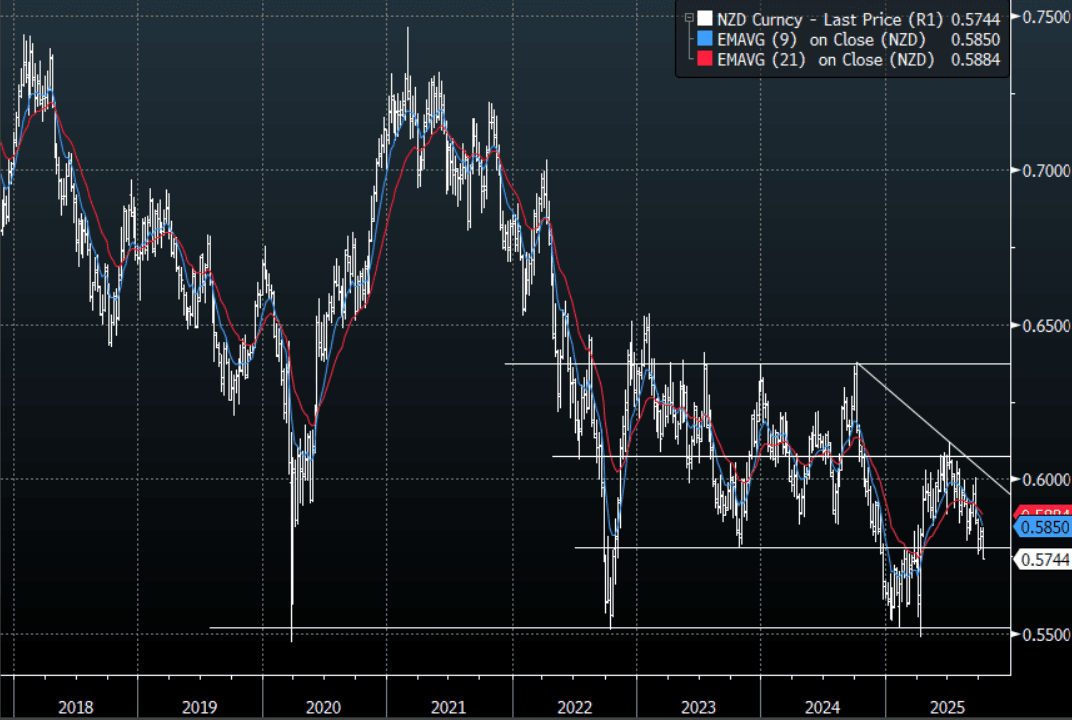
The NZD/USD had a range of 0.5739 - 0.5802 in the Asia-Pac session, going into the London open trading around 0.5745, -0.95%. A dovish surprise 50bps cut by the RBNZ has given the NZD/USD the momentum to extend below 0.5800 and is currently pressing the 0.5750 area. The market has already had a decent move on the day but rallies should now be faded. Should NZD/USD sustain the break through this support the focus will turn toward the multiple bottoms toward the 0.5500 area.
- MNI - RBNZ: Larger Cut Gives Sluggish Economic Recovery Extra Boost, Easing Bias. The MPC discussed cutting the OCR by 25bp or 50bp and all members agreed the latter was appropriate given material spare capacity in the economy. Given that this is likely to persist for some time and that while the economy has begun to recover it remains lacklustre, further cuts bringing policy into stimulatory territory are likely. In line with this it said that “the Committee remains open to further reductions in the OCR”
- RBNZ dated OIS pricing closed 9-15bps softer across meetings. 34bps of easing had been priced for this meeting. A cumulative 62bps of easing had been priced by November 2025 versus 75bps now (including today's move).
- "ANZ BANK NOW SEES RBNZ CUTTING CASH RATE TO 2.25% IN NOVEMBER" - BBG
- Options : Closest significant option expiries for NY cut, based on DTCC data: 0.5820(NZD305m). Upcoming Close Strikes : none - BBG
- AUD/NZD range for the session has been 1.1342 - 1.1446, currently trading around 1.1425. The Cross has surged back above 1.1400 on the surprise 50bps cut. I continue to feel the cross should do some work towards the 1.1500 area. A clear sustained break above 1.15/1.16 resistance and the market will begin to think about levels back towards 1.2000 and above.
Fig 1: NZD/USD Spot Weekly Chart
Source: MNI - Market News/Bloomberg Finance L.P
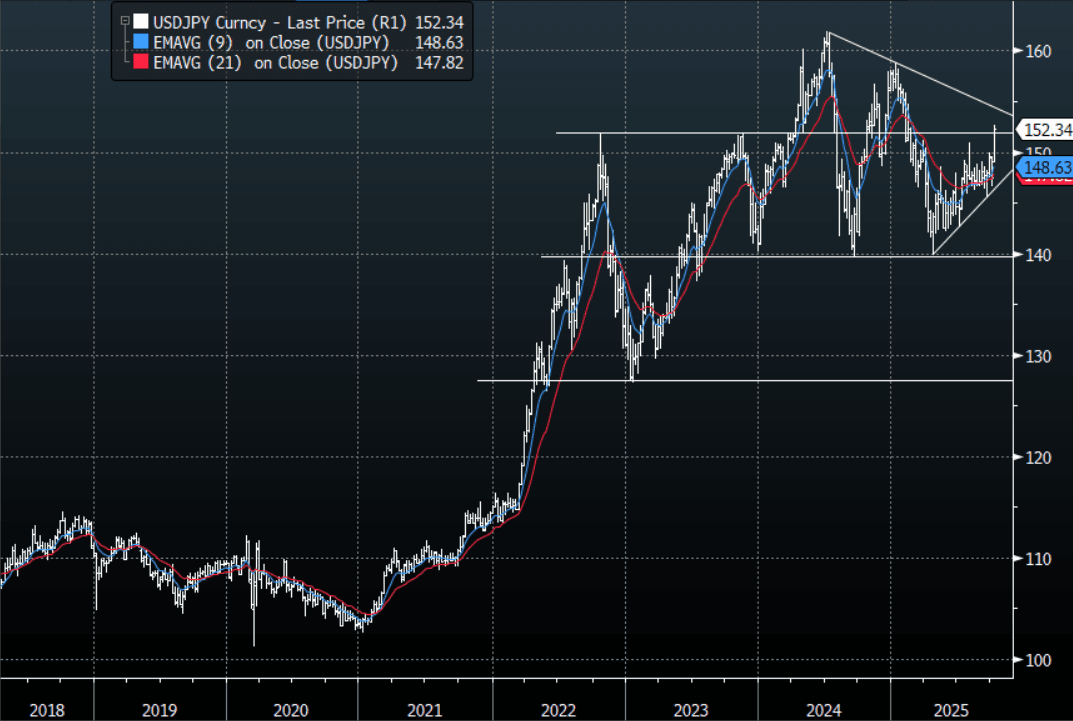
JPY: Asia-Pac: USD/JPY Breaking Above 152.00 If Sustained Targets 155-160 Area
The USD/JPY range has been 151.74 - 152.65 in the Asia-Pac session, it is currently trading around 152.35, +0.30%. The pair has extended its move higher in Asia and is attempting to break above the pivotal 152.00 area, if this break is confirmed it will turn the focus back to the 155-160 area. The last CFTC data available showed Asset Managers remained notably long JPY, should these moves begin to gather momentum, they could be forced to first pare back their longs and then if these significant levels are broken begin to rebuild JPY shorts. Many crosses are breaking through some pivotal areas(CNH/JPY Above 21.00) as well and unless the government says something to contradict the markets thinking these could begin to gather momentum. Expect dips to now find support unless there is push back on the market's views of Takaichi’s policies.
- MNI - Aug Labor Earnings Notably Sub Forecasts, BoJ Likely Holding In Oct: August labour earnings data in Japan was comfortably below market expectations. Headline earnings rose 1.5%y/y (against a 2.7 forecast and 3.4% July outcome), while real earnings dipped back to -1.4%y/y (-0.5%) was forecast. Real earnings have not been in positive territory (in y/y terms) so far in 2025. This will reinforce expectations of the BoJ likely remaining on hold at the Oct policy meeting.
- “JAPAN RULING BLOC TO DELAY DIET SESSION TO OCT. 20 OR LATER:FNN" - BBG
- Options : Close significant option expiries for NY cut, based on DTCC data: 147.00($1.47b). Upcoming Close Strikes : 150.00($778m Oct 9), 150.15($1.08b Oct 9) - BBG.
Fig 1 : USD/JPY Spot Weekly Chart
Source: MNI - Market News/Bloomberg Finance L.P
FOREX: Asia-Pac Wrap: The USD Builds On Its Overnight Gains
The BBDXY has had a range of 1208.46 - 1211.73 in the Asia-Pac session; it is currently trading around 1211, +0.15%. The USD has got a welcome reprieve from the surge in USD/JPY after failing to build any downward momentum below 1200 last week. This move extended overnight and again in our session as the USD continues to build on this pullback. The 1215-1225 area remains tough resistance, only a sustained close back above 1230 would start to challenge the conviction of the USD shorts, but the weaker hands are definitely beginning to fold.
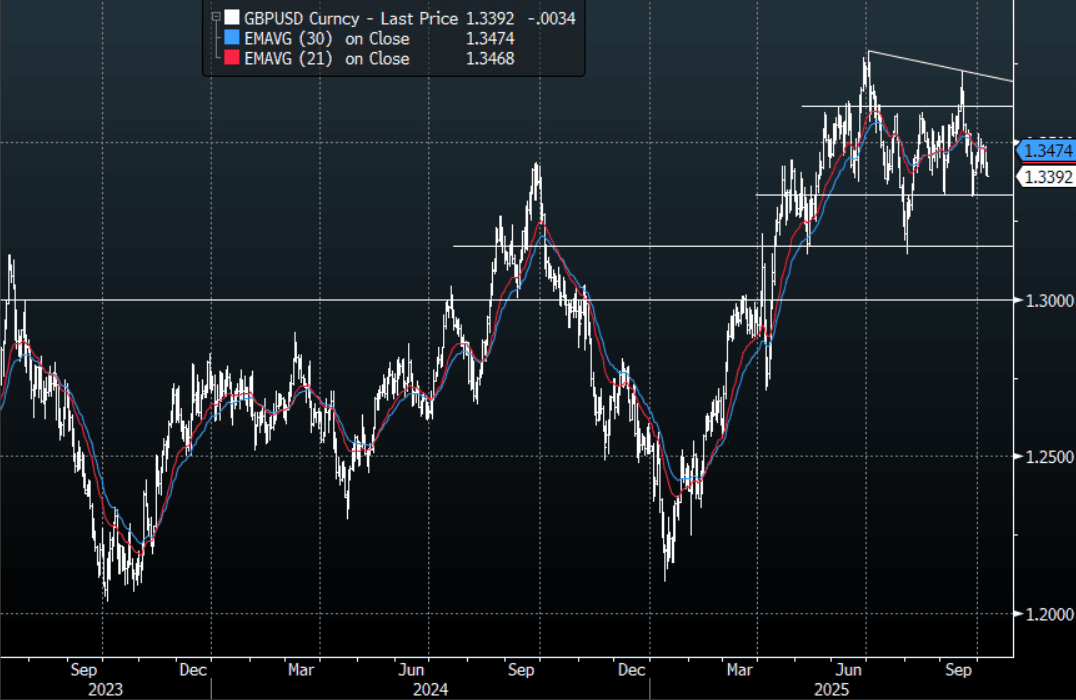
- EUR/USD - Asian range 1.1617 - 1.1661, Asia is currently trading 1.1620. The pair has begun to turn lower albeit still within its range as the USD bounce becomes more constructive. First support is back towards the 1.1550 area; a break through here could signal a deeper correction towards the more important 1.12001.1300 support.
- GBP/USD - Asian range 1.3391 - 1.3435, Asia is currently dealing around 1.3395. The pair continues to be capped on any move back towards the 1.3500 area. Cable needs a sustained break of the 1.3300 support to potentially signal a deeper move lower. Should this support give way the next support is around 1.3150 and it could signal a potential interim top in the pair.
- USD/CNH - Asian range 7.1443 - 7.1535, Asia is currently dealing around 7.1460. The area around 7.1500/1600 has proved to be solid resistance for now, it looks likely we could consolidate 7.09-7.16 for the moment. A break above here could signal a deeper pullback towards 7.20/22.
- Cross asset : SPX +0.15%, Gold $4025, US 10-Year 4.123%, BBDXY 1211, Crude Oil $62.23
- Data/Events : Germany Industrial Production SA
Fig 1: GBP/USD Spot Daily Chart
Source: MNI - Market News/Bloomberg Finance L.P
AUD: Asia-Pac: AUD/USD Drifts Lower In Sympathy With The NZD
The AUD/USD has had a range of 0.6558 - 0.6586 in the Asia- Pac session, it is currently trading around 0.6560, -0.30%. The AUD has continued to drift lower after topping out above 0.6600, this is in sympathy to the move in the NZD and the general bid tone of the USD. This puts the AUD firmly back within its recent range, and if the USD pullback continues to build the risk is skewed towards further losses, first support lies back toward the 0.6475 area.
- Options : Closest significant option expiries for NY cut, based on DTCC data: 0.6300(AUD899m), 0.6725(AUD 398m). Upcoming Close Strikes : 0.6545(AUD607m Oct 10) - BBG
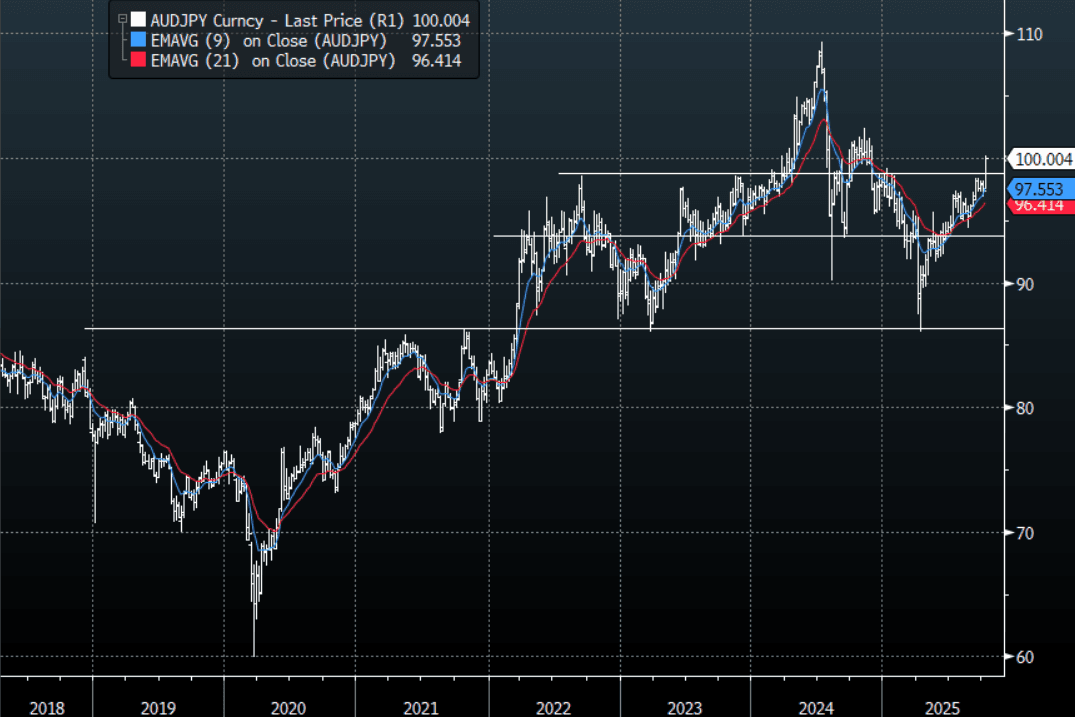
- AUD/JPY - Asia-Pac range 99.89 - 100.20, Asia is trading around 100.05. The pair has surged higher breaking some pivotal resistance. The move extended higher overnight even with risk wobbling. Dips should now continue to be supported as the focus turns toward trying to break above 100 and then beyond.
Fig 1: AUD/JPY spot Weekly Chart
Source: MNI - Market News/Bloomberg Finance L.P
ASIA STOCKS: Tech Rally Takes A Breather
Asia Pac equities are mixed, with some caution coming through in tech/AI related space. Hong Kong markets have returned weaker, with the HSI down over 1%, tracking lower for third straight session. The tech sub index off over 1.1%. We did see US tech related bourses underperform in US Tuesday's trade, while the Golden Dragon index lost 2.24%. Note onshore China markets return tomorrow.
- Reuters also noted: "U.S. lawmakers are calling for broader bans on chipmaking equipment to China after a bipartisan investigation found that Chinese chipmakers had purchased $38 billion of sophisticated gear last year." This has potentially weighed on China tech related plays in Hong Kong.
- BBG also notes Citigroup analysts who stated that Golden Week box office results were below expectations (hurting sentiment in this space).
- Taiwan's Taiex is off around 0.50%, but still 2700, so close to recent record highs. Even with this recent run higher, offshore investors have only added modestly to local stocks, (but regional holidays, with China and South Korea still out may be a factor).
- In South East Asia, trends are mixed. Indonesia went to a fresh record high, but is now tracking modestly lower. Onshore government bond yields continue to fall, amid the dovish BI outlook, while consumer sentiment data for Sep fell to fresh lows since 2022.
- Thailand stocks are up ahead of an expected BoT cut later (last 0.55%). We also stimulus measures (0.3-0.4ppts of GDP) announced yesterday to boost consumption (via BBG).
- NZ stocks are outperforming Australia, after the 50bps RBNZ cut surprised the market.
OIL: Crude Continues Trending Higher Ahead Of EIA Data & Fedspeak
Oil prices continued trending higher during today’s APAC session with little news to give them direction. US industry-based data showed product drawdowns and the market continues to monitor strikes on Russian energy infrastructure which are impacting refining rates. For now the US EIA’s forecast of higher non-OPEC output and lower prices has been looked through but the IEA’s report is not until 14 October.
- WTI is up 0.9% to $62.28/bbl after rising to $62.36 and Brent is 0.8% higher at $65.95/bbl following a peak of $66.04. Both benchmarks are up around 2.2% since the weekend’s cautious OPEC decision.
- Official EIA oil data will still be released Wednesday as the agency is continuing to publish for now despite the US government shutdown. Bloomberg reported mixed industry-based data with oil inventories building but falling at key hub Cushing last week, according to people familiar with the API data. The reported product drawdown has likely provided support to prices today ahead of the EIA data.
- A soft outlook was reflected in the EIA’s October report as it is forecasting global oil inventories to build through next year pushing Brent down to $52/bbl from $62 in Q4 2025. Global output rises across its forecast horizon driven by non-OPEC. It doesn’t believe OPEC will be able to achieve its higher production targets helping to support prices.
- Later the Fed’s Musalem, Barr, Goolsbee, Kashkari and the ECB’s Lagarde, Elderson, Buch, Tuominen and BoE’s Pill speak. The September FOMC meeting minutes will also be published.
Gold Clears $4000 As Global Uncertainties Mount, More Fed Comments Later
Gold has tested psychological round number resistance at $4000 and decisively breached it reaching a record high of $4014.62 driven by political instability in the G7 that may not be resolved imminently. Issues in heavily indebted US, France and Japan are driving safe-haven flows, but ETF and central bank buying are providing structural support and geopolitics, US rate cuts and threats to Fed independence have also driven buying of gold. The US dollar (BBDXY +0.2%) has strengthened again today and yields are little changed, but gold’s rally is immune.
- Bullion is currently up 0.7% to around $4012.0/oz. Given it has rallied 4% so far this month and over 16% since 1 September, the risk of a pause in the uptrend is growing.
- The US shutdown is not just an issue for political stability but it also weighs on growth and government-issued data is being delayed making it difficult to gauge the economic situation ahead of the 29 October Fed decision. The OIS market has almost a full 25bp rate cut priced in for the meeting, despite a lack of data.
- Silver is outperforming gold after Tuesday’s underperformance. It is up 1.2% to $48.40, after a high of $48.46. It will also be benefiting from flight-to-quality flows as well as a tight physical market.
- Later the Fed’s Musalem, Barr, Goolsbee, Kashkari and the ECB’s Lagarde, Elderson, Buch, Tuominen and BoE’s Pill speak. The September FOMC meeting minutes will also be published.
THAILAND: Confidence Consistent With Slowing Growth, BoT Likely To Cut
The University of the Thai Chamber of Commerce consumer confidence measure for September was little changed rising slightly to 50.7 from 50.1 with the economic assessment at 44.4 after 44.1. The quarterly averages have been moderating for over a year and Q3 suggests that consumption growth slowed further after moderating 0.4pp to 2.1% y/y in Q2. The slowing growth outlook while inflation holds below the bottom of the Bank of Thailand’s 1-3% target band should drive another 25bp rate cut to 1.25% today (see MNI BoT Preview). This is the first meeting for new Governor Vitai who wants to support growth.
Thailand private consumption
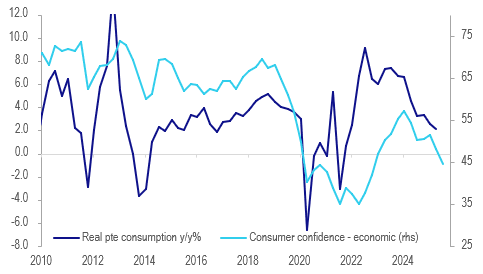
- Consumer confidence has been impacted by recent political instability with it falling in August to its lowest level since December 2022. Weak income growth and a drop in tourist arrivals have also weighed on spending.
Thailand tourist arrivals
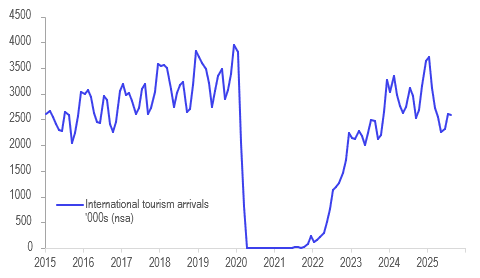
- Fiscal support worth $1.36bn was approved this week to subsidise household essentials and is to be distributed between 29 October and 31 December and may boost confidence in coming months. Around 20mn Thais will qualify for the THB 2000 payment and the government expects the plan to boost growth by 0.3-0.4pp. Elections are due before April and this looks like a sweetener for voters.
- The slight pickup in consumer confidence was driven by a 1.5 point improvement in the outlook to 58.7 while the assessment of present conditions remained depressed falling 1 point to 34.4.
- Even though labour market conditions only rose 0.2 to 48.5, there was an improvement in future income sentiment to 59.3 from 58.0.
INDONESIA: Confidence Signals Slower Q3 Consumption Growth & More Easing
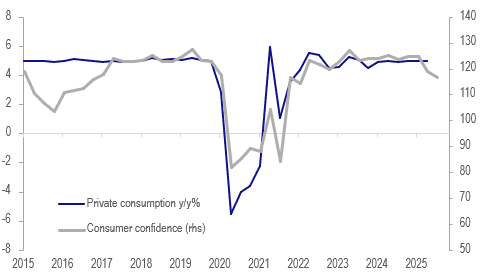
Indonesian consumer confidence fell for a second straight month to 115.0 in September from 117.2, the lowest since April 2022. There were major protests at the end of August regarding economic pressures and generous housing subsidies for politicians, which were overturned. The respected finance minister Indrawati was also replaced and dissent restricted. The issues appear to be still weighing on sentiment.
- Private consumption growth been steady around 5% for around two years but the 1.8% q/q drop in Q3 average consumer confidence is signalling that it slowed last quarter.
Indonesia private consumption
Source: MNI - Market News/LSEG
- Bank Indonesia surprisingly cut rates for the third consecutive month in September signalling that it has become more focussed on growth rather than the currency and so further easing on 22 October is possible given the softer consumption picture.
- BI's September statement added the phrase "joint efforts to stimulate economic growth", suggesting that it may be supporting government policy. It expects H2 2025 to improve due to the "strengthening policy synergy between Bank Indonesia and the Government".
- September consumer confidence was pressured by a 4 point drop in current incomes to 112.9 and 1 point in employment to 92.0. Thus it is unsurprising that durables purchases fell almost 2 points to 103.2. Expectations were 2 points lower to 127.2 driven by incomes and business but employment was slightly higher.
BSP: MNI BSP Preview - Oct 2025: On Hold But May Ease In Dec
- The consensus for tomorrow’s BSP meeting outcome is no change from the current 5.00% policy rate. Still, some sell-side expect a 25bps cut, with 6 out of the 25 economists surveyed by Bloomberg forecasting such a move (the remainder see rates holding steady). We sit in the no change camp, although note it may be a reasonably close call between this and a further 25bps cut.
- From an inflation standpoint, yesterday’s update for September didn’t materially change the outlook (BSP said as much after the data printed). Given this broadly unchanged backdrop and the fact that BSP Governor Remolona turned a little less dovish at the last policy meeting, it doesn’t point to a compelling case to ease from an inflation standpoint.
- Whilst downside growth risks may argue for a cut, fresh USD/PHP gains following a further BSP cut, could be an unwelcome development for the BSP. Additionally, the central bank gets an important Q3 GDP update on Nov 7, which comes ahead of the Dec BSP meeting. Hence the central bank may wait to assess growth trends at that meeting (with a window to cut), particularly given a broadly unchanged inflation backdrop in recent months.
- See the full preview at this link:
ASIA FX: Mixed Trends, BoT Expected To Cut Later, Yen Weakness Spilling Over
Asian currencies are mixed, with negative spill over evident from on-going yen weakness. This is true for 1 month USD/KRW and spot USD/SGD. We are retracing off recent USD highs for some other pairs though, like THB and PHP ahead of key central bank meetings.
- USD/CNH is a touch higher, last around 7.1475, against earlier highs above 7.1500. Onshore markets return tomorrow after the National Day holiday period. CNH/JPY has surged higher to 21.32, fresh highs since Jan of this year, as yen risks have been repriced since the LDP leadership election. Focus will be on the extent to which onshore USD/CNY spot (and the fixing) play catch up to these trends. History suggests USD/CNY upside will be modest and gradual.
- 1 month USD/KRW is at 1418, off 0.30% in won terms. The impact of weaker yen trends is continuing to be felt. Onshore South Korean markets return Friday.
- Spot USD/SGD continues to climb, the pair now eyeing a 1.3000 test (last near 1.2960).
- USD/PHP is lower, last around 58.00. Earlier data showed the Aug unemployment rate falling notably, which should add to the BSP on hold case tomorrow (which is what the consensus expects).
- USD/THB is down slightly, last near 32.47, backing away from a test of the 100-day EMA resistance point for now. The BoT is expected to cut rates later, but it may have to be quite a dovish cut to shift THB sentiment (particularly given fresh record highs in gold).
- USD/IDR is back above 16600, we fresh pressure potentially coming if we see the ID-US 10yr spread break under +200bps. Earlier data on consumer confidence likely adds to the firm downside bias in Indonesian bond yields. Consumer confidence fell for a second straight month to 115.0 in September from 117.2, the lowest since April 2022.
UP TODAY (TIMES GMT/LOCAL)
| Date | GMT/Local | Impact | Country | Event |
| 08/10/2025 | 0500/1400 |  JP JP | Economy Watcher's Survey | |
| 08/10/2025 | 0600/0800 | ** |  DE DE | Industrial Production |
| 08/10/2025 | 0600/0800 | *** |  SE SE | Flash Inflation Report |
| 08/10/2025 | 0600/0800 | *** | SE | Flash Inflation Report |
| 08/10/2025 | 0900/1000 | ** |  GB GB | Gilt Outright Auction Result |
| 08/10/2025 | 1030/1230 |  EU EU | ECB Elderson In Panel at Finance Conference | |
| 08/10/2025 | 1100/0700 | ** |  US US | MBA Weekly Applications Index |
| 08/10/2025 | 1320/0920 | US | St. Louis Fed's Alberto Musalem | |
| 08/10/2025 | 1330/0930 | US | Fed Governor Michael Barr | |
| 08/10/2025 | 1430/1030 | ** | US | DOE Weekly Crude Oil Stocks |
| 08/10/2025 | 1430/1030 | ** | US | US DOE Petroleum Supply |
| 08/10/2025 | 1500/1600 | GB | BOE Pill Speech at University of Birmingham | |
| 08/10/2025 | 1600/1800 | EU | ECB Lagarde Video Message at Werner Report Event | |
| 08/10/2025 | 1700/1300 | ** | US | US Note 10 Year Treasury Auction Result |
| 08/10/2025 | 1800/1400 | *** | US | FOMC Minutes |
| 08/10/2025 | 1915/1515 | US | Minneapolis Fed's Neel Kashkari | |
| 08/10/2025 | 2145/1745 | US | Fed Governor Michael Barr | |
| 09/10/2025 | 0600/0800 | ** | DE | Trade Balance |
| 09/10/2025 | 0830/0930 | GB | BOE Mann Keynote at Resolution Foundation Event | |
| 09/10/2025 | 1145/0745 |  CA CA | BOC Sr Deputy Gov Rogers speaks in Toronto (time TBC) | |
| 09/10/2025 | - | EU | ECB Lagarde & Cipollone at Eurogroup Meeting | |
| 09/10/2025 | 1230/0830 | *** | US | Jobless Claims |
| 09/10/2025 | 1230/0830 | ** | US | WASDE Weekly Import/Export |
| 09/10/2025 | 1230/0830 | US | Fed Chair Jerome Powell | |
| 09/10/2025 | 1235/0835 | US | Fed's Miki Bowman | |
| 09/10/2025 | 1245/0845 | US | Fed's Miki Bowman |


