RBNZ: Larger Cut Gives Sluggish Economic Recovery Extra Boost, Easing Bias
Oct-08 2025 01:42
The MPC discussed cutting the OCR by 25bp or 50bp and all members agreed the latter was appropriate given material spare capacity in the economy. Given that this is likely to persist for some time and that while the economy has begun to recover it remains lacklustre, further cuts bringing policy into stimulatory territory are likely. In line with this it said that “the Committee remains open to further reductions in the OCR”.
- The discussion included both 25bp and 50bp cuts. Arguments for 50bp to 2.5% included “prolonged spare capacity”, downside risks to growth and therefore inflation, moderation in domestic inflation resulting in greater confidence inflation is contained, and risk that households and businesses are being particularly cautious. The MPC wanted to send “a clear signal” to support the economy.
- Monetary policy lags, “signs of recovery”, time to ensure inflation returning to 2%, upside inflation risks from “constrained supply and cost pressures” and that signalling further easing for November would ease financial conditions argued for a more cautious 25bp cut.
- The MPC’s inflation concern appeared to shift this month. In August, it said it could ease policy further “if medium-term inflation pressures continued to ease as expected”, whereas this month it seemed more concerned with undershooting the target mid-point stating it “remains open to further reductions … for inflation to settle sustainably” near the 2% mid-point over the medium-term.
- It now expects inflation around 2% over H1 2026 rather than “by mid-2026” which may reflect its marginal revision to spare capacity and risks following the 0.9% q/q GDP contraction and recent modest activity data. Q2 GDP was impacted by a “large seasonal balancing item”, which the RBNZ expects to be reversed.
- There will be no press conference or forecast update today.
Want to read more?
Find more articles and bullets on these widgets:
Historical bullets
ASIA STOCKS: Equity Flow Update for Major Regional Bourses
Sep-08 2025 01:40
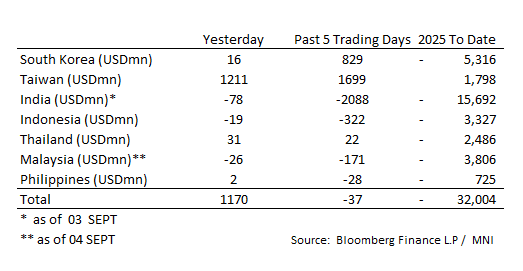
Taiwan has had its largest inflow in a month.
- South Korea: Recorded inflows of +$16m as of Friday, bringing the 5-day total to +$829m. 2025 to date flows are -$5,316m. The 5-day average is +$166m, the 20-day average is -$13m and the 100-day average of +$62m.
- Taiwan: Had inflows of +$1,211m yesterday, with total inflows of +$1,699 m over the past 5 days. YTD flows are positive at +$1,798m. The 5-day average is +$340m, the 20-day average of -$139m and the 100-day average of +$209m.
- India: Had outflows of -$78m as of the 3rd, with total outflows of -$2,088m over the past 5 days. YTD flows are negative -$15,692m. The 5-day average is -$418m, the 20-day average of -$215m and the 100-day average of -$3m.
- Indonesia: Had outflows of -$19m as of the 3rd, with total outflows of -$322m over the prior five days. YTD flows are negative -$3,327m. The 5-day average is -$64m, the 20-day average +$21m and the 100-day average -$13m.
- Thailand: Recorded inflows of +$31m Friday, with inflows totaling +$22m over the past 5 days. YTD flows are negative at -$2,486m. The 5-day average is +$4m, the 20-day average of -$40m and the 100-day average of -$14m.
- Malaysia: Recorded outflows as of the 4th of -$26m, totaling -$171m over the past 5 days. YTD flows are negative at -$3,806m. The 5-day average is -$34m, the 20-day average of -$34m and the 100-day average of -$11m.
- Philippines: Recorded inflows of +$2m Friday, with net outflows of -$28m over the past 5 days. YTD flows are negative at -$725m. The 5-day average is -$6m, the 20-day average of -$5m the 100-day average of -$4m.
AUSTRALIA: Survey Data Focus Of This Week
Sep-08 2025 01:28
Survey data are released this week and there is not much else. They will be important to gauge if the economic recovery continued in Q3 and how price pressures evolved.
- Tuesday sees September Westpac consumer confidence which rose each of the four months to August helped by lower rates and the prospects of further RBA easing. At 98.5 last month, it is now approaching the neutral 100-level.
- The NAB August business survey is also out on Tuesday. Business confidence has been trending higher since March and is positive again. Conditions however remain soft, although June/July printed above the 2025 average. Employment and cost/price components will be monitored closely.
- Melbourne Institute consumer inflation expectations for September are released on Thursday. It moderated substantially to 3.9% in August but the 3-month average has been around 4.5% since June.
- The RBA’s head of payments policy Connolly will participate in a panel on Thursday at 1130 AEST and assistant governor (financial system) Jones on Friday at 1200 AEST.
CHINA: Central Bank Injects CNY8.8bn via OMO
Sep-08 2025 01:28
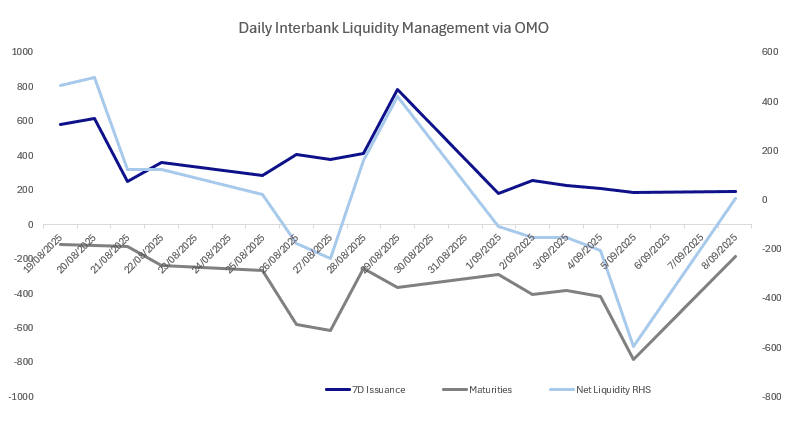
- The PBOC issued CNY191.5bn of 7-day reverse repo at 1.4% during this morning's operations.
- Today's maturities CNY182.7bn.
- Net liquidity injects CNY8.8bn.
- The PBOC monitors and maintains liquidity in the interbank system through the issuance of reverse repo.
- The CFETS Pledged Repo Deposit Institutions 7 Day Weighted is at 1.41%, from prior close of 1.43%.
- The China overnight interbank repo rate is at 1.31%, from the prior close of 1.30%.
- The China 7-day interbank repo rate is at 1.50%, from the prior close of 1.45%.