MNI ASIA OPEN: Tsys Testing Resistance Ahead Thursday GDP Data
EXECUTIVE SUMMARY
- MNI US: Treasury Sec Talks On China Trade, Fed Situation & Russia Sanctions
- MNI FED: NY's Williams: Labor Market Solid, "At Some Point" Need To Ease Policy
- MNI INTERVIEW: Fed Inflation Woes Extend Beyond Tariffs-Lacker
- MNI US OUTLOOK/OPINION: Q2 GDP Revisions Expected To Show Firmer Consumption
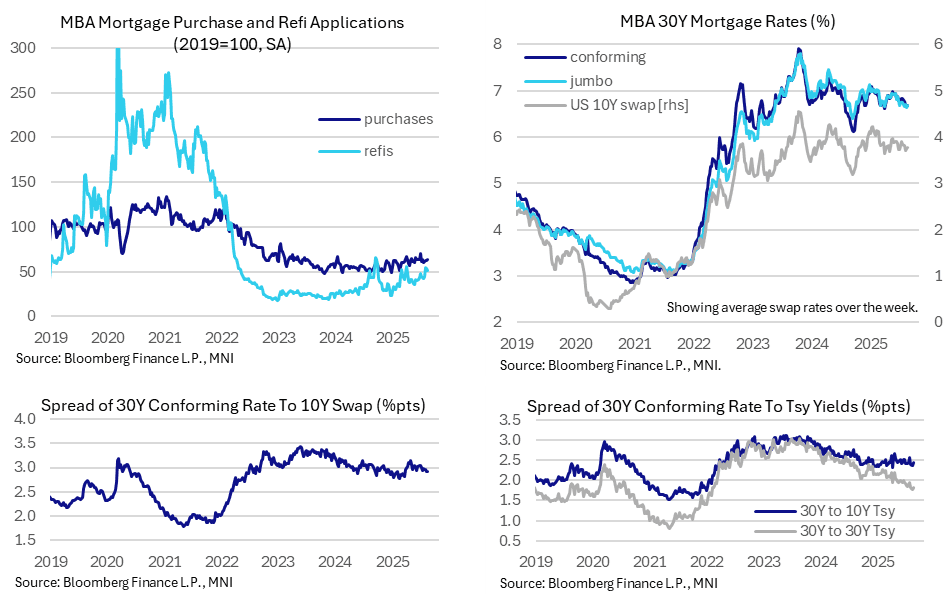
- MNI US DATA: Mortgage to Swap Rate Spreads Holding Near Post-Tariff Lows
US
MNI INTERVIEW: Fed Inflation Woes Extend Beyond Tariffs-Lacker
The Federal Reserve has not yet finished the job of taming inflation and cutting interest rates now could reignite price pressures, especially at a time when the central bank’s credibility is under threat from attacks on its independence, former Richmond Fed President Jeffrey Lacker told MNI. “I think they’ve got an inflation problem apart from the tariff effects. When they started cutting rates last year, inflation stopped falling and they haven’t had any disinflation since,” Lacker said in an interview Wednesday.
MNI FED: NY's Williams: Labor Market Solid, "At Some Point" Need To Ease Policy
NY Fed President Williams (permanent FOMC voter) on CNBC doesn't sound particularly concerned about the state of the labor market, in particular downplaying the weak nonfarm payrolls growth implied by the July employment report's downward revisions. While not contradicting Fed Chair Powell's apparent Jackson Hole signal of a likely September cut, which was based largely on a shift in the balance of risks to employment, Williams doesn't make the case for a cut here.
NEWS
MNI US: Democrats Hold Slight Lead On Generic Congressional Ballot
Analysis from G. Elliott Morris on an August Strength In Numbers/Verasight poll shows that the Democratic Party holds a slight advantage over the Republican Party on the generic ballot. Morris notes: "If the 2026 midterms were held today, 49% say they would back the Democratic candidate in their local House district, 41% the Republican candidate, and 10% remain undecided or say they aren't sure. Among decided voters, that's an eight-point Democratic lead."
MNI US: Treasury Sec Talks On China Trade, Fed Situation & Russia Sanctions
Speaking on Fox Business, Treasury Secretary Scott Bessent says that "everything is on the table" when it comes to future trade talks with China. He downplays the next set of talks, saying the visit of Li Chenggang, the top aide to Beijing’s lead negotiator, Vice-Premier He Lifeng, to Washington, D.C., this week as "more of a technical visit". Says that he is likely to meet the vice-premier in late-Oct/early Nov for the next set of high-level talks, adding that each meeting is "moving the ball forward".
US TSYS
MNI US Tsys Tracked German Bund, French Oat Earlier, Extend Late Highs
- Tsys reversed early weakness - extended highs in 2s-10s - following German Bund and French Oat contracts. Sources posited real$ bought the early dip in OATS squeezing shorts with Bunds then Tsys reacting in short order on decent volumes.
- Dec'25 10Y contract tapped 112-15, just below technical resistance at 112-15+, the Aug 5 high and the bull trigger. Clearance of this hurdle would resume the uptrend and pave the way for a climb towards 112-19 initially, a Fibonacci projection.
- Tsy curves twist steeper: 2s10s +3.484 at 61.533 (nearing mid-April's 3Y highs), 5s30s +3.160 at 120.597.
- No reaction to MBA composite mortgage applications dip -0.5% (sa) last week after -1.4% the week prior as they still holds onto most of its refi-driven 11% increase before that. New purchase applications increased 2.2%, their largest increase in a month, whilst refi applications fell another -3.5% after -3.1% following the 23% jump before that.
- NY Fed President Williams (permanent FOMC voter) on CNBC doesn't sound particularly concerned about the state of the labor market, in particular downplaying the weak nonfarm payrolls growth implied by the July employment report's downward revisions.
- Uncertainty over an independent Federal Reserve aside (following Trump's "firing" of Fed Gov Cook late Monday) Trump seeking a majority of like minded Fed boardmen in the aftermath of Chairman Powell's dovish Jackson Hole speech appears to be emboldening risk takers as SPX emini and Nasdaq indexes made new highs (6502.50 and 21616.18 respectively)
- Look ahead to Thursday's session: Weekly Claims, GDP, PCE and US Tsy $44B 7Y Auction.
OVERNIGHT DATA
MNI US DATA: Mortgage to Swap Rate Spreads Holding Near Post-Tariff Lows
- MBA composite mortgage applications dipped -0.5% (sa) last week after -1.4% the week prior as they still holds onto most of its refi-driven 11% increase before that. New purchase applications increased 2.2%, their largest increase in a month, whilst refi applications fell another -3.5% after -3.1% following the 23% jump before that.
MNI US OUTLOOK/OPINION: Q2 GDP Revisions Expected To Show Firmer Consumption
- The week’s data picks up significantly from tomorrow with the second estimate for Q2 national accounts and weekly jobless claims at 0830ET. The national accounts release offers first revisions to real GDP growth of 3.0% annualized in Q2 having surprised stronger in the flash release (then consensus 2.6%, GDPNow 2.9%) after -0.5% in Q1.
MARKETS SNAPSHOT
Key market levels of markets in late NY trade:
DJIA up 147.16 points (0.32%) at 45565.23
S&P E-Mini Future up 10.25 points (0.16%) at 6492.5
Nasdaq up 45.9 points (0.2%) at 21590.14
US 10-Yr yield is down 2.9 bps at 4.2324%
US Sep 10-Yr futures are up 7/32 at 112-13.5
EURUSD down 0.0007 (-0.06%) at 1.1635
USDJPY up 0.07 (0.05%) at 147.47
WTI Crude Oil (front-month) up $0.63 (1%) at $63.88
Gold is up $1.82 (0.05%) at $3395.38
European bourses closing levels:
EuroStoxx 50 up 9.39 points (0.17%) at 5393.07
FTSE 100 down 10.3 points (-0.11%) at 9255.5
German DAX down 106.66 points (-0.44%) at 24046.21
French CAC 40 up 34.12 points (0.44%) at 7743.93
US TREASURY FUTURES CLOSE
3M10Y -2.344, 5.212 (L: 5.212 / H: 10.326)
2Y10Y +3.312, 61.361 (L: 57.152 / H: 63.53)
2Y30Y +5.616, 129.233 (L: 122.246 / H: 130.879)
5Y30Y +3.551, 120.988 (L: 116.177 / H: 121.772)
Current futures levels:
Sep 2-Yr futures up 1.5/32 at 103-31.875 (L: 103-29 / H: 104-00)
Sep 5-Yr futures up 4.75/32 at 109-8.75 (L: 109-01.25 / H: 109-09)
Sep 10-Yr futures up 7/32 at 112-13.5 (L: 112-01 / H: 112-14)
Sep 30-Yr futures steady at at 114-19 (L: 113-28 / H: 114-21)
Sep Ultra futures down 3/32 at 116-28 (L: 115-31 / H: 117-00)
MNI US 10YR FUTURE TECHS: (Z5) Bullish Outlook
- RES 4: 113-00 Round number resistance
- RES 3: 112-28+ 1.764 proj of the Jul 15 - 22 - 28 price swing
- RES 2: 112-19 1.764 proj of the Jul 15 - 22 - 28 price swing
- RES 1: 112-15+ High Aug 5 and the bull trigger
- PRICE: 112-12+ @ 1335 ET Aug 27
- SUP 1: 111-25 20-day EMA
- SUP 2: 111-14+ 50-day EMA
- SUP 3: 111-13+ Low Aug 18
- SUP 4: 110-25 Low Aug 1
The trend outlook in Treasury futures remains bullish and the contract continues to trade above support at the 50-day EMA, at 111-14+. A clear break of this average would expose support at 110-25, the Aug 1 low. For bulls, attention is on 112-15+, the Aug 5 high and the bull trigger. Clearance of this hurdle would resume the uptrend and pave the way for a climb towards 112-19 initially, a Fibonacci projection.
SOFR FUTURES CLOSE
Current White pack (Sep 25-Jun 26):
Sep 25 +0.013 at 95.903
Dec 25 +0.010 at 96.235
Mar 26 +0.015 at 96.505
Jun 26 +0.025 at 96.780
Red Pack (Sep 26-Jun 27) +0.025 to +0.030
Green Pack (Sep 27-Jun 28) +0.035 to +0.040
Blue Pack (Sep 28-Jun 29) +0.040 to +0.045
Gold Pack (Sep 29-Jun 30) +0.035 to +0.040
REFERENCE RATES (PRIOR SESSION)
US TSYS: Repo Reference Rates
- Secured Overnight Financing Rate (SOFR): 4.38% (+0.01), volume: $2.820T
- Broad General Collateral Rate (BGCR): 4.37% (+0.02), volume: $1.164T
- Tri-Party General Collateral Rate (TCR): 4.37% (+0.02), volume: $1.125T
- (rate, volume levels reflect prior session)
STIR: FRBNY EFFR for prior session:
- Daily Effective Fed Funds Rate: 4.33% (+0.00), volume: $113B
- Daily Overnight Bank Funding Rate: 4.33% (+0.00), volume: $226B
FED Reverse Repo Operation
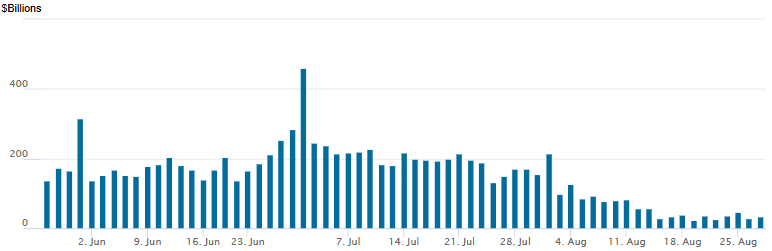
RRP usage rebounds to $34.744B with 21 counterparties this afternoon, from $28.574B yesterday. Compares to $22.344B on Tuesday, Aug 19 - lowest since April 5, 2021 vs. this year's high usage of $460.731B on June 30.
MNI PIPELINE: Corporate Bond Update: $3B Ontario 5Y SOFR Priced
- Date $MM Issuer (Priced *, Launch #)
- 08/27 $3B *Ontario 5Y SOFR +52
- 08/27 $2B *ESM 2030 WNG +39
- 08/27 $1.25B *Saudi Awwal 10NC5 +220
MNI BONDS: EGBs-GILTS CASH CLOSE: OATs Extend Underperformance
OATs underperformed for a 3rd consecutive session as French political concerns lingered.
- Core EGBs and Gilts gained in morning trade, the latter after registering fresh cycle lows at the open, amid a bit of risk-off with equities sagging.
- Impactful data was limited, but regional politics were a key focus, with France's Sep 8 no-confidence vote continuing to weigh on OATs (the Dutch government survived a no-confidence motion of its own today, though this was expected).
- Outright OAT yields hit recent highs with 30Y seeing yields hit a 14-year high, as spreads to Bunds continued to widen.
- Trade turned more constructive going into the close, with OATs seemingly finding a footing, boosting Bunds and Gilts (as well as Treasuries).
- The belly outperformed on the German curve (despite a soft 7Y auction), with yields down throughout, while the UK curve saw yields drop more or less in parallel.
- Thursday's data schedule includes consumer and business confidence for Italy and the Eurozone, along with an appearance by the ECB's Rehn and the account of the July ECB meeting.
- The week's regional focus - the Eurozone August flash inflation round - technically starts Thursday (Belgium is due) but most attention will be on Friday's releases for Spain, France, Italy, and Germany. MNI's preview is here.
Closing Yields / 10-Yr EGB Spreads To Germany
- Germany: The 2-Yr yield is down 2.3bps at 1.915%, 5-Yr is down 3.1bps at 2.237%, 10-Yr is down 2.3bps at 2.7%, and 30-Yr is down 1.3bps at 3.307%.
- UK: The 2-Yr yield is down 0.4bps at 3.964%, 5-Yr is down 0.6bps at 4.133%, 10-Yr is down 0.4bps at 4.736%, and 30-Yr is down 0.8bps at 5.6%.
- Italian BTP spread up 4bps at 87.3bps / French OAT up 5.1bps at 82.4bps
MNI FOREX: Early Dollar Strength Dissipates, US GDP/PCE Awaited
- Initial weakness for European stocks on Wednesday worked in favour of the dollar, prompting some notable weakness for the rest of the G10 FX complex. French political uncertainty likely stoked these concerns, weighing on EURUSD in particular. However, firmer sentiment for equities as the session progressed, and a bounce for French OATs then assisted a reversal back into the ranges for most major pairs.
- For EURUSD, the initial price action took spot below 1.16 and the key 50-day EMA pivot support, threatening an important bearish development. However, with spot now residing around 50 pips off the 1.1574 lows, the bullish overall trend looks set to stay intact.
- EURAUD breaking to new daily lows through the WMR fix puts the price clear of both the 50-dma at 1.7893 and likely avoids the formation of support at a possible uptrendline drawn off the February lows.
- Weakness for the New Zealand dollar still stands out, and despite the most recent bounce, spot has narrowed the gap to the pre-Powell lows overall, located at 0.5800.
- Friday’s low print adds to the medium-term significance of this level, which has proven an important pivot point dating back to late 2023. A break of the figure will be required for a deeper selloff, potentially targeting a move to 0.5728, the 61.8% retracement of the Apr/Jul rally.
- Despite USDJPY attempting to break back above 148.00 during the European morning, the pair tracks back around 147.50 as US GDP (2nd read) and PCE prints are awaited across Thursday and Friday.
- In emerging markets, more concrete details on a security deal being achieved between Mexico and the US provided a late boost for the Mexican peso. USDMXN had traded back up to resistance at 18.80 before the headlines, and the late dollar weakness provided an additional headwind for USDMXN, which trades back towards 18.69 approaching the APAC crossover.
THURSDAY DATA CALENDAR
| Date | GMT/Local | Impact | Country | Event |
| 28/08/2025 | 0700/0900 | ** |  SE SE | Economic Tendency Indicator |
| 28/08/2025 | 0700/0900 | *** |  CH CH | GDP |
| 28/08/2025 | 0700/0900 | ** | CH | KOF Economic Barometer |
| 28/08/2025 | 0800/1000 | ** |  EU EU | M3 |
| 28/08/2025 | 0800/1000 | ** |  IT IT | ISTAT Consumer Confidence |
| 28/08/2025 | 0800/1000 | ** | IT | ISTAT Business Confidence |
| 28/08/2025 | 0900/1100 | * | EU | Consumer Confidence, Industrial Sentiment |
| 28/08/2025 | 1230/0830 | *** |  US US | Jobless Claims |
| 28/08/2025 | 1230/0830 | ** | US | WASDE Weekly Import/Export |
| 28/08/2025 | 1230/0830 | * |  CA CA | Current account |
| 28/08/2025 | 1230/0830 | * | CA | Payroll employment |
| 28/08/2025 | 1230/0830 | *** | US | GDP / PCE Quarterly |
| 28/08/2025 | 1400/1000 | ** | US | NAR Pending Home Sales |
| 28/08/2025 | 1430/1030 | ** | US | Natural Gas Stocks |
| 28/08/2025 | 1500/1100 | ** | US | Kansas City Fed Manufacturing Index |
| 28/08/2025 | 1530/1130 | ** | US | US Bill 04 Week Treasury Auction Result |
| 28/08/2025 | 1530/1130 | * | US | US Bill 08 Week Treasury Auction Result |
| 28/08/2025 | 1700/1300 | ** | US | US Treasury Auction Result for 7 Year Note |
| 28/08/2025 | 2200/1800 | US | Fed Governor Christopher Waller | |
| 29/08/2025 | 2330/0830 | * |  JP JP | Labor Force Survey |
| 29/08/2025 | 2330/0830 | ** | JP | Tokyo CPI |
| 29/08/2025 | 2350/0850 | ** | JP | Industrial Production |
| 29/08/2025 | 2350/0850 | * | JP | Retail Sales (p) |


