AUSTRALIA: Inflation Gap Impact On Rate Estimates Offset By Output Gap
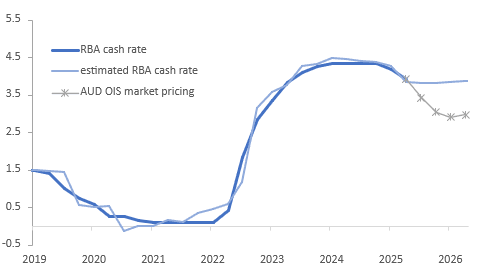
Our policy reaction function is signalling that rates on hold around 3.85% is consistent with the economic outlook. The RBA reduced its trimmed mean inflation projection by 0.1pp to 2.6% so that the inflation gap is now only 0.1pp and also revised down its growth projections due to current global trade uncertainty and slower-than-expected private consumption growth. The model is updated for yesterday’s Q1 GDP data but given much of the softness was due to weather events, a July 8 rate cut is likely to be more dependent on more timely monthly data releases and trade negotiation progress.
- The underlying inflation variable in the equation leads by two quarters and is therefore forward looking. The slight positive inflation gap adds pressure for higher rates.
- Our estimate for the output gap has been negative for a year and it continues to show spare capacity going forward, thus putting downward pressure on the cash rate estimates.
- These two effects essentially offset each other in our simple model and with the lagged dependent variable anchoring the calculation, it estimates rates troughing at the end of 2025 at around 3.80%, close the current 3.85%. They then trend gradually towards 3.90%.
- The RBA considers risks around its outlook, which are currently elevated due to global trade events, and many more variables than just GDP and trimmed mean CPI.
- The AUD OIS market has rates trending down into Q1 2026 where they are expected to stabilise in around March.
Australia policy reaction function using trimmed mean inflation
Want to read more?
Find more articles and bullets on these widgets:
Historical bullets
FOREX: G10 Wrap - USD Struggling To Catch A Bid
The BBDXY has had an Asian range of 1221.53 - 1225.17, Asia is currently trading around 1222. USD/Asia has stabilized with China back from holidays. Bloomberg - “The ECB is poised to continue cutting rates, according to Yannis Stournaras. The Greek central bank chief expects a clear slowdown of inflation in Europe due to US tariffs, and believes the continent will respond selectively to any US measures.” The lower China services PMI saw risk trade heavy in our session providing a bid to safe havens like the JPY.
- EUR/USD - Asian range 1.1280 - 1.1320, Asia is currently trading 1.1315. Intra-day support is around the 1.1250 area, should this area not hold demand should remerge on dips back to 1.1100.
- GBP/USD - Asian range 1.3260 - 1.3300, Asia is currently dealing around 1.3295. Intra-day support is around the 1.3250 area, then the pivotal 1.30/31 support is next.
- USD/JPY - Asian range 143.56 - 144.28, has drifted sideways for most of the Asia session. Look for some support initially back towards 143.00, we would probably need another catalyst to test below that again.
- USD/CNH - Asian range 7.2002 - 7.2352, the USD/CNY fix printed 7.2008. The capitulation in USD/Asia has taken a breather today, rallies should now find sellers who could not get out because of the pace of the move. First resistance 7.2600 Area and then back towards 7.3000.
- Cross asset : SPX -0.2%, Gold $3360, US TYM5 110-30, BBDXY 1221, Crude oil $58.02.
- Data/Events : SW PMI’s, FR Industrial Production & PMI’s, Spain Unemployment, Spain PMI’s, Italy PMI’s, Germ PMI’s, EU PPI, US Trade Balance
Fig 1: GBP/USD Spot Hourly Chart

Source: MNI - Market News/Bloomberg
FOREX: Antipodean Wrap - AUD & NZD Rise Falters As US Stocks Stall
The Asian session started off on the back foot with US stocks closing poorly even after a better than expected ISM Services PMI overnight. The lower China services PMI saw Asia remain under pressure providing headwinds for both the AUD and NZD. MNI - AU Building approvals in March were significantly weaker than expected falling 8.8% m/m with the more stable private houses component down 4.5% m/m. Bloomberg - “ANZ is forecasting a 0.2pp rise in the NZ Q1 unemployment rate to 5.3%, which would be the highest since Q4 2016, as growth in labour supply exceeds labour demand. It doesn’t think the data or the upcoming budget on May 22 will change the RBNZ monetary policy outlook and that the updated forecasts for the May 28 meeting will be more important, especially given the global environment.”
- AUD/USD - Asian range 0.6443 - 0.6470, the AUD is currently dealing around 0.6455. The AUD move higher seems to be running out of steam as risk runs into resistance. Support should be seen back towards 0.6400, a break below 0.6300 needed to reverse direction.
- AUD/JPY - Asian range 92.76 - 93.05, price goes into London trading around 92.85. Price is stalling towards the resistance seen around 94.00 as risk struggles in Asia. Support seen initially back towards the 92.00 area.
- NZDUSD - Asian range 0.5944 - 0.5973, going into London trading around 0.5965. The NZD continues to hold up well and is consolidating within a 0.5875/0.6025 range. On the day dips back to 0.5900 should continue to find support.
- AUD/NZD - Asian range 1.0819 - 1.0849, the Asian session is currently trading 1.0825. Sellers have returned back towards the 1.0850 area.
Fig 1 : AUD/JPY Spot Hourly Chart

Source: MNI - Market News/Bloomberg
GOLD: Gold’s Rally Returns with Strong Gains Today
- Gold’s overnight rally continued into the Asia trading day delivering a +0.80% gain.
- With equities strong across the region, bonds quiet and the dollar stronger against regional crosses, it was a day possibly where gold could have fallen.
- With positioning much lighter in longs than previously and money managers more neutral than they have been in over a year, the rally today looked like the re-establishment of longs given the recent sell off.
- Gold markets will be actively watching the FED this week as expectations for rate cuts diminish following the stronger than expected labour market.
- Gold opened the day at US$3,334.12 and rallied to $3,359.70 by mid afternoon.
- Bolivia’s released details of its reserves today showing that the Central Bank are another of the ever growing list of Central Banks adding to their gold reserves having purchased 4.94 tons of locally-produced gold in the first quarter of 2025


