AUSTRALIA DATA: Higher Gold Prices Supportive But Imports & Exports Rising
The October merchandise trade surplus widened to $4.385bn after a downwardly-revised $3.71bn but it remains in the range it has been in since the start of 2024. The move was driven by monthly export growth exceeding imports for the second consecutive month and both are showing upward momentum. Stronger exports add to activity while imports signal that domestic demand is robust. The RBA is likely to be on hold beyond the 9 December decision.
Australia goods exports vs imports y/y% 3-mth ma
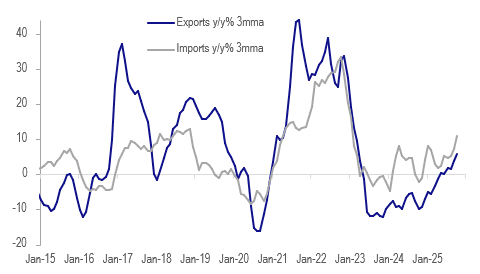
- Goods export values rose 3.4% m/m in October to be up 11.3% y/y after 9.8% y/y. Both rural and non-rural were higher on the month but annual growth is very different at 22.1% y/y and 2.7% y/y respectively.
- Non-monetary gold was the main driver of the rise in both export and import values in October as global prices rose 10.6% m/m to be up 50.8% y/y.
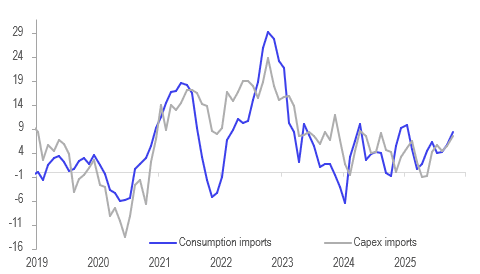
- Consumer goods imports rose 1.6% m/m to be up 7.9% y/y driven by increases in food & beverages, clothing & footwear and other goods.
- There was some payback in October for strong capex imports with them falling 5.5% m/m driven by a 30% drop in ADP equipment but telecoms rose 3.9% m/m and machinery & equipment +6.8%.
Australia merchandise imports y/y% 3-mth ma
- Goods exports to the US are moderating towards the 2024 average but are still up 15.8% y/y due to frontloading earlier in the year ahead of the introduction of US tariffs. Growth to China, Korea and India remains strong while it is still soft to Japan, Taiwan and has moderated to the UK and Indonesia.
- Metal ore shipments rose in October but coal & metals fell. Volumes were higher for iron ore, LNG and hard-coking & semi-soft coal. Prices were also generally higher, except for LNG.
Want to read more?
Find more articles and bullets on these widgets:
Historical bullets
NZD: NZD/USD Near Mid Oct Lows, Tracking Sub 0.5700
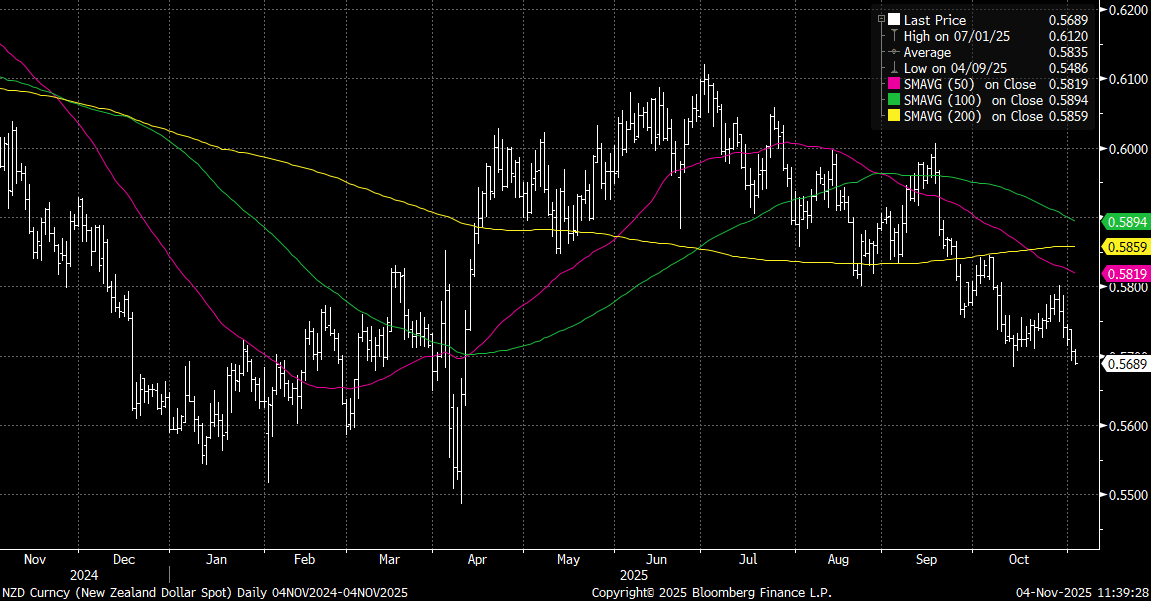
The Kiwi is the weakest performer in the G10 space, back close to mid Oct lows (0.5683), see the chart below. A fresh break lower targets the 0.55/0.5600 region. Fresh highs in AUD/NZD (last around 1.1480), as we await the RBA later, likely aiding NZD underperformance (we also have NZ jobs data tomorrow). Anything which pushes out the RBA easing timing, with inflation forecasts key, could see a 1.1500 test in the cross.
Fig 1: NZD/USD Eyeing Test Sub Mid Oct Lows
Source: Bloomberg Finance L.P./MNI
CNH: USD/CNY Fixing Egdes Up, But Error Term Wider, Aiding CNH Outperformance
The USD/CNY fixing printed at 7.0885, up on yesterday's outcome (7.0867), but well below market forecasts. The fixing error widened to -363pips, fresh wides since early Sep of this year. This continues to see the fixing bias lean against the higher dollar levels. In turn this should aid CNH outperformance on key crosses. USD/CNH was a little higher in latest dealings, last near 7.1295, while USD indices were 0.10% higher. CNH/JPY is above 21.66, eyeing a move above 21.70, which marked recent highs. EUR/CNH is testing under 8.2000.
RBA: Updated Inflation Forecasts Key To Monetary Policy Outlook
The RBA is widely expected to leave rates at 3.6% when its decision is announced today at 1430 AEDT. As a result, there will be particular focus on the statement tone but also the accompanying updated staff forecasts to determine the monetary policy outlook. Given trimmed mean inflation’s “material miss” in Q3, the question is how far the target of around 2.5% will be pushed or will the higher market rate profile mean that it still returns to 2.6% in Q2 2026. Changes to the RBA’s growth, especially consumption, and jobs forecasts are also likely to be a focus.
- The 0.3pp pickup in trimmed mean inflation in Q3 to 3%, the top of the RBA’s band and well above the August forecast of 2.6% for Q4, put an end to November easing expectations and also likely ruled out December. A meagre 0.2% q/q rise is needed to achieve 2.6% in Q4, which hasn’t happened since 2016 outside of Covid.
- If the RBA continues to expect 2.6% underlying inflation in Q2 and Q4 2026, possibly driven by higher market rates and softer labour market, then rate cut expectations are likely to rise again. Currently the AUD OIS market doesn’t have a full 25bp priced in.
- However, if Q4 2026 is forecast to be above 2.6% at even 2.7-2.8%, then an extended pause is likely to be the base case.
- The Q4 2025 unemployment rate may be revised higher after Q3 came in at 4.3%, the RBA’s August Q4 projection. Employment growth was also slower than it expected. Any weakening of 2026 projections could drive wage expectations down and thus help inflation.
- See MNI RBA Preview.


