RBA: Economy Developing As Expected, May Be “Scarring Effect” On Consumers
Deputy Governor Hauser’s comments at the Barrenjoey economic forum suggest that the RBA currently views the economy as evolving as expected. He noted that Q2 trimmed mean inflation and unemployment prints were in line with projections. The Q2 CPI data was “very welcome”. In May, there was 50bp of H2 easing assumed in the outlook.
- The Board is debating about how much momentum the economy has and in this context he noted that consumption growth has been underwhelming despite real income growth and low unemployment. The misery index suggests that consumer confidence should have improved more than it has which could be because of a “scarring effect” from recently falling real incomes, but that is difficult to model and may reflect “something special now”.
- A pickup in consumption growth in other countries as well as Australia’s positive real income growth is positive for the spending outlook. But if productivity growth stays weak, consumption could still disappoint.
- Unemployment remains historically low and firms are saying that while it is easier to find staff it still takes time and they have to pay the right rate. But there are signs that the labour market is rebalancing.
- His favourite charts have the cone around the base case for a variable, which in the case of the unemployment rate was very wide. So, it is easy to be surprised by unemployment but if it were to rise sharply, then the Board would have to react.
- In terms of tariffs, Hauser noted that the impact was less severe than feared as the worst duties and retaliation haven’t happened and as such the rise in the effective global tariff has been modest. Also, the global economy may be more resilient with frontloading/diverting of shipments but should be careful as the impact could be seen over the longer-term.
Want to read more?
Find more articles and bullets on these widgets:
Historical bullets
JAPAN DATA: Q2 Tankan Surprises On The Upside, Capex Outlook Firmer
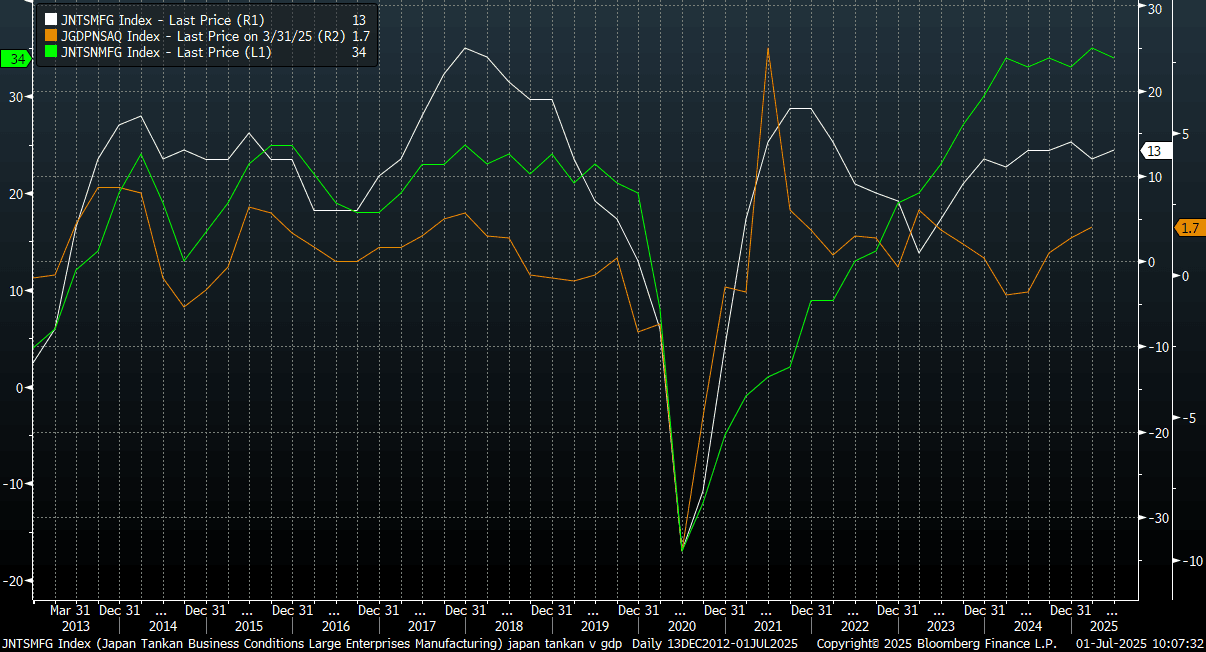
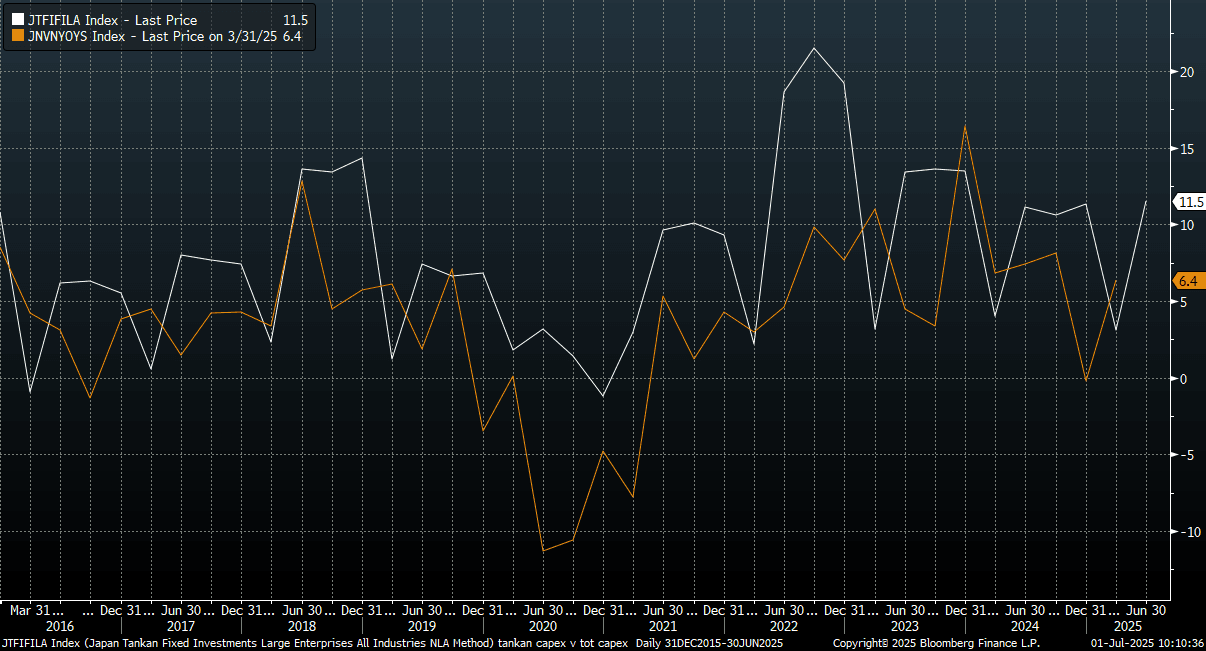
The Q2 Tankan survey delivered some positive upside surprises. The large manufacturing index rose to 13, versus 10 forecast and 12 prior. The outlook for this segment was also better than forecast, printing at 12 (9 was forecast and 12 was the Q1 outcome). The all industry capex estimate was also stronger than expected, coming in at 11.5%, versus 10.0% forecast (3.1% was the prior outcome). For large non-manufacturing firms, the results were slightly less positive, with headline index at 34, in line with forecast, while prior was 35. The outlook printed at 27, below the expected 29 outcome (28 was recorded in Q1).
- For smaller firms, manufacturing sentiment levels remained below levels recorded for non-manufacturing firms. Both sectors saw outcomes close to forecasts, 1 for small manufacturing firms, 15 for non-manufacturing firms.
- The first chart below plots the headline large manufacturing and non-manufacturing indices versus y/y Japan GDP growth, which is the orange line on the chart. In the face of external headwinds, particularly in terms of the tariff threat, today's results point to a resilient backdrop. Both Tankan measures for large firms are just off recent highs.
- The second chart below plots the capex estimate from the Tankan survey the white line on the chart) against the capital investment, which is only out for Q1. This is pointing to a firmer capex backdrop for Q2, which again will please the authorities in the face of external headwinds.
Fig 1: Q2 Tankan Survey Results Paint Resilient Backdrop
Source: Bloomberg Finance L.P./MNI
Fig 1: Q2 Tankan Capex Estimate & Capex Y/Y
Source: Bloomberg Finance L.P./MNI
US TSYS: Cash Open
TYU5 is trading 112-02, down 0-02 from its close.
- The US 2-year yield opens around 3.72%, unchanged from its close.
- The US 10-year yield opens around 4.23%, almost unchanged from from its close.
- MNI Interview - Atlanta Federal Reserve President Raphael Bostic told an MNI Connect event Monday the potential for tariffs to create inflation pressure into next year means going slow on cutting interest rates with one this year and three in 2026, expressing a broader caution until there's clarity around U.S. fiscal policy and global conflicts.
- “Goldman said the first rate cut may come in September, sooner than it had forecast.”(BBG)
- (Bloomberg) - Treasury Secretary Scott Bessent’s indication that his department is less keen on borrowing at longer tenors opens up the door to more bill issuance. That’s a sentiment echoed by President Donald Trump in comments last week, although his notion of only issuing debt of less than nine months’ maturity is highly unlikely to happen.
- The 10-year yield has accelerated through its support, this should clear the way for a move lower with the 4.10% area the first target. 10-year yields should now find demand on any bounce back to the 4.35/40% area.
- Data/Events: S&P Global US Man PMI, Wards Total Vehicle Sale, ISM Manufacturing, Construction Spending, JOLTS, Dallas Fed Services Activity
MNI: MNI BOJ JUNE TANKAN LARGE MFG INDEX +13; MAR 12; MEDIAN 9
- MNI BOJ JUNE TANKAN LARGE MFG INDEX +13; MAR 12; MEDIAN 9
- BOJ SEPT TANKAN LARGE MFG INDEX FORECAST AT +12
- BOJ TANKAN LARGE NON-MFG INDEX +34; MAR 35; MEDIAN 34
- BOJ SEPT TANKAN LARGE NON-MFG INDEX SEEN AT 27


