AUDUSD TECHS: Corrective Phase Still In Play
- RES 4: 0.6759 High Oct 11 ‘24
- RES 3: 0.6723 High Oct 21 ‘24
- RES 2: 0.6707 High Sep 17 and a key resistance
- RES 1: 0.6661/86 High Dec 16 / 10
- PRICE: 0.6608 @ 15:56 GMT Dec 19
- SUP 1: 0.6593 Low Dec 18
- SUP 2: 0.6566 50-day EMA
- SUP 3: 0.6517 Low Nov 27
- SUP 4: 0.6466/21 Low Nov 26 / 21
The trend condition in AUDUSD remains bullish and the latest pullback appears corrective. The move down is allowing a recent overbought condition to unwind. Support at the 20-day EMA, at 0.6598, has been pierced. The 50-day average is at 0.6566. The area between the two averages represents a key short-term support zone. A resumption of gains would refocus attention on key resistance at 0.6707, the Sep 17 high and bull trigger.
Want to read more?
Find more articles and bullets on these widgets:
Historical bullets
USDCAD TECHS: Sharp Reversal
- RES 4: 1.4200 Round number resistance
- RES 3: 1.4173 Channel top drawn from Jul 23 low
- RES 2: 1.4140/67 High Nov 5 / 50.0% of the Feb 3 - Jun 16 bear leg
- RES 1: 1.4065 High Nov 19
- PRICE: 1.4064 @ 17:37 GMT Nov 19
- SUP 1: 1.3969 50-day EMA
- SUP 2: 1.3897 Bull channel base drawn from the Jul 23 low
- SUP 3: 1.3888 Low Oct 29 and a key support
- SUP 4: 1.3833 Low Sep 24
Wednesday’s impulsive rally works against the previously bearish outlook, keeping resistance under pressure. Markets need to progress further here to challenge 1.4140 - the next notable resistance - and change the over-arching narrative. Despite the intraday rally, the short-term outlook in USDCAD is bearish and Tuesday’s price action reinforces this theme. The pair is trading inside a bull channel drawn from the Jul 23 low. The top of the channel provided a firm resistance on Nov 11. The subsequent move down highlights scope for an extension towards the base of the channel at 1.3897.
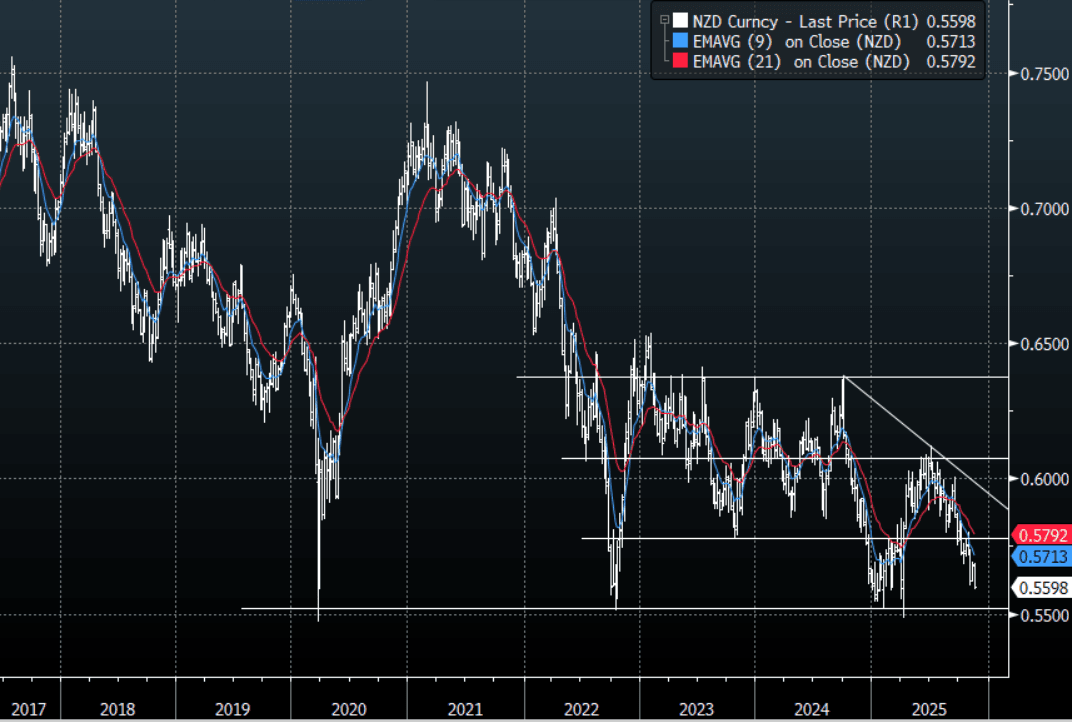
NZD: NZD/USD - Regains Momentum Lower, Breaking Below 0.5600
The NZD/USD had a range overnight of 0.5590 - 0.5644, Asia is trading around 0.5600. Fed members strongly differed on a December cut in the minutes and the BLS said it won’t publish an October jobs report. This has seen the market pull further back on hopes of a December cut and has seen the USD break higher and Crypto have another leg lower. The NZD broke below its recent support around 0.5630 and accelerated lower breaking below 0.5600. The market awaits the Nvidia results for the next catalyst. The next target is the pivotal 0.5500 area which has been very strong support in the past.
- Options : Closest significant option expiries for NY cut, based on DTCC data: 0.5675(NZD300m). Upcoming Close Strikes : 0.5480(NZD644m Nov 21), 0.5600(NZD450m Nov 25), 0.5720(NZD646m Nov 25) - BBG
- The NZD/USD Average True Range for the last 10 Trading days: 46 Points
Fig 1: NZD/USD Spot Weekly Chart
Source: MNI - Market News/Bloomberg Finance L.P
FED: Gov Miran Eyes A Smaller Fed Balance Sheet
Fed Gov Miran laid out a case for a smaller Fed footprint in the financial sector in a speech Wednesday called "Regulatory Dominance of the Federal Reserve’s Balance Sheet" While he supported the Fed's recent decision to end balance sheet runoff, and in fact would have supported ending it a month earlier than the Dec 1 conclusion, he is nonetheless eyeing a reduction in reserve balances from current proportions (eg as a % of GDP).
- It's unclear whether Miran will be reappointed to stay on the Fed Board after the end of his term in January - and thus he might not be in much of a position to shape future balance sheet policy - but it's worth considering his overall view as it may signal the current presidential administration's preferences. We note for instance parallels between his ambition for a smaller balance sheet along with his view that rates should be much lower; ex-Fed Gov Warsh, a candidate to succeed Jerome Powell as Fed Chair, has eyed lower rates and a smaller balance sheet as well.
- He argues that only once the Fed reshapes the regulatory framework can it begin to make plans for the future size and composition of its balance sheet: "It has become apparent to me that trying to settle the ongoing debates on how monetary policy is best implemented before settling the regulatory framework is putting the cart before the horse."
- "As we right-size the regulations, my hope is that it will allow us to further reduce the size of the balance sheet, relaxing the grip of regulatory dominance....as we make more progress peeling back regulations, I expect the optimal level of reserves may drop below where it is now, at least relative to GDP or the size of the banking system. It is possible that in the future, it will be appropriate to resume shrinking the balance sheet; stopping runoff today does not necessarily mean stopping it forever."
- He also makes the point that smaller reserves would ultimately reduce the amount the Fed pays out to banks on their holdings, a subject of contention among some politicians (though the interest on reserves regime has been heartily defended by others on the FOMC). He says "That [shrinking the balance sheet] would also enable us to reduce our interest payments on reserves. If we go far enough with removing regulations, we may be able to limit perceptions that the Fed is picking winners and losers through regulations, asset purchases, and credit allocation decisions. But before further reductions in the balance sheet, we first have to get the regulations right and ensure that bank balance sheets are flexible enough for an environment with a smaller Federal Reserve footprint."


