JGBS: Sharp Reprieve For Long-end JGBs On MOF Sources; Focus On Auction Demand
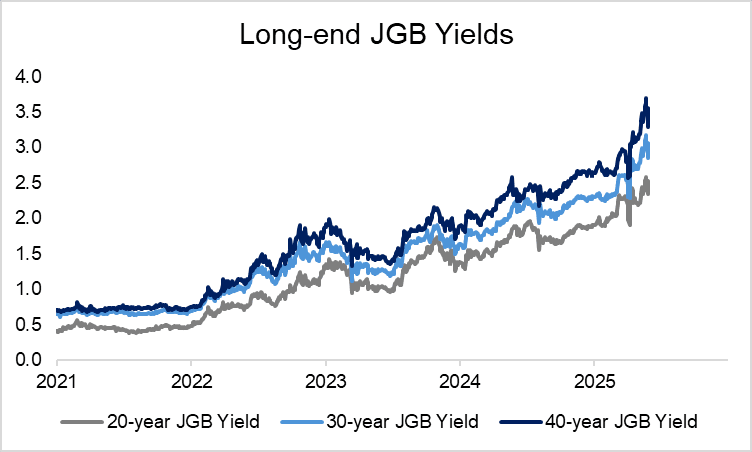
40-year JGB yields are down 24.5bps to 3.312% today, with the curve sharply bull flatter, after Reuters sources suggested the MOF will consider skewing the composition of its current issuance programme away from super-long-end instruments. That’s the largest one-day decline in 40-year yields since Bloomberg began tracking the data in February 2008 (and the 2nd largest absolute change in yields). 40-year yields are now almost 40bps below last Friday’s 3.697% high, with short-positioning likely exacerbating the last few days’ relief rally. However, focus remains intently on tomorrow’s 40-year auction.
- There have been several factors contributing to the sharp sell-off in (particularly long-end) JGBs over the last two months.
- (i) Signs of waning structural demand from domestic counterparties, such as the life insurance sector. Weak auction results (e.g last week’s 20-year auction) may reflect such dynamics.
- (ii) Concerns around less BOJ-led support for government bonds in the coming quarters.
- (iii) Fiscal concerns, particularly with the upper house election due in July. This morning (per BBG), a government advisory panel called for enhanced domestic fiscal prudence: “We must manage finances with a heightened sense of urgency to prevent rising debt costs from crowding out essential policy spending”.
- (iv) Global curve steepening on a wider global assessment of long-dated issuance in a structurally higher inflation environment with heightened policy uncertainty. Moves in US Treasuries have embodied this dynamic, with erratic tariff policy changes and still-expansionary fiscal policy forcing investors to demand a higher term premium for long-end US debt. The UK DMO has already skewed its issuance plans away from long-end debt due to “declining strength” of demand for these instruments.
Want to read more?
Find more articles and bullets on these widgets:
Historical bullets
US TSYS: Extraordinary Measures And Cash Look Sufficient To Head Off X-Date
Treasury has about $164B in "extraordinary measures" available as of April 23 to avoid hitting the debt limit, per its regular report out Friday. That's out of a maximum total of $375B (they have used $211B).
- With Treasury cash looking healthy (around $600B), that's a fair amount of dry powder to get through the summer months to wait out the debt limit impasse. Tax receipts have looked strong with tariff revenues also starting to boost cash flows, further reducing the near-term urgency to adjust bond issuance.
- This has also helped push back analyst “x-date” expectations to later in the summer/September. We expect to hear from Treasury about its own x-date assumptions next week.

US TSYS: Treasury Market Trading Stayed Orderly In April: Fed Report
Liquidity across financial markets including the Treasury market deteriorated after President Trump's April 2 reciprocal tariffs announcement but market functioning was generally orderly, according to the Federal Reserve's semiannual report on financial stability, released Friday. (PDF link is here)
- Treasury market liquidity has been poor for years and yields were particularly volatile in early April, contributing to a deterioration in market liquidity, the Fed said.
- Nevertheless "trading remained orderly, and markets continued to function without serious disruption," according to the report, which looked at information available as of April 11.
FED: Ex-Gov Warsh: Fed Has Failed To Satisfy Price Stability Remit
From our Washington Policy Team - Some fairly sharp words today from ex-Fed Governor Warsh on the central bank (who for what it's worth is seen by betting markets as by far the frontrunner for the next Fed Chair):
- The best way for the Federal Reserve to safeguard its independence is for policymakers to avoid expanding the institution's role over time, including wading into policy areas that are outside its core mission, former Fed Governor Kevin Warsh, a leading contender to replace Jerome Powell as chair next year, said Friday.
- "I strongly believe in the operational independence of monetary policy as a wise political economy decision. And I believe that Fed independence is chiefly up to the Fed," Warsh said in a speech at a Group of Thirty event on the sidelines of the IMF meetings. "Institutional drift has coincided with the Fed’s failure to satisfy an essential part of its statutory remit, price stability. It has also contributed to an explosion of federal spending." His speech made no mention of Trump's tariffs or the appropriate monetary policy to deal with them.
- He said the ideas of data dependence and forward guidance widely adopted by Fed officials are not especially useful and might even be counterproductive.
"We should care little about two numbers to the right of the decimal point in the latest government release. Breathlessly awaiting trailing data from stale national accounts -- subject to significant, subsequent revision -- is evidence of false precision and analytic complacency," he said.
"Near-term forecasting is another distracting Fed preoccupation. Economists are not immune to the frailties of human nature. Once policymakers reveal their economic forecast, they can become prisoners of their own words. Fed leaders would be well-served to skip opportunities to share their latest musings."


