OAT: Sell-Side Generally Remain Cautious On OAT/Bunds After Latest French News
As we recently noted, markets remain sensitive to French headline flow. Lecornu’s reappointment as PM is unlikely to reduce medium-term fiscal/political challenges facing France, so scope for meaningful OAT/Bund tightening still appears limited. Latest sell-side comments on the matter can be found below:
- Commerzbank write “the left-wing parties may demand even larger concessions in the budget talks and Lecornu may be more willing to compromise for the sake of political stability and the tight time schedule to reach the budget for 2026. Yet the risk of less ambitious compromises, and no-confidence votes and ultimately new elections is hardly diminishing. We expect more setbacks ahead of year-end, as the new government is unlikely to inspire confidence in the medium-term budget consolidation plans, while another rating downgrade to single-A is looming next month ahead of next year's wall of supply”.
- Goldman Sachs note that “the market is likely already discounting the potential for early parliamentary elections. Wider spreads would likely result from early presidential elections, or the suspension of the pension reform”. On pensions, they note that “given the near-term impact on deficits would be small, it is difficult to judge how much of an accumulated effect the market should price, but with our estimated elasticity of spreads to deficits of around 10-12bp/pp such a scenario could see spreads widen another 10bp, although some of this risk is likely to be priced. Unlike prior episodes of sovereign stress front-end French spreads have been well-behaved. Given the steepness of the credit curve from current levels, and that a ‘muddle-through’ scenario is likely to allow OAT-Bund spreads to move back to the middle of the recent trading range, we expect the credit curve to flatten”.
Want to read more?
Find more articles and bullets on these widgets:
Historical bullets
AUSSIE 3-YEAR TECHS: (U5) Bounces Further Off Support
- RES 3: 97.190 - High May 5 2023
- RES 2: 96.932 - 76.4% of Mar-Nov ‘23 bear leg
- RES 1: 96.860 - High Apr 07
- PRICE: 96.550 @ 15:36 BST Sep 12
- SUP 1: 96.430/95.900 - Low Sep 3 / Low Jan 14
- SUP 2: 95.760 - Low 14 Nov ‘24
- SUP 3: 95.480 - Low Jan 11 2023 and a major support
Aussie 3-yr futures are trading off recent lows. A resumption of gains from here would further narrow the gap with resistance at 96.730, the Sep 17 ‘24 high, leaving 96.860 as the next key level. Any continuation lower would instead strengthen a bearish threat. This would refocus attention on 95.760, the 14 Nov ‘24 low. Conversely, a reversal higher would open 96.860, the Apr 7 high.
FED: MNI Fed Preview-September 2025: A Reluctant Return To Easing
We've published our preview of the upcoming FOMC meeting - Download Full Report Here
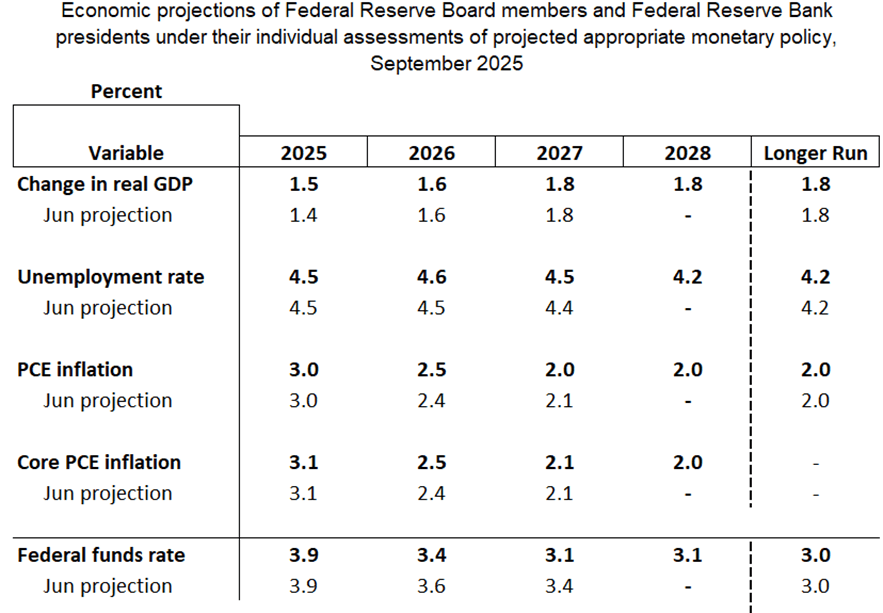
- The Federal Reserve is set to resume its easing cycle at the September 16-17 meeting with a 25bp cut to the funds rate range to 4.00-4.25%.
- The decision to cut after a 5-meeting pause was well-telegraphed by Chair Powell, whose Jackson Hole speech described a “shifting balance of risks” toward a weaker labor market that “may warrant adjusting our policy stance”.
- The updated quarterly projections aren’t likely to bring many changes to the macroeconomic variables, but as usual the signal sent from the Fed rate “Dot Plot” will garner attention. A Committee split between expecting one or two further cuts this year is likely, keeping each of the remaining meetings of 2025 “live”.
- The Statement will downgrade the description of the labor market to reflect a rise in the unemployment rate and poor payrolls growth, and is likely to include at least one dissent to the rate decision.
- But with a Committee that is fairly divided on the way forward, Powell will be noncommittal on future action, reiterating that policy is not on a preset course, and upcoming decisions will be data-dependent.
- A key undercurrent is an increasingly activist approach to Fed personnel management from the White House, which leaves the composition of the FOMC uncertain not just over the medium-term but also at this meeting.
MNI’s separate preview of sell-side analyst summaries to follow on Monday Sep 15
RATINGS: Fitch: France Cut To A+ From AA, Portugal Up To A From A-
Fitch has downgraded France's sovereign rating to A+ (with stable outlook) from AA-. Release here.
- Among other factors in the decision, Fitch cites "High and Rising Debt Ratio", "Political Fragmentation Hinders Consolidation", "Weak Fiscal Record", "High 2025 Deficit", "Uncertain Fiscal Consolidation Path", and "Fiscal Rigidities".
- In "Factors that Could, Individually or Collectively, Lead to Negative Rating Action/Downgrade", Fitch cites "Public Finances: A sustained increase in government debt/GDP over the medium term, due to failure to implement fiscal consolidation measures and/or a persistent increase in financing costs" and "Macro: Materially lower economic growth prospects and weakened competitiveness." Conversely, potentially leading to positive ratings action would be "Public Finances: Confidence that government debt/GDP will be put on a downward trajectory over the medium term, for example, due to fiscal consolidation and/or stronger economic growth".
- Fitch also raised Portugal to A (stable outlook) from A-, while elsewhere, S&P raised Spain to A+ (stable outlook) from A.
- As MNI wrote earlier, we expected France to be downgraded to A+ and Portugal to be upgraded to A.


