CANADA DATA: Payrolls Employment Sees Largest Drop In Nearly Two Years [1/2]
Nov-27 15:27
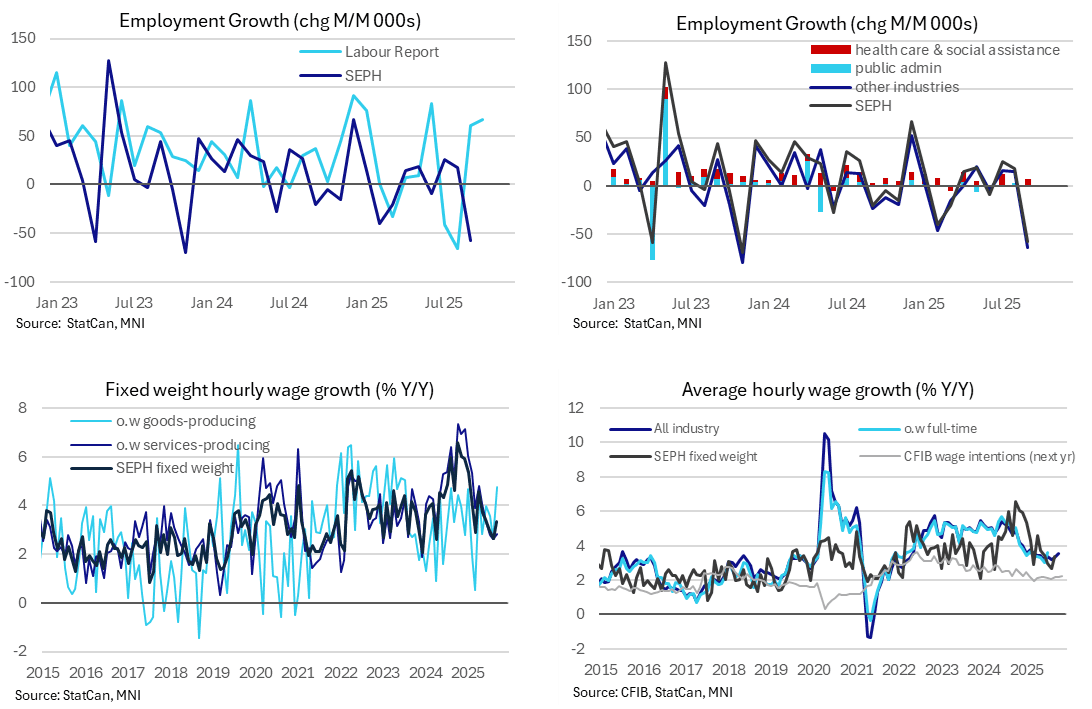
The SEPH report for September saw the heaviest monthly decline in payrolls in nearly two years, offering a more cautious take than recent strength in the more timely household survey measure of employment. That said, it’s unlikely on its own to have further altered the BoC’s view of a “soft” labour market ahead of the Dec 10 decision, where it’s firmly priced to remain on hold with rates seen “about right”.
- Payrolls fell -58k (sa) in September according to the SEPH report, with only a partially offsetting upward revision to 17.6k in Aug vs the 3k originally reported.
- The -58k more than reverses a two-month increase of 43.2k in Jul-Aug and sees its largest single monthly decline since Nov 2023.
- The press release notes widespread declines: “Monthly payroll employment declines were recorded in 11 of the 20 sectors, including educational services (-19,100; -1.3%), manufacturing (-9,600; -0.6%), professional, scientific and technical services (-6,400; -0.5%), real estate and rental and leasing (-5,400; -1.8%) and administrative and support, waste management and remediation services (-3,400; -0.4%).”
- “Health care and social assistance (+6,500; +0.3%) as well as arts, entertainment and recreation (+1,900; +0.6%) were the only sectors to record increases in September.”
- The payrolls data don’t directly tally with employment in the already published household survey, which saw a strong 67k in Oct after 60k in Sep, bouncing from two weak months including -66k in Aug.
- Payroll wage growth meanwhile continued its recent stabilization around the 3% Y/Y mark, with fixed weight average hourly wage growth at 3.3% Y/Y after a downward revised 2.7% (initially 3.0) in Aug and 3.0% in Jul. This measure ended 2024 at 5.9% Y/Y.
- Ahead the BoC decision on Dec 10, the report will likely have confirmed its view on the labour market from the October meeting: “Canada’s labour market remains soft. Employment gains in September followed two months of sizeable losses. Job losses continue to build in trade-sensitive sectors and hiring has been weak across the economy. The unemployment rate remained at 7.1% in September and wage growth has slowed. Slower population growth means fewer new jobs are needed to keep the employment rate steady.”
Want to read more?
Find more articles and bullets on these widgets:
Historical bullets
FED: US TSY 52W AUCTION: NON-COMP BIDS $825 MLN FROM $50.000 BLN TOTAL
Oct-28 15:15
- US TSY 52W AUCTION: NON-COMP BIDS $825 MLN FROM $50.000 BLN TOTAL
SONIA OPTIONS: Correction on the Large Sonia Condor
Oct-28 15:05
SFIZ5 96.30/96.20/96.15/96.05p condor, bought for 4 in 15k.
SONIA OPTIONS: Large Put Condor
Oct-28 15:04
BTC (26th Dec) 125.5k call, sold at 4495 in 100.


