MNI: RBNZ's Easing Likely Over With Next 25bp Cut - Fmr Staff

The Reserve Bank of New Zealand is likely to lower the Official Cash Rate by 25 basis points to 2.25% at its Nov 26 meeting, in line with market expectations, but further easing in 2026 would require a significant deterioration in the labour market and broader activity, former senior officials told MNI.
Leo Krippner, research fellow at Singapore Management University and a former RBNZ senior adviser, noted that Q3 data showed headline inflation hovering near the 3% upper end of the Bank’s 1-3% target band (See chart). “It doesn’t seem temporary. If you look at underlying or core measures, a lot are still between 2.5-3%. So there’s still a reasonable element of caution going forward, rather than just deciding more cuts are required,” Krippner noted.
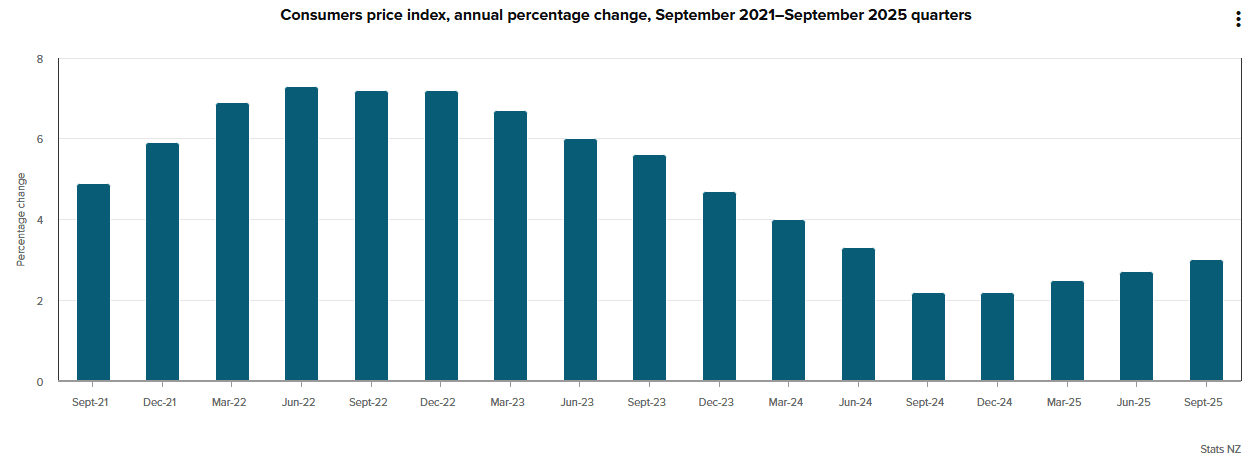
Strong soft commodity prices should drive a rebound in the agricultural sector next year, which would also decrease the Bank's willingness to ease further, he added. Markets have priced in a 2.09% rate by mid-2026.
“The agricultural sector is doing extremely well given the record prices… they’re going to be in a position to spend a bit more going into next year. Assuming the Fonterra sale of its dairy brands goes through, that will be another one-off injection into the agricultural economy, flowing through towns and cities.”
Michael Reddell, independent commentator and former RBNZ special adviser, also saw a 25bp move as most likely but did not rule out a larger cut. “You can’t rule out another 50bp, but it would be quite a big call, particularly when the Acting Governor [Christian Hawkesby] is going to then walk out the door,” he said, noting the Monetary Policy Committee may opt for a smaller move ahead of incoming Governor Anna Breman's start in December.
Reddell added that while Q3 core inflation appeared subdued, the headline measure could fall below the 2% midpoint next year as one-off factors unwind. “Core non-tradables like rent are almost zero on an annual basis, construction costs are weak, and there’s a lot of excess capacity," he said. A weaker exchange rate, however, could hold up headline inflation somewhat, he added.
NEUTRAL UNCERTAINTY
While the neutral rate remains uncertain, Reddell said the OCR was likely already below it. “Some people run a number nearer three. If that’s right, we’re already below neutral. Having done 150bp already, they’d need a stronger impulse for another 50bp.”
Krippner, who has argued the neutral rate may be above the RBNZ’s 2.5-3.5% estimate, said a smaller move now would allow the Bank to reassess in February when Breman delivers her first Monetary Policy Statement. (See MNI INTERVIEW: RBNZ's Neutral Estimate Too Low - Ex-Economist)
"At that same point, you'll get a little bit of the flavour of how the new governor will respond to the amount of easing that they will have put in place, assuming that they go the 25bp at their next meeting. That means they can afford to sit back and wait," he added.


