MNI POLICY: RBA Sees 3.6% As Still Likely Restrictive

The Reserve Bank of Australia’s 3.6% cash rate is likely still somewhat restrictive, despite a solid recent pickup in household and investor credit growth, MNI understands.
When nominal credit growth is viewed relative to household disposable income, the strength appears less pronounced, according to thinking at the RBA. While wages growth has picked up, this has occurred alongside strong population growth, which has itself lifted nominal credit growth.
Q2 data showed total new loan commitments for dwellings rose 1.9%, with investor loans up 1.4% to AUD32.9 billion and owner-occupier loans increasing 2.4% to AUD54.8 billion.
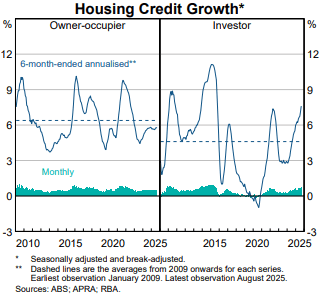
Since monetary policy began tightening in 2022, credit as a share of household income has declined – a trend even more evident when mortgage offset accounts are factored. Though funds in these accounts do not directly reduce debt, they lower mortgage costs and help households pay down loans faster.
As interest rates have risen, offset deposits have increased as borrowers react to the higher rates, suggesting tighter monetary conditions are continuing to weigh on household behaviour. Adjusted for offsets, housing credit as a share of disposable income is probably still edging lower.
This trend provides one lens through which the RBA assesses the degree of monetary restrictiveness, amid uncertainty surrounding estimates of the neutral rate, and aligns with Governor Michele Bullock’s comment following the Board’s September decision that the cash rate is probably still somewhat restrictive. (See MNI RBA WATCH: Bullock Declines To Confirm Easing Bias) Policymakers view the evolution of housing credit and credit-to-income ratios as key indicators of how tighter policy is transmitting through the economy.
Markets have priced in a 45% chance of a move lower at the Board's next meeting on Nov 4.


