MNI INTERVIEW: StatsCan Has Flash Trade Balance On Its Radar

Statistics Canada's trade division chief told MNI creating a flash merchandise trade balance is "on the radar" but there are challenges similar to its advance GDP figures and an extra barrier around waiting for data from customs agents.
The agency is bound to follow international standards when publishing data and it also wants to ensure figures don't need big revisions later, Christy Cheung said. Monthly trade figures also come from Canadian and U.S. customs officials rather than being gathered directly by StatsCan.
"It's on the radar. We just don't have anything concrete in the works right now," she said. "It's something that we understand is a priority. To have a faster release, or to use some of these real time methods, we need to make sure that they're sound."
Bank of Canada Deputy Sharon Kozicki said in a June 5 speech officials are using more real-time data on trucks and ships crossing the border. The central bank has reverted to scenarios rather than forecasts because of the uncertainty, and while investors agree the Bank will cut rates later this year they're divided on the pace because of different views of the economy's path.
The 35-day turnaround of Canada's trade balance after the end of a given month is already pretty fast, she said. StatsCan began publishing other flash figures like manufacturing and retail sales after the Covid pandemic took hold. For comparison, the latest advance retail number was for May and published June 20 alongside the official figure for April. (See: MNI INTERVIEW: StatsCan Likely Keeping Flash GDP Estimates)
DATA QUALITY
American economists are also concerned the Trump administration's budget cuts will compromise data, something Cheung at StatsCan hasn't witnessed. “We communicate very regularly with them. And up to this point, we've had no signal that there's a concern related to the quality coming in for our data,” she said. "Because we're relying on these customs agencies, if they have particular agreements to receive data, later timelines, we need to adhere to those."
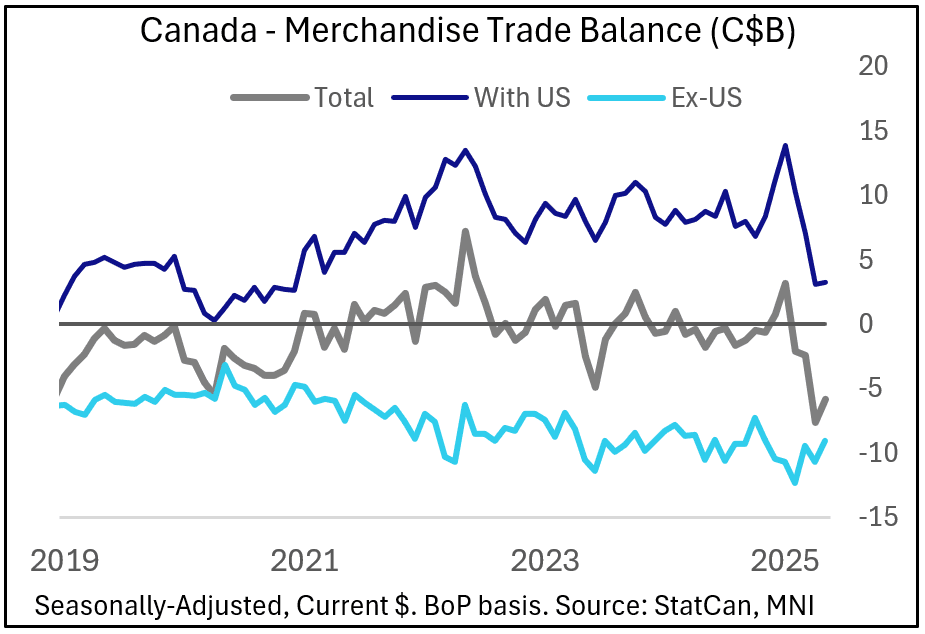
Canada's bilateral surplus with the U.S. reached a record high CAD13.9 billion in January on signs customers were stockpiling ahead of the trade war and has since dropped to CAD3.2 billion, dragging down Canada's global trade balance. The global trade deficit reached a record high CAD7.6 billion in April as U.S. tariffs took hold.
"I have to caveat that with the fact that there were other things going on in April too that I think we would definitely need to consider," besides U.S. tensions, Cheung said. "The dollar appreciated in April, which has sort of an effect of lowering the trade values. We've also had some lower crude oil prices and lower volumes."
May's trade deficit narrowed to CAD5.9 billion as exports outside the U.S. reached a record high. That's in line with some BOC signals the trade war isn't turning into a worst-case scenario.
After long-standing concerns Canada would never break a dependency on U.S. exports, the last report showed those shipments at a near-record low 68% of the total. That included volatile movements of gold but also evidence new oil and gas terminals are boosting overseas sales.
Even with uncertainty about some recent trends the trade war drag is clearly there, Cheung said. "With the record trade deficit in April, and how that corresponds with what's going on with our largest trading partner, you can sort of see that this is having a substantial impact."