MNI INTERVIEW: Spare Capacity Risks 2026 H2 RBA Hike - Fabo

The risk that the Reserve Bank of Australia will need to raise its cash rate from 3.6% in the second half of 2026 is increasing as the labour market tightens and businesses report shrinking spare capacity, a former senior RBA economist told MNI.
“Given firms are saying they've got less capacity in their business, the unemployment rate falls, so there’s a real risk that happens in coming months,” said Justin Fabo, founder of Antipodean Macro and the RBA’s former head of international financial markets.
“A hike is absolutely a risk next year. Obviously, there are a lot of moving parts here, but if the global backdrop holds up reasonably well, then yes absolutely there’s a risk of a hike creeping in. You can kind of see that financial markets are starting to toy with that a little bit.”
Stronger labour data saw markets unwind bets on further RBA easing next year, after unemployment fell 20 basis points to 4.3% in October.
Fabo, who correctly predicted higher Q3 inflation, said rising capacity utilisation has historically been a reliable leading indicator for the cash rate, noting September’s NAB Business Survey showed utilisation rising to its highest level since May 2024, signalling tighter labour conditions and upward pressure on inflation. (See MNI INTERVIEW: Stronger Q3 Inflation To Limit RBA Easing)
“If capacity use is going up, it’s usually telling you the economy is tightening. The unemployment rate typically falls not too long after, and then [the RBA] start tightening," he added, noting recent Reserve communications had talked about capacity utilisation recently. "Obviously, it still feels a bit half-hitched, but it’s certainly in the risk bucket for the next 12 months.”
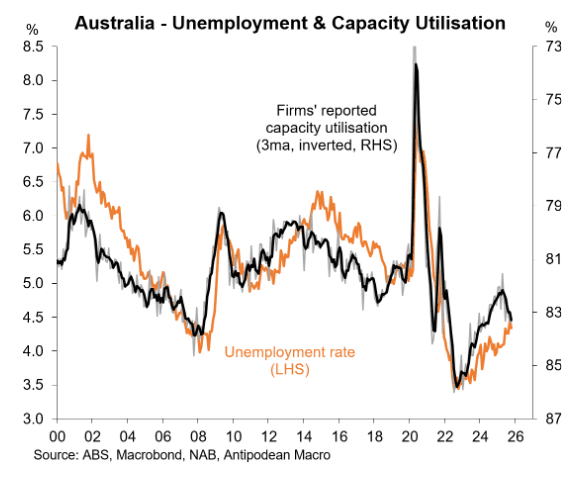
The higher capacity utilisation could give firms cover to raise prices, he added. "Do we have inflation going back to 2.5%? I highly doubt it. Why would we?” he said, pointing to the RBA's recent forecasts that had underlying inflation at 2.6% by the end of the projection period. (See MNI RBA WATCH: Bullock Strikes Cautious Tone Following Pause)
However, Fabo cautioned against over-interpreting a single print, particularly volatile monthly labour market data. “The RBA will assess a broad range of indicators to determine how restrictive the cash rate is and whether unemployment is near the NAIRU,” he said, characterising the Bank’s recent shift in tone, especially in the risk section of its latest statement, as “hawkish.”
NOT ENOUGH DAMAGE
Fabo said the RBA may ultimately have to tighten further because rates have not yet done enough to bring inflation down sustainably.
“To put it bluntly, they haven’t done enough damage to the economy to really get inflation down,” he said. “But we’re not alone, everyone’s finding this difficult. Even in countries where unemployment has risen a lot, most are still struggling to hit their inflation targets.”
Global factors now appear to dominate inflation dynamics more than domestic conditions, he added. “Look at New Zealand, their unemployment has jumped, wages growth is around 2%, and yet inflation has picked up again. It’s the same story in Canada. You’d think they’d be undershooting their targets by now, but they’re not.”


