MNI INTERVIEW: RBNZ's Conway Sees Lower OCR On Weak Growth

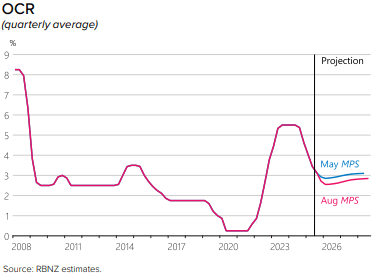
The Reserve Bank of New Zealand could lower the Official Cash Rate below the projected 2.5% level by March if global trade disputes slow economic growth more than expected, Chief Economist Paul Conway told MNI.
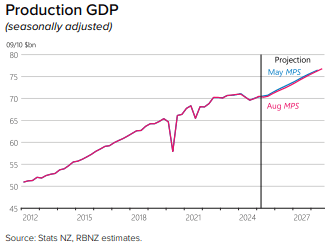
“Absolutely, that’s what the OCR’s for,” Conway said, following the Monetary Policy Committee’s decision this week to cut the rate 25 basis points to 3% and publish a dovish set of forecasts, including a 60bp downgrade to Q2 GDP growth expectations to -0.3%. (See MNI RBNZ WATCH: MPC Makes Dovish 25BP Cut, Eyes 2.5% OCR) “The OCR is a shock absorber. When the next shock affects us, we’ve got plenty of scope in the tank to stimulate this economy as it needs it. But we’re not forecasting that – we can’t predict shocks.”
Conway said the current OCR was neither restrictive nor stimulatory, sitting in the “neutral zone,” with the Bank keeping its neutral range estimate at 2.5-3.5%. While August’s Monetary Policy Statement revised growth lower, particularly for Q2, he argued the economy will recover, supported by the Bank’s more dovish rate track.
“If we hadn’t come out more assertively with interest rate cuts compared with May, the growth outlook might not be through the worst of it,” Conway said, pointing to the last set of forecasts which showed far more uncertainty and a 2.85% OCR track. (See MNI INTERVIEW: RBNZ's Uncertainty To Persist-Chief Economist) “We might get to 2.5%, but there’s a lot of economic water to flow under the OCR bridge between now and then. And if we do, that may well be stimulatory.”
He added that the weaker Q2 GDP forecast was largely due to the global trade shock, not restrictive monetary policy. “I do think this economy is going to climb out of its Q2 malaise, and I think the fact of the central bank cutting the OCR is one of the forces that’s going to help.”
FALLING UNCERTAINTY
Conway noted global uncertainty, while still high, had eased since Q2. The Bank still expects a 0.5% drop in global growth and weaker demand for New Zealand exports, but the outlook has not worsened since May, he added.
Global trade was also adapting, he said, with volumes holding up despite tariffs. “We’ve definitely seen trade rerouting through third countries to minimise the effect of tariffs. Global supply chains are still working pretty well. We’re not seeing any evidence of disruption, and we’re not seeing any impact on the prices for New Zealand’s exports and imports.”
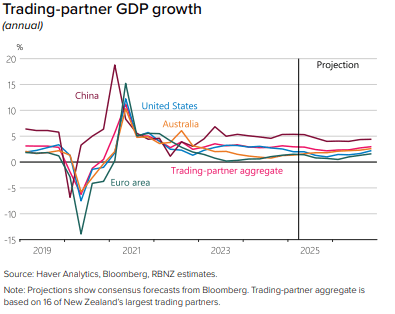
While risks remain, he said the impact of trade tensions was more likely to feed into deflationary pressures for New Zealand – another factor behind the Bank’s dovish stance.
“We are in economic recovery mode, and by that I mean the output gap is closing,” Conway said. Household spending and business investment are returning to normal after the Q2 trade-driven shock, while lower rates are supporting a pickup in activity. “The export industry is going well, but domestically-facing parts of the economy like retail and construction, less so. Longer term, it’s about productivity growth.”
While another bout of global uncertainty could hit, forecasts assume recent shocks will fade and momentum gradually return, he added. Looking ahead, Conway stressed that growth would be increasingly driven by domestic demand. “We see commodity prices as still being reasonable for kiwi exporters going forward. But we also see growth in the domestic economy. We’re not going to light the world on fire, but that’s growth – and that’s better.”