MNI EUROPEAN MARKETS ANALYSIS: US CPI Out Later
- The JGB yield rise remains in focus, as opinion polls point to the ruling coalition losing its majority at the up coming upper house elections. JGB futures are weaker, -13 compared to settlement levels, but ranges have been narrow. US Tsy yields have had a quiet session.
- The USD is down slightly versus the majors, while equity sentiment has been mixed. Buoyed in the tech space, as Nvidia announced it would resume sale of its H20 chip to China. Weaker property data though has weighed on real estate shares. China Q2 GDP was slightly above market forecasts.
- Looking ahead, the main focus will be on the US CPI print later.
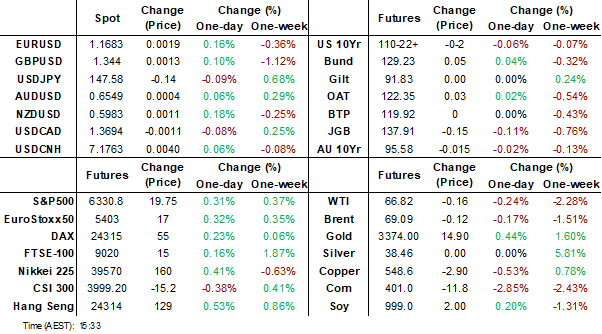
MARKETS
US TSYS: Asia Wrap - Quiet Session Looking Toward CPI
The TYU5 range has been 110-20+ to 110-25 during the Asia-Pacific session. It last changed hands at 110-23, down 0-01 from the previous close.
- The US 2-year yield is trading around 3.898%.
- The US 10-year yield is trading around 4.433%.
- The 10-year yield is again testing the 4.40/45% pivot within its wider 4.10% - 4.65% range. The market is clearly worried about inflation and the CPI this week will be a critical input into the market's thinking. A sustained close back above the 4.45% area could see more longs pared back, above here and the focus will turn back to the 4.65% area.
- Lance Roberts(RIA) - “Tuesday’s CPI and Wednesday’s PPI reports will be very helpful in appreciating how tariffs are impacting inflation. Thus far, there has been a negligible effect. However, the June reports will fully capture a period when the tariffs were being enforced. If data continues to be on the weak side, we suspect the Fed will become more dovish. However, higher-than-expected inflation data may allow them to continue to postpone rate cuts.”
- MNI US OUTLOOK/OPINION: Analysts See Core CPI On Cusp Of 0.2% or 0.3% M/M In June. Ahead of tomorrow’s US CPI release, we note that the broad Bloomberg consensus looks for both core and headline CPI inflation at 0.3% M/M in June although unrounded estimates suggest a risk of rounding lower.
JGBS: Bear-Steeper But Off Cheapest Levels
JGB futures are weaker, -13 compared to settlement levels, but ranges have been narrow.
- Today, the local calendar will be empty apart from 5-year Climate Transition supply.
- Cash US tsys are little changed in today’s Asia-Pac session. Focus is on today’s June CPI inflation data and several Fed speakers ahead of Friday evening's policy blackout.
- Cash JGBs are flat to 7bps cheaper across benchmarks, with a steeper curve. The benchmark 10-year yield is 0.7bp higher at 1.589% after revisiting the cycle high of 1.596% earlier in the session.
- As Japan's upper house elections approach (held July 20), focus remains on the relentless rise in longer-dated JGB yields. The 30-year is up 1bp at 3.182% after hitting 3.219%. This is a fresh high on record (since it was debuted in 1999, per BBG). Concerns around fiscal slippage are a factor in the JGB sell-off. The 2/30yr JGB curve is at +240bps, just off multi-decade highs.
- Swap rates are ~1bp higher to 1bp lower, with a flatter curve. Swap spreads are mostly tighter.
- Tomorrow, the local calendar will be empty.
JAPAN: Long Dated Yield Surge Continues, With Election Driving Uncertain Outlook
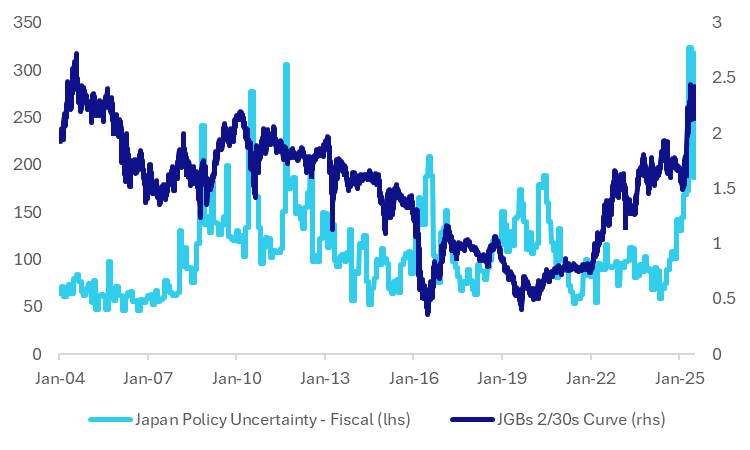
As Japan's upper house elections approach (held July 20), focus remains on the relentless rise in longer-dated JGB yields. The 30yr is up a further +4bps today, last around 3.21%. This is a fresh high on record (since it was debuted in 1999, per BBG). The 10yr JGB yield was last near 1.60% with the 20yr around 2.64%. Concerns around fiscal slippage is a factor in the JGB sell-off. The 2/30yr JGB curve is at +241bps, just off recent highs and near multi-decade highs
- The chart below plots the JGBs 2/30s curve against a policy uncertainty index, related to fiscal policy. June saw fiscal policy uncertainty edge down per this metric (which is a monthly indicator), but it remains elevated by historical standards. The index ticker on BBG is EPUCJNFP <Index>.
- To be sure, there are lots of episodes where the JGB curve has been steep, whilst fiscal policy uncertainty is low. However, at the moment, the correlations between the two series are running at close to 80% (using the last 12 months as a sample window).
- A number of onshore media outlet are reporting that the ruling coalition is at risk of losing its majority with the upper house elections, helping fuel fiscal policy uncertainty, but with a skew towards a stronger fiscal impulse going forward.
- Rtrs adds: "All three of the leading opposition parties espouse some form of consumption tax cuts, with the populist, right-wing Sanseito party proposing a phasing out of VAT altogether. The policy has gained sway with the public as well: a recent poll by the Asahi newspaper showed 68% of voters thought a sales tax cut was the best way to cushion the blow from rising living costs."
- It quotes analysis from Barclays: "Barclays calculates that the rise in 30yr yields currently factors in about a three percentage-point cut to Japan's 10% consumption tax rate. "Even if the ruling parties retain their majority in the upper house, they would still be unable to pass budget bills, including the upcoming supplementary budget, without the cooperation of the opposition parties."
- Japan PM Ishiba has favoured cash handouts to provide cost-of-living relief so far, but it remains to be seen if this is sustained post the election result.
- Note on July 23rd we have 40y debt auction, as potentially the first litmus test after the election result.
Fig 1: JGBs 2/30yr Curve & Fiscal Policy Uncertainty Index
Source: Bloomberg Finance L.P./MNI
JAPAN: 30yr JGB Yield Correlation With Other G7 Yields Elevated
Fiscal spending concerns are not just present in Japan, but in much of the G7 markets. Pressure points come from the recently passed US tax bill, whilst the UK government is grappling with how to balance spending priorities amid revenue constraints. Germany is also moving away from fiscal restraint, whilst broader EU trends are looking at increased defense spending as well.
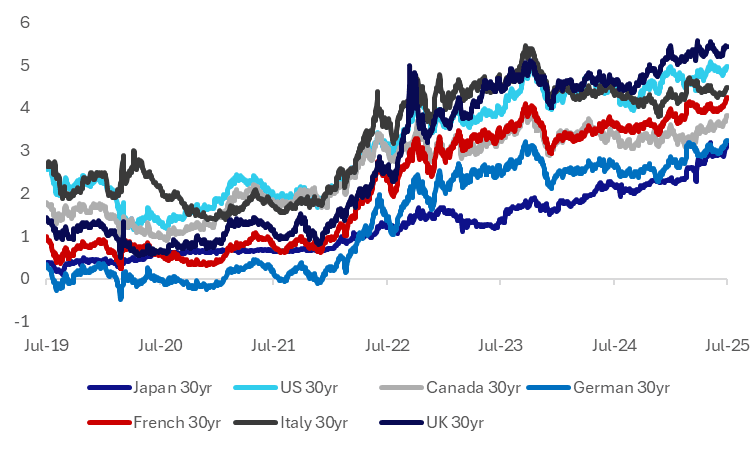
- The chart below plots the 30yr government bond yields for these economies. We have mostly been trending higher over the past 6-12 months. Japan, an historical laggard in this space, has now caught up with the level of German 30yr yield levels.
- The second chart presents the correlations between the 30yr JGB yield and those of the rest of the G7. The correlations are presented as a rolling 6 month window.
- Outside of JGB and Italian yields, the correlations have been trending higher of late and sit close to cyclical highs. This provides scope for spill over from high JGB yields and vice versa to Japan from other G7 markets.
Fig 1: G7 30yr Government Bond Yields
Source: Bloomberg Finance L.P./MNI
Fig 2: JGB 30yr Yield Correlations With Other 30yr G7 Yields
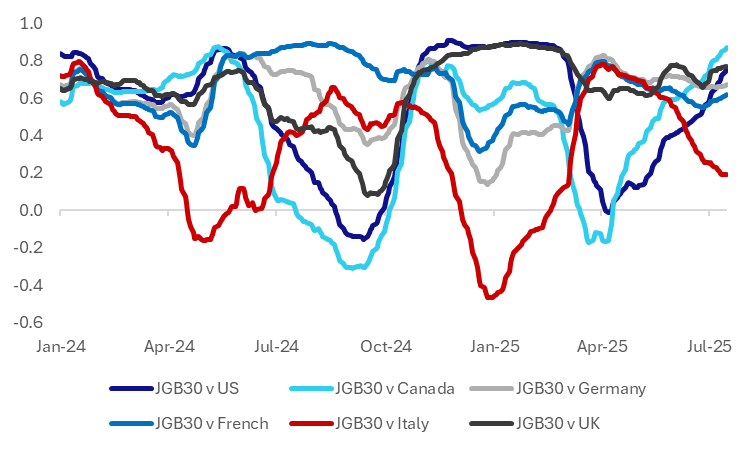
Fig 2: JGB 30yr Yield Correlations With Other 30yr G7 Yields
AUSSIE BONDS: Cheaper, US CPI Tonight, PM Talks On China Relations
ACGBs (YM -3.0 & XM -1.5) are modestly cheaper with narrow ranges.
- Prime Minister Anthony Albanese said Australia values its relationship with China and will approach it in a "calm and consistent" manner. Albanese told President Xi Jinping that "dialog needs to be at the centre of our relationship" and he welcomes the opportunity to set out Australia's views and interests. (per BBG)
- Ronald Mizez (AFR) on LinkedIn: The Commonwealth Bank has urged Jim Chalmers to consider major tax reform to revive productivity, including slashing income taxes, overhauling the GST, capping superannuation concessions and introducing wealth taxes.
- Cash US tsys are little changed ahead of today's US CPI data.
- Cash ACGBs are 2bps cheaper with the AU-US 10-year yield differential at -5bps.
- The bills strip weaker, with pricing -2 to -4.
- RBA-dated OIS pricing is firmer across meetings today. A 25bp rate cut in August is given an 88% probability, with a cumulative 56bps of easing priced by year-end.
- Tomorrow, the local calendar will be empty.
- The AOFM plans to sell A$800mn of the 4.25% 21 March 2036 bond tomorrow and A$1100mn of the 1.00% 21 November 2031 bond on Friday.
AUSTRALIA DATA: Westpac Consumer Sentiment Edges Up, RBA Pause Capped Move
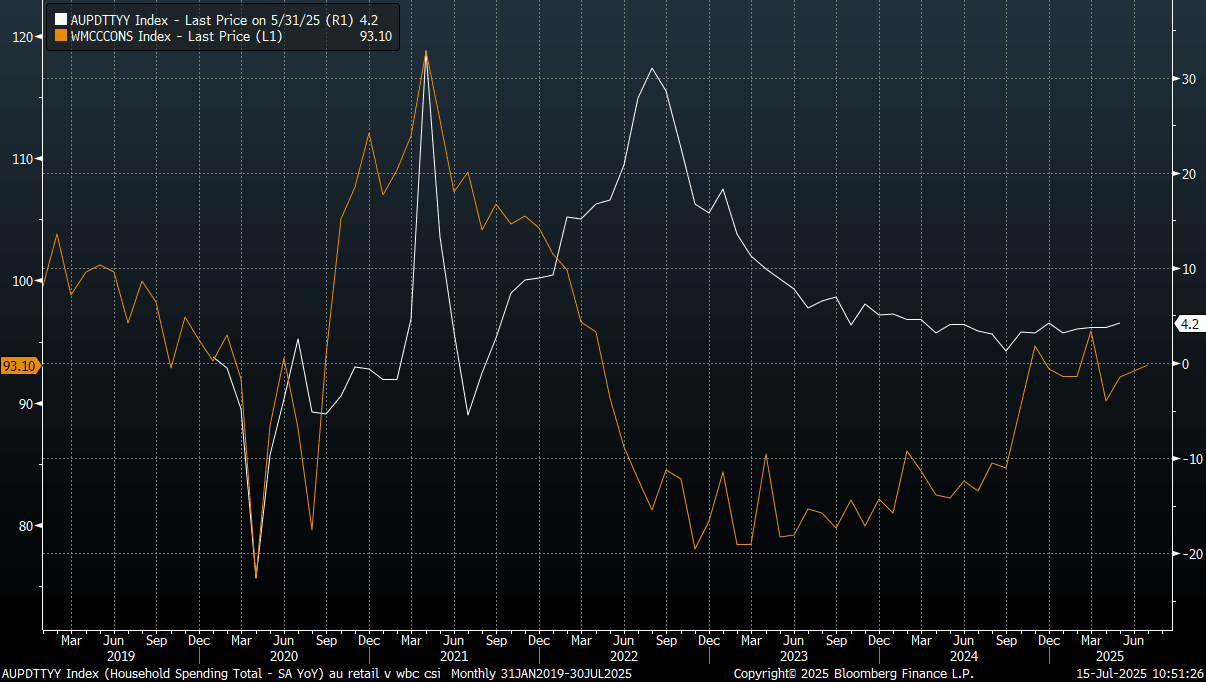
The July Westpac consumer confidence index rose 0.6%m/m, putting the index at 93.1 (from 92.6 in June). The edge higher comes despite last week's surprise RBA on hold decision. The chart below plots the CSI (the orange line) against household y/y spending outcomes. Sentiment is up from recent lows, but still below recent highs, leaving us within recent ranges.
- In terms of the CSI sub-indices, the time to buy a major household item fell by 2.6% (after gaining 7.5% in June). The buy a dwelling question fell by 5.1% (after a 3.6% gain in June). Family finances improved from a year ago and for the year ahead.
- Westpac noted: "Australia’s consumer sentiment recovery experienced another ‘false start’ in July. While the mood improved a touch for the month as a whole, responses over the survey week show a clear disappointment following the RBA’s surprise move to leave rates on hold at its July meeting. Those surveyed before the decision was announced reported an index read of 95.6 while those surveyed after reported an index read of 92. The reaction checked what would probably have been a solid rise."
Fig 1: Westpac Consumer Sentiment & Household Spend Y/Y
Source: Bloomberg Finance L.P./Westpac/MNI
BONDS: NZGBS: Closed With A Modest Bear-Steepener
NZGBs closed showing a modest bear-steepener, with benchmark yields 1-2bps higher. Ranges were narrow. The NZ-US 10-year yield differential is unchanged on the day at +15bps.
- Cash US tsys are little changed ahead of today’s US CPI data.
- “We expect an ageing population to put downward pressure on the neutral interest rate, but other factors may offset its impact,” the RBNZ said in a report published Tuesday in Wellington. Any impacts are likely to be gradual over decades, it said.” (per BBG)
- Swap rates closed 1bp higher.
- RBNZ dated OIS pricing closed little changed across meetings. 19bps of easing is priced for August, with a cumulative 33bps by November 2025.
- Tomorrow, the local calendar will see Non-Resident Bond Holdings data.
- On Thursday, the NZ Treasury plans to sell NZ$200mn of the 4.50% May-30 bond, NZ$200mn of the 4.25% May-36 bond and NZ$50mn of the 1.75% May-41 bond.
FOREX: Asia FX Wrap - BBDXY Consolidates Above 1200, Focus Turns To US CPI
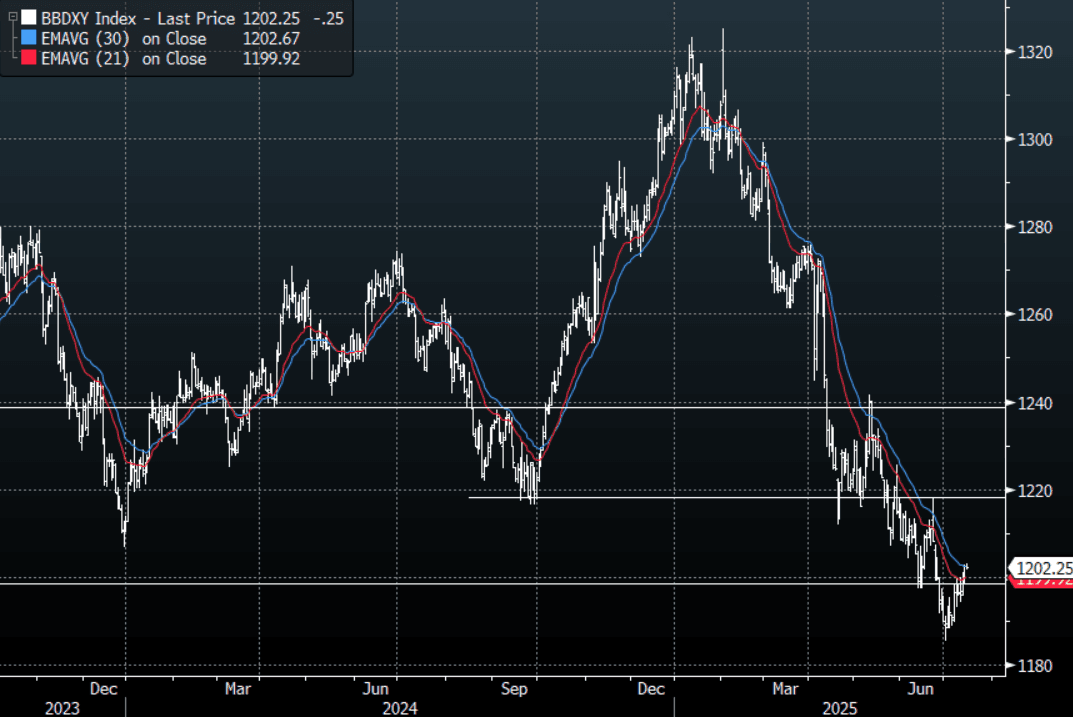
The BBDXY has had a range of 1201.78 - 1203.10 in the Asia-Pac session, it is currently trading around 1202, -0.02%. The BBDXY is consolidating its gains above the 1200 area as it awaits US CPI tonight. On the way down the BBDXY has been heavily sold every time it has challenged the 30 EMA on the Daily(See Chart Below), will the sellers again use this area to reload shorts or can the USD finally initiate some sort of a correction. CHINA GDP in Line with Targets: China's second quarter GDP YoY printed slightly above estimates at +5.2%, but down from first quarter result of +5.4%. The second quarter result keeps GDP on track with the recently announced growth target of "around 5 percent" for 2025, the same as their 2024 target.
- EUR/USD - Asian range 1.1661 - 1.1678, Asia is currently trading 1.1675. The pair continues to see some demand towards the 1.1650 area. The price is still starting to look a little stretched in the short term and is vulnerable to any correction in the USD, first support is back towards 1.1600 then more importantly the 1.1450 area.
- GBP/USD - Asian range 1.3422 - 1.3441, Asia is currently dealing around 1.3430. Price has rejected the move higher and Bailey’s hint that bigger rate cuts are on their way if the job market deteriorates further has added further headwinds. Support seen around the 1.3350/1.3450 area, a close back below here could signal an even deeper correction.
- USD/CNH - Asian range 7.1689 - 7.1785, the USD/CNY fix printed 7.1491, Asia is currently dealing around 7.1780. Sellers should be around on bounces while price holds below the 7.2500 area and the PBOC manages the fix lower.
- Cross asset : SPX -0.25%, Gold $3355, US 10-Year 4.33%, BBDXY 1195, Crude oil $65.67
- Data/Events : Germany ZEW Survey, EZ Zew Survey & Industrial Production, Spain CPI
Fig 1: BBDXY Spot Daily Chart
Source: MNI - Market News/Bloomberg Finance L.P
JPY: Asia Wrap - USD/JPY Consolidates Ahead Of US CPI
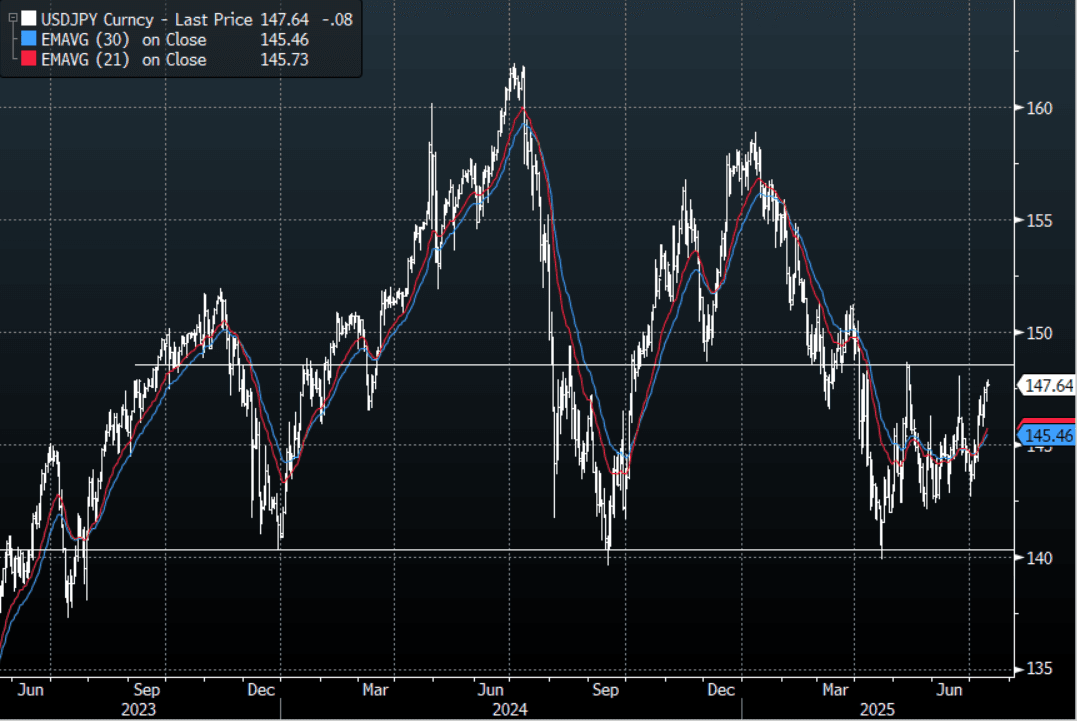
The Asia-Pac USD/JPY range has been 147.56 - 147.89, Asia is currently trading around 147.65, -0.05%. The pair has traded sideways with little direction, consolidating its recent move higher. The USD/JPY relentless march higher has been pretty telling, challenging a market positioned the wrong way. Price is now consolidating some of those recent gains, dips back towards 146.00 should now find support first up. The US CPI tonight will be closely watched by the bond market and consequently will also be important for USD/JPY.
- JAPAN Long Dated Yield Surge Continues, With Election Driving Uncertain Outlook: As Japan's upper house elections approach (held July 20), focus remains on the relentless rise in longer-dated JGB yields. The 30yr is up a further +4bps today, last around 3.21%. Concerns around fiscal slippage is a factor in the JGB sell-off.
- Reuters : "Barclays calculates that the rise in 30yr yields currently factors in about a three percentage-point cut to Japan's 10% consumption tax rate. "Even if the ruling parties retain their majority in the upper house, they would still be unable to pass budget bills, including the upcoming supplementary budget, without the cooperation of the opposition parties."
- "JAPAN, EU TO ISSUE JOINT STATEMENT ON ECONOMIC ALLIANCE:YOMIURI" - BBG
- "JAPAN RULING BLOC MAY STRUGGLE FOR MAJORITY: MAINICHI ANALYSIS" - BBG
- USD/JPY has lost all downside momentum for now and is back in its wider 142.00 - 148.00 range. The Market is long JPY and should the USD manage to continue to correct higher the risk is a move back to the top end of the range to further challenge the conviction of the shorts.
- Options : Close significant option expiries for NY cut, based on DTCC data: none. Upcoming Close Strikes : 146.50($1.4b July 16).
- CFTC data shows Asset managers reduced their JPY longs slightly +89331, while leveraged funds have almost squared their newly built JPY longs +5224.
- Data/Event : US CPI
Fig 1 : USD/JPY Spot Daily Chart
Source: MNI - Market News/Bloomberg Finance L.P
AUD: Asia Wrap - AUD/USD Middle Of The Range, Awaits US CPI
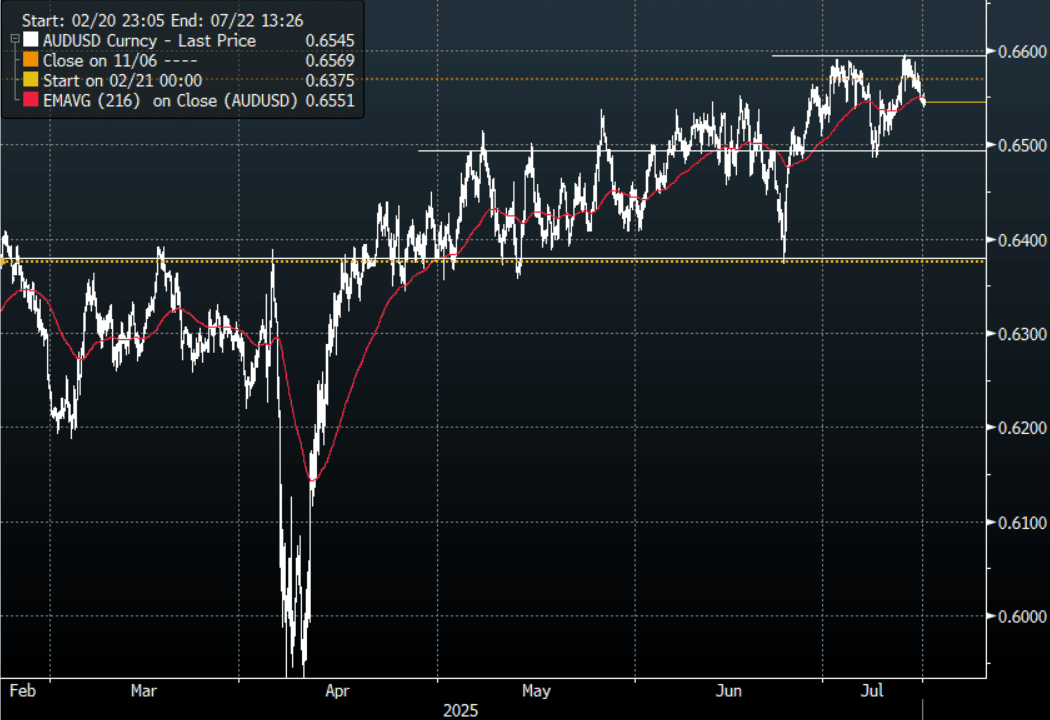
The AUD/USD has had a range of 0.6539 - 0.6555 in the Asia- Pac session, it is currently trading around 0.6545, +0.01%. Risk got a boost this morning as Nvidia posted on a blog that they had received assurances from the US Government that it would be granted licenses to resume sales of its H20 to China. AUD/USD initially tried to bounce on this but has not followed through, it trades in the middle of its recent 0.6500 - 0.6600 range awaiting US CPI tonight.
- Ronald Mizez(AFR) on LinkedIn: The Commonwealth Bank has urged Jim Chalmers to consider major tax reform to revive productivity, including slashing income taxes, overhauling the GST, capping superannuation concessions and introducing wealth taxes.
- The July Westpac consumer confidence index rose 0.6%m/m, putting the index at 93.1 (from 92.6 in June). The edge higher comes despite last week's surprise RBA on hold decision. Sentiment is up from recent lows, but still below recent highs, leaving us within recent ranges.
- The AUD/USD continues to hold above its support around 0.6500, looks like it's back to the 0.6500 - 0.6600 range and it should now take its cues from the USD. Watching to see if the market can build on this outperformance and break above 0.6600.
- Options : Closest significant option expiries for NY cut, based on DTCC data: 0.6560(AUD631m), 0.6495(AUD611m),. Upcoming Close Strikes : 0.6575(AUD609m July 16), 0.6480(AUD586m July18), 0.6700(AUD611m July 16).
- CFTC Data shows Asset managers added to their shorts slightly -38252, the Leveraged community pared back their shorts to -19061.
- AUD/JPY - Today's range 96.55 - 96.86, it is trading currently around 96.65, -0.20%. The pair has had a good move above 96.00 and this time looks to be building momentum to extend higher. The market has been caught wrong-footed in both legs of this pair and price action suggests a potential move back to 99.00/100.00. Dips back to 95.50/96.00 should now be supported.
Fig 1: AUD/USD spot Hourly Chart
Source: MNI - Market News/Bloomberg Finance L.P
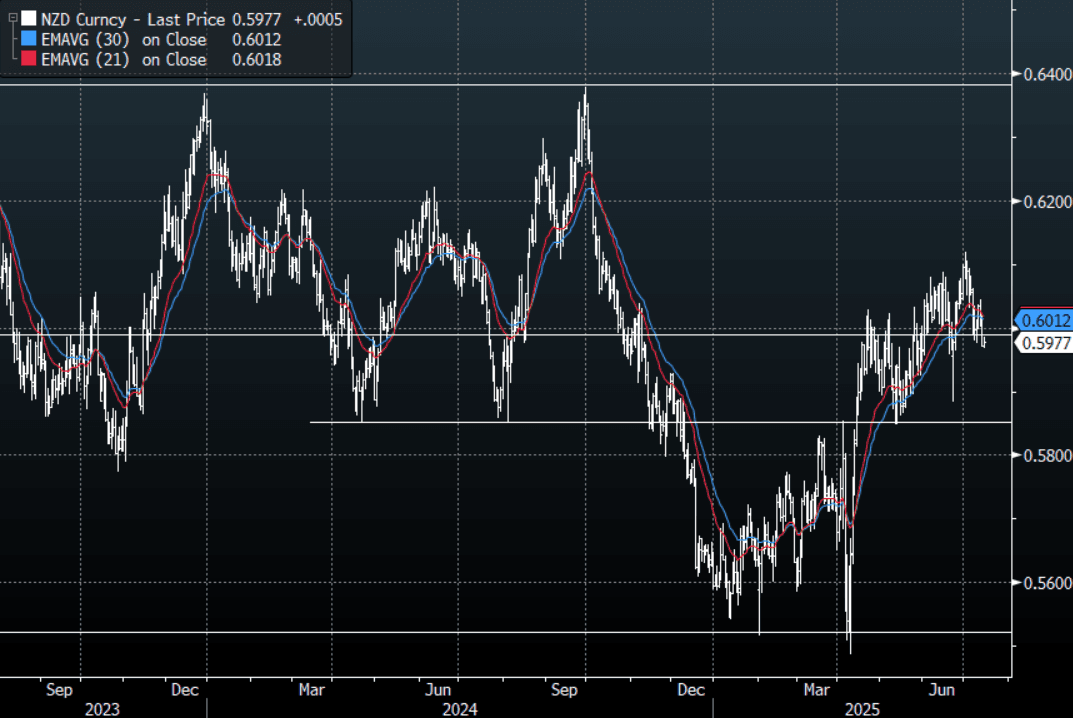
NZD: Asia Wrap - NZD/USD Probing Support Around 0.5980
The NZD/USD had a range of 0.5968 - 0.5986 in the Asia-Pac session, going into the London open trading around 0.5975, +0.08%. Risk got a boost this morning as Nvidia posted on a blog that they had received assurances from the US Government that it would be granted licenses to resume sales of its H20 to China. NZD/USD is again probing its support just below 0.6000, lets see if it can follow through. A break below this support and the market would potentially move back towards the 0.5850/0.5900 area.
- Bloomberg - “Nvidia Corp. plans to resume sales of its H20 artificial intelligence accelerator to China, after it received assurances from the US government that it would be granted licenses, the company said in a blog post.”
- Options : Closest significant option expiries for NY cut, based on DTCC data: none. Upcoming Close Strikes : 0.5932(NZD317m July18).
- CFTC Data shows Asset Managers added slightly to their newly built longs in NZD +9229, the Leveraged community added slightly to their shorts last week -8654.
- AUD/NZD range for the session has been 1.0945 - 1.0967, currently trading 1.0950. The cross has broken out of its recent range and is now trying to push through the more pivotal 1.0950 area. Dips back to 1.0850/1.0900 should now be supported as the pair tries to build momentum to move higher.
Fig 1: NZD/USD Spot Daily Chart
Source: MNI - Market News/Bloomberg Finance L.P
ASIA STOCKS: Early China/HK Gains Not Sustained, China Property Falls
Sentiment in the tech space was buoyed by early headlines that chip/AI bellwether Nvidia would resume sale of its H20 chip to China (with US government approval). US equity futures rose, led by the Nasdaq (last up around 0.35%), while Hong Kong and China tech sensitive plays were also higher. However, as the afternoon session has progressed, we have moved away from these best levels.
- In China, the aggregate CSI 300 index was up 0.60% at one stage, but at the lunchtime break is now -0.50% weaker. The Shanghai Composite is down 0.93%. Outside of the tech news, we also had Q2 GDP print, which was slightly better than forecast (y/y growth holding above 5%). Monthly June activity data saw Industrial production beat, but retail sales, fixed asset investment and property indicators were weaker. Home prices also fell more than in May.
- The CSI 300 real estate index is down 2% at the break. Headlines "CHINA'S URBANISATION IS TRANSITIONING FROM HIGH-SPEED GROWTH TO STEADY DEVELOPMENT- XINHUA" RTRS, crossed a short while ago, which has likely dampened speculation of sharp policy shift in this space (like we saw in 2015 and which was also speculated on late last week). China's Vanke also reported a first half loss.
- In Hong Kong the HSI is still up 0.20%, but is also well off earlier highs. The tech sub is +0.41% at the break, but was much higher in earlier trade.
- Elsewhere, Japan markets are little changed, while the Kospi has ticked down, struggling to hold above 3200 in index terms. The Taiex is up around 0.80% and one of the better performers on the day.
- In SEA trends are fairly modest, with Philippines and Malaysia, but Thailand and Indonesia a touch higher.
ASIA STOCKS: Recent Positive Inflow Momentum Stalls (Ex South Korea)
The start of the week saw positive inflow momentum into South Korea and Thailand, but mostly softer trends elsewhere. South Korea's Kospi continues to rally, testing through 3200, amid bullish sell-side optimism (on reform hopes and earnings). This is likely aiding a return of offshore inflows, although year to date flows remain firmly in negative territory, so there is still scope for catch up.
- Taiwan saw net outflows yesterday, trimming net inflows seen in the past 5 trading sessions. At the end of last week, India saw sharp outflows, the largest since the end of May.
- Offshore investors returned to net selling Indonesian stocks yesterday, a consistent theme since the start of July.
- The rebound in the SET Thailand index (which gained a further +2% yesterday) is drawing in flows, with month to date offshore buying now back into positive territory.
Table 1: Asian Markets Net Equity Flows
| Yesterday | Past 5 Trading Days | 2025 To Date | |
| South Korea (USDmn) | 160 | 843 | -8340 |
| Taiwan (USDmn) | -163 | 1121 | -2104 |
| India (USDmn)* | -524 | 9 | -8328 |
| Indonesia (USDmn) | -70 | -148 | -3571 |
| Thailand (USDmn) | 42 | 115 | -2323 |
| Malaysia (USDmn) | 0 | -57 | -2793 |
| Philippines (USDmn) | 11 | -5 | -551 |
| Total (USDmn) | -542 | 1877 | -28011 |
| * Data Up To July 11 |
Source: Bloomberg Finance L.P./MNI
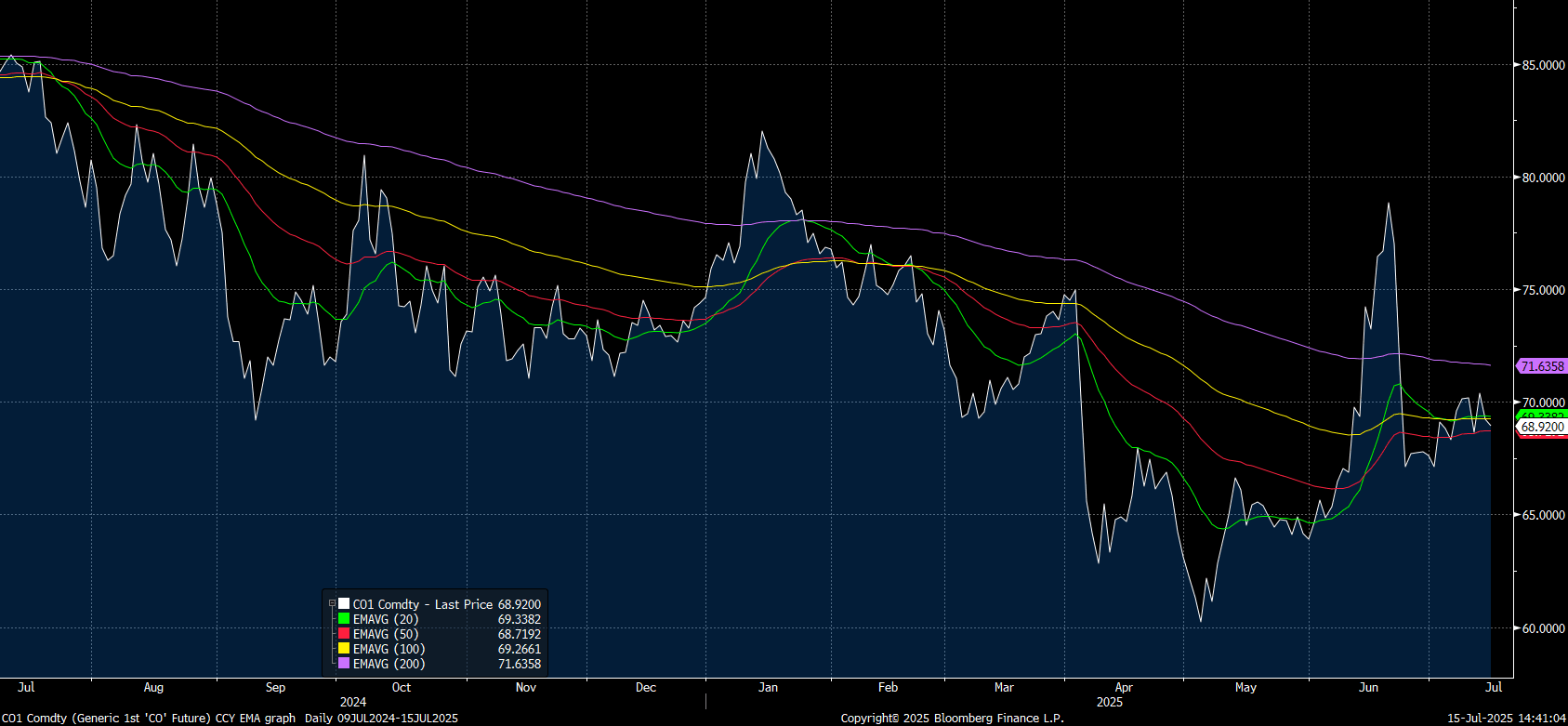
Oil Drops Further as US Pressures Russia
- Oil prices declined Tuesday in the Asia trading day with focus being on President Trumps plan to pressure Russia.
- Trump has floated potential for tariffs on Russia's energy exports, a move that could interrupt supply.
- Despite this, oil fell further today following on from yesterday's significant falls.
- WTI is down -0.36 at US$66.62 bbl
Brent is down -0.28 at US$68.93 bbl and is at the mid-point between the 100-day EMA of $69.26 and the 50-day EMA of $68.71.
source: Bloomberg Finance LP / MNI
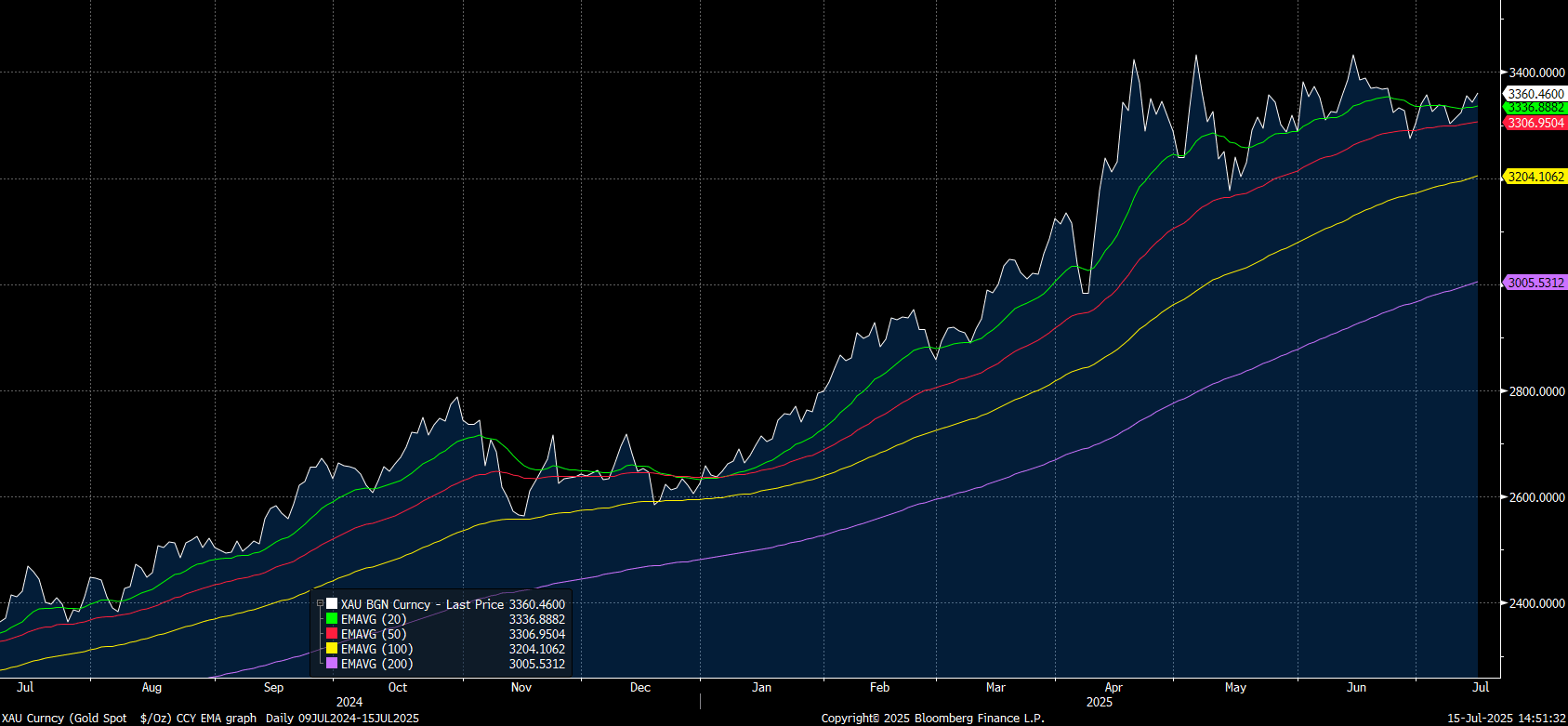
Gold Pares Back Yesterday's Losses
- As President Trump takes aim at Russia, global risk sentiment is challenged.
- This has given gold a boost and it has rallied today in the Asia trading day to take back yesterday's losses.
- At US$3,360.48 gold is not far from its early June year highs and remains in a strong technical position with all major moving averages modestly upward sloping.
Gold sits above all major moving averages, the nearest being the 20-day EMA of $3,336.90.
source: Bloomberg Finance LP / MNI
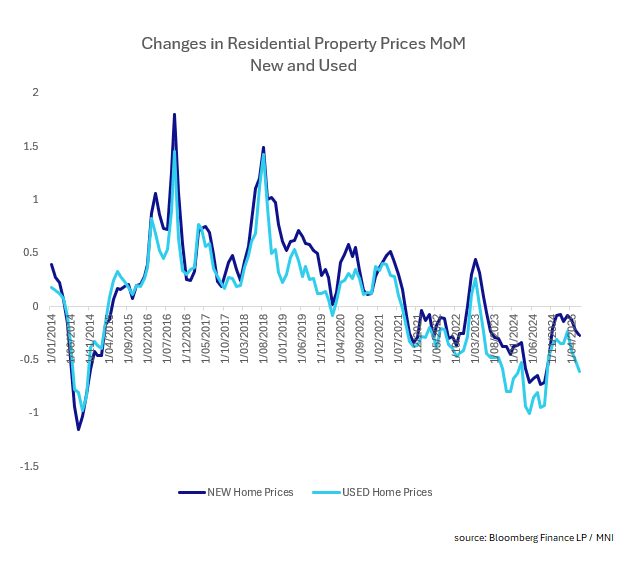
CHINA: House Prices Decline Further in June
- For the third successive month, new home prices in China declined further than the month prior.
- June's result saw a decline in -0.27, the worst result since October 2024.
- The year on year result was marginally better than the month prior with declines of -3.69% (vs -4.08% in May.)
- New home prices did rise in 14 cities (vs 13 in May) MoM and 3 cities YoY.
- Beijing declined -0.3% MoM and -4.1% YoY whilst Shanghai rose +0.4% MoM and +6% YoY.
- Used home prices declined -0.61% MoM versus -0.50% in May for the worst result since September 2024.
- Used home prices were lower -6.09% YoY (vs -6.30% in May) and the MoM figure saw rises in just one city with both Beijing and Shanghai recording modest MoM declines.
CHINA: GDP in Line with Targets
- China's second quarter GDP YoY printed slightly above estimates at +5.2%, but down from first quarter result of +5.4%.
- The second quarter result keeps GDP on track with the recently announced growth target of "around 5 percent" for 2025, the same as their 2024 target.
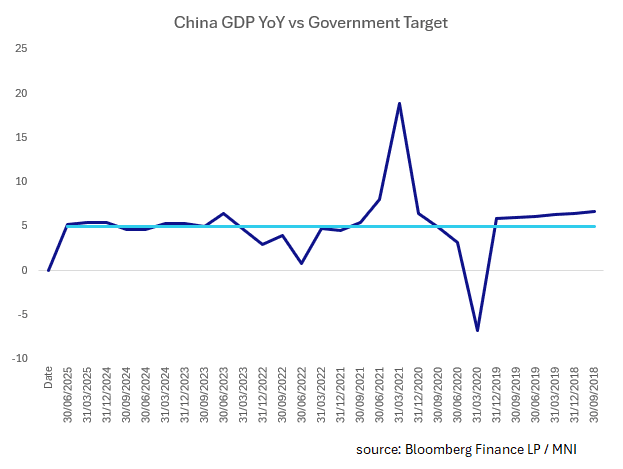
- The seasonally adjusted quarter on quarter result was also higher than expected, rising +1.1%, from +1.2% in Q1.
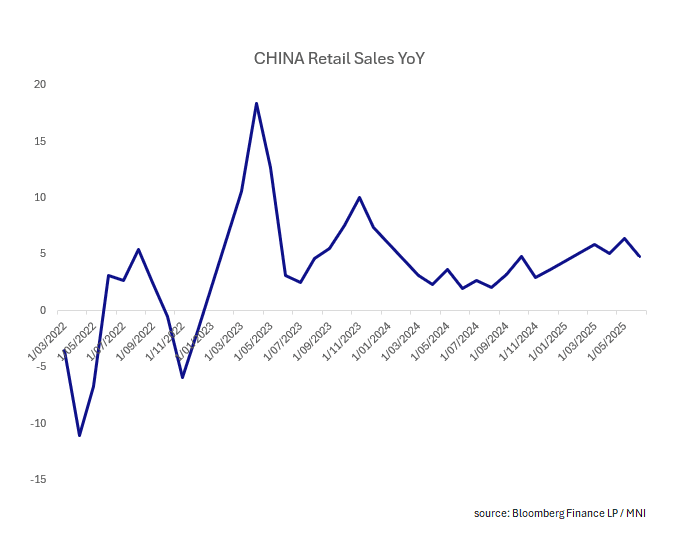
- Retail sales for June were softer at +4.8% (from +6.4% in May) but remain firmly above the 3-year average of 3.5%
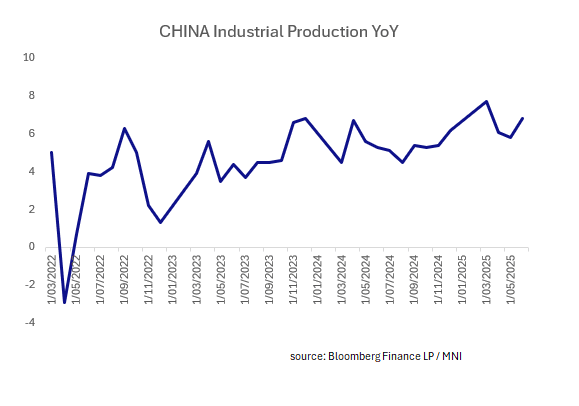
- Industrial production jumped by +6.8% from +5.8%, potentially pointing to benefits from the agreement with the US on tariffs with Manufacturing seeing the biggest rise, up +7.4%, having declined in May.
MNI BI Preview - July 2025: No Change in a Close Call
Download Full Report Here:
We see the BI on hold in what is a close call given:
- The stability of the Rupiah.
- The success of monetary policy operations delivering lower IndONIA and bond yields.
- Inflation remains subdued but no showing signs of stabilizing.
- Global uncertainty remains, particularly around tariffs.
ASIA FX: USD/CNH Supported On Dips As Equities Weaken, TWD Lower
In North East Asia FX markets, FX trends are little changed for CNH and KRW, while TWD has weakened further. HKD remains close to the top end of the peg band (near 7.8500).
- USD/CNH saw a brief dip sub 7.1700, but has rebounded this afternoon, last near 7.1775. this leaves us within recent ranges. We saw early positive equity sentiment as Nvidia stated it will resume H20 chip sales to China, but property related indices have weakened. We saw home prices fall accelerate, while activity measures also remained weak. Q2 GDP was better than forecast, with IP growth accelerating further, but retail sales missed. This doesn't point to much rebalancing of growth away from the manufacturing side. The Urban Work Conference also pointed to urban development shifting from large-scale expansion to improving existing resources. This doesn't suggest a return to the 2015 policy of urban development, which had been speculated late last week.
- Spot USD/KRW sits little changed, last around the 1383 level. Earlier highs in the pair were at 1385.7. The onshore equity rally has paused somewhat, unable to hold above 3200 at this stage.
- USD/TWD is pushing higher, last around +0.20% above end Monday levels, putting the pair back close to 29.35. Local equities are higher, with the Nvidia news, likely providing positive spill over. Still, this is a seasonal weak period for TWD, amidst dividend outflows. We are now just above the 20-day EMA resistance point.
UP TODAY (TIMES GMT/LOCAL)
| Date | GMT/Local | Impact | Country | Event |
| 15/07/2025 | 0700/0900 | *** |  ES ES | HICP (f) |
| 15/07/2025 | 0900/1100 | ** |  EU EU | Industrial Production |
| 15/07/2025 | 0900/1100 | *** |  DE DE | ZEW Current Expectations Index |
| 15/07/2025 | 1230/0830 | *** |  CA CA | CPI |
| 15/07/2025 | 1230/0830 | ** | CA | Monthly Survey of Manufacturing |
| 15/07/2025 | 1230/0830 | ** |  US US | Empire State Manufacturing Survey |
| 15/07/2025 | 1230/0830 | *** | US | CPI |
| 15/07/2025 | 1230/0830 | *** | US | CPI |
| 15/07/2025 | 1230/0830 | *** | US | CPI |
| 15/07/2025 | 1255/0855 | ** | US | Redbook Retail Sales Index |
| 15/07/2025 | 1300/0900 | * | CA | CREA Existing Home Sales |
| 15/07/2025 | 1315/0915 | US | Fed Vice Chair Michelle Bowman | |
| 15/07/2025 | 1645/1245 | US | Fed Governor Michael Barr | |
| 15/07/2025 | 1845/1445 | US | Boston Fed's Susan Collins | |
| 15/07/2025 | 2000/2100 |  GB GB | Mansion House: Chancellor Reeves and BOE Bailey | |
| 15/07/2025 | 2345/1945 | US | Dallas Fed's Lorie Logan | |
| 16/07/2025 | 0600/0700 | *** | GB | Consumer inflation report |
| 16/07/2025 | 0800/1000 | *** |  IT IT | HICP (f) |
| 16/07/2025 | 0900/1100 | * | EU | Trade Balance |
| 16/07/2025 | 1100/0700 | ** | US | MBA Weekly Applications Index |
| 16/07/2025 | 1215/0815 | ** | CA | CMHC Housing Starts |
| 16/07/2025 | 1230/0830 | *** | US | PPI |
| 16/07/2025 | 1315/0915 | *** | US | Industrial Production |
| 16/07/2025 | 1315/0915 | US | Cleveland Fed's Beth Hammack |


