MNI EUROPEAN MARKETS ANALYSIS: US-China Talks To Continue
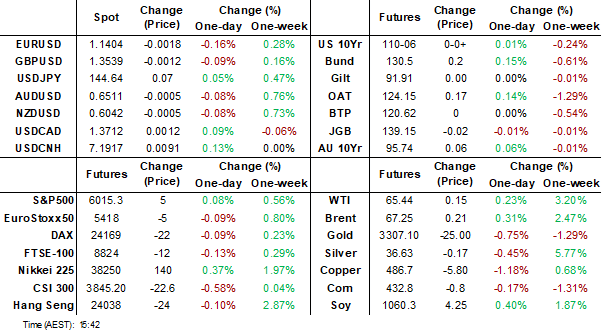
- Risk appetite has softened as we approach the Asia Pac/London cross over. The move started in China/Hong equities, with no obvious headline driver. This comes ahead of day 2 of US-China trade talks in London.
- Broader macro moves have been fairly modest, the USD higher following an earlier US equity futures bounce, but follow through has been limited. US Tsy yields are down a touch.
- BoJ Governor Ueda has been before parliament, answering questions from lawmakers. The Governor noted limited policy space on the downside, given the current 0.50% policy rate.
- Later US May NFIB small business optimism and UK April/May labour market data are released. ECB’s Donnery and Buch appear. The focus remains on Wednesday’s May US CPI data but also Thursday’s US long-dated Treasury auction given fiscal concerns.
MARKETS
US TSYS: Asia Wrap - A Quiet Session, Focus On Upcoming CPI
The TYU5 range has been 110-02 to 110-07 during the Asia-Pacific session. It last changed hands at 110-04, down 0-01 from the previous close.
- The US 2-year yield is unchanged, dealing around 4.0075%.
- The US 10-year yield has edged higher, trading around 4.48%, up 0.1 from its close.
- Bloomberg - “Negotiations in London wrapped on Monday with an extension of the talks into a second day, offering little lifeline to the struggling greenback. US Commerce Secretary Howard Lutnick called the discussions “fruitful,” while Treasury Secretary Scott Bessent described it as a “good meeting.”
- Bloomberg - “Senator Ted Cruz has proposed eliminating the interest paid to banks that deposit cash at the Federal Reserve, which could save the government around $1 trillion over a decade.”
- “JPMorgan strategists warn that this move could significantly impact banks' profitability, liquidity management strategies, and short-term interest rates, and risk the Fed losing control of money market rates.”
- The 10-year yield held its support around the 4.35% area last week. While this level holds focus will remain on potentially extending higher, CPI tomorrow will be a very important input.
- Data/Events: NFIB Small Business Optimism
JGBS: Twist-Flattener, Kato: Seeks More JGB Holding By Domestics
JGB futures are weaker and at Tokyo session lows, -12 compared to settlement levels.
- BoJ Governor Ueda has been before parliament, answering questions from lawmakers. The Governor noted limited policy space on the downside, given the current 0.50% policy rate. This is if fresh stimulus is needed. The real rate is being kept sub-0% to stimulate the economy further, as Ueda states that Japan is still some distance from the 2% inflation objective. Ueda reiterated that they will raise rates if they have confidence in achieving the 2% target.
- " Kato: Seeking more JGB holdings by domestic investors, will make efforts toward appropriate JGB management. Crucial to seek JGB holdings by diverse groups." – BBG
- The broader implications of greater domestic participation in JGBs may mean less outbound investment in overseas bonds (and potential equities). This could have implications for offshore debt markets.
- Cash US tsys are ~1bp cheaper in today's Asia-Pac session after yesterday's modest rally.
- Cash JGBs have twist-flattened across benchmarks, with the 7-year yield 2bps higher and the 30-year yield 1bp lower. The benchmark 10-year yield is 0.9bp higher at 1.477% versus the cycle high of 1.596%.
- Swap rates are flat to 5bps higher, with the curve steeper. Swap spreads are wider.
- Tomorrow, the local calendar will see PPI data.
JAPAN: Outbound Bond Investment Steady In Recent Years, Stock Still Large
Earlier headlines crossed from Japan's FinMin Kato that the country is seeking more JGB holdings by domestic investors. This comes after recent increased scrutiny of Japan's fiscal position, with poor auction results for longer dated securities driving higher back end yields. Speculation is the BOJ may shift its taper plans, while Japan's MOF may change the mix of its bond issuance, i.e. focus more on short dated rather than longer dated issuance.
- The broader implications of greater domestic participation in JGBs may mean less outbound investment to overseas bonds (and potential equities). This could have implications for offshore debt markets.
- The chart below plots cumulative outbound investment flows into overseas bonds and equities since 2000. Investments into offshore bonds dominates, although outflow trends to both bonds and equities have flatlined in recent years.
- In this sense, Japan has become a less important marginal buyer of overseas bonds/equities in recent years, at least compared to the period prior to 2020. Still, its stock of holdings remains very large.
Fig 1: Japan Cumulative Outbound Portfolio Flows (JPY Billions)

Source: Bloomberg Finance L.P./MNI
- If we see disinvestment of offshore portfolio holdings, particularly in the bond space, what country's/regions might be impacted? The second chart below looks at cumulative flows back to the start of 2005, with North America very dominate (i.e. the US) in recent years.
- This is followed by the EU, although cumulate inflows peaked back in early 2021. Cumulative flows to Germany have been trending lower over the past decade, and are now comfortably negative. France and Italy have been relatively steady, while France has been losing ground in recent years (but still represents the largest stock. Still, this is still modest compared to the cumulative flows that have been seen to the US.
- There are obviously lots of factors in play in terms local investors asset allocation decisions, but these flows/stocks are worth being mindful of if local investors are called upon to support the home bond market.
Fig 2: Japan Cumulative Outbound Flows To Long-Term Debt Securities (JPY, Billions)

Source: Bloomberg Finance L.P./MNI
AUSSIE BONDS: Futures Modestly Richer, Bus Survey Shows Pick Up In Labour Costs
ACGBs (YM +2.0 & XM +3.0) are modestly stronger after today’s confidence data.
- NAB business price/cost components in May were mixed, containing elements of concern and optimism. The pickup in labour costs in addition to signs that wage growth is rising again, is likely to be monitored closely. The employment component of the survey though was very weak, which may pressure pay gains.
- Westpac's measure of consumer confidence rose 0.5% in June to 92.6 after May's 2.2% increase, boosted by 50bp of RBA easing this year and lower inflation. The index is at its highest since January, but still 1.8% below that level as global events have weighed on sentiment.
- Cash US tsys are ~1bp cheaper in today's Asia-Pac session after yesterday's modest rally.
- Cash ACGBs are 3bps cheaper after yesterday's holiday with the AU-US 10-year yield differential at -18bps.
- The bills strip has twist-flattened, with pricing -3 to +2.
- RBA-dated OIS pricing is firmer across meetings today. A 25bp rate cut in July is given an 82% probability, with a cumulative 73bps of easing priced by year-end.
- Tomorrow, the local calendar will be empty.
- The AOFM plans to sell A$1000mn of the 1.75% 21 November 2032 bond tomorrow.
AUSTRALIA DATA: May NAB Business Labour Costs Fastest Since January
NAB business price/cost components in May were mixed containing elements of concern and optimism. The pickup in labour costs in addition to signs that wage growth is rising again are likely to be monitored closely. The employment component of the survey though was very weak which may pressure pay gains.
- Purchase costs rose 1.1% 3m/3m and the price of final products were up only 0.5%, both the slowest since January 2021. Retail prices rose 1.2% 3m/3m, unchanged from April and the fastest since October.
Australia NAB business prices/costs 3m/3m %

- However, labour costs rose 1.7% 3m/3m from 1.5% in April, highest since January and signalling that wage growth may have risen further in Q2 after both the annual rise in WPI and compensation per employee increased in Q1 with April SEEK advertised salary growth steady.
- Businesses in certain sectors noted to the RBA that it was difficult to pass higher costs onto customers.
Australia labour costs 3m/3m %

AUSTRALIA DATA: Employment Weakens But Forward Orders Improve
NAB business confidence continued to oscillate around zero in May as it has done for around two and half years. It printed at +1.9 after -0.9 in April, the highest since January. However, conditions carried on their downtrend reaching 0.3 in May following 1.6, the lowest since the Covid-impacted August 2020. Q2 average confidence is suggesting a stabilisation in annual growth in the quarter but conditions suggest it will slow.
Australia NAB business survey vs GDP y/y%

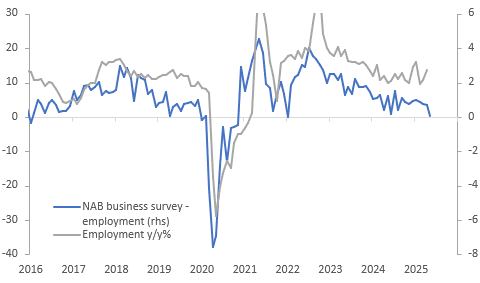
- Business conditions were driven down by employment and trading. Profitability was stable. In terms of the outlook, forward orders improved to -1.8 from -3.0, the best since October 2023. Given heightened global uncertainty, there was good news on the export front with both current and sales rising in May to their highest since December.
- Labour demand fell to 0.4 in May from 3.6, the lowest since January 2022. The trending down over this year is suggesting that employment growth is likely to slow. May data prints on June 19.
Australia employment
Source: MNI - Market News/LSEG/ABS
AUSTRALIA DATA: Lower Rates/Inflation Cautiously Boosting Confidence
Westpac’s measure of consumer confidence rose 0.5% in June to 92.6 after May’s 2.2% increase boosted by 50bp of RBA easing this year and lower inflation. The index is at its highest since January but still 1.8% below that level as global events have weighed on sentiment.
- The survey was taken after the RBA cut rates on May 20, which likely supported sentiment this month. This and lower inflation are reflected in the 7.5% m/m pickup in “time to buy a major purchase” to 100.2. Westpac expects the Board to remain cautious and be on hold in July with the next easing in August.
Australia Westpac consumer confidence

- While consumer confidence is improving, global events continue to be a dampener. Westpac asked about news recall this month and for “international conditions” 77% assessed it as “unfavourable”, a 3-year high. Forward-looking components of consumer sentiment also were more negative than current ones, reflecting elevated global uncertainties around the outlook.
- 63% assessed news reports around inflation as “unfavourable” down 2pp since March and 13pp since December. Interest rate news was seen as more positive than negative for the first time since 2021.
- Unemployment expectations rose 5% m/m to 127.4, just below the series average of 129.
- Family finances compared to a year ago rose 0.5% m/m, while over the coming year they fell 1.9%. This is despite around 80% of respondents expecting rates to fall over the year.
- “Time to buy a dwelling” rose 3.6% m/m, while house price expectations jumped 7%, highest since 2013.
BONDS: NZGBS: Closed With A Modest Bull-Flattener, Net Migration Data Tomorrow
NZGBs closed showing a modest bull-flattener. Benchmark yields finished at their lows, 1-2bps lower, on a local data-light session.
- (Bloomberg) -- "Economists at ANZ Bank New Zealand and ASB Bank have raised their 1q economic growth forecasts, adding to signs the RBNZ may be justified in pausing interest rate hikes next month, according to emailed notes. ANZ expects the June 19 report will show GDP grew 0.7% after provisionally projecting 0.6%."
- " NZ Treasury expects growth impulse from net exports will wane” - BBG.
- Cash US tsys are ~1bp cheaper in today's Asia-Pac session after yesterday's modest rally.
- Bloomberg - "Senator Ted Cruz has proposed eliminating the interest paid to banks that deposit cash at the Federal Reserve, which could save the government around $1 trillion over a decade."
- "JPMorgan strategists warn that this move could significantly impact banks' profitability, liquidity management strategies, and short-term interest rates, and risk the Fed losing control of money market rates."
- RBNZ dated OIS pricing closed with 4bps of easing priced for July and a cumulative 29bps by November 2025.
- Tomorrow, the local calendar will see Net Migration data.
- On Thursday, the NZ Treasury plans to sell NZ$250mn of the 4.50% May-30 bond and NZ$200mn of the 4.25% May-36 bond.
FOREX: Asia Fx Wrap - The USD Bounces With Stocks
The BBDXY has had a range of 1208.71 - 1212.46 in the Asia-Pac session, it is currently trading around 1211. “Rachel Reeves will announce a “housing bank” as early as Wednesday to deliver cheaper financing to housebuilders, the FT reported”(BBG). “Thames Water’s senior creditors submitted a rescue plan to the UK’s water industry regulator, envisaging £5 billion of fresh funds and hefty losses for the utility’s debt holders.”(BBG)
- EUR/USD - Asian range 1.1386 - 1.1436, Asia is currently trading 1.1395. EUR has drifted lower during the Asian session as the USD bounces in response to the move higher in US stocks. Dips should continue to find demand, first support around 1.1350 then the 1.1100/1200 area.
- GBP/USD - Asian range 1.3520 - 1.3564, Asia is currently dealing around 1.3535. The GBP is attempting another run higher but is struggling to gain any momentum above the pivotal 1.3500 weekly pivot. Support seen back towards 1.3400 and then 1.3200.
- USD/CNH - Asian range 7.1778 - 7.1864, the USD/CNY fix printed 7.1840. Asia is currently dealing around 7.1860. Sellers should be around on bounces while price holds below the 7.2500 area.
- Cross asset : SPX +0.35%, Gold $3303, US 10-Year 4.48%, BBDXY 1211, Crude oil $65.41
Data/Events : Italy Industrial Production
Fig 1: GBP/USD Spot Daily Chart

Source: MNI - Market News/Bloomberg Finance L.P
JPY: Asia Wrap - Ueda & Stocks Help USD/JPY Higher
The Asia-Pac USD/JPY range has been 144.40 - 145.29, Asia is currently trading around 144.95. USD/JPY had a pop higher just after the Japanese Fix as Ueda said Japan’s price trend still has some way to go to reach their 2% target.
- BoJ Governor Ueda has been before parliament, answering questions from lawmakers. The Governor noted limited policy space on the downside, given the current 0.50% policy rate. This is if a fresh stimulus is needed. The real rate is being kept sub 0% to stimulate the economy further, as Ueda states that Japan is still some distance from the 2% inflation objective. Ueda reiterated that they will raise rates if they have confidence in achieving the 2% target.
- "KATO: SEEKING MORE JGB HOLDINGS BY DOMESTIC INVESTORS, WILL MAKE EFFORTS TOWARD APPROPRIATE JGB MANAGEMENT. CRUCIAL TO SEEK JGB HOLDINGS BY DIVERSE GROUPS" - BBG
- Demand seen again today in USD/JPY as risk continues to outperform, large option interest around these levels could see it do some work around here.
- The market still seems very confident of a move lower in USD/JPY but with positioning quite large now we have seen the risk of pullbacks increase.
- With the failure to break below 142.00 last week, price is back in its recent 142.00 - 147.00 range and will need a break either side of that to get a clearer direction. US CPI tomorrow will potentially have a say.
- Options : Close significant option expiries for NY cut, based on DTCC data: 144.00($708m), 143.30($618m). Upcoming Close Strikes : 143.00($1.28b June 12), 140.00($1.22b June 12), 144.00($1.19b June 13), 145.00($4.37b June 16).
CFTC data shows Asset managers maintained their already extensive JPY longs, and leveraged funds are trying again to build their own longs.
Fig 1 : USD/JPY Spot Daily Chart

Source: MNI - Market News/Bloomberg Finance L.P
AUD: Asia Wrap - AUD Bounces With Higher US Equity Futures
The AUD/USD has had a range of 0.6502 - 0.6530 in the Asia- Pac session, it is currently trading around 0.6528. The AUD has again found demand back towards the 0.6500 area as it eyes testing above the 0.6550 area. Stocks have performed well in the Asian session and the AUD continues to benefit from this.
- AUSTRALIA DATA: May NAB Business Labour Costs Fastest Since January. NAB business price/cost components in May were mixed containing elements of concern and optimism. The pickup in labour costs in addition to signs that wage growth is rising again are likely to be monitored closely. The employment component of the survey though was very weak which may pressure pay gains.
- AUSTRALIA DATA: Westpac's measure of consumer confidence rose 0.5% in June to 92.6 after May's 2.2% increase boosted by 50bp of RBA easing this year and lower inflation. The index is at its highest since January but still 1.8% below that level as global events have weighed on sentiment.
- Price in the 0.6350 - 0.6550 range for now, a sustained break above 0.6550 is needed for the move higher to accelerate. Price looks set to test the top end of the range but I am not sure how far it extends until we get US CPI tomorrow out the way.
- Expect buyers to continue to be around on dips while the support in the AUD holds, a close back below 0.6350 is needed to challenge the newly formed uptrend.
- Options : Closest significant option expiries for NY cut, based on DTCC data: 0.64200(AUD771m)/ 0.6460(AUD 529m). Upcoming Close Strikes : 0.6350(AUD 711m June 12), 0.6600(AUD643m June 12)
- CFTC Data shows Asset managers maintaining their shorts, the Leveraged community though continued to add to their shorts once more.
AUD/JPY - Today's range 94.15 - 94.59, it is trading currently around 94.58. Price broke the multiple tops around the 94.00 area over NFP’s. It has since managed to hold these gains, while this continues focus will turn to the high towards 96.00. Support should now be back towards the 93.00/50 area.
Fig 1: AUD/USD spot Daily Chart

Source: MNI - Market News/Bloomberg Finance L.P
NZD: Asia Wrap - Holds Gains, Looks To Extend
The NZD/USD had a range of 0.6028 - 0.6059 in the Asia-Pac session, going into the London open trading around 0.6055. The NZD continues to find demand on dips as Stocks have had a good session. NZD/USD looking to hold the 0.6050 area and press onwards to new highs.
- (Bloomberg) -- “Economists at ANZ Bank New Zealand and ASB Bank have raised their 1q economic growth forecasts, adding to signs the RBNZ may be justified in pausing interest rate hikes next month, according to emailed notes. ANZ expects the June 19 report will show GDP grew 0.7% after provisionally projecting 0.6%.”
- “NZ TREASURY EXPECTS GROWTH IMPULSE FROM NET EXPORTS WILL WANE - BBG.”
- The NZD has found solid demand back towards the 0.6000 area as dips remain well supported, aided by the more positive risk backdrop.
- The support back towards 0.5850 has held very well, and while this continues to hold expect buyers to be around on dips. A clear break above 0.6050/0.6100 could provide the spark for the next leg higher. The market remains short and above here they could be forced to pare back.
- CFTC Data showed Asset managers maintaining their shorts, while the leverage actually added to their shorts last week.
AUD/NZD range for the session has been 1.0763 - 1.0797, currently trading 1.0780. A top looks in place now just above 1.0900, the cross topped out yesterday towards the 1.0800/25 sell area, the first target looks to be around 1.0650.
Fig 1: NZD/USD Spot Daily Chart

Source: MNI - Market News/Bloomberg Finance L.P
ASIA STOCKS: Positive Day for Stocks with Taiwan Leading
With markets broadly positive across the region, Taiwan's TAIEX was the outperformer as TSMC shares surged. TSMC shares were up almost 4% on hopes that there could be some reduction of curbs on techs from the ongoing trade talks as the US indicated it would remove restrictions in exchange for rare earth shipments.
- Most of China's major bourses were up with the Hang Seng leading the way. The Hang Seng is up +0.33%, following yesterday's close up +1.63%. The CSI 300 gained just +0.16% today whilst the Shanghai Comp rose +0.11%. Shenzhen however went the other way, down -0.25%.
- The TAIEX in Taiwan is up +2.11% following on from yesterday's gain of +0.60%.
- The KOSPI is moderately higher by +0.22%, to be up over 6% in the last five trading sessions.
- The FTSE Malay KLCI rose a mere +0.14%, similar to yesterday's modest gains of +0.17%
- The Jakarta Composite is very strong, up +1.30% having been closed Friday and Monday.
- The FTSE Straits Times in Singapore is down -0.11% and the PSEi in the Philippines is down -0.55%.
- The NIFTY 50 has had a good start to the day up +0.22% following on from yesterday's gains of +0.40%.
ASIA STOCKS: Large Inflow for Korea to Start the Week
A relatively quiet start to the week with a major inflow for Korea tipping the last 5-days of inflows above $2bn
- South Korea: Recorded inflows of +$834m yesterday, bringing the 5-day total to +$2,117m. 2025 to date flows are -$8,739. The 5-day average is +$423m, the 20-day average is +$158m and the 100-day average of -$89m.
- Taiwan: Had inflows of +$4m as yesterday, with total inflows of +$167 m over the past 5 days. YTD flows are negative at -$12,611. The 5-day average is +$33m, the 20-day average of +$93m and the 100-day average of -$116m.
- India: Had inflows of +$147m as of the 6th, with total outflows of -$292m over the past 5 days. YTD flows are negative -$10,820m. The 5-day average is -$58m, the 20-day average of -$11m and the 100-day average of -$106m.
- Indonesia: Had outflows of -$44m as of the 5th, with total outflows of -$205m over the prior five days. YTD flows are negative -$3,014m. The 5-day average is -$41m, the 20-day average +$2m and the 100-day average -$30m.
- Thailand: Recorded outflows of -$6m as of yesterday, outflows totaling -$417m over the past 5 days. YTD flows are negative at -$2,172m. The 5-day average is -$41m, the 20-day average of +$2m and the 100-day average of -$30m.
- Malaysia: Recorded outflows of -$8m as of yesterday, totaling -$100m over the past 5 days. YTD flows are negative at -$3,523m. The 5-day average is -$18m, the 20-day average of -$2m and the 100-day average of -$25m.
- Philippines: Saw outflows of -$4m yesterday, with net inflows of +$6m over the past 5 days. YTD flows are negative at -$517m. The 5-day average is +$1m, the 20-day average of -$14m the 100-day average of -$5m.

OIL: Crude Holds Recent Gains While Watching Trade Talk Progress
Oil has held onto gains from recent trading during today’s APAC session with prices slightly higher as the market watches the second day of US-China trade talks to take place today. WTI is up 0.2% to $65.39/bbl but off the intraday high of $65.66. It remains above resistance at $64.86. Brent is 0.3% higher at $67.21/bbl following a peak of $67.40, approaching resistance at $67.73, a Fibonacci retracement level. The USD index is up 0.2%.
- Crude reacted sharply to the announcement of US reciprocal tariffs on fears of their impact on global energy demand. Thus it is watching the US-China trade talks closely and is currently mildly optimistic following US Commerce Secretary Lutnick describing negotiations so far as “fruitful”.
- The other issue markets are watching is US-Iran nuclear negotiations. The UN said that Iran’s stockpiling of almost weapons grade uranium needs to be monitored and addressed. There is a UN watchdog meeting this week in Vienna followed by one between the US and Iran in Oman on Sunday, according to Iranian officials.
- Later US May NFIB small business optimism and UK April/May labour market data are released. ECB’s Donnery and Buch appear. The focus remains on Wednesday’s May US CPI data but also Thursday’s US long-dated Treasury auction given fiscal concerns.
Gold Down Today As Risk Sentiment Improves With Ongoing Trade Talks
Gold prices reached $3327.96 early in the session up from Monday’s close of $3326.19, but trended lower thereafter falling to $3302.03. It has stabilised between $3304-3310 and is currently down 0.7% to $3305.0. The stronger US dollar (USD BBDXY +0.2%), little change in US yields and stronger equity markets have weighed on bullion in today’s APAC trading. US-China trade talks are continuing today and hopes of a deal are impacting safe-haven flows.
- Export controls are the focus of the US-China talks in London. There appears a willingness for the US to ease restrictions on tech exports if China eases rules on rare earths. Gold prices stabilised once trade negotiations began and the US delayed duties but official progress is needed for them to moderate again with any set back likely to drive a resumption of flight-to-quality flows.
- Silver is also weaker down 0.7% to $36.50 after falling to $36.31 from a high of $36.83. It broke above initial resistance at $36.71 briefly.
- Equities are generally stronger with the Hang Seng up 0.3%, TAIEX +2.1% and S&P e-mini +0.3%. Oil prices are moderately higher with WTI +0.1% to $65.37/bbl. Copper is down 1.0%, while iron ore is off its lows to be around $94-95/t.
- Later US May NFIB small business optimism and UK April/May labour market data are released. ECB’s Donnery and Buch appear. The focus remains on Wednesday’s May US CPI data but also Thursday’s US long-dated Treasury auction given fiscal concerns.
CHINA: Country Wrap: China Tapping Provident Fund for Housing
- China is tapping an often overlooked pool of funds worth 10.9 trillion yuan ($1.5 trillion) to salvage its housing sector, offering people an alternative to bank mortgages. The housing provident fund, a government savings program used to help people buy homes, has become an increasingly important means to obtain financing, as banks turn more cautious with profit challenges. The fund has outpaced banks in giving out loans, hitting 8.1 trillion yuan in outstanding mortgages last year. (source BBG)
- Chinese President Xi Jinping says China, South Korea should promote strategic cooperative partnership to higher level, state-run Xinhua News Agency reports, citing a phone call between Xi and South Korea’s President Lee Jae-myung. Xi urges both countries to inject more certainty into regional and international situations
- China, South Korea to jointly safeguard multilateralism, free trade, ensure stable, smooth global and regional industrial, supply chains (source XINHUA)
- Most of China's major bourses were up with the Hang Seng leading the way. The Hang Seng is up +0.33%, following yesterday's close up +1.63%. The CSI 300 gained just +0.16% today whilst the Shanghai Comp rose +0.11%. Shenzhen however went the other way, down -0.25%.
- Yuan Reference Rate at 7.1840 Per USD; Estimate 7.1870
- The CBG 10YR is at 1.69%
INDIA: Country Wrap: RBI to Stop Injections
- India’s central bank said it will stop daily fund injections into the financial system, days after the monetary authority shifted its policy stance and said the space for future easing was constrained. The Reserve Bank of India said on Monday that it would discontinue daily variable rate repurchase auctions from June 11, almost five months after it started such operations. (source BBG)
- The NIFTY 50 has had a good start to the day up +0.22% following on from yesterday's gains of +0.40%.
- The rupee is better by +0.09% today at 85.55 and up in the last five days of trading by +0.05%
- Bonds are performing with the IGB 10YR lower by -2bps at 6.32%
SOUTH KOREA: Country Wrap: Current A/C Surplus Weighed By Equity Dividends
- South Korea's April current account surplus narrowed sharply. From $9.145bn in March, we fell to $5.7bn in April. This largely reflected a sharp swing in the income balance, as net investment income swung from a surplus to a deficit. We printed -$648mn on net equity income, versus a +$2597mn in March. This swift likely reflected dividend related outflows to offshore investors in April. This is the seasonal norm, with the portfolio investment income balance returning to surplus in May in recent years. This often leads to improving current account trends as we progress through Q2, all else equal. The goods balance remained healthy, just short of $9bn for April. There weren't sharp shifts elsewhere in the current account position. (source MNI)
- Korea's economy continues to remain "weak" due to sluggish construction activity and deteriorating export conditions, driven by rising U.S. tariffs, a state-run think tank said Tuesday. "The domestic economy continues to show weak overall momentum, as construction investment remains subdued and export growth slows, particularly due to the impact of U.S. tariff hikes," the Korea Development Institute (KDI) said in its latest monthly economic assessment. The KDI noted that weak construction investment is weighing on domestic demand, while overall industrial output is showing signs of deceleration, particularly in the construction sector. (source Korea Times)
- The KOSPI is moderately higher by +0.22%, to be up over 6% in the last five trading sessions.
- The Won is down -0.77% today at 1,365.10
- Bonds: KTBs are mixed today the the 2YR lower by -2bps and the 10YR by -1bps and other maturities modestly higher in yield.
Table of Contents
ASIA FX: USD Better Supported, But Recent Ranges Still Holding
In North East Asia FX markets, trends have been biased towards a firmer USD, but pairs continue to respect recent ranges. The equity tone is positive, albeit with markets up modestly (ex Taiwan).
- USD/CNH continues to trace out a very low vol backdrop. We saw earlier lows at 7.1778 but had steadily drifted higher since, last near 7.1865. Early Monday highs were above 7.1920, so we remain within recent ranges. Focus will be the second day of trade talks between US and China officials in London. The first days proceedings were described as positive, but lacked any meaningful detail.
- USD/KRW spot has gravitated higher today, last around 1361/62, up close to 0.50% versus end Monday levels. Onshore equity gains have cooled, with the Kospi only up +0.20% so far today (the RSI (14) is signaling overbought for this index). This, along with the edge higher in USD/CNH, may be trimming KRW appetite at the margins. Recent highs in USD/KRW rest in the 1364/65 region. Earlier data showed a narrowing in the current account surplus, due to equity/dividend related income outflows.
- Spot USD/TWD is holding fairly steady, the pair last near 29.90/95. We have seen local equities gain strongly, the Taiex up over 2%. AI momentum and US-China trade talks likely positives.
UP TODAY (TIMES GMT/LOCAL)
| Date | GMT/Local | Impact | Country | Event |
| 10/06/2025 | 0600/0800 | *** |  NO NO | CPI Norway |
| 10/06/2025 | 0600/0700 | *** |  GB GB | Labour Market Survey |
| 10/06/2025 | 0600/0800 | ** |  SE SE | Private Sector Production m/m |
| 10/06/2025 | 0800/1000 | * |  IT IT | Industrial Production |
| 10/06/2025 | 1000/0600 | ** |  US US | NFIB Small Business Optimism Index |
| 10/06/2025 | - | *** |  CN CN | Money Supply |
| 10/06/2025 | - | *** | CN | New Loans |
| 10/06/2025 | - | *** | CN | Social Financing |
| 10/06/2025 | 1255/0855 | ** | US | Redbook Retail Sales Index |
| 10/06/2025 | 1530/1130 | ** | US | US Treasury Auction Result for 52 Week Bill |
| 10/06/2025 | 1700/1300 | *** | US | US Note 03 Year Treasury Auction Result |
| 11/06/2025 | 0630/0730 | GB | BOE Saporta Speech At Bank of Finland and SUERF Conference | |
| 11/06/2025 | 0900/1000 | ** | GB | Gilt Outright Auction Result |
| 11/06/2025 | 0900/1000 | ** | GB | Gilt Outright Auction Result |
| 11/06/2025 | 0930/1130 |  EU EU | ECB Lane At 2025 Government Borrowers Forum | |
| 11/06/2025 | 1100/0700 | ** | US | MBA Weekly Applications Index |
| 11/06/2025 | 1130/1230 | GB | Chancellor Reeves presents Spending Review to Parliament | |
| 11/06/2025 | 1200/1400 | EU | ECB Cipollone On Digital Payments Panel | |
| 11/06/2025 | 1230/0830 | * |  CA CA | Building Permits |
| 11/06/2025 | 1230/0830 | *** | US | CPI |


