MNI EUROPEAN MARKETS ANALYSIS: Gold, Silver Rally Continues
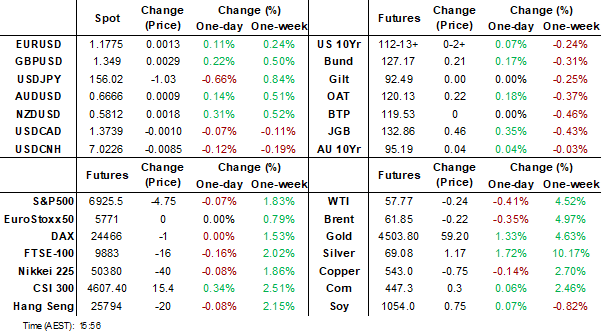
- Gold and silver are off new record highs reached today but remain higher than Monday’s closing levels supported by multiple factors.
- The USD BBDXY index continues to track lower, with JPY outperforming in the G10 space amid intervention threats, USD/CNH has also fallen to fresh lows.
- Asia Pac government bond yields are lower, with Japan unwinding some of the post BoJ gains from last Friday.
- Later US 6 December ADP employment, Q3 GDP, October orders, December Philly & Richmond Fed indices, December Conference Board consumer confidence and Oct/Nov IP/capacity utilisation, as well as Q3 Spanish GDP, Canadian October GDP and BoC summary of deliberations are released.
MARKETS
US TSYS: Yields Grind Lower, TYH6 Nears Key Tech Level
US Bond futures have ground higher today in very light volumes during the Asia trading day. The 10-Yr is up +02+ at 112-13+ , near to the 100-day EMA of 112-14+. Downside resistance remains at the 200-day EMA of 111-31.
Cash was better with yields up to -1.5bps lower, with the long end outperforming.
- The 2-Yr is flat at 3.509%
- The 5-Yr is down -0.7bps at 3.708%
- The 10-yr is down -1.2bps at 4.155%
- The 30-Yr is down -1.4bps at 4.824%
Tonight markets turn their attention to a US$75bn 6-week and US$50bn 52-week bill auction and a US$28bn 2-Yr FRN reopening and a US$70bn 5-Yr auction.
For the U.S. Q3 2025 GDP release scheduled for tonight expectations are for continued solid growth, albeit at a slightly slower pace than the previous quarter. Markets generally expect real GDP to increase at an annualized rate of 3.3% for the third quarter. However as an alternate indicator the Federal Reserve Bank of Atlanta FED GDPNOW tracker is slightly more optimistic, providing a nowcast of 3.5% as of mid-December. Tonight's release is unique because the standard "Advance Estimate" usually due in October was cancelled due to a federal government shutdown; tonight's report serves as the first official consolidated print for the quarter.
JGBS: Yields Lower, 10yr Still Above 2.0%, Takaichi Vows Responsible Fiscal Pol
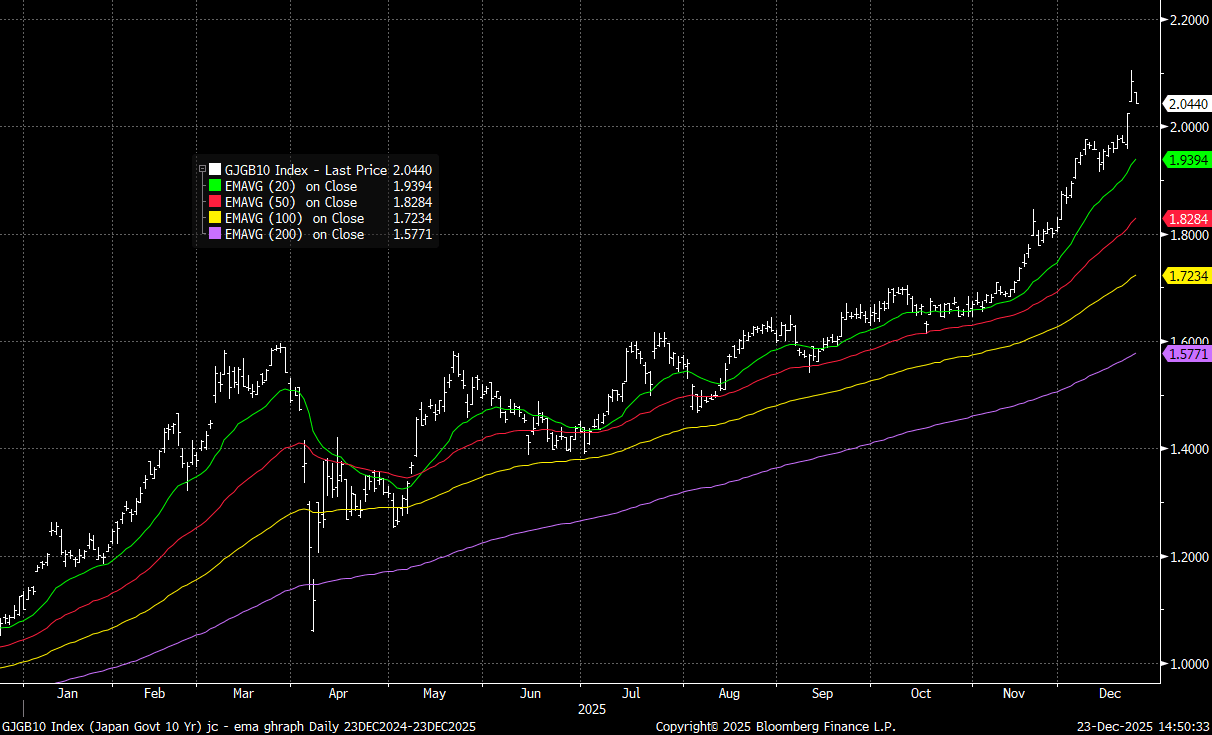
JGB futures continue to recover from recent lows, last 132.85, +.45 versus settlement levels. US Tsy futures have also drifted a little higher in the first part of Tuesday. For JGB futures, this looks to be a correction from oversold conditions, with broader bearish risks still intact.
- It has been a similar backdrop for JGB outright yields, we sit around 2-4.5bps lower across most parts of the curve, led by 5-+10yr tenors. The 10yr was last around 2.04%, but remains above all key EMAs in yield terms, see the chart below. The nearest support point is back around 1.94% (per the 20-day EMA).
- USD/JPY weakness has likely helped yields retrace lower at the margins, with the pair testing under 156.00 amid increased FX rhetoric from the Japan FinMin around the intervention risk.
- Headlines have also crossed this afternoon: "JAPAN PM TAKAICHI IN NIKKEI INTERVIEW: "RESPONSIBLE PROACTIVE FISCAL POLICY" DOES NOT MEAN IRRESPONSIBLE BOND ISSUANCE OR TAX CUTS - [RTRS]"
- BoJ hike odds are around flat for both the Jan and March meetings 2026, per market OIS pricing.
- Tomorrow on the data front we get the PPI services for Nov along with the final Oct reads for the leading and coincident indices. Still due later today is Nov final machine tool orders.
Fig 1: JGB 10yr Yield Versus Key EMAs
Source: Bloomberg Finance L.P./MNI
AUSSIE BONDS: ACGB Yields 3-4bps Lower, RBA Cautious On Outlook
Aussie bond futures have held a positive bias in Tuesday trade consistent with gains in US Tsy futures and JGBs, while at the same time the RBA Minutes, from the Dec policy meeting, didn't contain any hawkish surprises. Front end, 3yr futures (YM) are marginally outperforming, up +4bps to 95.795, although we are slightly down from best levels. 10yr futures (XM) are +3.5bps to 95.185. ACGB yields are around 3-4bps lower, with the front end marginally leading in yield terms.
- The RBA Minutes noted that the Board felt it needed more time to assess data to determine how persistent the pickup in inflation is. It was "too early" to know especially given the newness of the monthly CPI. It noted the upside risks to Q4 inflation and the "circumstances" that would drive a hike were also discussed. However, it noted a number of times that it was appropriate to be "cautious".
- Elsewhere, the December Bloomberg survey showed a median upward revision to consensus cash rate forecasts in 2026 as well as H1 GDP growth driven by stronger investment. A lot of forecasters have taken out easing expectations from their projections with some adding tightening.
- RBA tightening expectations are little changed for the Feb 2026 meeting, with market implied pricing giving around a 35% probability to a hike.
- The ACGB 10yr has backed away from a test 4.80% for now. A clean break higher could see the 5% handle targeted, while dips under 4.70% have been supported so far in Dec. For the 3yr upside focus rests around 4.20%.
- The AU-US10yr spread is slightly flatter at +61bps, but remains close to recent highs and continues to reflect risks around the 2026 central bank outlook between the Fed and RBA.
RBA: Board “Cautious”, Inflation Persistence & Excess Demand Could Drive Hike
Rates were unchanged in December as the Board felt it needed more time to assess data to determine how persistent the pickup in inflation is. It was “too early” to know especially given the newness of the monthly CPI. It did note that the October reading increased the risks that Q4 could exceed its projections, as well as price measures in the Q3 national accounts. Importantly, the “circumstances” that would drive a hike were discussed. However, it noted a number of times that it was appropriate to be “cautious”.
- The December minutes said that if financial conditions were not “sufficiently restrictive” enough to bring demand and supply back into balance and that the rise in inflation proved to be more persistent and drives a pickup in expectations then a rate hike “might need to be considered” in 2026. It appears there is a high bar for a delay to the return of inflation to the band mid-point.
- There were three “judgements” that drove the last decision – 1. output gap size and implications for inflation persistence, 2. Labour and economic outlook, and 3. If financial conditions were still restrictive.
- The Board appeared split over whether conditions were “no longer restrictive” or “a little restrictive”. The former noted that banks were being more competitive, the housing market reacted strongly to easing, and the low capital market risk premia.
- The Board estimates that there is excess demand and therefore a positive output gap. It noted data signalling capacity constraints in the labour market and the economy as a whole. It said there were upside risks to its forecast of a “broadly stable” output gap.
- It also wants to wait to see the full impact of 2025’s 75bp of easing but also the rise in short- and long-term yields.
AUSTRALIA: Q4 Wages Data Mixed Following Sharp Rise In Q3 Compensation
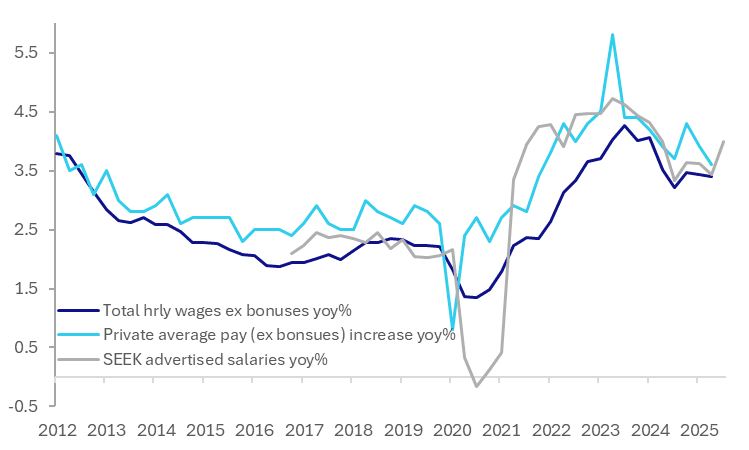
The RBA stated as part of its December decision to leave policy on hold that while the wage price index “has eased from its peak” other “broader measures” were showing “strong growth”. Many measures are quarterly and thus backward looking but Q4 monthly data to date have been mixed.
- November SEEK advertised salaries rose 3.8% y/y up from 3.6% and the highest since September 2024. 3-month annualized momentum picked up to 4.0% from 3.7% and has been trending higher since the August trough.
- Q4 average SEEK salaries rose 3.7% y/y up from Q3’s 3.4% and is signaling a pickup in Q4 WPI growth, which won’t be released until 18 February. This is likely to concern the RBA which is forecasting it to hold at 3.4%.
Australia wages growth ex bonuses y/y%
Source: MNI - Market News/ABS/SEEK
- While SEEK salaries are indicating higher wage inflation, NAB’s business labour costs slowed in Q4. The 3-month change moderated 0.1pp to 1.4% in November. The Q4 average is currently at 1.4% down from both Q3’s 1.8% and Q2’s 1.6%.
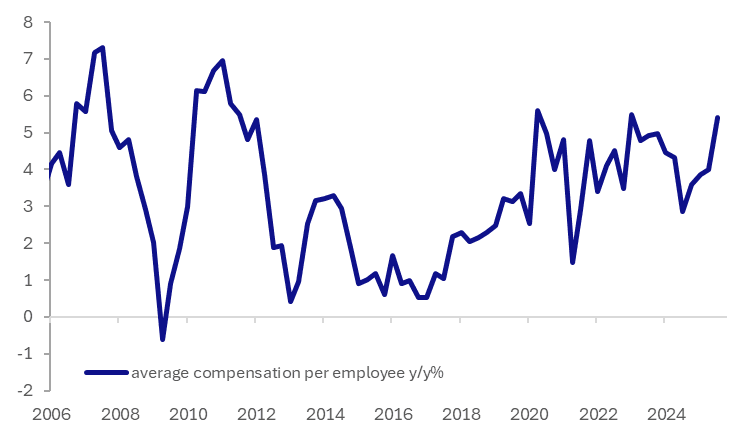
- The RBA was likely worried about the sharp rebound in average compensation per employee in the Q3 national accounts which rose 1.8% q/q and 5.4% y/y. This was up from 4.0% y/y in Q2 and the highest annual growth rate in two and half years.
Australia average compensation per employee y/y%
Source: MNI - Market News/ABS
- It has been worried about unit labour costs for some time which rose 1.3% q/q and 4.9% y/y in Q3, the strongest in over a year.
- Easing WPI growth appears to have stalled mid-year with both Q2 and Q3 rising 0.8% q/q and 3.4% y/y. However, the last RBA statement showed that the Board has a range of wage indicators that it considers.
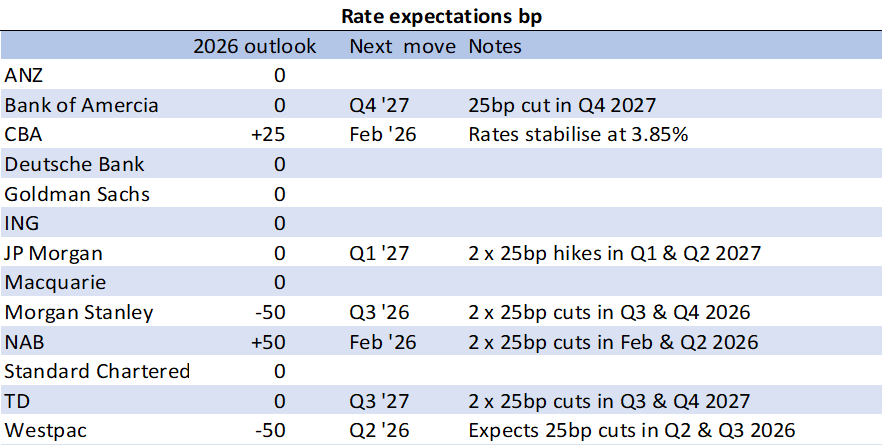
AUSTRALIA: Analysts Divided Over Whether RBA Holds, Hikes Or Cuts In 2026
The December Bloomberg survey showed a median upward revision to consensus cash rate forecasts in 2026 as well as H1 GDP growth driven by stronger investment. A lot of forecasters have taken out easing expectations from their projections with some adding tightening. Headline inflation is little changed with analysts continuing to project it to return to the RBA’s 2-3% band in Q3 2026 as the impact of government electricity rebates drop out of the annual comparisons.
- The median forecast for the cash rate is 3.6% through to the end of the time horizon to Q1 2028, implying analysts now expect rates to be on hold. This is a change from a full 25bp cut expected by Q3 that left rates at 3.35% in the November survey.
- Some forecasters now expect a 25bp hike in Q1, likely at the February monetary policy statement meeting. CBA expects 25bp in February, NAB & Capital Economics 25bp in February and again in Q2, while JP Morgan has 50bp of tightening in H1 2027.
- In contrast, Westpac still expects the RBA to ease but has pushed it out a quarter with 25bp in Q2 and again in Q3 2026 leaving rates at 3.1% and Morgan Stanley in Q3 and Q4 2026.
- The December RBA minutes said that if financial conditions were not “sufficiently restrictive” enough to bring demand and supply back into balance and that the rise in inflation proved to be more persistent and drives a pickup in expectations then a rate hike “might need to be considered” in 2026.
- Consensus unemployment rate projections are little changed with Q4 2025 averaging 4.4% and Q4 2026 4.5%.
- The Bloomberg survey was taken over 5-12 December. The last RBA decision was 9 December.
Australia cash rate expectations
Source: MNI - Market News/Bloomberg Finance L.P.
BONDS: NZGBS: Yields Mixed, 2/10s Curve Off Highs, NZ-US 10yr At +30bps
NZGB yields are mixed, with the 2yr higher, +2bps to 2.72%, while the rest of the curve is weaker in yield terms (down around 1.5-1.8bps). The 10yr is back to 4.44%. The back end moves are consistent with regional/US Tsy yield trends, so far in Tuesday trade and reverses some of yesterday's solid yield gains. Local news flow has been light, with markets winding down ahead of the Christmas/NY break.
- Broader ranges are holding for NZGBs, with some selling interest emerging when 10yr yields dip under the 4.40% region. For the 2yr we have edged up from a test of Dec lows under 2.70%. The 2/10s curve is slightly flatter at +172bps, but has been in a strong uptrend since the start of Dec.
- The 2yr swap rate (NDSO) is firmer, last around 2.76%, bouncing off 20-day EMA support (near 2.70%), in recent sessions.
The NZ-US 10-yr spread is relatively steady around +30bps, little changed today, but up from around flat in Oct/Nov, which fits with the respective central bank outlooks (with the Fed seen more at risk of cutting in the first part of 2026 compared to the RBNZ).
FOREX: USD - BBDXY Extends Lower Pressing 1203-1204 Support
The BBDXY has had a range today of 1203.09 - 1205.35 in the Asia-Pac session; it is currently trading around {BBDXY Index}. The USD has slipped again in the Asian session following on from yesterday's price action. The move last week had more to do with the surge higher in USD/JPY than any real USD strength as the moves elsewhere in currencies and more importantly in metals attest to. Robin Brook made an important point on Friday, take out the JPY in the USD basket and the USD is falling a lot more than is being appreciated. On the day, I suspect rallies to be faded while the 1210 area holds. First sell-zone is between 1207-1209, can this 1203-1204 area continue to provide support if not a move below here would target 1198-1200.
- EUR/USD - Asian range 1.1755-1.1781, Asia is currently trading {EURUSD Curncy}. The pair broke above the overnight highs in Asia and has extended. On the day, support is back toward 1.1730-1750 initially, as the market tries to build some momentum to test higher into the year-end.
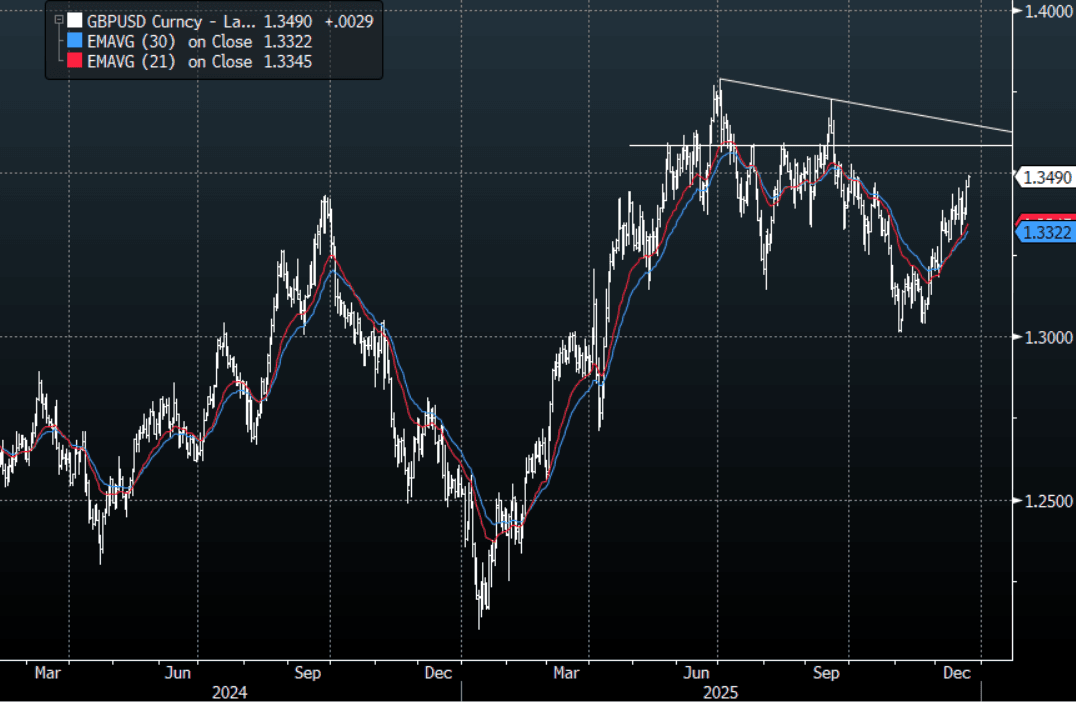
- GBP/USD - Asian range 1.3456-1.3493, Asia is currently dealing around {GBPUSD Curncy}. The pair has regained its upward momentum pushing up to test toward the 1.3500 area. On the day, I look for dips back toward 1.3400-1.3430 to now be supported initially. My skew toward looking for signs to short have not been well founded as of yet.
- Cross asset : SPX +0.02%, Gold $4485, US 10-Year 4.155%, BBDXY 1203, Crude Oil $57.94
- Data/Events : Spain GDP/PPI, Germany Import Price Index
Fig 1: GBP/USD Spot Daily Chart
Source: MNI - Market News/Bloomberg Finance L.P
JPY: USD/JPY - Further Jaw-Boning Drags It Lower, Is That All It Takes ?
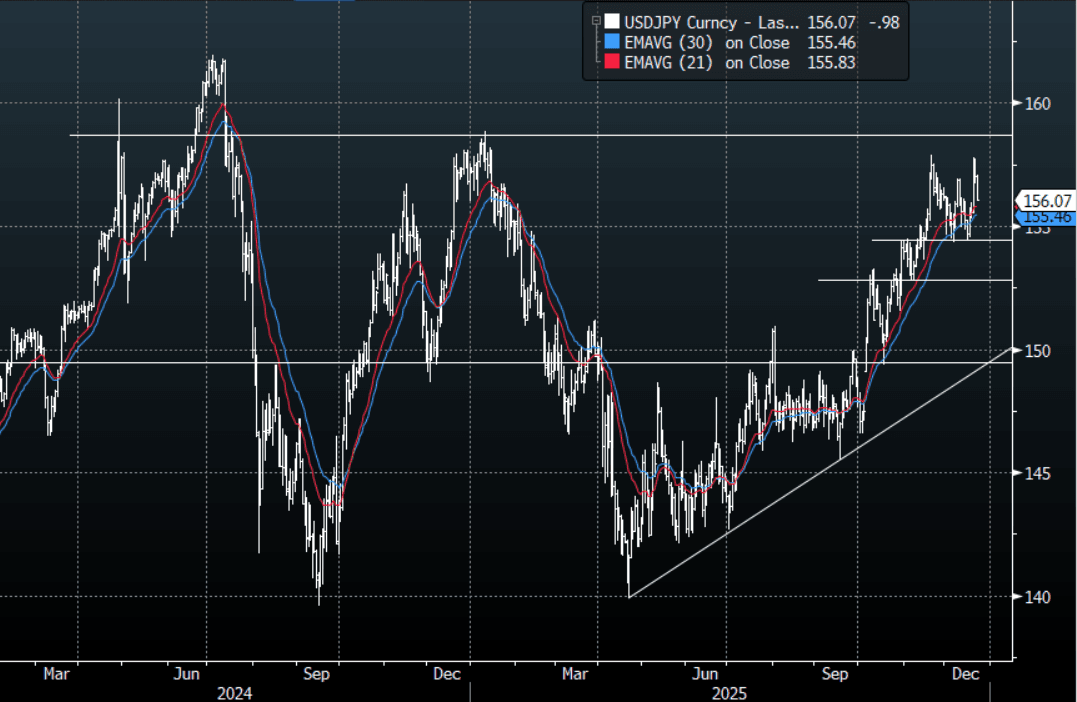
The USD/JPY range today has been 155.96 - 157.08 in the Asia-Pac session, it is currently trading around {USDJPY Curncy}. USD/JPY has had another leg lower as officials continue jaw-boning about the one-sided nature of the move. The BOJ is in a tough spot, and they are going to need to do something significant to turn around the market's perception of a weak Yen. The minimal reduction in differentials is not incentivising a market that is concerned about Japan’s Fiscal policy to start buying Yen. A test of the BOJ/MOF resolve looks inevitable at the moment as the market turns its focus toward the important 160.00 area. Technically USD/JPY remains in an uptrend, while the first support back toward the 152.50-154.50 area is intact it remains a buy on dips. On the day, we have pulled back nicely, but I suspect buyers are looking to fade this move initially. First support is around 155.80-156.00 and then the more important 154.50-155.50 area.
- "KATAYAMA: DECLINE TO COMMENT ON CURRENT FX, YIELD LEVELS. THERE ARE MANY FACTORS BEHIND FX, YIELDS MOVES. SEE SOME FX MOVES NOT IN LINE WITH FUNDAMENTALS" - BBG
- "JAPAN FINMIN KATAYAMA: WILL TAKE APPROPRIATE ACTION AGAINST EXCESSIVE MOVES, JAPAN HAS A FREE HAND IN DEALING WITH EXCESSIVE MOVES IN THE YEN - [RTRS]
- Options : Close significant option expiries for NY cut, based on DTCC data: 156.00($1.32b), 158.00($968m). Upcoming Close Strikes : 155.50($486m Dec 26), 157.00($889m Dec 24), 158.00($589m Dec 24) - BBG.
- The USD/JPY Average True Range(ATR) for the last 10 Trading days: 118 Points
Fig 1 : USD/JPY Spot Daily Chart
Source: MNI - Market News/Bloomberg Finance L.P
AUD/USD - Extends Above 0.6650 In Asia
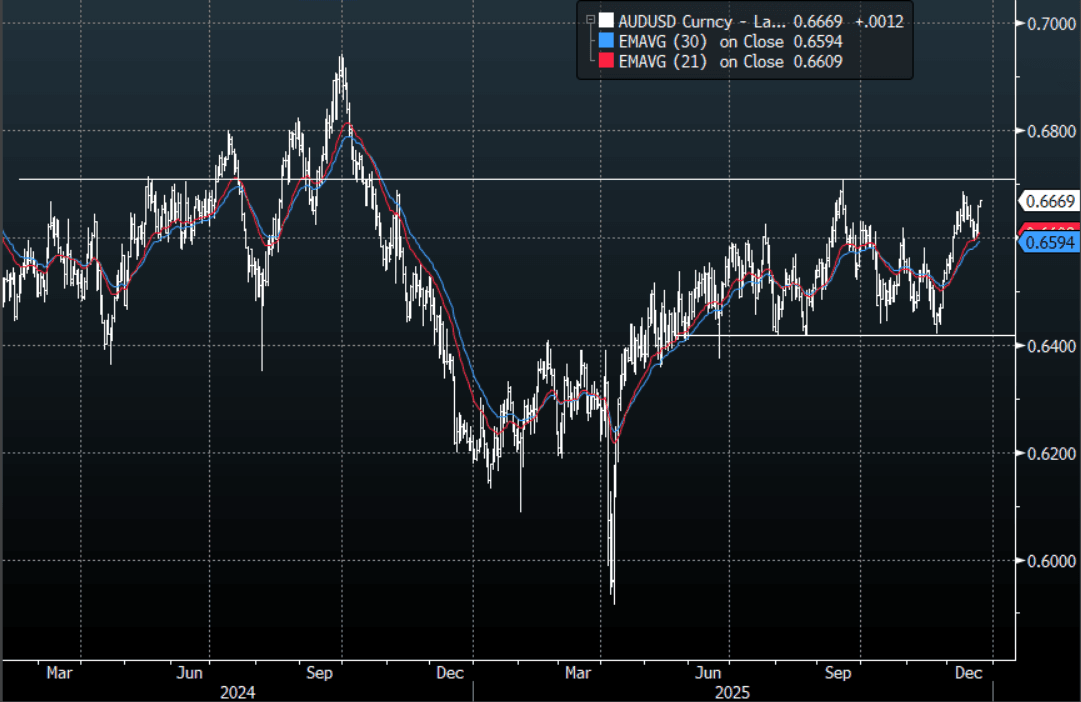
The AUD/USD has had a range today of 0.6655 - 0.6670 in the Asia- Pac session, it is currently trading around {AUDUSD Curncy}. The AUD continues to grind higher in Asia building on yesterday's gains with very little pullback as risk looks likely to resume the Santa rally. The AUD price action for the moment remains constructive as the pair looks to build the momentum to retest the 0.6700 area. Technically while the AUD remains above 0.6500-0.6550 dips should continue to be supported. On the day, I suspect dips back toward 0.6620-40 will now be supported as the market turns its focus back toward 0.6700.
- MNI AU -RBA: Board “Cautious”, Inflation Persistence & Excess Demand Could Drive Hike. Rates were unchanged in December as the Board felt it needed more time to assess data to determine how persistent the pickup in inflation is. It was “too early” to know, especially given the newness of the monthly CPI. It did note that the October reading increased the risks that Q4 could exceed its projections, as well as price measures in the Q3 national accounts. Importantly, the “circumstances” that would drive a hike were discussed. However, it noted a number of times that it was appropriate to be “cautious”.
- Options : Closest significant option expiries for NY cut, based on DTCC data: 0.6535(AUD428m), 0.6600(AUD557m). Upcoming Close Strikes : none - BBG
- The AUD/USD Average True Range for the last 10 Trading days: 40 Points
Fig 1: AUD/USD spot Daily Chart
Source: MNI - Market News/Bloomberg Finance L.P
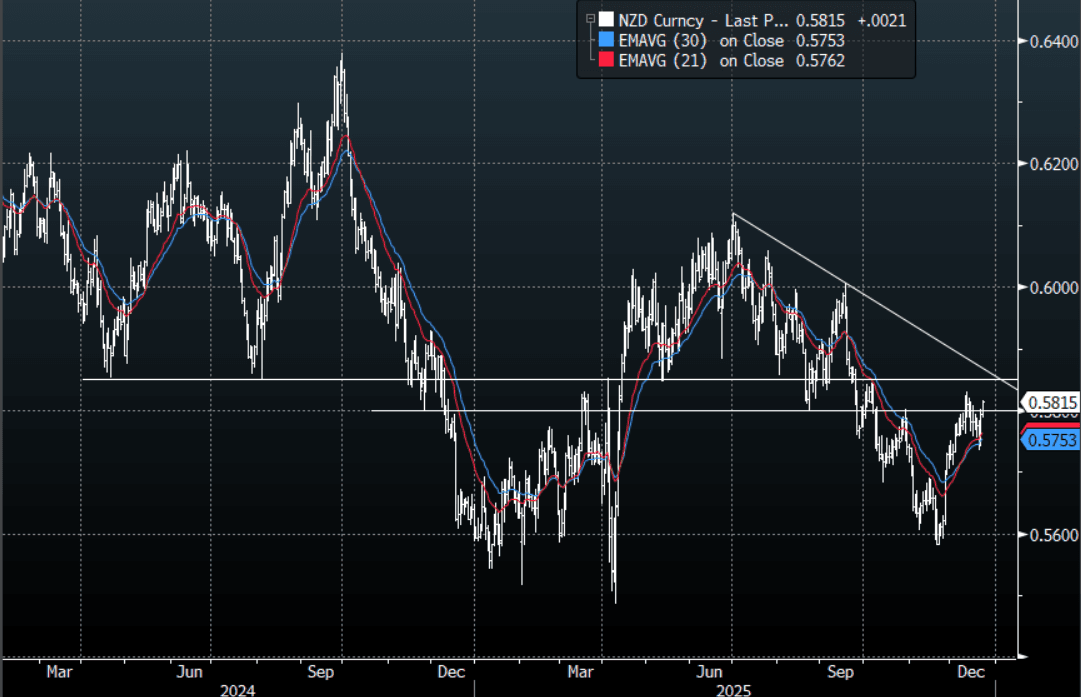
NZD/USD - Pushed Back Above 0.5800 In Asia
The NZD/USD had a range today of 0.5788-0.5817 in the Asia-Pac session, it is currently trading around {NZD Curncy}. The NZD built on the strength seen overnight and pushed back above 0.5800 challenging the top of its recent range. The NZD is holding above 0.5700-0.5750 and for the most part was left unscathed by the choppy price action seen elsewhere last week, as risk looks to build onto the Santa rally I suspect the NZD could probe back above 0.5830. On the day, I suspect a pullback toward 0.5765-85 should find demand as the market looks to potentially challenge the 0.5810/30 area.
- Options : Closest significant option expiries for NY cut, based on DTCC data: 0.5530(NZD475m). Upcoming Close Strikes : None - BBG
- The NZD/USD Average True Range for the last 10 Trading days: 44 Points
Fig 1: NZD/USD Spot Daily Chart
Source: MNI - Market News/Bloomberg Finance L.P
ASIA STOCKS: Stocks Extend Gains, AI / Tech Remain Focus
Asian equity markets are broadly higher today largely extending gains from the previous session driven by momentum from Wall Street and optimism around Artificial Intelligence (AI) related stocks as Tesla and Nvidia gained. Major indices in Japan, Korea and Hong Kong advanced whilst China's indices were more muted. Ahead of the advanced US GDP report, a report in the Shanghai Securities news citing the Chief Macro Analyst from Golden Credit Rating suggests that cuts to rates and RRR's will come in Q1 2026 in China, boosting sentiment. China's embattled property developer China Vanke appears to have won a last minute reprieve from creditors to extend the grace period for a bond due to Jan 28, whilst the proposal to defer principal payment for 12 months was unsuccessful.
- The NIKKEI has done very little today, hovering around 50,374 where it opened. Yesterday's gains took the NIKKEI back above all major moving averages.
- The KOSPI is up +0.43% to 4,123 as it too consolidates above all major moving averages.
- China's major bourses were all up modestly today with the CSI 300 leading gains. Up +0.50% at 4,635, the CSI 300 has consolidated above all major moving averages.
- India's NIFTY 50 failed to capitalize on yesterday's gains of +0.79% and is down -0.10% today and at 26,147 is near to the November high of 26,215.
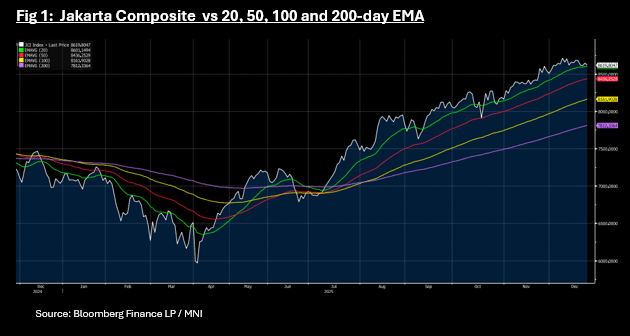
- Both the Jakarta Composite and the FTSE Malay KLCI are down modestly today. The JCI is down -0.30% at 8,621 and is near to the 20-day EMA 8,600, having last traded below it in October.
OIL: Uncertainty Over Venezuela & Russia Putting Floor Under Oil Prices
Crude is slightly lower during Tuesday’s APAC trading but holding onto the previous days’ gains as geopolitical risks rose in oil producing regions. Prices have moved today in a very narrow range of around 20c with Brent around $61.92/62.08 and currently down 0.1% to $62.01/bbl and WTI between $57.79/57.99 and now 0.2% lower at $57.92/bbl.
- Tensions between the US and Venezuela have boosted oil markets at a time when the focus is on excess supply. The US has boarded two shadow fleet vessels and is seeking a third. President Trump said that the US will capture it and that it would be “smart” for Venezuela’s Maduro to leave power. He also suggested land attacks are possible. The US will keep the tankers and crude but despite this Venezuelan oil continues to be loaded.
- Ukraine’s escalation of attacks on Russian energy infrastructure is adding to geopolitical worries. The closure of Kazakhstan’s main export dock on the Black Sea following a Ukrainian strike at the end of November is ongoing.
- A record market surplus in 2026 has been forecast for some time and the additional production is expected to show up in rising inventories but they may also increase due to global uncertainties. Later on Tuesday US industry-based stock data print with the official EIA out on Wednesday.
- Later US 6 December ADP employment, Q3 GDP, October orders, December Philly & Richmond Fed indices, December Conference Board consumer confidence and Oct/Nov IP/capacity utilisation, as well as Q3 Spanish GDP, Canadian October GDP and BoC summary of deliberations are released.
PRECIOUS METALS: $70 Providing Resistance For Silver
Gold and silver are off new record highs reached today but remain higher than Monday’s closing levels supported by a softer US dollar (BBDXY -0.2%), slightly lower US yields, Fed easing expectations and safe-haven flows due to a rise in geopolitical tensions. Gold reached $4497.74/oz earlier and is now up 1.0% to $4487.0.
- Bullion broke above resistance at $4493.7, a Fibonacci projection, but was unable to hold it. The trend remains bullish.
- Silver is 0.9% higher at $69.66 after rising to $69.993, above resistance at $69.687. It is yet to pierce psychological resistance at $70.00. Moving average studies continue to highlight a dominant medium-term uptrend.
- Geopolitical concerns have risen with increased tensions between the US and Venezuela as the former blockades tankers. Ukrainian attacks on Russian energy infrastructure including an empty vessel in the Mediterranean have added to worries. There are also strains between China and Japan.
- President Trump said that the US will capture the third tanker it is chasing and that it would be “smart” for Venezuela’s Maduro to leave power. The US will keep the tankers and crude that it has seized despite this Venezuelan oil continues to be loaded.
- Equities are generally stronger with the CSI 500 up 0.5% and TAIEX +0.5% but S&P e-mini and Nikkei flat. Oil prices slightly lower with WTI -0.1% to $57.94/bbl. Copper is down 0.1%.
- Later US 6 December ADP employment, Q3 GDP, October orders, December Philly & Richmond Fed indices, December Conference Board consumer confidence and Oct/Nov IP/capacity utilisation, as well as Q3 Spanish GDP, Canadian October GDP and BoC summary of deliberations are released.
SOUTH KOREA: KRW Swaps Begin to Price in Rate Hikes
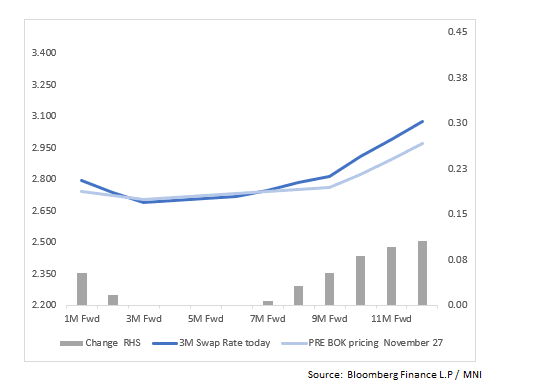
- Following the KRW1.5tn government bond purchase exercise by the BOK in December to replenish their pool of securities for repo sales, the swaps curve's pricing of rate hikes into 2026 has changed marginally.
- Over the next 1, 2 and 3 months there is a cumulative 16bps of cuts priced in (from -13bps last week), and over the next 12 months +23bps of increases ( from +24bps last week), all of which are in the 11 and 12 month forwards.
- The MIPR function on BBG has 2bps of increases over a 12 month period (from 8bps last week).
- With the economic data continuing to improve, the risk to bond investors is that the market prices out the rate cuts over the coming months, bringing forward the probability of a rate hike as the next move by the BOK.
- The next key data release is the November Industrial Production out on December 30. As exporters ramped up ahead of the Xi Trump summit, industrial production rose strongly only to contract in October. It is expected to return to expansion again in November with median forecasts for a 2.2% increase.
ASIA FX: USD/CNH Testing Sub 7.0200, KRW Lags, BoT/FinMin Meet To Discuss THB
USD/Asia pairs are mixed despite continued USD weakness against the majors. The USD BBDXY index continues to extend lower, off another 0.20% to the low 1203 region (with USD/JPY back under 156.00 as intervention rhetoric/threats rise). USD/CNH is testing under 7.0200, as onshore CNY spot gains accelerate. The won continues to lag broader USD softness though. TWD is higher but within recent ranges, while in SEA, SGD and MYR are higher, while IDR is steady. Focus for THB is on a meeting later between BoT and FinMin to discuss the baht.
- USD/CNH has tested under 7.0200 in recent dealings, keeping risks of a test at 7.00 alive before year end. Onshore spot gains have accelerated since USD/CNY broke under 7.0400, which is likely aiding CNH sentiment. The USD/CNY fixing was set well above market forecasts but the downtrend in the fixing continues and spot CNY is only modestly stronger relative to the fixing level.
- USD/KRW spot is at fresh highs near 1484 in latest dealings, completely ignoring this fresh round of USD weakness. Focus remains on the authorities response to weaker won levels, with measures to date not enough to ward off negative won sentiment. USD/KRW price action still suggests strong onshore demand for overseas assets with the authorities highlighting the strong outflows to US asset markets in 2025. USD/TWD is down a little last under 31.50, well within recent ranges.
- USD/THB got to lows of 31.09 earlier, but sits back at 31.165 in latest dealings (now little changed for the session). Headlines crossed earlier that a meeting between the BoT and FinMin will take place at 0630GMT today to discuss the baht. The market may be mindful of potential policy steps, with the authorities looking to curb baht gains.
- USD/MYR has broken under 4.0700 and remains oversold on RSI (14) but is showing little sign of turning around. USD/SGD is under 1.2870, fresh lows back to late Sep last year. Nov CPI data was close to forecast, headline CPI at 1.2% (mkt forecast was 1.3%).
- USD/IDR is holding higher, with dollar demand a potential factor ahead of year end. We were last around 16780, leaving IDR an underperformer in Dec to date.
UP TODAY (TIMES GMT/LOCAL)
| Date | GMT/Local | Impact | Country | Event |
| 23/12/2025 | 0700/0800 | ** |  SE SE | PPI |
| 23/12/2025 | 0700/0800 | ** |  DE DE | Import/Export Prices |
| 23/12/2025 | 0800/0900 | ** |  ES ES | PPI |
| 23/12/2025 | 0800/0900 | *** | ES | GDP (f) |
| 23/12/2025 | 1200/0700 | ** |  BR BR | Brazil Preliminary CPI |
| 23/12/2025 | 1330/0830 | *** |  CA CA | Gross Domestic Product by Industry |
| 23/12/2025 | 1330/0830 | ** |  US US | Philadelphia Fed Nonmanufacturing Index |
| 23/12/2025 | 1330/0830 | *** | US | GDP / PCE Quarterly |
| 23/12/2025 | 1330/0830 | *** | US | GDP / PCE Quarterly |
| 23/12/2025 | 1330/0830 | ** | US | Durable Goods New Orders |
| 23/12/2025 | 1330/0830 | ** | US | Durable Goods New Orders |
| 23/12/2025 | 1355/0855 | ** | US | Redbook Retail Sales Index |
| 23/12/2025 | 1415/0915 | *** | US | Industrial Production |
| 23/12/2025 | 1500/1000 | ** | US | Richmond Fed Survey |
| 23/12/2025 | 1500/1000 | *** | US | Conference Board Consumer Confidence |
| 23/12/2025 | 1630/1130 | ** | US | US Treasury Auction Result for 52 Week Bill |
| 23/12/2025 | 1800/1300 | ** | US | Baker Hughes Rig Count Overview - Weekly |
| 23/12/2025 | 1800/1300 | ** | US | US Treasury Auction Result for 2 Year Floating Rate Note |
| 23/12/2025 | 1800/1300 | * | US | US Treasury Auction Result for 5 Year Note |
| 23/12/2025 | 1830/1330 | CA | Bank of Canada meeting minutes | |
| 24/12/2025 | 1200/0700 | ** | US | MBA Weekly Applications Index |
| 24/12/2025 | 1330/0830 | *** | US | Jobless Claims |


