MNI: Canada Recession Looms On Tariffs And Hot CAD, EDC Says
Canada is heading for recession this year as the trade war hurts activity and the currency shows unusual strength against the U.S. dollar, while inflation limits the central bank to one more rate cut this year and no moves in 2026, the government's trade financing bank said Tuesday.
"Canada is already feeling the impact of tariffs as the labour market weakens and goods exports plunge," according to the report led by Export Development Canada chief economist Stuart Bergman. Momentum has swung from American stockpiling ahead of tariffs to steep declines in exports from Canada, the report said. About 40% of Canadian goods remain subject to Donald Trump's 25% tariff on products outside the USMCA agreement.
Volatile U.S. policies will create the slowest two years of global growth since 2001 and 2002, EDC said, an era defined by the 9-11 terrorist attacks and a bust in tech stocks. Canada is vulnerable because for years it sold three-quarters of exports to the U.S., though at times a weaker dollar helped provide a cushion.
This time Canada's dollar is another burden, climbing this year to make exports more expensive to foreign buyers because of "the loss of confidence in the U.S. dollar to policy uncertainties," the report said. The Canadian dollar will average USD0.72 in 2025 and USD0.75 in 2026 according to the forecast, and EDC is one of the few agencies to forecast the currency. Its prior forecast had the U.S. dollar showing global strength that would weaken Canada's currency.
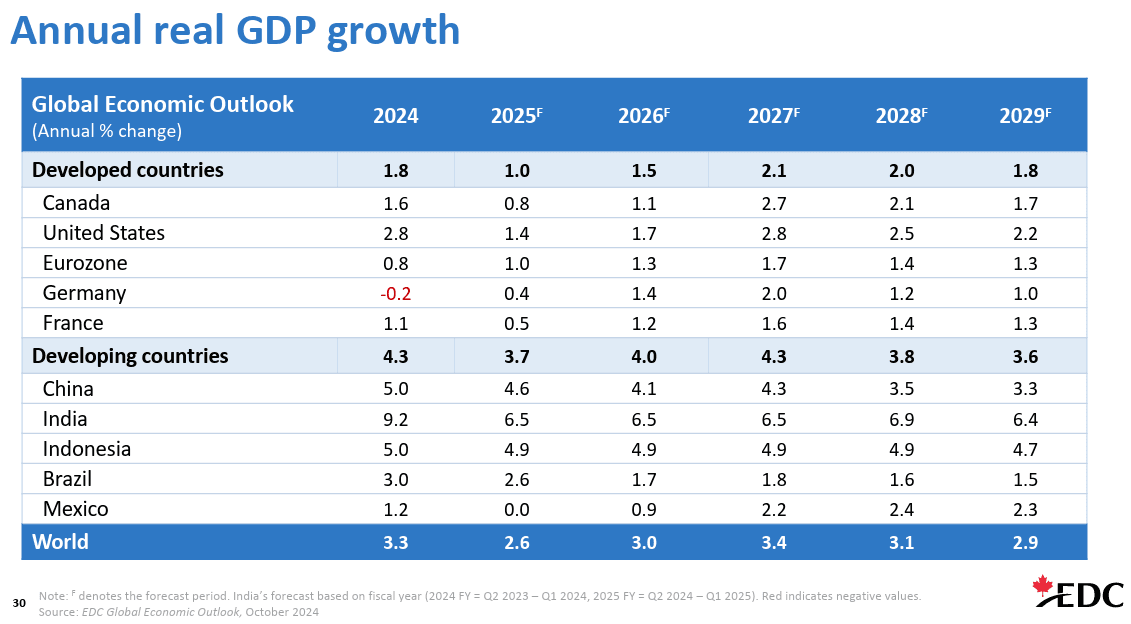
Tensions go beyond the United States at a time when Canada's government is seeking to diversify trade away from its southern neighbor. EDC cited Russia’s invasion of Ukraine, Middle East conflicts and tensions around the Taiwan Strait. Global growth will be 2.6% this year and 3% next year. The forecast is based on information through mid-June meaning it doesn't include Trump's recent threat of 35% tariffs on Canada by Aug. 1 and other penalties on the EU.
Canada's annual economic growth will slow by half to 0.8% this year according to EDC and next year see a modest pickup to 1.1%. The central bank will cut a total of three times this year, the report said, adding to moves in January and March, and see no change in 2026.
"An increasingly volatile outlook complicates business planning for Canadian companies, export-dependent or not, dampening investment and hiring prospects," EDC said. On a global level, "what’s clear is that growth is slowing and the cost of doing business is rising."