MNI: Canada Deficit CAD78B, Largest Ex Covid, On US Trade War

Canada budgeted its biggest ever cash deficit this fiscal year, excluding the pandemic, as Prime Minister Mark Carney seeks to revitalize an economy hurt by the U.S. trade war that has exposed a more chronic loss of competitiveness.
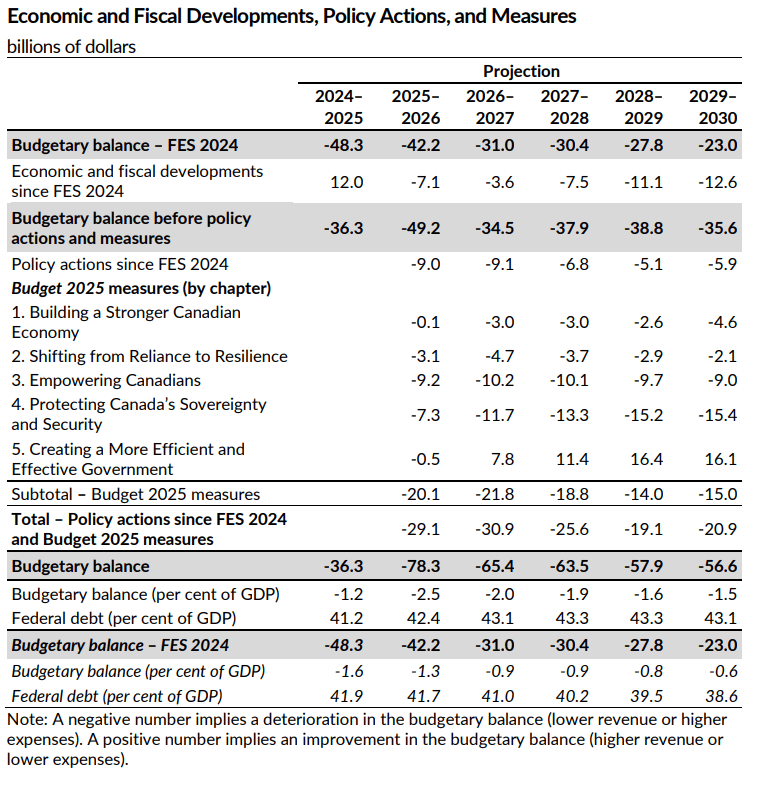
The CAD78 billion shortfall is up from a previous estimate of CAD42 billion last year when rising red ink led to Justin Trudeau's resignation after his finance minister refused to present that kind of a fiscal plan. Carney's Finance Minister Francois-Philippe Champagne says the deficit will narrow in the fiscal year starting April 1 to CAD65 billion or 2% of GDP from this year's 2.5%. Economists expected deficits of about CAD75 billion in both years.
Over a five-year horizon there is a cumulative extra CAD167 billion of extra deficits. Widening of the deficit in the next two years-- the average life of a minority government like Carney's-- includes a CAD10.7 billion weakening of the budget balance from trade-war damage and CAD60 billion of new tax and spending measures.
Gone is the Liberal Party's campaign pledge to lower federal debt as a share of GDP over the projection horizon, and it instead climbs from 41.2% last year to 43.1% in fiscal 2029. Champagne is keeping a "fiscal anchor" of lowering the deficit as a share of GDP, down to 1.5% over the next five years.
USING FISCAL FIREPOWER
"Canada has the lowest net debt-to-GDP ratio in the G7, and the federal debt-to-GDP ratio will remain stable over the Budget horizon," Champagne 's budget speech says. "And we must use this fiscal firepower to make generational investments."
The budget touts Canada's favorable position compared to a U.S. deficit of 7.4% of GDP, and a higher credit rating north of the border. Canada’s 10-year bond yielded 3.15% on Monday, well below the 4.11% for a similar US Treasury, reflecting of investor confidence in the country’s finances.
Canada will also lower its marginal investment tax rate further below the U.S. even after President Donald Trump's recent tax cuts, though economists warn the overall business tax rate likely favors U.S. projects.
Economic forecasts the finance department drew from private analysts show a much weaker economy than the prior fiscal update given last fall, but avoiding the recession that feared when Trump first threatened steep tariffs and using economic force to make Canada the 51st State. Growth is seen at 1.2% next year and the consensus is for the BOC policy rate to remain at 2.25% through 2026. (See: MNI INTERVIEW: Supply Damage Supports BOC Hold- Dal's McNeil)
Extra deficits still come without a steep increase in government borrowing plans, and there is even a slight downward revision to next year's expected bond and bill sales to CAD594 billion from CAD614 billion.
IMMIGRATION, SPENDING CUTS
Cuts including 10% of the federal workforce and CAD60 billion of program spending over the next five years are part of the plan, a goal investors say is often hard for governments to follow through on.
Immigration targets were also reduced again after a period of record inflows that added to a housing squeeze. The target for permanent residents was reduced to 380,000 for the next three years from the current 395,000 and temporary permits to 385,000 in 2026 from about 674,000 this year.
The budget affirmed past commitments to accelerating major resource projects, encouraging private investment to boost lagging productivity, meeting the 5% of GDP NATO spending target by 2035, a more vigorous industrial policy, building more homes, and measures to help with the rising cost of living. Government capital investment spending jumps from CAD52 billion in fiscal 2024 to CAD92 billion next year.
The federal debt rises from CAD1.27 trillion in fiscal 2024 to CAD1.59 trillion in 2029.
The deficit in cash terms is smaller than only pandemic years. It reached CAD328B in 2020-21, declined to CAD35B two years later, and moved up to CAD62B in 2023-24. Canada hasn’t run a substantial budget surplus since 2007. (See: MNI: Carney Deficits Are Bulwark Against Big Macklem BOC Cuts)