MNI BRIEF: Canada Budget Main Fiscal And Economic Tables
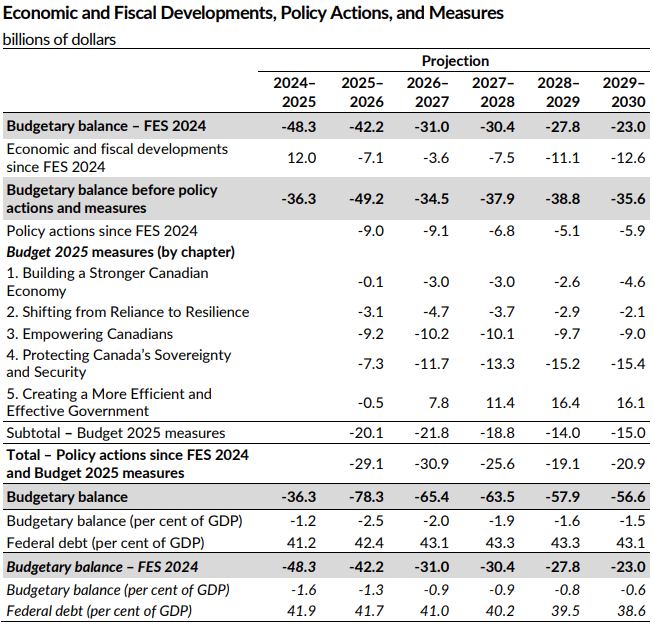
“The impact of recent U.S. tariffs and uncertainty over future trade rules have weighed on the Canadian economy. The downward revisions to the economic outlook relative to FES 2024 could be expected to result in an average estimated deterioration in the budgetary balance of $7 billion per year over the forecast horizon.”
“Real GDP growth is projected to recover through 2026, supported by stabilising exports and a recovery in domestic demand amid lower interest rates. As the Canadian economy adjusts to the new trading environment, growth is expected to pick up to reach around 2 per cent by 2027 and beyond.
Despite the trade war, real and nominal GDP in Canada are still expected to expand. The IMF expects that Canada will see the second strongest real GDP growth in the G7 in 2026, following only the U.S. (Chart 22).
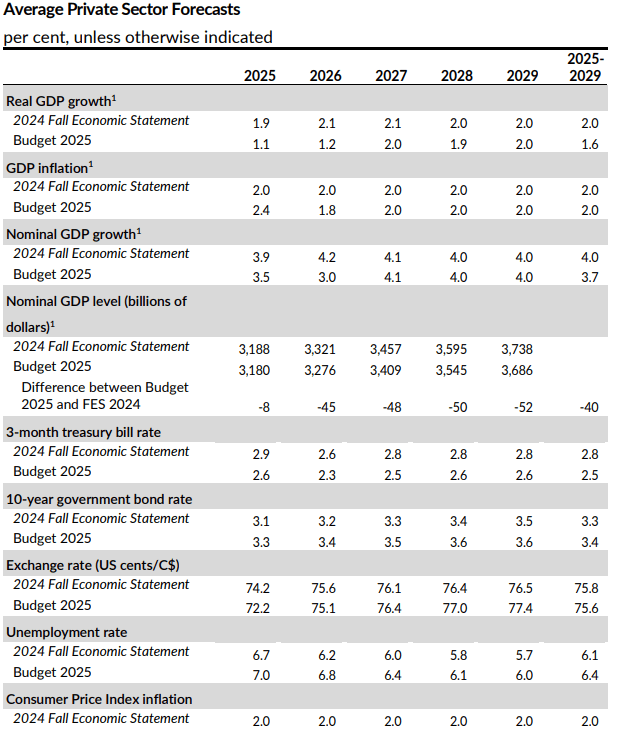
Overall, private sector forecasters expect real GDP growth of 1.1 per cent in 2025 and 1.2 per cent in 2026—revised down from the FES 2024 outlook of 1.9 per cent and 2.1 per cent, respectively. The level of real GDP is about 1.8 per cent lower than forecast in FES 2024 by the end of 2027. GDP inflation is expected to average 2.4 per cent in 2025 and 1.8 per cent in 2026 (compared to 2.0 per cent in both years in FES 2024) but is broadly similar to the FES 2024 outlook afterwards. Over the forecast horizon (2025-2029), the level of nominal GDP is lower than the FES 2024 projection by $40 billion on average per year.”