US OUTLOOK/OPINION: Macro Since Last FOMC: Labor - Solid NFPs But Other Cracks
- We characterized the single payrolls report since the last FOMC meeting as being “good enough to keep the Fed patient”.
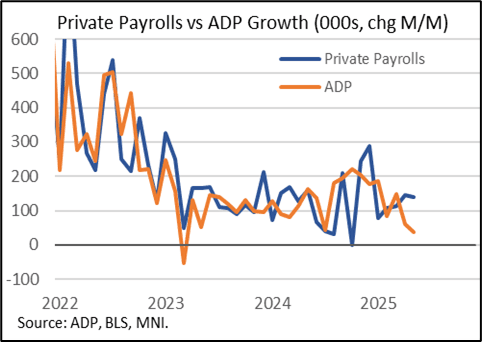
- Nonfarm paryolls growth modestly beat expectations in May with 139k (cons 126k) although was marred by a 95k two-month downward revision. It left a three-month average of 135k, which is still reasonable considering heavy restrictions in immigration policies see long-term breakeven estimates of 100k start to be a more realistic comparison.
- Private sector job creation has driven that almost entirely, with a three-month average of 133k, although the separate ADP report points to a more modest trend with a three-month average of 81k including just 37k in May.
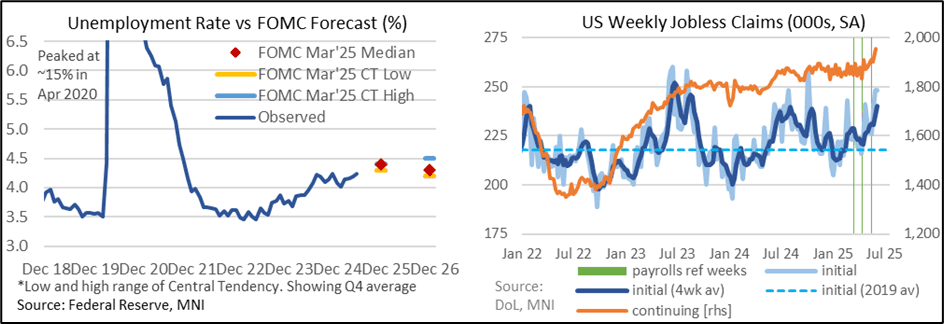
- The unemployment rate continued a slow upward trajectory as it increased from 4.187% to 4.244%, a fourth consecutive monthly increases. Whilst it has only increased a combined 0.11pp in the latest three months, it has nevertheless inched above November’s recent high of 4.23% for technically the highest since Oct 2021.
- On its own, and ahead of fresh projections to be formed at this meeting, it’s unlikely to trouble the median FOMC projection for an unemployment rate of 4.4% in 4Q25 from the March SEP (projections of course made ahead of reciprocal tariff announcements).
- However, whilst the initial resilience to policy changes under the second Trump administration might tempt some on the FOMC to leave their forecasts unchanged, the past two weeks of jobless claims data have provided a warning shot with signs of more pronounced deterioration.
Want to read more?
Find more articles and bullets on these widgets:
Historical bullets
RATINGS: Moody's Downgrades US's AAA Rating As Deficits Seen Ballooning
Moody's has downgraded the US's long-term credit rating to Aa1 trom Aaa. The move may not have been fully expected today. But it was the last holdout among they S&P and Fitch to demote the USA from the top rating, and they placed negative outlook on the US last year (now stable). Fiscal deterioration, both past and anticipated as Congress wrangles with the Republican fiscal bill, is cited as the key factor. From the release (link):
- “While we recognize the US’ significant economic and financial strengths, we believe these no longer fully counterbalance the decline in fiscal metrics."
- "This one-notch downgrade on our 21-notch rating scale reflects the increase over more than a decade in government debt and interest payment ratios to levels that are significantly higher than similarly rated sovereigns...We do not believe that material multi-year reductions in mandatory spending and deficits will result from current fiscal proposals under consideration."
- "If the 2017 Tax Cuts and Jobs Act is extended, which is our base case, it will add around $4 trillion to the federal fiscal primary (excluding interest payments) deficit over the next decade. As a result, we expect federal deficits to widen, reaching nearly 9% of GDP by 2035, up from 6.4% in 2024, driven mainly by increased interest payments on debt, rising entitlement spending, and relatively low revenue generation."
- "We anticipate that the federal debt burden will rise to about 134% of GDP by 2035, compared to 98% in 2024."
- "Federal interest payments are likely to absorb around 30% of revenue by 2035, up from about 18% in 2024 and 9% in 2021. The US general government interest burden, which takes into account federal, state and local debt, absorbed 12% of revenue in 2024, compared to 1.6% for Aaa-rated sovereigns."
US FISCAL: "Extraordinary Measures" Continue To Dwindle Amid Debt Impasse
The "extraordinary measures" available to Treasury to stave off a debt default were down to $82B as of May 14, per a Treasury Department release today.
- That compares unfavorably with a high of $335B in January when the debt limit impasse began. Combined with $562B in Treasury cash on hand, though, after April's large tax intakes, that makes for around $644B in available resources before the "x-date" is reached.
- Resources are gradually being eroded since reaching nearly $800B in mid-April.
- Per Tsy Sec Bessent's letter to Congress last week, "after reviewing receipts from the recent April tax filing season, there is a reasonable probability that the federal government's cash and extraordinary measures will be exhausted in August while Congress is scheduled to be in recess. Therefore, I respectfully urge Congress to increase or suspend the debt limit by mid-July, before its scheduled break, to protect the full faith and credit of the United States."

CANADA DATA: Sales Activity Points To Potential Marking Up Of GDP Ests
There was mixed news on the housing and wholesale/manufacturing sales fronts this week, which on net look to slightly upwardly bias Q1 GDP estimates, pending next week's retail sales reading.
Housing starts blew through expectations at 278.6k in April (226.2k expected, 214.2k prior). This came after building permits fell a worse-than-expected 4.1% M/M in March as reported Wednesday.
- Meanwhile, he Canadian Real Estate Association reported existing home says April sales unexpectedly contracted -0.1% M/M (+1.0% expected, -4.8% prior). Sales are now down 9.8% Y/Y, while prices fell 1.2% M/M (3.6% Y/Y on the price index). (Link)
- Overall, confidence appears subdued, which is likely to translate into subdued activity.

On the sales front, March data was soft but positive versus expectations and could add a slight upward drift to Q1 GDP expectations.
- Manufacturing sales were less negative than expected at -1.4% M/M (-1.9% expected/flash estimate, -0.2% prior rev up 0.4pp). The decline was led by primary metals -6.5%, an area hit by U.S. tariffs, and oil -4.2%. Overall Q1 factory sales grew +1.6% vs prior +1.1%.(Link)
- Wholesales ex-petroleum and grains rose 0.2% in March, vs the advance estimate / consensus -0.3%. Sales volumes fell 0.3%. Overall Q1 wholesales rose 2.5%, led by machinery/equipment and autos/parts.


