JAPAN DATA: Import Prices Rising M/M, As USD/JPY Firms, But Y/Y Still Negative
Rebounding USD/JPY levels has helped push up imported price pressures in Japan. Recent comments from Japan policy makers suggest the weaker yen's impact is not going unnoticed. Still, it remarks to be seen if we see policy steps to address this, particularly as PM Takaichi remarks seemingly push back against an aggressive BoJ tightening cycle.
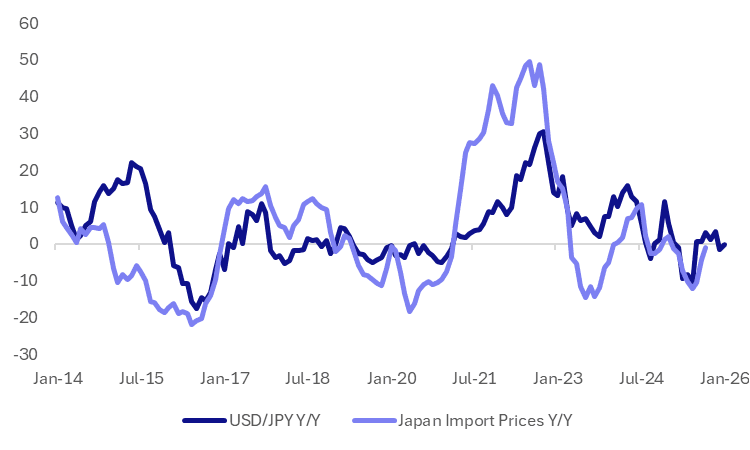
- Earlier data for Oct showed a 2.5%m/m gain, the strongest rise since late 2024. Still, in y/y terms, we remain negative at -1.5%. If USD/JPY continues to track higher, positive m/m gains are likely to continue if we see higher USD/JPY levels. In y/y terms if current levels hold around 155, the the y/y import price pulse is not likely to strengthen too much (see the chart below). If we get closer towards 160, this implies positive y/y import prices through to year end/early 2026 (roughly in the 3-4% region)
- From yesterday the Japan FinMin stated: "JAPAN FINMIN KATAYAMA: WON'T DENY DISADVANTAGES OF WEAK YEN OUTWEIGHING ADVANTAGES - [RTRS]"
- While earlier today, "JAPAN FINANCE MINISTER KATAYAMA: IF YEN MAKES FREE FALL, THAT WILL PUSH UP IMPORT COSTS AND CAUSE INFLATION UNSEEN IN THE PAST BUT WE WILL PURSUE 'RESPONSIBLE' FISCAL POLICY TO AVOID THIS FROM HAPPENING - [RTRS]"
- If current USD/JPY levels persist, y/y momentum in import price pressures may remain fairly contained. These metrics are likely to shift though if we trend towards 160.00.
Fig 1: USD/JPY Y/Y & Japan Import Prices Y/Y (Extended A Few Mths Assuming USD/JPY Holds Near 155)
Source: Bloomberg Finance L.P./MNI
Want to read more?
Find more articles and bullets on these widgets:
Historical bullets
CHINA: 10-Yr Bond Future Tests Key Technical
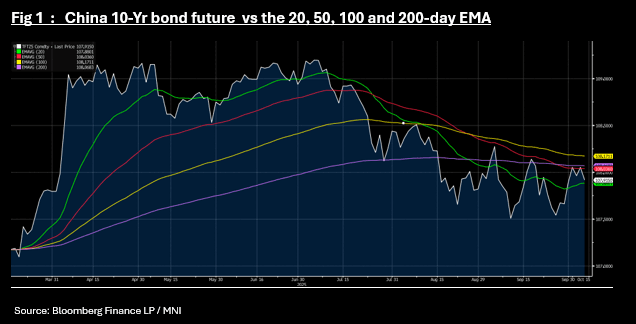
- Bond futures are lower in morning trade, with the 10-Yr down -0.14 as equities open stronger.
- The fall in the 10-Yr saw the future trade near to the 20-day EMA of 107.87, failing to break below.
- The 2-Yr is down -0.02 at 102.346 to move further below all major moving averages.
- The 10-Yr CGB is up marginally in yield at 1.85% and continues to trade in tight ranges between 1.80% - 1.90% and has been unable to break clear of this range, despite the issuance across central and regional government and despite the absence of PBOC buying. The equity strength of late has failed to push yields dramatically higher either suggesting that we could be in this range for the near term or until further policy were to be announced.
- China is issuing CNY40 bn of 2045 bonds today as the key issuance for the week.
CHINA PRESS: E-commerce Platforms Begin Shopping Festival Promotion
Several leading e-commerce platforms have already kicked off their campaigns for the upcoming Nov 11 “Double 11” shopping festival, according to a report by Yicai. Sources indicate that Taobao’s Flash Sale platform will participate in Tmall’s Double 11 for the first time this year, offering more than 10 million free-order coupons to consumers. Zhang Yi, founder and chief analyst at iiMedia Research, noted that the integration of instant retail services into the Double 11 event is likely to intensify the subsidy competition among platforms. With food delivery companies expected to join the event, Zhang anticipates sharper price wars across categories such as daily necessities, baby products, and food. However, for small- and medium-sized merchants, business may become increasingly challenging, Yicai noted.
CHINA PRESS: China's Imports Should Achieve Positive Annual Growth
China’s steady recovery in domestic demand is expected to drive imports to positive annual growth, following a 7.5% year-on-year increase in September, according to Cui Fan, professor at the University of International Business and Economics. Total imports for the first nine months reached CNY13.6 trillion, narrowing the decline during the first nine months to just 0.2%. On the export front, Cui noted that cumulative exports rose 7.1% year-on-year in the first three quarters, with September exports up 8.4%, coming despite a 16.2% year-on-year drop in shipments to the U.S., demonstrating overall resilience.


