BOC: Gov Macklem: USD's Status As Global "Safe Asset" Under Threat
BOC Gov Macklem's speech Tuesday (link) titled "Global trade, capital flows and Canada’s prosperity" focuses on structural issues facing the Canadian (and to an extent, the US) economy. With little new on current monetary policy, implied BOC rates are little changed upon speech release (still 22bp of cuts priced through year-end), with USDCAD remaining around session highs (at 1.3845, next resistance to watch is Sep 11 high of 1.3890).
- The speech opens with the line "Canada is a trading nation" - but goes on to outline "four megatrends in global trade and capital flows that are transforming the global economic and financial landscape: Global trade growth has slowed. The United States is no longer the dominant trading nation, but it still dominates global financial flows. And global trade imbalances are widening again. President Trump did not precipitate these megatrends, but his policies will likely reduce trade with the United States further and could dent the US dollar as the global safe asset."
- In this new landscape, he says re BOC policy: "Tariffs have weakened our exports and GDP growth, slowed the job market and added costs. Monetary policy cannot undo the damage caused by tariffs, but it has a role to play supporting the economy through this period of adjustment while maintaining price stability. Last week, the Bank lowered its policy interest rate to better balance the risks we face as the economy adjusts to a new trade relationship with the United States. We are proceeding carefully with particular attention to the risks and uncertainties. And as we demonstrated last week, we are prepared to respond to new information. We will support economic growth while ensuring inflation remains well controlled."
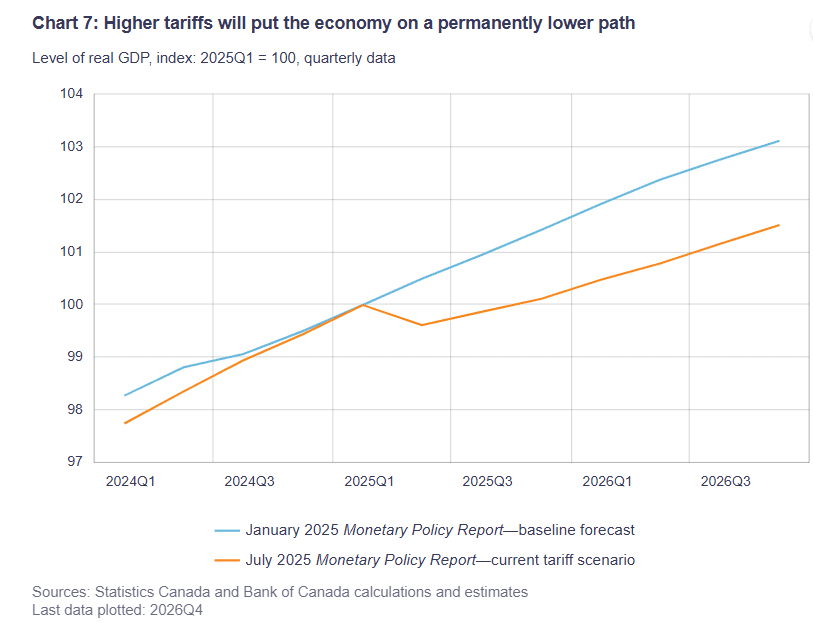
- He repeats commentary about short-term impacts of the US-Canada trade conflict "The tariff shock is hurting economic growth and employment". And he repeats the BOC's longer-run assessment from this year's Monetary Policy Reports that "In the longer term, increased trade friction with the United States means our economy will work less efficiently, with added costs and less income."
- "Canada has a choice. We can live with the structural impact of a more protectionist United States—the lower path. Or we can improve our productivity and competitiveness...Canadians have embraced the power of economic patriotism—elbows up. But now we need to roll up our sleeves and do the hard work to be more competitive."
- On the USD, he says "President Trump’s “Liberation Day” shook global confidence, and the dollar’s safe-haven role was called into question. Stock markets have since recovered, but the dollar has depreciated by about 10% against other major currencies since the start of the year, and the price of gold is up over 40%. It’s too early to know if this is the start of a new era. For now, the greenback remains dominant, and—without a clear alternative—I suspect it will remain the global reserve currency for the foreseeable future. But for many, its value as a hedge in times of stress has been dented. And President Trump’s attempts to influence the Federal Reserve are raising questions about the continued independence of US monetary policy."
Want to read more?
Find more articles and bullets on these widgets:
Historical bullets
FED: NatWest Now Sees Cuts In 2025, Starting In September
As with Deutsche earlier, NatWest has changed its Fed call after the Powell Jackson Hole speech to reflect a 25bp September cut. Previously, the call was for no cuts in 2025. The new baseline outlook includes further 25bp cuts in December and March, bringing rates closer to neutral ("however, the changing composition of the committee becomes far less clear once Powell term expires in May").
- "While the August jobs and CPI reports will be watched carefully, it is clear to us that Powell has already seen enough to decide renewed action to counter downside economic risks is likely warranted, and so we now look for a 25 basis point rate cut on September 17th.
- "We expect officials will very much downplay the likelihood of a 50bp rate cut leading up to the jobs data, but we have to admit if the report is "weak enough" (e.g., the unemployment rate increases by 0.3pct to 4.5% (where officials had it at year end) anything can happen and wouldn't rule anything out. However, given the latest pivot and with financial markets pricing (86% of a 25bp rate cut) a lot has to happen (unemployment rate 3-handle and core CPI +0.5%) for the FOMC to undeliver and hold off from a rate cut in September. "
USDCAD TECHS: Bull Cycle Hindered
- RES 4: 1.4111 High Apr 10
- RES 3: 1.4019 38.2% retracement of the Feb 3 - Jun 16 bear leg
- RES 2: 1.3968 High May 20
- RES 1: 1.3925 High Aug 22
- PRICE: 1.3840 @ 16:55 BST Aug 22
- SUP 1: 1.3794 20-day EMA
- SUP 2: 1.3769/22 50-day EMA / Low Aug 22
- SUP 3: 1.3576 Low Jul 23
- SUP 4: 1.3557/40 Low Jul 3 / Low Jun 16 and the bear trigger
Gains this week in USDCAD and the breach of resistance at 1.3879, the Aug 1 high, marked a positive development, however the slippage into the Friday close undermines this sentiment - for now. Moving average studies have crossed and are in a bull-mode position, reinforcing current conditions. An extension higher would signal scope for a climb towards 1.4019, a Fibonacci retracement. On the downside, support to watch lies at 1.3769, the 50-day EMA - a level not yet challenged by the correction lower.
CANADA: Q2 Expected To See GDP Contraction, BOC's Estimate Looks Too Negative
The June retail sales release helps wrap up the last major data before Canadian Q2 GDP is released on Friday August 29.
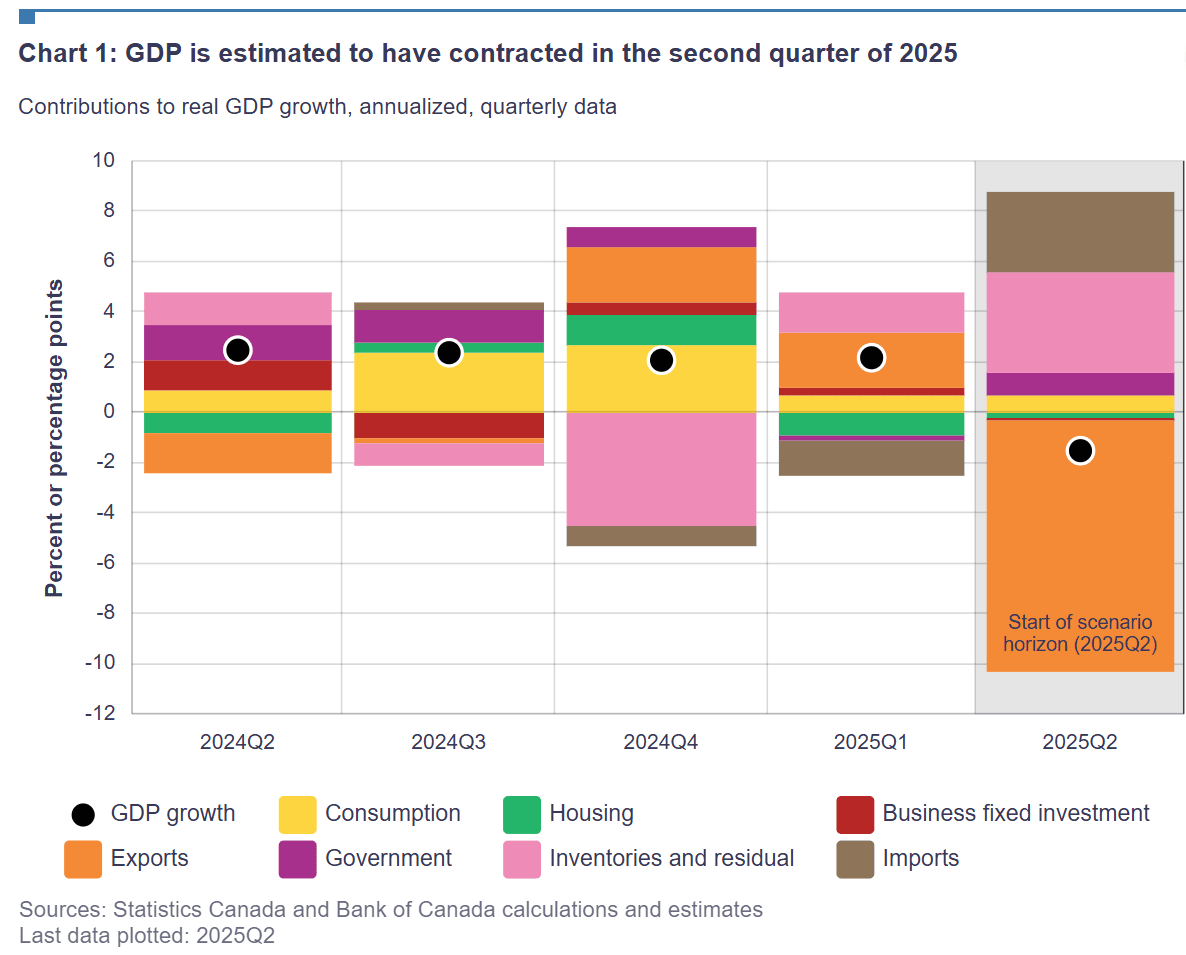
- Current Bloomberg analyst consensus shows Q2 is expected to show a 0.7% Q/Q annualized contraction, versus +2.2% in Q1. The private sector consensus is more optimistic than the Bank of Canada's -1.5% estimate in its July Monetary Policy Report (which MNI thinks is too low) but the component-by-component breakdown is similar if of differing magnitudes.
- Widely expected are: a softening in household consumption growth (+1.2% in Q1), with a pickup in government spending, continued weakness in fixed investment (-3.0% in Q1) though with residential outperforming business capital formation, and a reversal of Q2's positive contribution from net exports. In short, the data are expected to confirm that trade activity was brought forward to Q1 ahead of tariffs, with the effects reversing in Q2.
- Going forward, the BOC envisages growth resuming in Q3 (+1.0% in its "current tariff" scenario). In the meantime, a weak Q2 reading could provide Governing Council with more conviction to resume easing rates in September, with the July meeting decision noting "If a weakening economy puts further downward pressure on inflation and the upward price pressures from the trade disruptions are contained, there may be a need for a reduction in the policy interest rate".