JGBS: Downtrend In Futures Intact, BoJ No Hints On Further Rate Hike Timing
JGB futures ended last Friday trade holding the bulk of post BoJ losses, March futures at 132.84, -.01 versus settlement levels. The early bias may be negative given softer US Tsy futures on Friday (although part of this was reflective of the JGB move post the BoJ on Friday). Downside focus will persist though, particularly now that the 10yr outright JGB yield is above 2.00%. The technical trend for futures remains bearish, with 132.17 representing 1.0% of the 10-dma envelope in terms of a potential downside target.
- BoJ Governor Ueda on Friday, laid the groundwork for further interest rate increases after the BOJ’s board decided on a unanimous 25-basis-point hike to the highest level in three decades on Friday, but provided little clue as to timing and stressed that policymakers must examine the impact of higher rates on the economy, inflation and financial conditions.
- We did see fresh yen weakness after the BOJ outcome (and Ueda's press conference), as markets were left unsatisfied around next BoJ rate hike timing. Focus will be on whether yen weakness drives JGB yields.
- This is also feeding into steeper curve biases, with 2/10s to fresh highs near +93bps, while the 2/30s is around +233bps, still under recent cycle highs.
- The local data calendar only has Nov Tokyo condominiums for sale today, not a market mover.
Want to read more?
Find more articles and bullets on these widgets:
Historical bullets
RATINGS: Moody's Upgrades Italy To Baa2 From Baa3, Still A Notch Below Others
The Moody's upgrade to Italy's credit rating announced late Friday was the first from the agency since 2002 but shouldn't be considered a major surprise. Among the 3 major ratings agencies, Moody's had the lowest rating on Italy - by two notches (Fitch and S&P both BBB+).
- So this upgrade to Baa2 from Baa3 represents something of a closing of that gap rather than a major breakthrough for Italy.
- From the release:
- "The rating upgrade reflects a consistent track-record of political and policy stability which enhances the effectiveness of economic and fiscal reforms and investment implemented under the National Recovery and Resilience Plan (NRRP). It also points to prospects of further policy actions supporting growth and fiscal consolidation beyond the plan's deadline in August 2026. As a result, we expect that Italy's high government debt burden will gradually decline from 2027 onwards."
FED: Heading Into Its Final Weeks, QT Pace Remains At $20B/Month (2/2)
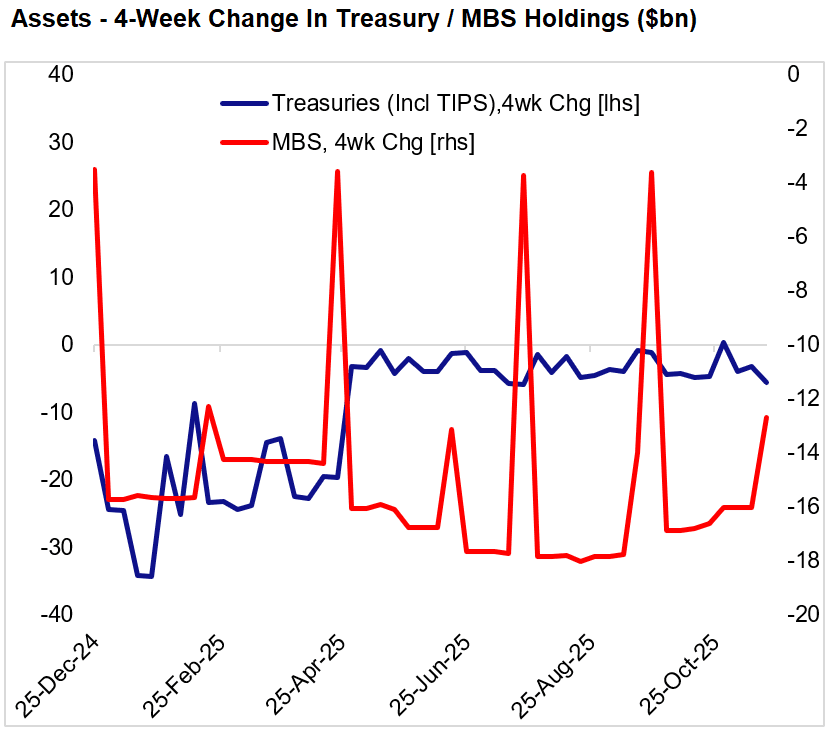
On the asset side of the Fed balance sheet, we saw a $25B drop in assets, of which just $2B could be attributed to QT in one of its final weeks (ends Dec 1).
- Instead it was a $6B drop in dealer repo operations vs a week earlier, and $17B in "other" areas that aren't related directly to monetary policy and typically don't have any significant impact on the size of the balance sheet (such changes are largely due to items such as bank premises, accrued interest, and other accounts receivable.)
- Discount window takeup edged up $0.3B to $6.1B but remains relatively low.
- QT has totaled just under $21B over the last month, around the expected pace, though as noted this will flatline in December with a pickup in net bills as MBS proceeds are rolled over into T-bills.

LOOK AHEAD: US Week Ahead: Retail Sales, PPI & Claims Headline Thanksgiving Week
A Thanksgiving-condensed week sees data highlights from delayed retail sales and PPI reports for September on Tuesday (Nov 25) before a Wednesday release for weekly jobless claims (Nov 26). Aside, the Fed’s Beige Book should also offer another important update on Wednesday for latest liaison reporting, with no Fedspeak currently scheduled around the holiday and the FOMC media blackout due to start on Saturday, Nov 29.
- As we regularly comment in this weekly publication, Redbook and Chicago Fed CARTS indicators point to solid nominal growth in retail sales, something broadly reflected in analyst consensus for the release.
- PPI inflation will offer a useful albeit not overly timely update on input cost pressures.
- Jobless claims will be watched particularly closely, both for latest initial claims for signs of layoffs and a notable update for continuing claims. The latter covers the payrolls reference period for November and will be an important reference point for FOMC members trying to get a sense of latest unemployment rate clues with the next payrolls reports coming after the Dec 9-10 FOMC decision (going into it with this week’s 0.12bp rise to 4.44% back in September).


