EM ASIA CREDIT: China Resources Land: New USD deal
Nov-13 01:24
(CRHZCH, Baa1/BBB+/BBB+)
"*IPT: CHINA RESOURCES LAND $BMRK 3Y REGS GREEN NOTES +120 BPS A" - BBG
Real estate business, China Resources Land is coming to the market with a new 3Y USD and 5Y CNH deal.
Want to read more?
Find more articles and bullets on these widgets:
Historical bullets
CHINA: Central Bank Injects CNY91bn via OMO
Oct-14 01:24
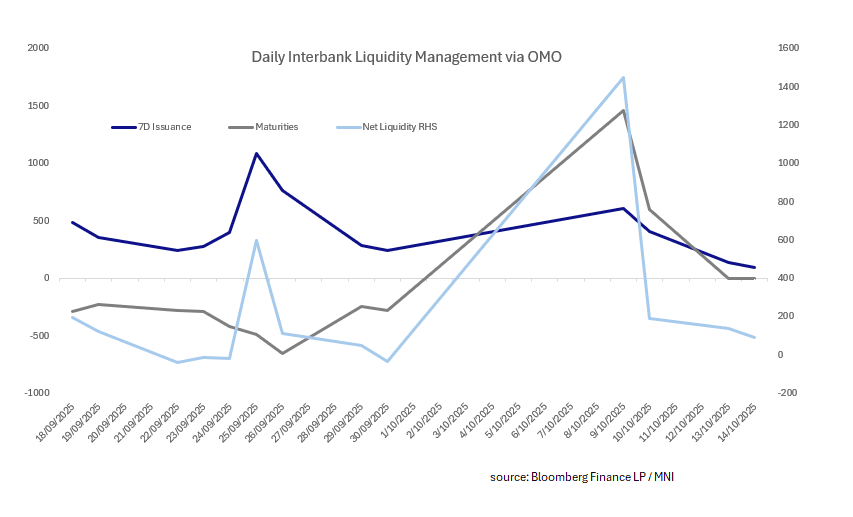
- The PBOC issued CNY91bn of 7-day reverse repo at 1.4% during this morning's operations.
- Today's maturities CNY 0 bn.
- Net liquidity injection CNY91bn.
- The PBOC monitors and maintains liquidity in the interbank system through the issuance of reverse repo.
- The CFETS Pledged Repo Deposit Institutions 7 Day Weighted is at 1.41%, from prior close of 1.44%.
- The China overnight interbank repo rate is at 1.30%, from the prior close of 1.28%.
- The China 7-day interbank repo rate is at 1.43%, from the prior close of 1.46%.
CHINA SETS YUAN CENTRAL PARITY AT 7.1021 TUES VS 7.1007
Oct-14 01:19
- CHINA SETS YUAN CENTRAL PARITY AT 7.1021 TUES VS 7.1007
RBA: Minutes Reflect More Caution Than Downside Concerns, Nov Hold Plausible
Oct-14 01:11
The RBA minutes clearly reflected the Board’s caution at the 30 September decision to keep rates unchanged. Its “decisions”, ie. not just last month’s, “remain cautious and data dependent”. Thus the outcomes of releases between now and 4 November are very important and the tone of the minutes was clear that a rate cut at that meeting is not a given. Today’s September NAB business survey was consistent with an ongoing recovery in activity.
- There were a number of observations that suggest the Board may hold again. It noted that “early indicators” for Q3 showed private demand could be recovering a bit faster than expected, so not just the backward-looking Q2 GDP data, and that it may have underestimated consumption growth in August. Also on growth, the US is “steady” and the risk from “higher tariffs” has “diminished”, while fiscal policy should support a weaker China.
- Not only do the July/August CPI outcomes suggest Q3 inflation may be higher than the RBA expected in August but that combined with “broadly stable labour market conditions” may imply that it underestimated the extent of capacity pressures. As Governor Bullock noted, elevated services in other countries may have “potential lessons for Australia” too.
- Monetary policy is deemed “restrictive” but the RBA doesn’t know by how much. It is seeing the impact of previous easing on housing and credit growth and it knows that it hasn’t fully fed through. It seems to be slightly uncomfortable with the current effect of easier financial conditions.
- There was little discussion of downside risks with the only consideration in the minutes that staff projections “were not taking sufficient signal” from “persistent weakness in consumer sentiment”, softer employment and “timely indicators of wages”.
- Key data coming up include 29 October Q3 CPI, 16 October September jobs, 31 October September private credit and 3 November September household spending.

Trending Top
Jan-30 21:43

Jan-30 21:11

