CANADA DATA: Breadth Of Employment Gains Impresses In Strong October LFS Report
Nov-07 14:06
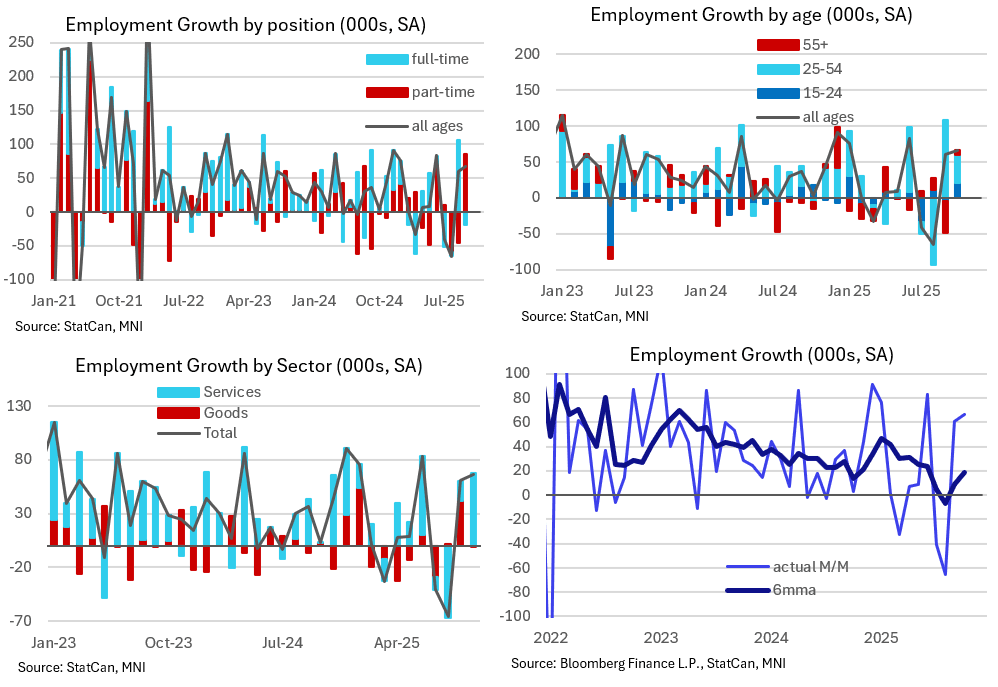
For a second consecutive month, October's Labour Force Survey greatly impressed versus expectations. Employment gains totaled 66.6k, a 4-month best, and up from 60.4k in September. And the unemployment rate fell 0.22p to an unrounded 6.88%, a 4-month low. The median Canadian analyst had seen +10k / 7.1%.
- Looking first at the employment numbers, the first aspect that stands out is the large jump in part-time employment: +85k for the largest gain since February 2022; whereas full-time employment fell 19k for the weakest reading in 3 months. However this came after a fall of over 100k in PT in the prior 2 months, and the 3-month sum now stands at just -20k, so this is something of an even-ing out. FT employment has risen by 82k in the last 3 months.
- While trend employment growth remains subdued versus 2023-24, it's more clearly beginning to inflect higher after 6-month growth rates went negative in the summer. At this point full-time employment is still rising at about 1.2% Y/Y, with part-time now up 2.7%; overall employment is +1.4% Y/Y, not quite keeping up with labour force growth of 1.7% Y/Y.
- Employment gains were seen across all three major age categories for the first time since January 2024. Age 15-24 employment rebounded 21k after falling 4k prior, 55+ was up 7k after -44k prior, and prime age employment rose 39k after an outsized 109k prior.
- From a sectoral perspective, gains were focused largely in the services sector which saw 68k higher employment, led by Wholesale and retail trade (+41k) and Transportation and warehousing (+30k) - particularly key since these had both contracted for 2 consecutive months and had been seen to be particularly vulnerable to the US-Canada trade conflict. Information, culture and recreation was a big contributor too, up 25k for the biggest rise since Feb 2022 though there was modest weakness in most other services categories.
- Also on the trade-related front, manufacturing employment rose for a second consecutive month at +9k, after 28k, though this wasn't enough to keep overall goods-production employment from falling 1k (a 15k drop in Construction - a 3rd drop in 4 months - was the standout here). Overall there is some stabilization here though after a very weak Feb-Jul.
Want to read more?
Find more articles and bullets on these widgets:
Historical bullets
SOFR OPTIONS: BLOCK/Pit: Large Feb'26 SOFR Call Spread Buy
Oct-08 13:47
- +50,000 SFRG6 97.25/97.50 call spds, 1.0 ref 96.52 at 0939-0942ET
EUR: Euro Effective Exchange Rate Still Historically Stretched
Oct-08 13:47
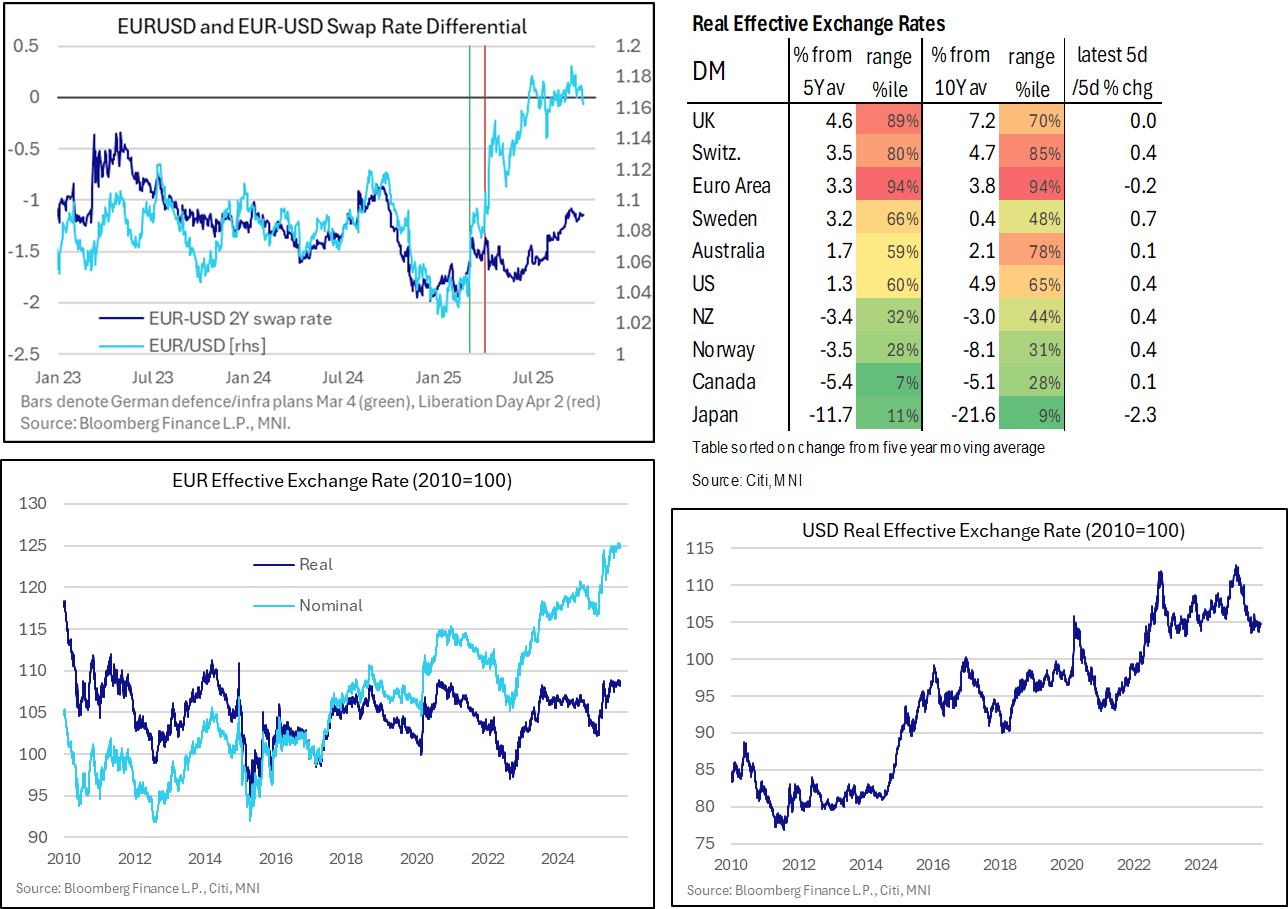
- EURUSD has held onto a dip below 1.1650 today, earlier touching a low of 1.1606 in what was its lowest since early September.
- In doing so, it has pulled back from mid-September’s short-lived fresh cycle high of 1.1919 having pushed through the previous high of 1.1829 on Jul 1. The latter came with ECB VP De Guindos explicitly saying a 1.20 level is “acceptable” but something above that “would be more complicated”. It was part of remarks that were more typical for central bank speech, with the speed of the euro’s climb more worrying than the level.
- Since then, at an MNI event on Sep 18, De Guindos pushed back on focusing on EURUSD and talked to the nominal effective exchange rate as part of a comprehensive approach.
- “The media gives a lot of attention to the exchange rate of the euro vis-a-vis the dollar, but I think that we have to give much more attention to what we call the nominal effective exchange rate. And here with China, I think that sometimes we overlook a little bit what's happening there, and this is another element of uncertainty that we will have to carry”. The NEER is “something that we have to look at carefully, because it’s going to be relevant for growth and for inflation”.
- To this end, the euro NEER according to Citi has eased 0.7% from highs seen on Sep 18 but clearly remains close to those multi-year highs – see charts.
- We prefer looking in real terms when it comes to a cross-country comparison, and here the euro sits at the 94th percentile over both five- and ten-year windows. This is the most stretched across developed markets although both sterling and the Swiss franc see higher relative deviations from historical averages.
- These ranges in isolation suggest asymmetrical risk ahead with skew towards a weaker euro.
- That’s coupled with some ECB Governing Council members not appearing overly concerned by disinflationary implications from the currently elevated exchange rate. One example was a typically centrist Bank of Spain’s Escriva earlier today saying he wouldn’t overemphasize a strong euro as a risk factor for the inflation outlook, whilst Bundesbank's Nagel wasn't concerned about the euro's valuation on Sep 22.
EURIBOR OPTIONS: More Large Upside Options
Oct-08 13:37
ERH6 98.25/98.37cs, bought for 1 in 20k.

Trending Top
Mar-27 20:13


