NEW ZEALAND: BNZ Indices Signal Economic Slowdown & Job Shedding
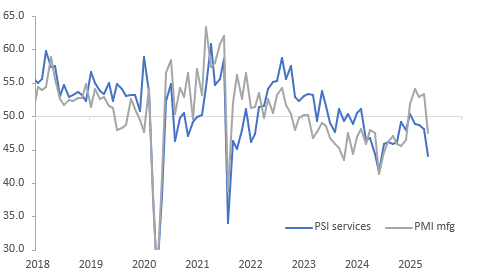
BNZ’s manufacturing and services PMIs both deteriorated in May and are below the breakeven-50 level and senior economist Steel warned that they are consistent with a return to a recession. With rates now in the “neutral zone” and the RBNZ Governor Hawkesby saying the MPC doesn’t have a bias, it looks like the RBNZ will be on hold on July 9 as it waits for more data, but it does monitor these indices and they suggest that the meeting will be “live”. The June PMIs are not released until July 10 & 13.
NZ BNZ PMI vs PSI
Source: MNI - Market News/BNZ/LSEG
- The performance of services index fell 4.1 points to 44.0 in May, the lowest since June 2024 signalling that the sector contracted at its fastest rate in almost a year. The decline was driven by sharp drops in new orders and activity/sales. All components are in negative territory.
- BNZ noted that negative comments from services businesses rose to 65.6% in May from 61.8% in April and 56.7% in March. They cited “rising costs, economic uncertainty and low consumer confidence” as reasons for the increase and that customers remain cautious.
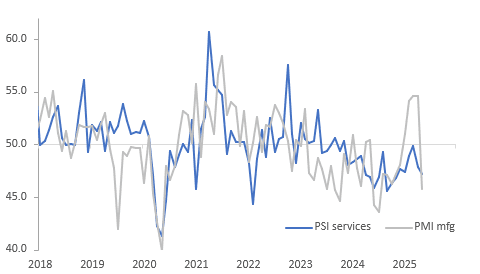
- Services employment fell at a slightly faster pace in May at 47.2 than April’s 47.9. There was also job shedding in the manufacturing sector with the employment index falling to 45.7 from 54.6, the lowest since July 2024 and suggesting that recent global developments have impacted hiring plans. This does not bode well for Q2 employment with both sectors so weak.
- The manufacturing PMI in May shifted into contractionary territory for the first time in 2025 at 47.5 with all components except inventories contracting. New orders deteriorated to 45.3 from 50.8.
NZ BNZ PMI vs PSI - Employment
Source: MNI - Market News/BNZ/LSEG
Want to read more?
Find more articles and bullets on these widgets:
Historical bullets
RATINGS: Moody's Downgrades US's AAA Rating As Deficits Seen Ballooning
Moody's has downgraded the US's long-term credit rating to Aa1 trom Aaa. The move may not have been fully expected today. But it was the last holdout among they S&P and Fitch to demote the USA from the top rating, and they placed negative outlook on the US last year (now stable). Fiscal deterioration, both past and anticipated as Congress wrangles with the Republican fiscal bill, is cited as the key factor. From the release (link):
- “While we recognize the US’ significant economic and financial strengths, we believe these no longer fully counterbalance the decline in fiscal metrics."
- "This one-notch downgrade on our 21-notch rating scale reflects the increase over more than a decade in government debt and interest payment ratios to levels that are significantly higher than similarly rated sovereigns...We do not believe that material multi-year reductions in mandatory spending and deficits will result from current fiscal proposals under consideration."
- "If the 2017 Tax Cuts and Jobs Act is extended, which is our base case, it will add around $4 trillion to the federal fiscal primary (excluding interest payments) deficit over the next decade. As a result, we expect federal deficits to widen, reaching nearly 9% of GDP by 2035, up from 6.4% in 2024, driven mainly by increased interest payments on debt, rising entitlement spending, and relatively low revenue generation."
- "We anticipate that the federal debt burden will rise to about 134% of GDP by 2035, compared to 98% in 2024."
- "Federal interest payments are likely to absorb around 30% of revenue by 2035, up from about 18% in 2024 and 9% in 2021. The US general government interest burden, which takes into account federal, state and local debt, absorbed 12% of revenue in 2024, compared to 1.6% for Aaa-rated sovereigns."
US FISCAL: "Extraordinary Measures" Continue To Dwindle Amid Debt Impasse
The "extraordinary measures" available to Treasury to stave off a debt default were down to $82B as of May 14, per a Treasury Department release today.
- That compares unfavorably with a high of $335B in January when the debt limit impasse began. Combined with $562B in Treasury cash on hand, though, after April's large tax intakes, that makes for around $644B in available resources before the "x-date" is reached.
- Resources are gradually being eroded since reaching nearly $800B in mid-April.
- Per Tsy Sec Bessent's letter to Congress last week, "after reviewing receipts from the recent April tax filing season, there is a reasonable probability that the federal government's cash and extraordinary measures will be exhausted in August while Congress is scheduled to be in recess. Therefore, I respectfully urge Congress to increase or suspend the debt limit by mid-July, before its scheduled break, to protect the full faith and credit of the United States."

CANADA DATA: Sales Activity Points To Potential Marking Up Of GDP Ests
There was mixed news on the housing and wholesale/manufacturing sales fronts this week, which on net look to slightly upwardly bias Q1 GDP estimates, pending next week's retail sales reading.
Housing starts blew through expectations at 278.6k in April (226.2k expected, 214.2k prior). This came after building permits fell a worse-than-expected 4.1% M/M in March as reported Wednesday.
- Meanwhile, he Canadian Real Estate Association reported existing home says April sales unexpectedly contracted -0.1% M/M (+1.0% expected, -4.8% prior). Sales are now down 9.8% Y/Y, while prices fell 1.2% M/M (3.6% Y/Y on the price index). (Link)
- Overall, confidence appears subdued, which is likely to translate into subdued activity.

On the sales front, March data was soft but positive versus expectations and could add a slight upward drift to Q1 GDP expectations.
- Manufacturing sales were less negative than expected at -1.4% M/M (-1.9% expected/flash estimate, -0.2% prior rev up 0.4pp). The decline was led by primary metals -6.5%, an area hit by U.S. tariffs, and oil -4.2%. Overall Q1 factory sales grew +1.6% vs prior +1.1%.(Link)
- Wholesales ex-petroleum and grains rose 0.2% in March, vs the advance estimate / consensus -0.3%. Sales volumes fell 0.3%. Overall Q1 wholesales rose 2.5%, led by machinery/equipment and autos/parts.


