FOREX: USDCAD Pressured Lower Following Stellar Jobs Report
Nov-07 14:03
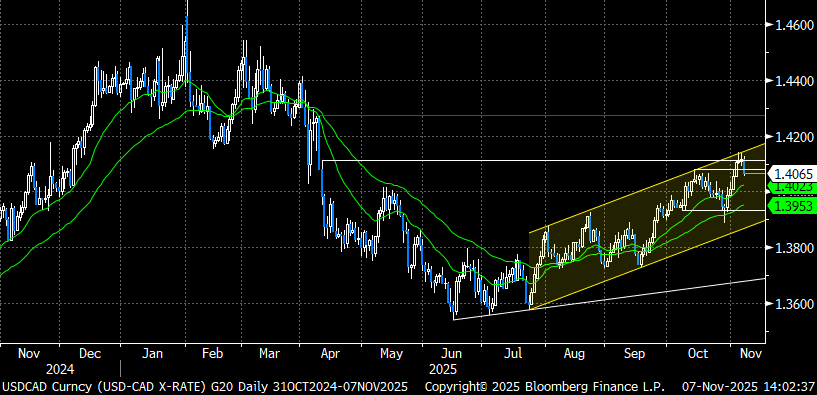
- USDCAD has come under firm pressure following the above-consensus jobs figures. The pair is now 0.4% lower on the session, notably falling back below the prior breakout level at 1.4080. Furthermore, the latest price action sees USDCAD edge further away from the touted resistance, the top of a bull channel, drawn from the July 23 low.
- Having highlighted this area as a key obstacle to further USDCAD strength, price has subsequently failed their twice, bolstering the potential of a short-term bearish signal. Stabilising equity markets have helped CADJPY extend its intra-day advance to 0.6%.
- Canada's job market thrived for a second consecutive month in October, with employment climbing 66,600, comfortably beating analyst expectations.
- The data showed gains even in areas thought to be hit hardest by U.S. tariffs, suggesting the central bank will be more comfortable with its view interest rates are low enough to support the economy and keep inflation on target.
Want to read more?
Find more articles and bullets on these widgets:
Historical bullets
SOFR OPTIONS: BLOCK/Pit: Large Feb'26 SOFR Call Spread Buy
Oct-08 13:47
- +50,000 SFRG6 97.25/97.50 call spds, 1.0 ref 96.52 at 0939-0942ET
EUR: Euro Effective Exchange Rate Still Historically Stretched
Oct-08 13:47
- EURUSD has held onto a dip below 1.1650 today, earlier touching a low of 1.1606 in what was its lowest since early September.
- In doing so, it has pulled back from mid-September’s short-lived fresh cycle high of 1.1919 having pushed through the previous high of 1.1829 on Jul 1. The latter came with ECB VP De Guindos explicitly saying a 1.20 level is “acceptable” but something above that “would be more complicated”. It was part of remarks that were more typical for central bank speech, with the speed of the euro’s climb more worrying than the level.
- Since then, at an MNI event on Sep 18, De Guindos pushed back on focusing on EURUSD and talked to the nominal effective exchange rate as part of a comprehensive approach.
- “The media gives a lot of attention to the exchange rate of the euro vis-a-vis the dollar, but I think that we have to give much more attention to what we call the nominal effective exchange rate. And here with China, I think that sometimes we overlook a little bit what's happening there, and this is another element of uncertainty that we will have to carry”. The NEER is “something that we have to look at carefully, because it’s going to be relevant for growth and for inflation”.
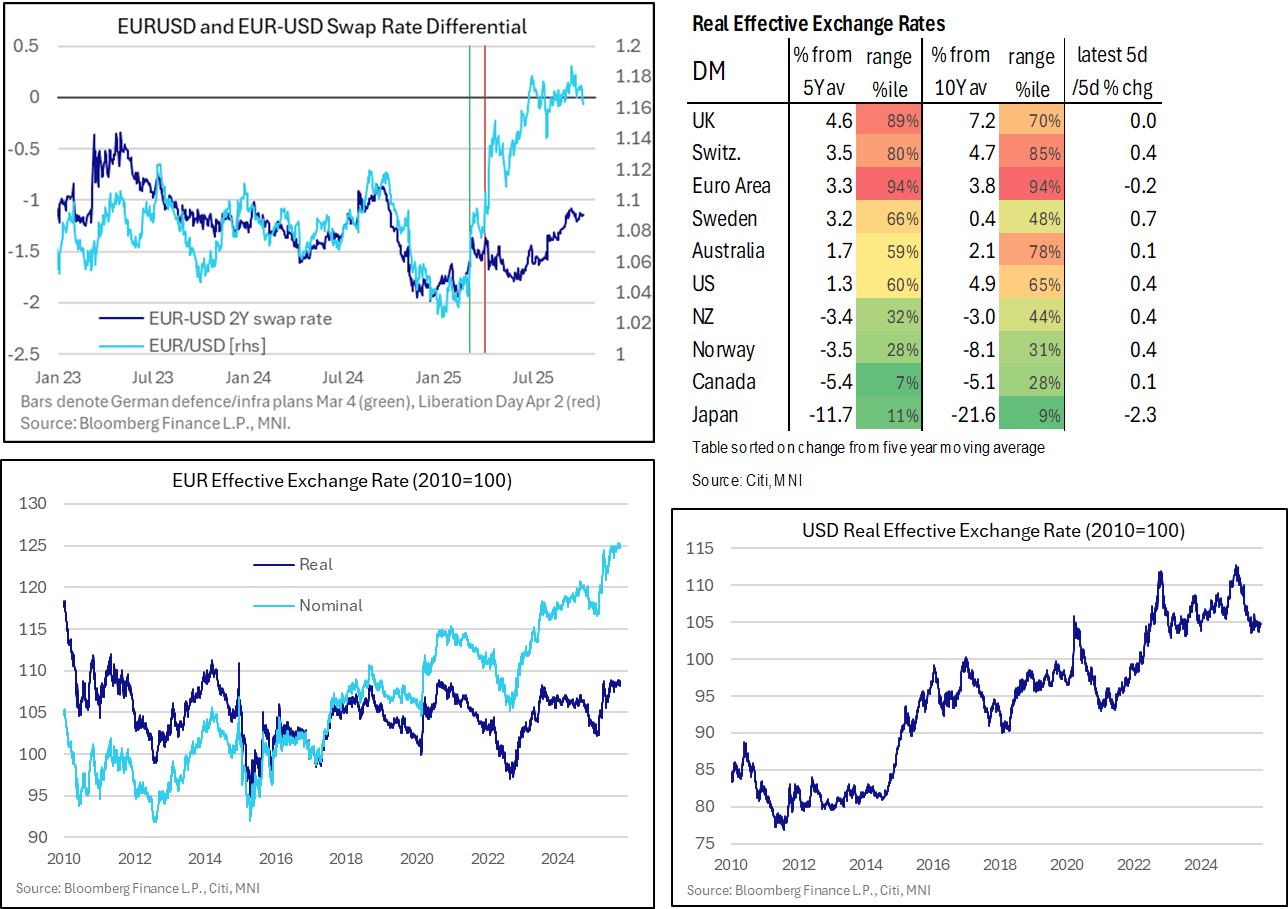
- To this end, the euro NEER according to Citi has eased 0.7% from highs seen on Sep 18 but clearly remains close to those multi-year highs – see charts.
- We prefer looking in real terms when it comes to a cross-country comparison, and here the euro sits at the 94th percentile over both five- and ten-year windows. This is the most stretched across developed markets although both sterling and the Swiss franc see higher relative deviations from historical averages.
- These ranges in isolation suggest asymmetrical risk ahead with skew towards a weaker euro.
- That’s coupled with some ECB Governing Council members not appearing overly concerned by disinflationary implications from the currently elevated exchange rate. One example was a typically centrist Bank of Spain’s Escriva earlier today saying he wouldn’t overemphasize a strong euro as a risk factor for the inflation outlook, whilst Bundesbank's Nagel wasn't concerned about the euro's valuation on Sep 22.
EURIBOR OPTIONS: More Large Upside Options
Oct-08 13:37
ERH6 98.25/98.37cs, bought for 1 in 20k.


