SECURITY: Ukraine Nearing Deal With Putin - Bloomberg
(Bloomberg) -- "Ukraine's top negotiator with Russia said he sees progress toward a potential peace ...
Want to read more?
Find more articles and bullets on these widgets:
Historical bullets
OIL: Rallying Despite Reports Quantifying Potential Strategic Reserve Release
Latest sources update from the WSJ reaffirms that “the International Energy Agency has proposed the largest release of oil reserves in its history to bring down crude prices that have soared during the U.S.-Israel war with Iran”.
- The WSJ sources go on to note that “the release of 400 million barrels of oil would more than double the agency's biggest prior release, when IEA member countries in 2022 put 182 million barrels on the market after Russia launched its full-scale invasion of Ukraine”.
- Meanwhile, BBG’s source reports covering the matter flag the potential for a slightly less aggressive strategic reserve release noting that “the IEA has proposed a release in the range of about 300 million to 400 million barrels”.
- Oil continues to rally despite the reports, which have quantified the likely release size for the first time (prior reporting pointed to the potential for a record release. FI & equities remain under pressure as a result.
ITALY: Meloni: Govt Considering Cutting Fuel Excise Duties
"ITALY'S PM MELONI: GOVT CONSIDERING CUTTING EXCISE DUTIES TO SOFTEN FUEL PRICES IN EVENT PRICES INCREASE STEADILY" Reuters
Note the following from our policy team yesterday:
- "Italy and Slovenia asked for the activation of the General Escape Clause from the EU's fiscal rules at Monday's meeting of euro area finance ministers, MNI was told by a source at the meeting."
- "The call came as ministers discussed policy options to respond to the surge in oil and gas prices, such as energy price caps and the release of emergency oil reserves."
- However, "Economy Commissioner Valdis Dombrovskis told ministers that the legal conditions to apply the escape clause have not been fulfilled"
SWEDEN: Mixed Signals From Business Survey, Strengthens Case For Steady Rates
The key caveat with the Riksbank’s February Business Survey is that interviews were mainly carried out between Jan 29 – Feb 9. As such, it doesn’t capture any direct impact of the Middle East War.
With that in mind, the results are mixed, with a few dovish signals but otherwise confirmation that a tentative economic recovery is underway. Overall, we continue to think that the Riksbank will once again signal plans to hold rates at 1.75% "for some time" at next week's decision, but stress a wider range of potential outcomes than before.
- Respondents suggested that a geopolitical shock would increase consumer’s marginal propensity to save, and many companies note that consumer behaviours is limiting the ability to raise prices above inflation.
- However, there were no comments around whether a rise in energy prices (as has been seen in the current environment) would force companies to raise prices even if it meant sacrificing demand.
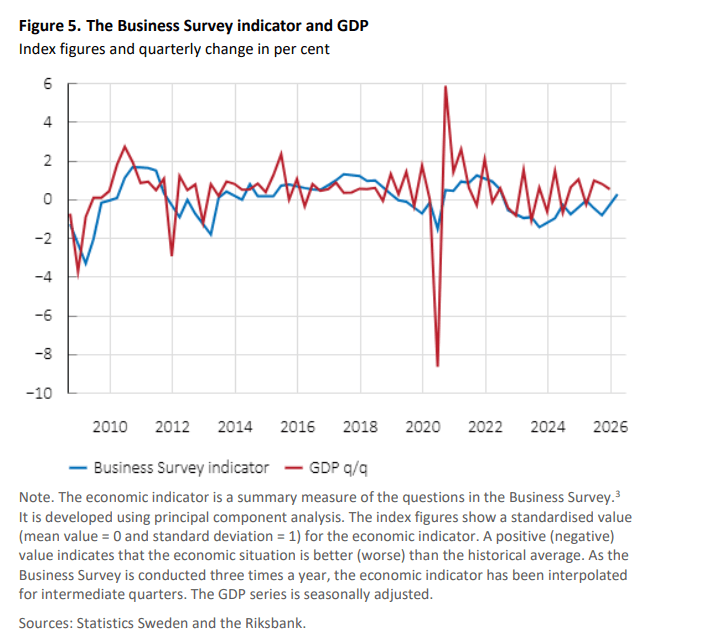
- The Business Survey indicator did strengthen relative to last quarter, and is now above the historical average: “It is primarily companies' hopes that demand will strengthen that are contributing to the rise in the indicator”
Some highlights from the report:
- “Large Swedish companies are experiencing some improvement in economic activity, but the recovery is both slow and hesitant. “
- “Companies that sell goods and services to households describe the situation in somewhat brighter terms compared with last autumn. Households’ willingness to consume has strengthened “…. “companies see a risk that global events may cause households to tighten their purse strings again.”
- “Among manufacturing companies, the view of the economy is more divided than usual. The uncertain geopolitical situation reinforces the disparity between sectors.”… “The appreciation of the krona is having a negative impact on the earnings of export companies, but it is above all the fluctuations in the exchange rate that are perceived as challenging.”
- “Non-durable goods retailers plan to reduce their selling prices when VAT on food is temporarily reduced. Other retailers and companies selling services to households instead plan to increase selling prices in line with inflation. They emphasise that households' price consciousness is dampening pricing plans.”
- “Almost all companies use AI in their operations. But they mainly use AI to increase productivity with existing staff, not to reduce headcount.”