BONDS: Swiss-German Spread Extends Record Highs Ahead Of SNB; More Room In 2s10s
Sep-24 15:18
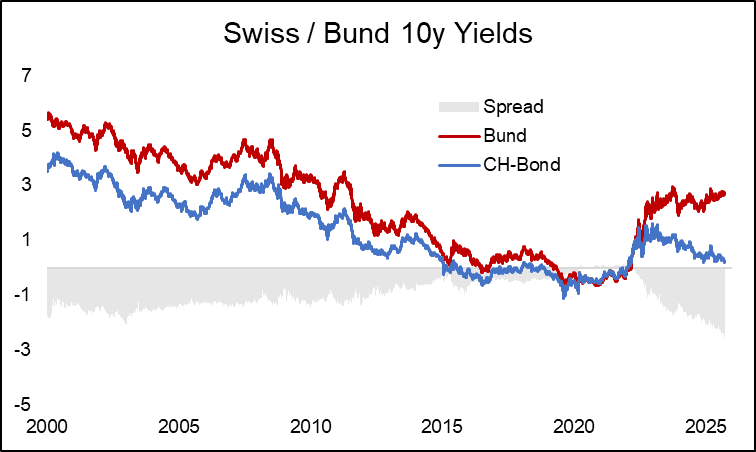
At 254bps, the Swiss - German 10-year government bond yield spread stands at its widest levels on record, extending its longer-term trend which started 2022.
- Form a broader perspective, the moves lower in Swiss 10-year yields over the past two years continue to be striking when viewed against global core FI markets, and highlight the unique position the Swiss economy finds itself - characterized by low inflation and the prudent federal fiscal position. German yields increased last year as expansionary fiscal policy reduced scarcity through expected higher issuance. But this has not been the case in Switzerland where scarcity still remains.
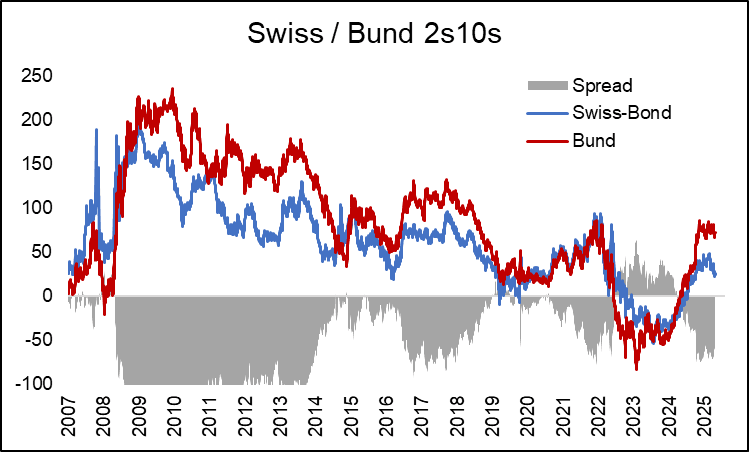
- The moves recently in Germany have been seen across the curve - and have generally been driven by the short-end. In Switzerland, the 2-year has remained well anchored as it already anticipates policy rates remaining at or close to zero for an extended period, but there has been a flattening of the 2s10s Swiss curve, partly driven by US-driven factors (that seem to have spilled over more outside of the Eurozone) and partly driven by the expectation that policy rates in Switzerland may remain lower for longer - and notably longer than 2-years.
- Given both the ECB and SNB (preview of tomorrow's decision here) appear to stand near or at end of their rates cycles, further room for adjustment of the Swiss - German 10y spread may be centred around the respective countries' curve shapes. This leaves focus on a potential re-pickup of global core FI steepening, the German fiscal situation, as well as any news on the Swiss trade situation.
Want to read more?
Find more articles and bullets on these widgets:
Historical bullets
FED: US TSY 13W AUCTION: NON-COMP BIDS $2.072 BLN FROM $82.000 BLN TOTAL
Aug-25 15:15
- US TSY 13W AUCTION: NON-COMP BIDS $2.072 BLN FROM $82.000 BLN TOTAL
FED: US TSY 26W AUCTION: NON-COMP BIDS $1.799 BLN FROM $73.000 BLN TOTAL
Aug-25 15:15
- US TSY 26W AUCTION: NON-COMP BIDS $1.799 BLN FROM $73.000 BLN TOTAL
US DATA: Better Activity, Still-Elevated Inflation In Texas Manufacturing Sector
Aug-25 15:05
The Dallas Fed's Texas Manufacturing Outlook Survey for August showed continued growth in regional production, albeit with a slightly bigger than anticipated relapse in the overall general business activity index and slightly firmer price pressures. While these readings are volatile month-to-month, they continue to suggest improvement in activity after a tariff-hit period, but price pressures remain elevated (and regional firms still sound extremely concerned about tariff impacts).
- The general business activity index, which is tracked by Bloomberg consensus, missed expectations at -1.8 (vs -0.9 expected, +0.9 prior), which the Dallas Fed characterizes as "indicating little change in activity".
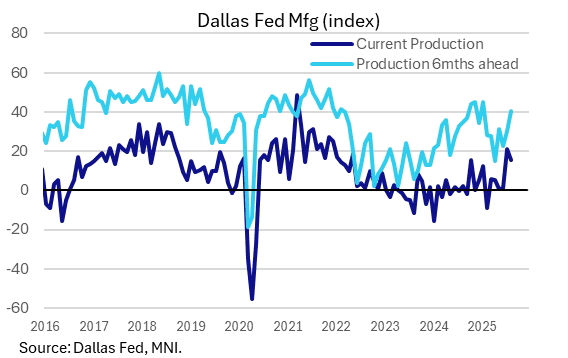
- But this underplayed the broader current strength in activity in the report. The production index, "a key measure of state manufacturing conditions" per the report, fell to 15.3 from 21.3 prior but remained above average, and other measures were also solid. The highlights in that department were new orders, rising for the first time since January (5.8 from -3.6), and shipments rising 12 points to 14.2 for a 3+ year high.
- Forward-looking indicators also suggested improvement (the 6-month production outlook rose to a 7-month high 40.4), while "labor market measures suggested increases in employment and work hours".
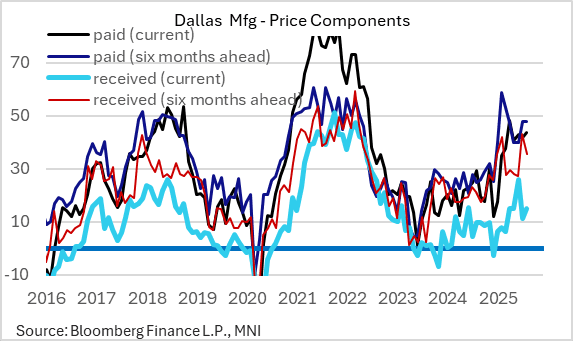
- Against this backdrop, price pressures mostly edged higher: current prices paid to a 5-month high 43.7 (up 2.0 points) with priced received at a 2-month high 15.1 (up 4.0 points). 6-month ahead prices paid were basically unchanged at 47.8 (up 0.1 points) albeit a fresh 5-month high, with future prices received pulling back to a 2-month low -12.3 from -4.5.
- Special questions (which also covered services firms ahead of Tuesday's Dallas Fed services release) showed that 48 percent of surveyed businesses "said they’ve been negatively impacted by higher tariffs this year" (just 2% said they were positively impacted), with more than 70 percent of manufacturing firms noting negative impacts. Note also "Firms negatively impacted by tariffs were mixed on whether they passed on cost increases to customers (48 percent of firms) versus absorbed costs internally (39 percent of firms)." The anecdotes in the report add some color to these findings - link here.