INDIA: Swaps Markets Price in End of Easing Cycle
- Governor Malhotra's neutral stance and liquidity management have seen a repricing of rate expectations in India.
- Open Market Operations (OMOs) Purchases: The RBI announced and began executing a plan to buy government bonds worth an aggregate INR 1 trillion through OMO purchase auctions in December 2025, split into two tranches of INR 500 billion each. Liquidity Management: The central bank has also used other tools to manage liquidity, including a $5 billion USD/INR buy-sell swap auction for a three-year tenor held on December 16, 2025, which injected durable rupee liquidity into the system. Additionally, the RBI's bond-buying efforts have helped to temper rising bond yields, which were under pressure due to foreign outflows and concerns that the rate-cut cycle was ending.
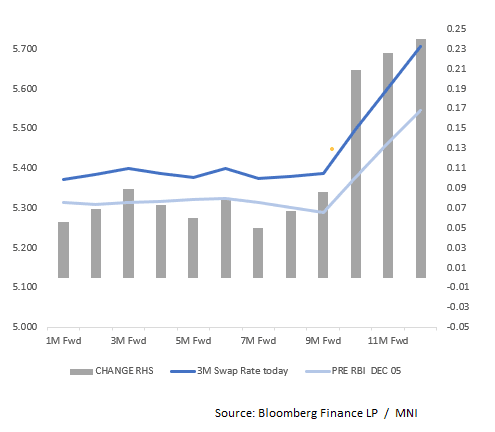
- Swaps markets in recent weeks had been gradually pricing out any prior rate cuts and are now moving to rate hikes by the end of next year.
- However the front end now has -18bps of cuts over the next month.
- The RBI policies have likely resulted in the 1 month pricing being less reflective of interest rate expectations.
- Over a 12-month time horizon cumulatively INR swaps now have +16bps of hikes, down from +42bps last week.
- The MIPR function on BBG has -13bps of cuts priced in over 12 months.
- Friday sees the release of November CPI which is forecast to rise from historic lows to +0.70%. A miss could see a moderation of the rate rises currently priced in.
Want to read more?
Find more articles and bullets on these widgets:
Historical bullets
USD: BBDXY - Moves Back To Test 1221-1222 As The USD Edges Higher
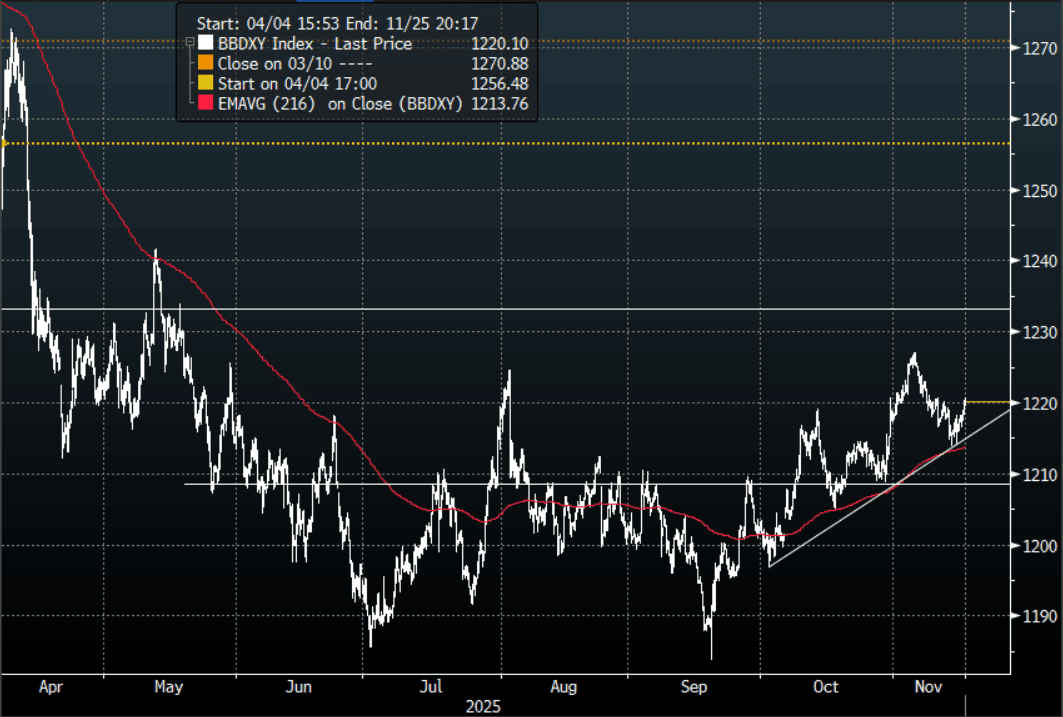
The BBDXY range overnight was 1216.42 - 1220.42, Asia is currently trading around 1220, +0.05%. The USD has bounced nicely off the 1210-1215 support area where it found some demand first up. Risk started the week on the backfoot yesterday again and the USD was the beneficiary. I continue to watch for signs of a base forming from which to move higher again if risk stays under pressure. On the day look for dips toward 1217-18 to now be supported first up, a break of the 1221-1222 area remains the short-term pivot on the topside, above there and it could look to rebuild momentum for a test of the 1230-35 area.
- MNI BRIEF: Fed's Waller Backs December Rate Cut. Federal Reserve Governor Christopher Waller said Monday the central bank should cut interest rates again next month because the labor market continues to deteriorate, while the inflationary effect of tariffs will be temporary.
Fig 1: BBDXY Daily Chart
Source: MNI - Market News/Bloomberg Finance L.P
CHINA PRESS: China FX Market Broadly Balanced In October
China’s foreign-exchange market remained broadly balanced in October, according to Li Bin, spokesperson at the State Administration of Foreign Exchange. Banks recorded a settlement-and-sales surplus of USD17.7 billion during the month, a decrease from September but broadly consistent with the average levels during the first nine months, Li noted. He added that while September experienced a modest net capital outflow from non-bank sectors due to the National Day and Mid-Autumn holidays, net capital inflows increased in October. Taken together, the two months produced an average monthly net cross-border inflows of USD24 billion.
CHINA PRESS: Household Deposit Transfer Funds Remain In Bank-Related Instruments
The People’s Bank of China’s October financial statistics report showed that household and corporate deposits declined by CNY1.34 trillion and CNY1.09 trillion, while non-bank deposits increased by CNY1.85 trillion, Yicai reports. Many market participants said this shows the strong stock-market performance has prompted households to shift deposits into equities. However, several industry experts interviewed by Yicai argued that when households, companies and non-bank institutions use deposits to buy or sell stocks, this merely redistributes deposits and equities among different entities, leaving the overall volume of deposits largely unchanged. An industry expert noted that when deposit rates fall, investors may favour wealth-management or asset-management products, with most of these funds still to circulate back into bank-related instruments such as negotiable certificates of deposit or bonds, ultimately reappearing as interbank deposits or deposits held by operating entities.


