EM ASIA CREDIT: Reliance Industries: Russian oil sanctions manageable
(RILIN, Baa2/BBB+/ BBB)
Russian oil sanction impact negative, though manageable, spread neutral.
Reliance Industries purchases around 500,000 barrels per day of Russian crude oil under a long-term contract with Rosneft, making it the largest Indian buyer.
New U.S. sanctions on Rosneft and Lukoil are expected to force Reliance’s Oil to Chemicals (O2C) segment, which accounts for roughly 60% of group EBITDA, to secure alternative crude supplies. These purchases are primarily used at the company’s Jamnagar refinery complex.
Reports indicate that while Russian crude remains cheaper (around USD 56/bbl versus USD 66/bbl for Brent), total landed costs, including logistics and insurance, offset much of the discount. As a result, the immediate market reaction has been limited.
Leverage remains low, with net debt to EBITDA steady at 0.6x at end-2Q26, unchanged from both 1Q26 and FY25 and equity and credit market responses have been muted.
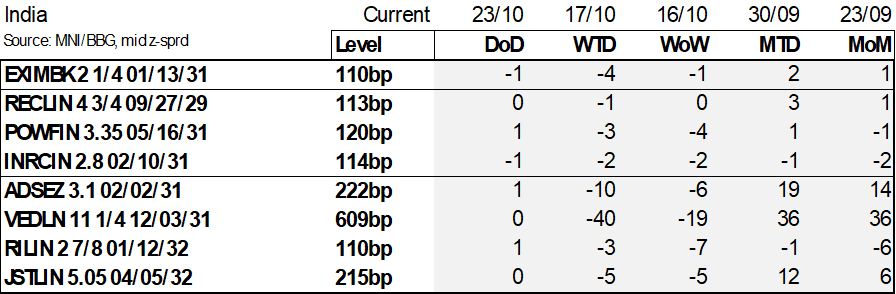
The equity is around 1.5% lower following the sanctions announcement, while in credit markets, USD bonds are marginally weaker, roughly 1bp wider on32s, which is consistent with broader moves in Indian corporates (see table).
In the longer term, sanctions on Russian oil could potentially pave the way for closer U.S.-India trade engagement.
Want to read more?
Find more articles and bullets on these widgets:
Historical bullets
AUSTRALIA DATA: August CPI Headline Up To 3%Y/Y, Trimmed Mean Eases To 2.6%
The headline August CPI print was 3.0%y/y, against a 2.9% market consensus and 2.8% July outcome. The trimmed mean was 2.6% y/y, after printing 2.7% in July (there is no consensus estimate for this outcome).
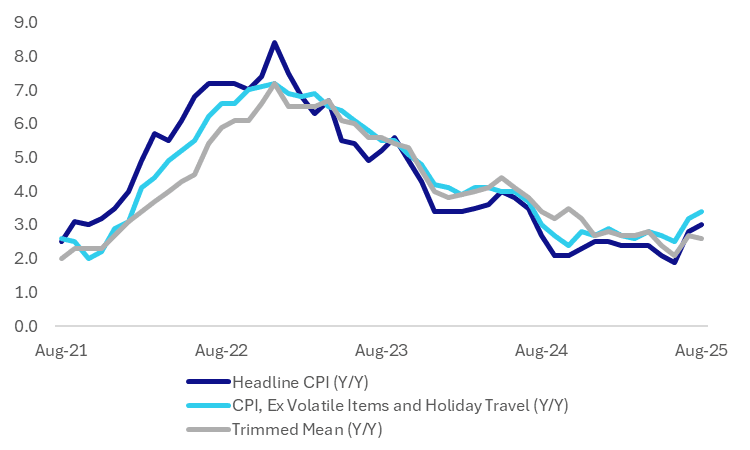
- The chart below plots the CPI monthly y/y trends, including the ABS's ex volatile items and holiday travel measure. We are comfortably up from earlier 2025 lows, even for the trimmed mean (though it ticked down from July levels).
- The ABS notes, "The largest contributors to annual inflation were Housing (+4.5 per cent), Food and non-alcoholic beverages (+3.0 per cent), and Alcohol and tobacco (+6.0 per cent)."
- 4 out of the 11 sub categories have a y/y pace under 2.0%. Transportation is the weakest at 0.4%y/y, but August saw the first rise in 7 months.
Recreation prices shifted down to 1%y/y from 2.6% in July. - The ABS added: "Annual Housing inflation was 4.5 per cent to August, up from 3.6 per cent to July, reflecting increases in Electricity costs. Electricity costs rose 24.6 per cent in the 12 months to August. In monthly terms, electricity costs fell 6.3 per cent in August 2025. The fall in costs this month was driven by NSW and ACT, with households in those States receiving their first payments of the extended Commonwealth Energy Bill Relief Fund (EBRF) rebates."
- Whilst the RBA will continue to place more weight on the quarterly CPI (we get the new comprehensive monthly series towards the end of Nov, for the Oct reference period), today's data will reinforce some caution for the central bank around further easing. It is likely to firm the no change stance next week (although market pricing has priced in very little chance of a move).
- The Q3 CPI print is out on Oct 29, with the RBA outcome on Nov 4. The central bank is forecasting trimmed mean at 2.6%y/y by year end. Any meaningful upside threat to that may trim easing prospects (either ahead of year end or for 2026).
Fig 1: Australia Monthly CPI Y/Y Trends, Up From Recent Lows
Source: ABS/MNI
CHINA PRESS: China To Boost Investment In Humanoid Robots, Metaverse
China will quicken the creation of a number of emerging pillar industries as new growth drivers, and strengthen cutting-edge technology research and development to focus on humanoid robots, brain-computer interfaces, metaverse, and quantum information for the 15th Five-Year Plan (2026-2030), China Securities Journal reported citing Li Lecheng, Minister of Industry and Information Technology.
CHINA PRESS: Over One Million Users Flock To Stock Trading Apps
The number of monthly active users of stock trading apps reached 173 million amid August's A-share rally, a rise of 4% m/m or 27% y/y, marking the highest monthly record in 2025, 21st Century Business Herald reported. The rally is also driving new investors into the market, with the number of new A-share accounts opened last month reaching 2.65 million, an increase of 35% m/m or 165% y/y, according to data from the Shanghai Stock Exchange, the newspaper said.


