THAILAND: Price Pressures Remain Subdued, THB Stays Strong
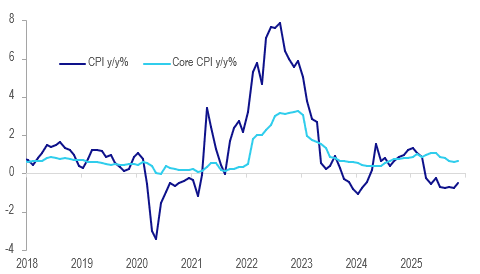
Thai November CPI inflation improved slightly from prolonged very low rates and was marginally better than consensus expected. Headline printed at -0.5% y/y after -0.8% in October while core rose to +0.7% y/y from +0.6%. Both are holding below the Bank of Thailand’s 1-3% band and the Commerce Ministry is forecasting inflation to remain below target in 2026 at 0%-1%, which could drive further BoT easing.
Thailand CPI y/y%
Source: MNI - Market News/LSEG
- BoT expects headline inflation to rise to 0.5% in 2026 and return to the band early in 2027.
- In December to date, USDTHB is down 6.3% y/y and the BIS THB NEER up 3.2% y/y, which is adding to disinflationary pressures from soft domestic demand. The NEER has only fallen in 3 months in 2025. BoT is monitoring baht strength.
Thailand THB
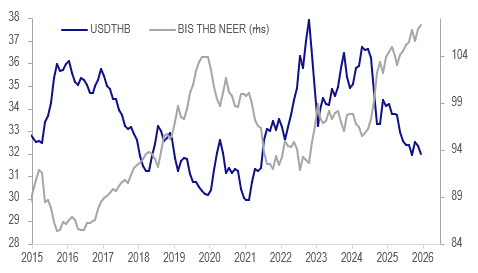
- The next rate decision is 17 December and in late November the governor said that there is room to ease policy further as he wants a weaker currency, as it is not reflecting economic fundamentals. With rates at 1.5%, limited policy space has concerned some MPC members.
- November headline inflation was negative for the eighth consecutive month but the least negative since June. Government subsidies have put downward pressure on the series.
- Core only rose to 1% or above briefly in four months this year but BoT doesn’t believe that it will go negative and will gradually return to the bottom of its band.
- Recent severe weather events may cause some data volatility as they are likely to reduce demand but may also impact supply.
- Food inflation rose to +0.5% y/y in November from -0.2% driven by fresh food but rice & flour fell 1.8% y/y after +0.2%.
Want to read more?
Find more articles and bullets on these widgets:
Historical bullets
STIR: Market Gives A RBA Cut Tomorrow No Chance
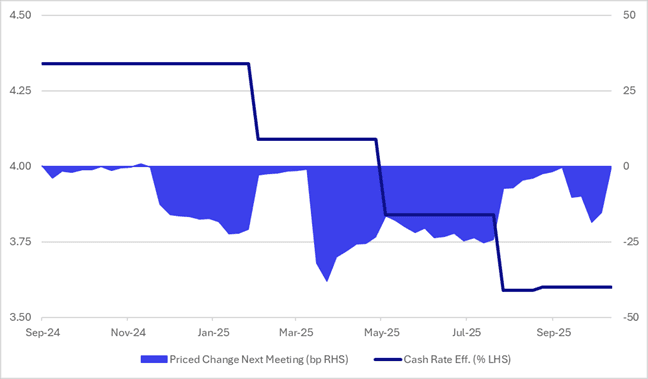
Going into tomorrow’s RBA policy decision, RBA-dated OIS pricing implies almost no chance of an easing, with just a 2% probability assigned.
- In the wake of the surprise rise in the September unemployment rate to 4.5% in mid-October, markets had briefly priced as much as an 80% probability of a 25bp rate cut in November.
- However, that confidence faded in the lead-up to last week’s Q3 CPI release.
- Compared with previous episodes in this easing cycle, markets appeared noticeably less certain about a November 4 cut ahead of the CPI release.
- That caution proved justified, with the Q3 CPI printing well above expectations.
- As it currently stands, the OIS market has only an 80% chance of a 25bp cut by mid-2026.
Figure 1: RBA-Dated OIS – Cash Rate Vs. Priced Change Next Meeting
Source: Bloomberg Finance LP / MNI
CHINA: Bond Futures Mixed on Liquidity Withdrawal
- In what looks like a decision to pause the bond rally, the liquidity withdrawal via the OMO sees bond futures mixed in morning trade.
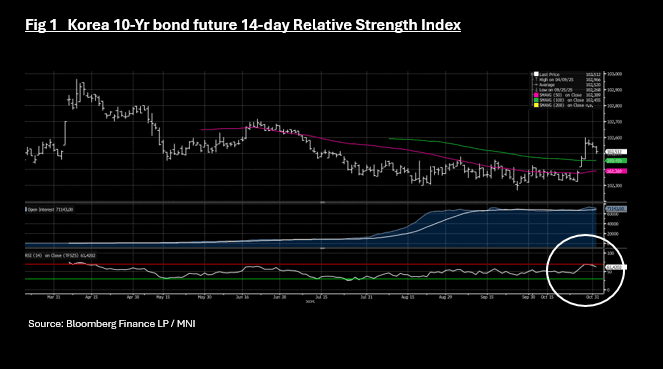
- The 10-yr is flat at 108.67, maintaining its position above all major moving averages and near to oversold on a 14-day relative strength index.
- The 2-Yr is down -0.03 at 102.51 and remains above all major moving averages, having bounced from being oversold.
- The CGB 10-yr has ground lower in yield to be at 1.794%
CHINA PRESS: Changes To Gold VAT Could Increase China's Pricing Power
Changes to value-added tax (VAT) rules for gold trading on major exchanges could strengthen China’s international influence in gold pricing, according to Song Xiangqing, vice president at the China Business Economics Association. The Ministry of Finance recently announced that transactions without physical delivery will be exempt from VAT and for trades involving physical delivery, VAT treatment will vary based on the intended use of the gold, with non-investment use either being exempt from the tax or allowing buyers to apply a 6% input tax deduction rate. An expert noted the move could attract large institutional players to concentrate more trades on the major exchanges, thereby enhancing market liquidity and price-setting influence.


